
OPPO

Search documents
工业与消费需求共振,3D打印的“奇点”时刻到来?
Hua Er Jie Jian Wen· 2026-01-09 08:56
Core Insights - The additive manufacturing (3D printing) industry has transitioned from a technology hype cycle to a phase of technological maturity and cost reduction, marking a significant manufacturing revolution [1][3] Industry Overview - The global market size for additive manufacturing has reached $21.9 billion, with China experiencing a remarkable growth rate of 30%, projected to reach 70 billion yuan by 2025 [3] - The industry is moving from niche to mainstream, with industrial and consumer markets experiencing a rare resonance explosion [3] Technological Advantages - 3D printing offers core advantages over traditional subtractive and formative manufacturing, including "moldless" production and high material utilization rates exceeding 90%, leading to significant cost savings, especially for expensive materials like titanium alloys [4] Market Segmentation - The technology landscape is divided into two main camps: metal and non-metal. In the non-metal sector, FDM (Fused Deposition Modeling) dominates with a 61.6% global market share, while SLM (Selective Laser Melting) is the core technology in the metal sector, holding an 89.4% market share [7] Industrial Market Dynamics - The global industrial landscape is shifting towards a "Western dominance, Chinese rise" pattern, with China's market share increasing from 8.2% in 2009 to 11.5% in 2024. In the valuable metal 3D printing sector, Chinese company BLT has captured a 20% global market share, ranking second worldwide [9] Key Growth Drivers - Two core downstream sectors are driving industrial growth: 1. Commercial aerospace, where companies like SpaceX and domestic players are demonstrating significant reductions in engine component counts and manufacturing cycles [10] 2. Consumer electronics, with 2026 anticipated as a year of large-scale production for metal 3D printing, as major brands like Xiaomi and Apple enter the market [12] Consumer Market Landscape - The global consumer 3D printing market is projected to reach $4.1 billion by 2024, with the top four companies (CR4) in the market all being Chinese firms, holding a combined market share of 71.3% [13] - Companies like拓竹科技 are adopting a "3D printing farm" model, utilizing clusters of devices for flexible manufacturing, particularly in the trendy and cultural sectors [14] Technological Innovations - Innovations in algorithms and lidar technology are addressing printing speed and success rates, making devices more user-friendly. The establishment of a MakerWorld model community is creating a closed-loop ecosystem of "hardware + software + content" [16]

智能手机的2025:厮杀、阵痛与价值重塑
投中网· 2026-01-09 01:50
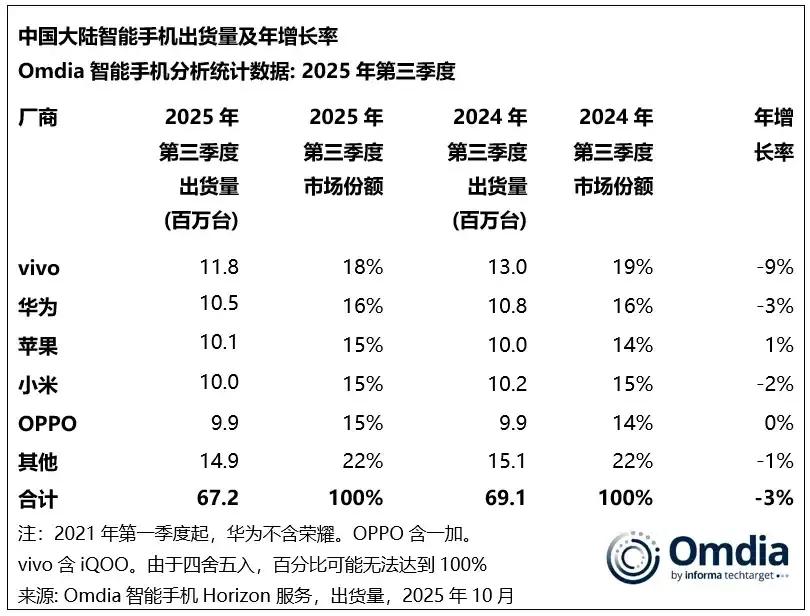
Core Viewpoint - The Chinese smartphone market in 2025 is experiencing a shift from a "quantity" competition to a "quality" battle, driven by fierce competition and changing consumer behavior [5][9]. Market Performance - In the first half of 2025, the market was pessimistic due to saturation and rational consumer decisions, but by the fourth quarter, smartphone sales increased by 11% year-on-year, with Apple iPhone sales up by 29% [6][7][8]. - The top five smartphone manufacturers in Q3 2025 saw a slight decline in overall shipments, with a total of approximately 68.4 million units shipped, down 0.6% year-on-year [13][14]. Competitive Landscape - The competition is characterized by a struggle within a defined market boundary, with limited growth opportunities and increasingly difficult user acquisition [11][12]. - Vivo led the market with 11.8 million units shipped, followed closely by Apple with 10.8 million units, and Huawei with 10.4 million units [14]. Strategic Shifts - Apple adopted a disruptive strategy of "increasing volume while lowering prices," significantly impacting the mid-to-high-end market of domestic brands [15]. - Domestic brands like Xiaomi and OPPO are focusing on high-end markets, launching products priced above 6000 yuan to differentiate themselves [17]. Technological Evolution - The focus of competition has shifted from hardware specifications to user experience, particularly in imaging technology, where brands are emphasizing software capabilities over mere hardware [19][20]. - AI technology is becoming a practical solution in smartphones, with features like automatic scene recognition and enhanced photography being integrated into devices [22]. User Experience Innovations - New features addressing specific user pain points, such as motion sickness modes, are emerging, reflecting a deeper understanding of consumer needs [23]. - The average smartphone replacement cycle has extended from 24 months in 2020 to 36 months in 2024, indicating a shift in consumer behavior towards longer device usage [25]. Future Directions - The smartphone industry is expected to rely more on internal innovation and structural changes, with major players moving towards vertical integration to enhance product differentiation and profit margins [26]. - The foldable smartphone market is evolving, with multiple manufacturers entering, suggesting a potential for new applications and high-value markets [26]. Conclusion - The 2025 smartphone market represents a duality of challenges and opportunities, with competition now focused on enhancing user experience and addressing specific pain points, indicating a need for brands to build emotional connections with consumers [27][28].



二手商品交易 有助扩大消费
Shen Zhen Shang Bao· 2026-01-08 22:56
Group 1 - Shenzhen has been designated as the only pilot city for second-hand goods circulation in Guangdong Province, highlighting its role in leading China's circular economy development [1] - Xianyu has opened its first offline circular store in Shenzhen, with plans to expand more stores in key areas like Nanshan, promoting green consumption [1] - Zhuanzhuan Group has established a 4,500 square meter intelligent quality inspection center in Shenzhen, capable of processing up to 17,000 items daily [1] Group 2 - Strategic collaborations among leading enterprises in Shenzhen's circular economy have created strong synergies, with China Resources Recycling Group forming partnerships with top companies like Zhuanzhuan [2] - The China Second-hand Electronic Trading Center, a government-supported project, has established deep strategic relationships with major firms such as Huawei and JD.com [2] - A 1% increase in urban second-hand e-commerce transaction volume correlates with a 0.1% increase in total retail sales of consumer goods, indicating the economic impact of the circular economy [2]
二手商品交易 有助扩大消费 作为全国二手商品流通试点城市 深圳循环经济提速
Shen Zhen Shang Bao· 2026-01-08 18:16
Group 1 - Xianyu has opened its first circular store in South China in August and plans to establish more stores in key areas of Shenzhen, promoting the concept of green circular consumption [1] - Shenzhen has been selected as the only city in Guangdong Province for the first batch of national second-hand goods circulation pilot cities and enterprises, highlighting its role in leading China's circular economy [1] - Zhuanzhuan Group has built a 4,500 square meter intelligent quality inspection center in Shenzhen, capable of processing up to 17,000 items per day [1] Group 2 - Strategic cooperation among leading circular economy enterprises in Shenzhen has created strong synergies, with China Resource Recycling Group establishing partnerships with top companies like Zhuanzhuan [2] - The China Second-hand Electronic Trading Center, a government-supported project, has formed deep strategic collaborations with major firms such as Huawei and JD.com [2] - A 1% increase in urban idle second-hand e-commerce transaction volume correlates with a 0.1% increase in total retail sales of consumer goods, indicating the significant impact of the new online-offline circular economy model on local consumption [2]
青木科技20260108
2026-01-08 16:02
Summary of Aoki Technology Conference Call Company Overview - **Company**: Aoki Technology - **Key Product**: Aoki Woodpecker, an AI-driven advertising tool focused on e-commerce Industry Insights - **Industry**: E-commerce and AI advertising - **Market Trends**: Shift from traditional search engines to AI applications for consumer engagement Core Points and Arguments - **Revenue Growth**: Aoki Woodpecker's AI advertising revenue increased by 30% year-over-year in the first three quarters of 2026 [2][3] - **Target Market**: Focus on major brands in fast-moving consumer goods (FMCG), including apparel, beauty, and 3C products [2][7] - **Data Utilization**: The company leverages consumer behavior data across platforms for precise targeting, enhancing return on investment (ROI) by 20%-30% compared to traditional brand advertising [2][3][7] - **Profit Margins**: Gross margin for major client advertising business is approximately 70%-80%, with net profit around 50% [2][6] - **Clientele**: Serves well-known international and domestic brands, which provides a strong data foundation for advertising strategies [3][6] Strategic Developments - **AI Partnerships**: Collaborating with applications like Doubao, Qianwen, Deepseek, and Yuanbao to enhance real-time consumer engagement and product recommendations [2][3] - **Product Development**: Aoki is developing standardized operational tools for small and medium-sized businesses, with expected annual costs for these tools ranging from 10,000 to 30,000 yuan [3][9] - **Investment Plans**: Plans to increase investment in AI technology by approximately 20% in 2026 to capitalize on the shift towards AI applications [3][10][11] Competitive Positioning - **Business Model Comparison**: Aoki's model is similar to competitors like Yidian Tianxia but differs in resource allocation and focus on internal needs before expanding to external clients [6] - **Operational Efficiency**: Aoki Woodpecker's advertising efficiency is 20%-30% higher than brands' self-managed campaigns, indicating a competitive edge in technology and service delivery [6][7] Future Outlook - **Market Predictions**: 2026 is anticipated to be a pivotal year for AI applications, particularly in the consumer market, as traditional search engine usage declines [5] - **Talent Acquisition**: Continued focus on recruiting talent to support AI initiatives and adapt to evolving market demands [10][11] - **Client Budget Expansion**: Aiming to increase the proportion of client budgets allocated to Aoki's services, potentially rising from 5% to 10%-20% [11] Additional Important Insights - **AI Agent Services**: As one of Alibaba's first AI Agent service providers, Aoki is enhancing its capabilities in automated customer service tools [8][9] - **SaaS Development**: The company is preparing to launch SaaS-based operational tools, leveraging its extensive experience in the apparel sector to address market needs [9][10]
“1+1+1>3”?一加之后,OPPO整合realme
Guo Ji Jin Rong Bao· 2026-01-08 13:31
Core Viewpoint - The global smartphone industry is shifting from a "growth narrative" to a "value narrative," leading major manufacturers to focus on resource integration and collaborative strategies rather than mere scale expansion [1] Group 1: Company Developments - OPPO has confirmed that realme will return as a sub-brand under its umbrella, aiming for enhanced collaboration and resource integration [1] - Realme's CEO, Li Bingzhong, will lead the overall sub-brand business, while the president of OnePlus China, Li Jie, will maintain his responsibilities [1] - Realme's new products will be released as scheduled and will fully integrate into OPPO's after-sales service system [1] Group 2: Market Context - The backdrop for realme's establishment in 2018 was intense competition in the domestic smartphone market, prompting major brands to seek growth in overseas markets [2] - Realme quickly expanded into multiple global markets, including Singapore, Malaysia, and Pakistan, after its launch in India [3] - By November 2023, realme announced that its global sales had surpassed 200 million units, achieving this milestone in just two years after reaching 100 million [4] Group 3: Industry Challenges - Counterpoint Research predicts a potential 2.1% decline in global smartphone shipments in 2026 due to rising component costs, which have already affected various consumer electronics [6] - The price of memory components is expected to rise by approximately 40% before the second quarter of 2026, further increasing the bill of materials (BoM) costs [7] - The integration of realme back into OPPO is seen as a strategy to leverage collaborative advantages and enhance product differentiation [7] Group 4: Performance Insights - OPPO's growth rate outperformed other major OEMs, with a 2.1% year-on-year increase, largely driven by the stable sales of the Reno 14 series and strong growth from OnePlus [10] - OnePlus achieved a remarkable 42.3% year-on-year increase in sales in 2025, marking the highest growth rate in the industry [10] - The return of realme to OPPO signifies a shift towards a "group army combat" model, raising questions about whether the combined efforts of OPPO's three brands can achieve a synergistic effect [10]

realme重回OPPO“襁褓”,陈明永不再执着高端化
3 6 Ke· 2026-01-08 13:13
Core Viewpoint - OPPO is shifting its strategy from aggressive high-end market expansion to consolidation and cost reduction, as evidenced by the return of its sub-brand realme under its umbrella [1][2][12]. Group 1: Market Performance - OPPO's global shipment volume in Q1 2025 was approximately 23.5 million units, with a market share of 7.7%, ranking fifth [3]. - By Q3 2025, OPPO's shipment volume in mainland China dropped to 9.9 million units, also ranking fifth [4]. - The company faced significant challenges in maintaining its market position, with a notable decline in performance compared to competitors [3][4]. Group 2: Strategic Shift - OPPO's high-end strategy, initiated in 2020, aimed to elevate its brand through significant investments in technology and product development, including self-developed chips and premium devices [5][11]. - The company has recognized the unsustainable nature of its high-end focus, leading to a strategic pivot towards more practical market survival and share acquisition [10][12]. - The return of realme is seen as a critical move to enhance overall sales and consolidate resources, allowing OPPO to leverage its strengths in the mid-range and budget segments [12][13]. Group 3: Organizational Changes - Significant personnel changes occurred in late 2025, indicating a fundamental shift in OPPO's strategic direction, with key executives reassigned to focus on overseas markets rather than high-end domestic competition [8][10]. - The restructuring reflects OPPO's need to adapt to external pressures and prioritize market share over high-end aspirations [9][10]. - The integration of realme into OPPO's brand matrix aims to streamline operations and enhance competitiveness against rivals like Xiaomi and Honor [12][14].
荣耀绝不倒下
3 6 Ke· 2026-01-08 11:57
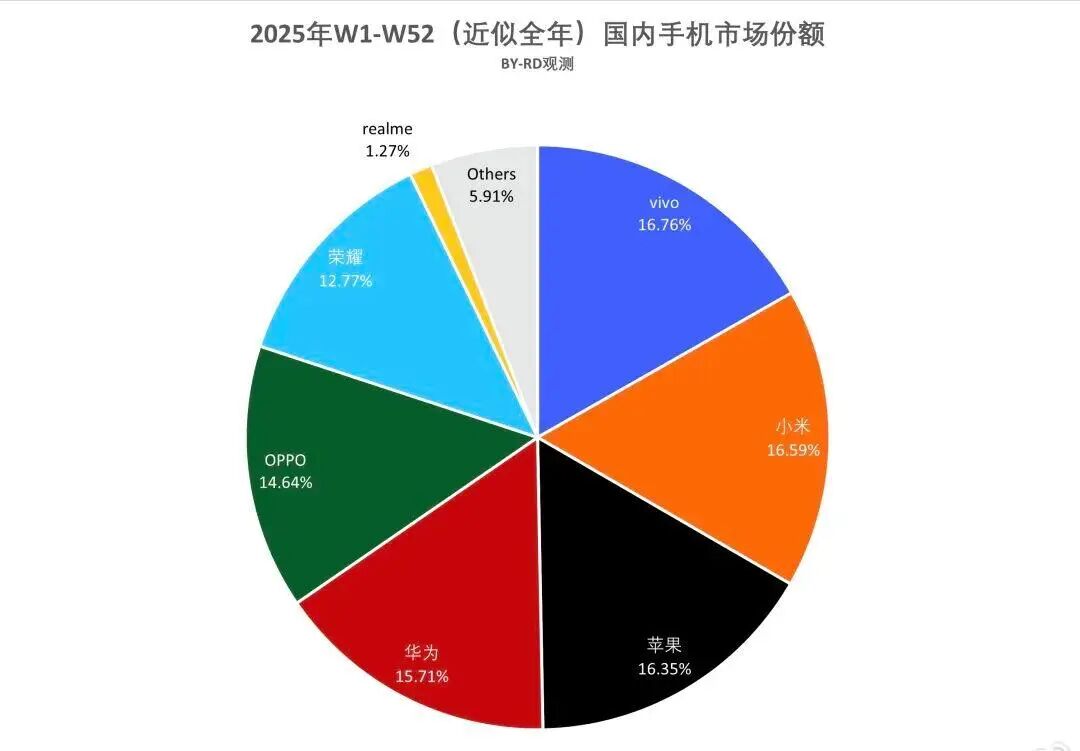
Core Viewpoint - Honor, once a market leader in China, is now facing a "mid-life crisis" characterized by intense price competition and struggles in the high-end market, while its transformation efforts appear to replicate Huawei's strategies rather than establish a unique identity [1][2]. Group 1: Market Performance - Honor's market share in China dropped to 12.77% in 2025, down approximately 2 percentage points from 14.79% in 2024, marking the largest decline among the top six brands [2]. - In Q1 2024, Honor reached a peak market share of 17.1%, but by 2025, it had decreased by 4.3 percentage points, equivalent to a 25% reduction [4]. - Honor's reliance on low-end products is evident, with 58% of its offerings priced below 2000 yuan, a 12 percentage point increase from the previous year [4]. Group 2: Brand Positioning and Challenges - Honor's market share in the high-end segment (priced above $600) is only 1.58%, significantly lower than Apple's 34% and Huawei's 16.4%, indicating severe marginalization [6]. - The company's gross margin in H1 2025 was 13.2%, down 2.8 percentage points year-on-year, and below the industry average of 15.6% [6]. - Honor's branding struggles stem from its historical ties to Huawei, leading consumers to view it as a "substitute" rather than a distinct brand [7][9]. Group 3: AI Transformation and Strategic Initiatives - Honor aims to transition into an AI-centric smart terminal ecosystem, with over 10 billion yuan invested in AI technology development [12]. - The "1×3×N" ecological strategy is designed to integrate AI capabilities across various sectors, but the company faces significant competition from established tech giants [12][13]. - Despite challenges, Honor's international sales have seen over 50% growth in emerging markets, with a notable 377% increase in foldable phone sales in Europe [15]. Group 4: Financial Outlook and Future Prospects - Honor's Pre-IPO valuation is approximately 200 billion yuan, a 23% decrease from its 2020 valuation of 260 billion yuan, reflecting cautious market sentiment regarding its competitiveness [17]. - The company must balance short-term shareholder returns with long-term investments in R&D to achieve a successful transformation [18]. - The year 2026 is critical for Honor to navigate the AI landscape and redefine its market position [18].
OPPO整合realme与一加深化品牌协同战略布局
Xin Lang Cai Jing· 2026-01-08 11:48
Core Viewpoint - OPPO is restructuring its brand strategy by reintegrating realme as a subsidiary to enhance synergy and optimize resource allocation, aiming for strategic collaboration with its other brand, OnePlus [2][3] Group 1: Brand Strategy and Management - realme will operate under OPPO as a subsidiary, with a focus on strategic alignment in market positioning and product differentiation alongside OnePlus [2][3] - The CEO of realme, Li Bingzhong, will oversee the management of OPPO's subsidiary brands, while the responsibilities of OnePlus China President, Li Jie, will remain unchanged [2][3] - realme's product launch plans will continue as scheduled, and the brand will integrate into OPPO's existing after-sales service network to enhance user experience [2][3] Group 2: Market Performance and Efficiency - The integration of OnePlus and realme into OPPO's structure has led to a deeper resource consolidation and clearer strategic division between the main brand and its subsidiaries [2][3] - By 2025, this organizational adjustment is expected to yield positive results, with both brands experiencing market share growth in China and overseas, achieving industry-leading growth rates [3][4] - The consolidation of resources is believed to help OPPO concentrate its strengths, improve operational efficiency, and support ongoing global market expansion [4]
realme回归OPPO体系协同发力,子品牌助力销量增长
Xin Lang Cai Jing· 2026-01-08 11:48
据数码领域相关信息显示,2025年国内智能手机激活量排名前五的品牌依次为:vivo、小米、苹果、 OPPO和华为。其中,vivo、小米与OPPO的统计数据均包含其各自子品牌的表现——iQOO计入vivo、 REDMI计入小米,而OPPO则涵盖一加与realme。数据显示,小米、苹果及OPPO均实现同比增长,整 体市场表现稳健。 1月7日,真我手机官方旗舰店宣布,为实现更高效的资源整合与协同发展,realme将正式回归OPPO体 系,成为其旗下子品牌。未来,realme与一加两大子品牌将与OPPO主品牌共同构建协同发展的战略布 局。 根据中国信息通信研究院发布的数据,2025年1月至11月,国内市场手机出货总量达2.82亿部,同比增 长0.9%。其中,5G手机出货量为2.44亿部,同比增长1.3%,占同期手机总出货量的86.6%,持续占据市 场主导地位。 1月7日,真我手机官方旗舰店宣布,为实现更高效的资源整合与协同发展,realme将正式回归OPPO体 系,成为其旗下子品牌。未来,realme与一加两大子品牌将与OPPO主品牌共同构建协同发展的战略布 局。 据数码领域相关信息显示,2025年国内智能手机激活量 ...