SHEIN

Search documents
敦煌网在美国突然爆火,中国跨境电商应用霸榜美区App Store
Sou Hu Cai Jing· 2025-04-16 19:54
Core Insights - A Chinese cross-border e-commerce app, DHgate, has seen a dramatic surge in downloads in the U.S., reaching the second position in the iOS App Store's free apps chart within two days, only behind ChatGPT [1][3] - The app's rise is attributed to a recent U.S. tariff policy change that has caused consumer anxiety about potential price increases, prompting a rush to purchase goods before the new regulations take effect [3][4] Group 1: Application Performance - DHgate's downloads in the U.S. began to spike on April 12, with a single-day download count of 65,100 on April 13, representing a 940% increase compared to the previous 30-day average [3] - The app has topped the free shopping app category in the U.S., with other Chinese apps like Taobao and SHEIN also ranking highly [1] Group 2: Market Dynamics - The U.S. government's decision to eliminate the "small package tariff exemption" for imports valued under $800, effective May 2, has led to consumer panic buying [3][4] - Despite the impending tariff increases, Chinese products, particularly in clothing and accessories, remain significantly cheaper than U.S. brands, often 3 to 5 times less expensive [4] Group 3: Marketing Strategies - TikTok videos showcasing the price differences and revealing the manufacturing origins of products have driven consumer interest in DHgate, with related content amassing over 10 million views [5] - DHgate's B2B model allows small businesses to order in smaller quantities, catering to the needs of U.S. small retailers looking to stock up before potential price hikes [5][6] Group 4: Company Background and Resources - Founded in 2004, DHgate is one of China's earliest cross-border B2B platforms, boasting over 2.54 million registered suppliers and a product catalog exceeding 34 million items [6] - The platform has established partnerships with international logistics companies like DHL and FedEx, ensuring efficient delivery times of 7 to 15 days [6] Group 5: Consumer Perception - The perception of "Made in China" has shifted positively, with consumers recognizing the quality and efficiency of Chinese manufacturing processes, which has helped mitigate the negative impacts of trade tensions [6] - As TikTok faces potential bans in the U.S., DHgate has successfully attracted users seeking alternative shopping platforms, positioning itself as a viable option for cost-effective cross-border purchases [7]


Sensor Tower:3月中国移动应用(非游戏)在海外市场延续强劲势头 TikTok位居收入榜第一
智通财经网· 2025-04-16 02:23
Core Insights - The overseas market for Chinese mobile applications (non-gaming) is experiencing strong momentum, driven by short video, cross-border e-commerce, and utility applications, with emerging markets and technological innovation becoming competitive focal points [1] Group 1: Short Video Applications - Short video applications are maintaining robust growth in overseas markets, with Crazy Maple Studio's ReelShort achieving a 6% month-over-month revenue increase through an innovative "short video + interaction" model [8] - STORYMATRIX's DramaBox has seen a 35% increase in downloads and a 17% rise in active users in the European and American markets, showcasing effective cross-regional operational capabilities [8] - FARSUN's FlickReels has emerged as the fastest-growing application in March, with a 78% revenue increase, 397% surge in downloads, and 199% growth in active users in the Latin American market [8] Group 2: E-commerce and Utility Applications - In the cross-border e-commerce sector, Temu continues to expand with a "low price + social virality" model, achieving an 18% increase in downloads and rising active user engagement [9] - SHEIN has optimized its supply chain and vertical user operations, resulting in a 6% growth in active users, solidifying its leading position in the fast fashion sector [9] - Glority Software's plant identification tool, PictureThis, has seen a 56% revenue increase and a 38% rise in active users, highlighting its technological barriers and ability to tap into vertical demand [9] Group 3: Technological Drivers and Emerging Markets - Leading companies are building formidable competitive barriers through technological advantages, exemplified by TikTok's 25% month-over-month revenue growth due to continuous optimization of its core recommendation algorithm [10] - NETSTORY's short video platform, NetShort, targeting the Southeast Asian market, has experienced a 90% revenue surge, 137% increase in downloads, and 111% growth in active users, validating the effectiveness of low-cost localized content and social virality strategies [10] - The explosive growth of FlickReels in the Latin American market underscores the adaptability of lightweight products to high-growth regions [10] Group 4: Future Outlook - The competition in the short video sector is intensifying, necessitating leading companies to accelerate IP resource accumulation and multilingual production capabilities, while smaller firms can seek differentiation by focusing on specific themes or regional markets [11] - Cross-border e-commerce needs to enhance the synergy between supply chain and localized marketing, while utility applications should concentrate on vertical scenarios to build technological barriers [11] - AI-driven personalized recommendation systems, low-code development tools, and low-bandwidth adaptation technologies are emerging as key competitive advantages that will directly impact user retention and market penetration efficiency [11] Group 5: Conclusion - The overseas market in March 2025 exhibits a "multi-dimensional competition" landscape, with short video applications leading through content innovation, e-commerce and utility applications solidifying their foundations through technology and operations, and emerging markets providing opportunities for smaller firms to gain traction [12] - The ability to balance content quality, technological empowerment, and regional insights will be crucial for publishers to succeed in the global market [12]

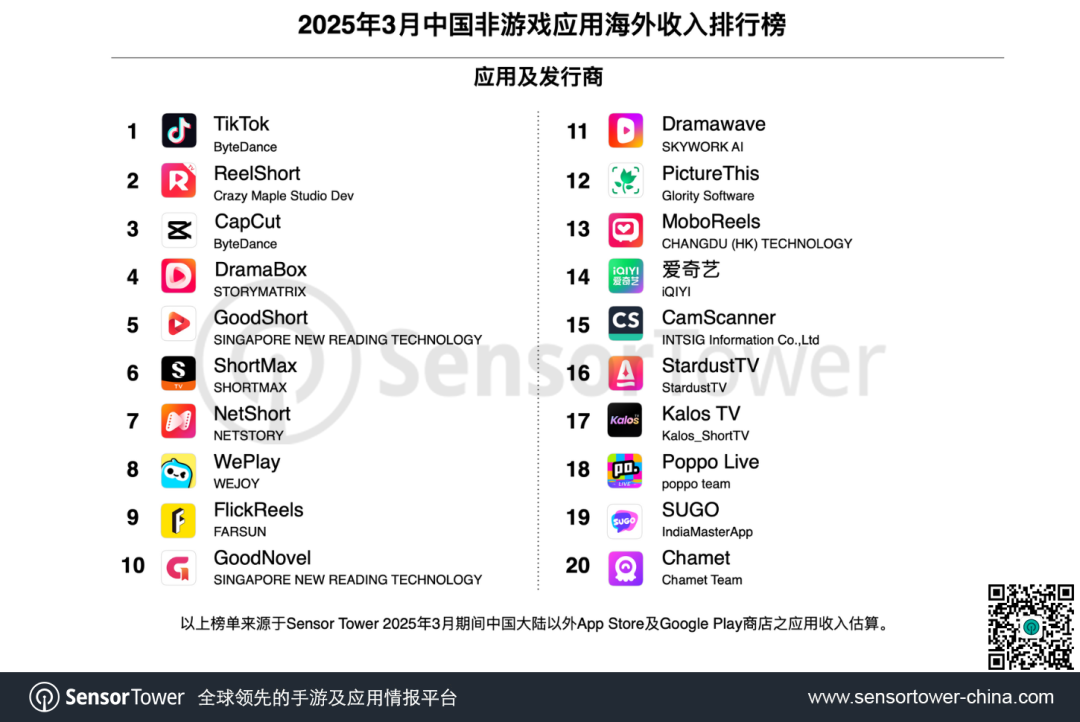
盘前必读丨美国免除部分商品“对等关税”;新莱福重大资产重组
Di Yi Cai Jing· 2025-04-13 23:50
随着美元回落,国际油价企稳反弹,WTI原油近月合约涨2.39%,报61.50美元/桶。布伦特原油近月合约涨2.26%,报64.76美元/桶。 国际金价续创历史,纽约商品交易所4月交割的COMEX黄金期货合约涨2.12%,报3222.20美元/盎司。 机构指出,A股市场有望逐步摆脱短期扰动,受益于扩内需、促消费政策的行业值得关注,包括家用电器、食品饮料、社会服务、商贸零售等行业。 【财经日历】 中国3月贸易帐; 世界互联网大会亚太峰会; 第三届中国国际通用航空与无人机发展大会。 | 〜 盘前必读 | // 外盘怎么样 // | | | | --- | --- | --- | --- | | 名称 | 现价 | 涨跌 | 涨跌幅 | | 道琼斯工业指数 | 40212.71 c 619.05 | | 1.56% | | 纳斯达克指数 | 16724.46 c 337.15 | | 2.06% | | 标普500 | 5363.36 c 95.31 1.81% | | | 截至上周五收盘,道指上涨619.05点,涨幅1.56%,报40212.71点,纳指涨2.06%,报16724.46点,标普500指数涨1.81% ...




千亿关税豁免后的交易机会——A股一周走势研判及事件提醒



Datayes· 2025-04-13 13:43
摘要/ 交出筹码后 周末最火的消息应该是手机等商品的关税豁免! 美国海关与边境保护局(CBP)于周五深夜更新了关于特朗普总统根据总统令 14257号及其修正案(EO 14259)实施的互惠关税中的商品排除指南。 此次豁 免范围涵盖大量电子产品,包括智能手机、笔记本电脑及相关组件。 随后白宫发布声明,自2025年4月5日东部夏令时间凌晨12:01起,依据总统令 14257号及其后续命令,对被豁免的进口商品(即被归类为"半导体"的商品)所 征收的关税,将依据CBP退税标准程序予以退还。 从两种口径大致估算下,豁免产品规模约在1000亿美元左右。 | | 本轮清单豁免产品出口规模测算 | | | | | --- | --- | --- | --- | --- | | 代码 | 产品 | 2024对美出口金 | 占中国对美出 | 占中国 | | | | 额(亿美元) | ロ比重(%) | 比重 | | 8471 | 自动数据处理设备(如计算机、服务器) | 412.2 | 7.9 | | | 8473.30 | 打印设备零件及附件 | 44.4 | 0.8 | | | 8486 | 半导体制造设备零件(如晶圆传输装置 ...
中国公司全球化周报|字节海外收入达390亿美元,占比为历史新高/京东在伦敦上线自营零售商城JoyBuy

3 6 Ke· 2025-04-12 04:18
访问36氪出海网站 letschuhai.com ,获取更多全球商业相关资讯。 头条大事 活动|中东出海快车道:阿联酋Ajman自由区深圳交流会火热招募中 4月27日,"中东出海快车道:阿联酋 Ajman 自由区深圳交流会"将在深圳举办。本次交流会将搭建一个高效、精准的交流平台,汇聚中阿政商代表、行业专 家和众多出海企业,深入解析中东市场的发展潜力,全方位展示 Ajman 自由区作为企业出海战略据点的独特优势,为中国企业本土落地提供清晰指引。如 果您对中东市场感兴趣,欢迎您扫描下方二维码或点击"此处"填写表单,报名参加本次活动。活动报名将于2025年4月26日中午12:00截止。 公司动态 字节跳动2024年利润增速和利润率下滑,海外收入占比达历史最高 据报道,字节跳动2024年净利润330亿美元,同比增幅仅6%,较2023年大幅下滑。知情人士透露,字节跳动高管告诉投资者,公司利润率已达顶峰,因为公 司计划在未来几年增加对人工智能的投资。字节跳动的净利润率已下降到21%。这反映了字节跳动增长的急剧放缓。净利润增幅及利润率的双双放缓,反映 公司人工智能领域和全球电商业务的支出增加。不过,字节跳动海外业务收入(主 ...

陆家嘴财经早餐2025年4月12日星期六
Wind万得· 2025-04-11 22:25
Group 1 - The State Council's Tariff Commission announced an increase in tariffs on U.S. imports from 84% to 125% starting April 12, indicating that U.S. goods have no market acceptance in China at current tariff levels [3] - The Ministry of Commerce criticized the U.S. for its high tariffs on China, stating that such measures have become a "numbers game" with no real economic significance, and warned of resolute countermeasures if the U.S. continues to harm China's interests [3] - The Shenzhen Stock Exchange outlined a plan for long-term capital market entry, focusing on product supply, optimizing trading mechanisms, and promoting targeted investment strategies [3] Group 2 - U.S. stock indices closed higher, with the Dow Jones up 1.56% at 40,212.71 points, and the S&P 500 rising 1.81% to 5,363.36 points, driven by gains in major companies like Apple and JPMorgan [5] - European stock indices showed mixed results, with Germany's DAX down 0.92% and the UK's FTSE 100 up 0.64% [6] - Major Asia-Pacific indices fell, with Japan's Nikkei 225 down 2.96% and South Korea's KOSPI down 0.5% [6] Group 3 - The International Financial Association reported a net outflow of $17.1 billion from emerging market fixed income and equities in March, marking the largest monthly outflow since August 2023 [6] - International gold futures surged 2.44% to $3,254.90 per ounce, reaching a new historical high, with a weekly increase of 7.23% [6] - Brent crude oil prices rose 1.99% to $64.59 per barrel, despite a weekly decline of 1.51% [6] Group 4 - The National Financial Regulatory Administration issued guidelines to promote the high-quality development of financial asset management companies, emphasizing the need for a balanced approach to asset growth [11] - The Ministry of Commerce reiterated its stance against unilateral U.S. tariffs, asserting that such actions violate WTO rules and disrupt multilateral trade systems [11] - The People's Bank of China conducted a 285 billion yuan reverse repurchase operation at a rate of 1.50%, with no reverse repos maturing that day [11] Group 5 - A-shares and Hong Kong stocks rebounded for four consecutive days, with the Shanghai Composite Index closing up 0.45% at 3,238.23 points [14] - The Hang Seng Index rose 1.13% to 20,914.69 points, with significant buying in gold and semiconductor sectors [14] - The Taiwan Weighted Index closed up 2.78% at 19,528.77 points [15] Group 6 - The China Securities Regulatory Commission approved Huazhi Jie’s IPO registration on the Shanghai Stock Exchange [15] - The Shanghai Stock Exchange took regulatory measures against 155 instances of abnormal trading behavior this week [15] - China Mobile launched AI glasses with integrated features for real-time translation and meeting management [16] Group 7 - The Ministry of Industry and Information Technology reported that China's automobile production and sales reached 7.561 million and 7.47 million units respectively in Q1, with a year-on-year increase of 14.5% and 11.2% [26] - The semiconductor industry association announced new rules for the origin certification of semiconductor products [26] - The IDC forecasted that China's gaming cloud market will reach $1.87 billion in 2024, growing at a compound annual growth rate of 6.9% [26] Group 8 - The U.S. Federal Reserve indicated that tariffs and trade uncertainties are significant factors affecting economic growth, which is expected to slow to 1% this year [28] - The U.S. March PPI rose 2.7% year-on-year, below expectations, while core PPI increased by 3.3% [28] - The UK reported a 1.4% year-on-year increase in GDP for February, exceeding expectations [29]

关税风暴中的跨境电商从业者:抢运、迁徙与韧性大考
36氪未来消费· 2025-04-11 13:07
Core Viewpoint - The article discusses the dramatic impact of the U.S. government's decision to terminate the $800 tax exemption for small packages from China, which has led to significant uncertainty and challenges for cross-border e-commerce businesses [3][5][21]. Group 1: Policy Changes and Their Impact - On April 3, 2023, the U.S. announced the end of the $800 tax exemption for small packages from China, effective May 2, 2023, causing immediate concern among cross-border e-commerce sellers [3][5]. - The policy changes began with a 10% tariff on Chinese goods announced on February 1, 2023, followed by a temporary restoration of the $800 exemption on February 7, only to be revoked later [4][5]. - Cumulative tariffs on Chinese goods have reached as high as 54%, with potential increases to 104% and 125% in subsequent announcements, creating a chaotic environment for sellers [5][6]. Group 2: Seller Reactions and Strategies - Many sellers, like Leo, rushed to ship goods before the new tax rules took effect, leading to increased shipping costs and logistical challenges [9][10]. - The uncertainty around tariffs has led to a halt in cooperation between sellers and suppliers, with some sellers opting to raise prices by 5%-10% to alleviate pressure [11][12]. - Some sellers are resorting to refunding customers due to the inability to predict tariffs accurately, while others are adjusting their pricing strategies to cope with increased costs [12][15]. Group 3: Market Dynamics and Adaptation - Major players like Temu and SHEIN, which benefited from the previous tax exemption, have begun shifting their business models to mitigate the impact of the new tariffs [21][22]. - The article highlights a trend of sellers exploring markets outside the U.S. and relocating production to countries with more favorable tariff conditions [28][29]. - Despite the challenges, some sellers remain optimistic, believing that their products still offer competitive pricing even after accounting for tariffs [12][21].

空中云汇刘月婷:拉美和中东是重点布局方向|36氪专访
36氪· 2025-04-10 23:55
以下文章来源于36氪财经 ,作者宋婉心 郑怀舟 36氪财经 . 36氪旗下官方账号。洞见市场,比99%的投资者更聪明。 2023年的一项研究显示,有83%的中小企业更倾向于通过SaaS平台和线上交易平台直接使用金融服务。 中小企业小额高频的B2B交易指数级增长,问题也随之而来,电汇费率高、到账慢、汇损大,都是他们相对于大厂面临的更棘手 的问题。 与此同时,也有很多新行业加入到出海的大军中来,比如游戏与直播。 通过自建支付网络, 90%实现当天到账。 文 | 宋婉心 编辑 | 郑怀舟 来源| 36氪财经(ID:krfinance) 封面来源 | 企业供图 2023年以来,随着出海越来越成为中国企业的一种共识,作为跨境服务链路"最后一公里"的跨境支付行业,也进入了高增长、强 竞争的发展阶段。数据显示,2024年全球跨境支付市场规模达到了2.4亿美元,同比增长12%。 在近年地缘政治动荡的大背景下,出海呈现出很多新趋势。 比如,中国的出口贸易呈现"碎片化"趋势,传统外贸"大单"逐渐被小且分散的"碎片化"订单所取代,数百万的中小微外贸企业贡 献了中国出口交易额的60%以上,且正在逐年递增。 痛点很简单,以前比如一个主 ...

空中云汇刘月婷:拉美和中东是重点布局方向
3 6 Ke· 2025-04-09 09:55
Industry Overview - The cross-border payment industry is experiencing high growth and strong competition as more Chinese companies expand overseas, with the global market expected to reach $240 billion in 2024, a 12% year-on-year increase [1] - The trend of "fragmentation" in China's export trade is emerging, with small and dispersed orders replacing traditional large orders, contributing over 60% of China's export volume from millions of small and micro foreign trade enterprises [2] Challenges for SMEs - A study in 2023 revealed that 83% of SMEs prefer using SaaS platforms and online trading platforms for financial services, facing challenges such as high wire transfer fees, slow transaction times, and significant currency losses compared to larger companies [3] Industry-Specific Insights - New industries, such as gaming and live streaming, are joining the trend of going global, each facing unique challenges. For instance, gaming companies prioritize transaction stability due to the rapid influx of business from hit games [4] - Airwallex, a cross-border payment unicorn, reported a transaction volume exceeding $130 billion in 2024, with a valuation surpassing $5.6 billion, serving over 150,000 clients globally, including well-known companies like SHEIN and Qantas [4] Payment Efficiency - Airwallex claims to achieve 90% of transactions settled on the same day and over 60% in real-time, significantly outperforming traditional banking networks [4][14] - The company has reduced withdrawal costs for live streamers from $50 per transaction to as low as $1 or $2, enabling quicker access to funds [5] Global Market Expansion - Airwallex has obtained payment licenses in over 60 countries and regions, positioning itself as one of the leading fintech companies with the most licenses globally. The company is actively expanding in Brazil, UAE, Saudi Arabia, France, and Japan to meet diverse regional demands [16] - The Americas market is projected to see business growth exceeding twofold by 2025, with similar growth expected in Europe, the Middle East, and Africa [17]
中国电商破冰印度,会是下一个东南亚奇迹吗?
创业邦· 2025-04-08 10:07
Core Viewpoint - The article discusses the dual nature of the Indian e-commerce market for Chinese cross-border merchants, highlighting its potential as a lucrative opportunity while also presenting significant challenges due to regulatory restrictions and market dynamics [3][5]. Market Potential - India is seen as a promising e-commerce market with a projected market size exceeding $100 billion by 2024, reflecting over 20% growth from 2023 [3][7]. - The country has a large population of over 1.4 billion, with internet users expected to reach 900 million by 2024, providing a substantial consumer base for e-commerce [7][11]. Competitive Landscape - Major local players like Flipkart and Amazon India dominate the market, with Flipkart holding a market share of 32.4% and Amazon at approximately 24.3% as of the end of 2023 [11]. - New entrants like Meesho and JioMart are emerging, leveraging social commerce and extensive offline retail networks to capture market share [12][11]. Challenges for Chinese Platforms - Chinese e-commerce platforms faced significant barriers after the Indian government imposed restrictions on Chinese apps in 2020, citing data security concerns [5][15]. - Despite attempts to re-enter the market, such as SHEIN's partnership with Reliance Retail, challenges remain due to strict regulations on foreign ownership and data localization [16][18]. Trade Dynamics - Following a decline in imports from China by 14.1% in 2020, India’s imports from China rebounded significantly in 2021 and 2022, indicating a reliance on Chinese goods [21]. - The return of Chinese e-commerce platforms to India is seen as a positive development for Chinese sellers, although the number of Chinese sellers on local platforms remains limited [21][20]. Operational Challenges - High return rates in India, with estimates of 60%-65% of e-commerce orders being cash on delivery and a return rate of up to 80%, pose operational difficulties for sellers [23]. - Regulatory uncertainties and compliance costs are increasing for Chinese sellers, particularly regarding data localization and import tariffs [23]. Strategic Considerations - Understanding local laws, culture, and consumer behavior is crucial for Chinese sellers to succeed in the Indian market [25]. - A diversified approach to international trade is recommended to mitigate risks associated with market fluctuations and geopolitical tensions [25].