
宁波银行

Search documents
国信证券晨会纪要-20260116
Guoxin Securities· 2026-01-16 01:25
Macro and Strategy - December financial data shows a significant recovery in corporate financing, with new social financing reaching 2.21 trillion yuan, exceeding expectations of 1.82 trillion yuan, and new RMB loans at 910 billion yuan, surpassing the forecast of 679.4 billion yuan. M2 growth year-on-year was 8.5%, above the expected 7.9% [7][8] - The improvement in corporate loans indicates a recovery in financing demand, aligning with the manufacturing PMI returning to expansion territory, suggesting a positive economic outlook towards the end of the year [7][8] - The People's Bank of China announced a reduction in structural monetary policy tool rates, effective January 19, 2026, to enhance support for key sectors and stabilize expectations for bank net interest margins [12][8] Industry and Company - The banking sector is expected to see a significant reduction in the decline of net interest margins in 2026, indicating a potential end to the current downtrend cycle. This is contrasted with the previous two years of uncertainty regarding the bottom line of net interest margins [13][17] - The acquisition of 67.48% of Zhejiang Jiali Industrial Co., Ltd. by Debang Lighting for 1.454 billion yuan is aimed at expanding its presence in the automotive lighting sector, which is expected to grow significantly [18] - The banking industry is focusing on risk resolution, with the regulatory framework remaining consistent with previous years, emphasizing the need to mitigate risks in small financial institutions and the real estate sector [13][17]
金价疯涨,银行积存金“戴着镣铐跳舞”
3 6 Ke· 2026-01-16 00:22
Core Viewpoint - The recent surge in gold prices, reaching a historical high of $4643 per ounce, has led to increased investor interest in gold accumulation products offered by banks, which are seen as accessible and flexible investment options [1] Group 1: Market Trends - From January 2 to January 14, 2026, the London spot gold price increased by 7.35% [1] - Banks are responding to the rising demand for gold accumulation products by lowering fees while simultaneously raising minimum investment thresholds and enhancing risk warnings [1][5] Group 2: Business Strategies - Banks are marketing gold accumulation products as "pain-free gold saving," promoting low entry barriers to attract individual investors [3] - Some banks, like Jiangsu Bank, have launched promotional campaigns encouraging customers to convert small expenditures into gold investments [3] - Various banks are offering temporary fee discounts to lower the cost of entry for investors, such as Industrial and Commercial Bank of China (ICBC) waiving fees for purchases made between January 1 and March 31, 2026 [3] Group 3: Risk Management - Banks are tightening risk management measures in response to the volatility in gold prices, transitioning gold accumulation products from general savings alternatives to medium-risk investment products [5] - ICBC has raised the minimum investment amount for its gold accumulation products from 1000 yuan to 1100 yuan as of January 8, 2026 [5][6] - Risk assessment requirements for investors have been increased, with banks like ICBC requiring a minimum risk rating of C3 (balanced) for new accounts and investments [6][7] Group 4: Investor Suitability - The increase in risk assessment levels aims to ensure that only investors with appropriate risk awareness and capacity can participate, thereby protecting them from potential losses during price fluctuations [7] - The dual strategy of raising entry barriers while offering fee discounts is designed to attract qualified investors and enhance market share, reflecting a balanced approach to risk management and business growth [7]

昱能科技股份有限公司关于签订募集资金专户存储三方监管协议补充协议的公告
Shang Hai Zheng Quan Bao· 2026-01-15 19:17
Group 1 - The company has signed a supplementary agreement for the three-party supervision of the special account for raised funds, aimed at optimizing the management and usage of the raised funds [3][4] - The company successfully raised a total of RMB 326 million through its initial public offering, with a net amount of RMB 303.7 million after deducting issuance costs [2] - The special account for raised funds, opened with Ningbo Bank, has a current balance of RMB 145,681.58 as of December 24, 2025, and is designated solely for the storage and use of raised funds [5][6] Group 2 - The supplementary agreement includes provisions for the opening of online banking wealth management functions for the special account, allowing for safe, principal-protected financial products [3][6] - The agreement confirms the merger of Oriental Securities with its wholly-owned subsidiary, which will affect the management of investment banking projects previously handled by the subsidiary [4] - All parties involved in the agreement are required to comply with anti-commercial bribery laws and regulations related to the securities and futures industry [6]

银行业点评:精准滴灌,稳定银行息差预期
Guoxin Securities· 2026-01-15 15:32
核心观点 锚定经济结构性矛盾,精准落地结构性货币政策工具。此次结构性货币政策利率调整,既是对中央经济工 作会议精神的快速响应,也是破解我国当前经济结构性矛盾的关键抓手。结构性货币政策多年来持续加码, 以抵押补充贷款(PSL)利率调整为例,自 2022 年以来其利率已累计调降过 3 次,从最初的 2.80%逐步降 至 2025 年 5 月的 2.00%,此次再次调降至 1.75%。这一持续调降的背后,是政策对重点领域支持的连贯性, 以增强市场预期稳定性。这既畅通了货币政策传导机制,缓解了重点领域与薄弱环节的融资压力,又从根 本上防范总量宽松可能带来的风险积累,充分彰显结构性货币政策在平衡稳增长与调结构中的核心作用。 证券研究报告 | 2026年01月15日 银行业点评 精准滴灌,稳定银行息差预期 | 行业研究·行业快评 | | | 银行 | 投资评级:优于大市(维持) | | --- | --- | --- | --- | --- | | 证券分析师: | 田维韦 | 021-60875161 | tianweiwei@guosen.com.cn | 执证编码:S0980520030002 | | ...
继续聚焦风险化解:金融监管总局 2026 年监管工作会议学习体会
Guoxin Securities· 2026-01-15 15:17
Investment Rating - The investment rating for the industry is "Outperform the Market" (maintained) [1][5]. Core Insights - The Financial Regulatory Bureau held a meeting to summarize the work of 2025 and arrange key tasks for 2026, with a continued focus on risk resolution, particularly for small and medium-sized financial institutions [2][3]. - The meeting emphasized five main areas: risk resolution for small financial institutions, prevention of risks in real estate and financing platforms, enhancement of high-quality development capabilities, improvement of financial regulation, and better financial services for economic and social quality [3][4]. - Compared to 2025, the requirements for 2026 remain largely unchanged, with a strong emphasis on preventing "explosive" risks in small financial institutions and a focus on normalizing the operation of real estate financing coordination mechanisms [3][6]. Summary by Sections Risk Resolution - The primary focus remains on resolving risks in small and medium-sized financial institutions, with a goal to firmly maintain the bottom line of preventing "explosive" risks [3][6]. - In 2025, nearly 400 banks were approved for dissolution or merger, and this trend is expected to continue into 2026 [3]. High-Quality Development - The requirement to enhance the industry's high-quality development capabilities remains unchanged, with new directives to cautiously advance the reduction and quality improvement of small financial institutions and to address disorderly competition [4][6]. Financial Regulation - There is a strong emphasis on strengthening and improving financial regulation, focusing on substantive risks and practical issues, and enhancing regulatory capabilities [4][6]. Financial Services - The meeting called for continuous improvement in financial services to enhance economic and social quality, including support for major strategies and sectors [4][6]. Investment Recommendations - The industry is expected to benefit from a narrowing of net interest margin declines, leading to an improvement in fundamentals for 2026, maintaining the "Outperform the Market" rating. Recommended stocks include Ningbo Bank and Changshu Bank, with attention to Changsha Bank and Chongqing Rural Commercial Bank. Stable high-dividend stocks such as China Merchants Bank, Industrial and Commercial Bank of China, and Jiangsu Bank are also considered valuable for allocation [7].
银行财富管理架构变阵 抢滩300万亿居民资产
2 1 Shi Ji Jing Ji Bao Dao· 2026-01-15 15:07
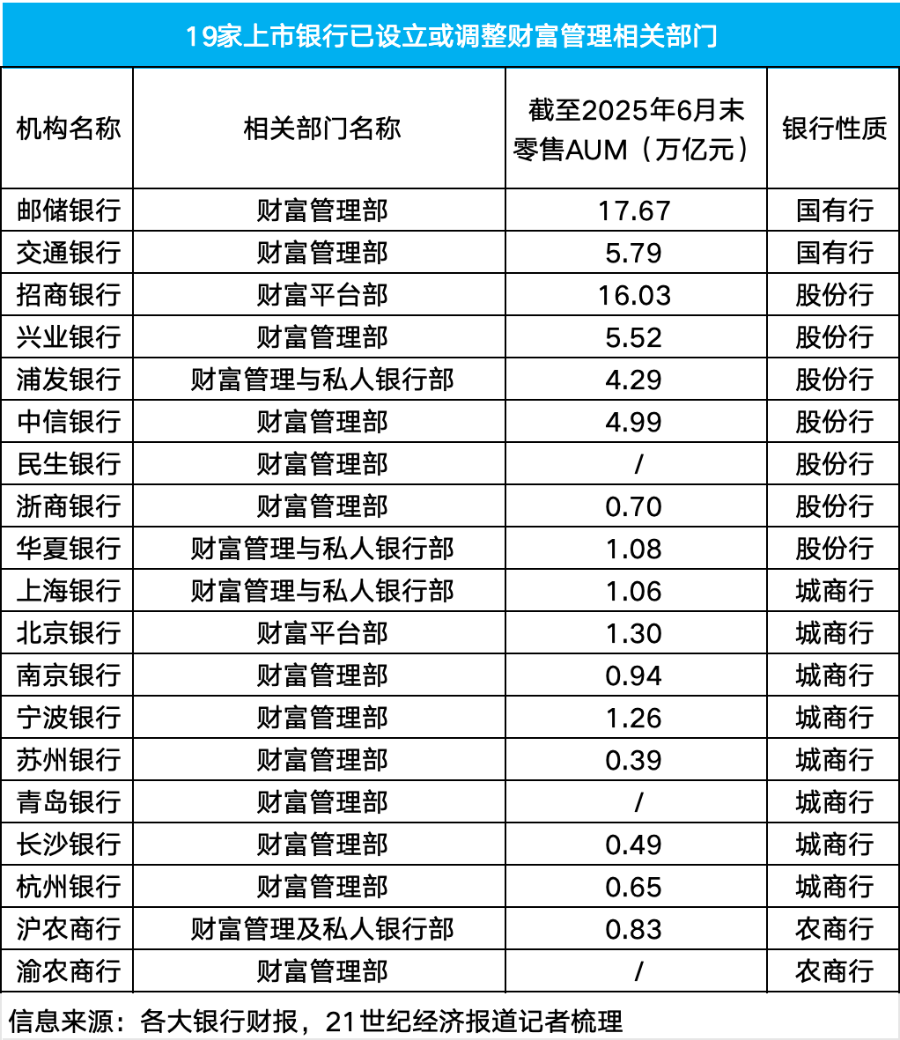
Core Insights - The wealth management market is heating up, with banks accelerating the integration of their wealth management departments to capture this promising market [1][2] - By June 2025, China's investable assets are expected to exceed 300 trillion yuan, indicating significant growth potential in wealth management as many assets remain "asleep" [1] - Major banks are restructuring their organizational frameworks to enhance their wealth management strategies and business layouts [1] Group 1: Bank Actions and Adjustments - In 2025, several major banks, including Bank of Communications and Postal Savings Bank, announced the establishment of wealth management departments at the head office level [3] - As of June 2025, 19 listed banks have established or adjusted their wealth management-related departments, including 2 state-owned banks, 7 joint-stock banks, 8 city commercial banks, and 2 rural commercial banks [3][4] - The establishment of these departments is seen as a key move for state-owned banks to deepen their wealth management strategies and promote digital transformation [3] Group 2: Strategic Focus and Market Dynamics - Different banks are focusing on various aspects of wealth management, with some emphasizing the establishment of wealth management departments as a core strategy [5] - The restructuring of wealth management departments signals a strategic shift in response to narrowing interest margins and evolving customer demands for diversified asset allocation [6][7] - The actions of major state-owned banks serve as a bellwether for the industry, indicating a shift from incremental competition to in-depth management of existing clients [8] Group 3: Wealth Management Market Landscape - As of June 2025, the retail asset management scale (AUM) among 42 listed banks shows a clear tiered structure, with state-owned banks leading the market [11] - The first tier includes major state-owned banks like ICBC, ABC, and CCB, with AUMs of 24 trillion yuan, 23.68 trillion yuan, and 22 trillion yuan respectively [11] - The second tier consists mainly of joint-stock banks, while the third tier includes city commercial banks and rural commercial banks, which are crucial for local wealth management ecosystems [11] Group 4: Future Competition and Technological Integration - Future competition in wealth management will focus on service quality, technological capabilities, and comprehensive financial ecosystems [13] - The establishment of wealth management departments aims to shift banks from product-driven to customer-driven models, enhancing service consistency and customer loyalty [13] - Financial technology is expected to play a critical role in enhancing service depth and breadth, with AI being utilized for investment advisory and customer experience management [14][15]

宁波银行:内源性资本将为公司发展创造更大的价值
Xin Lang Cai Jing· 2026-01-15 14:49
Core Viewpoint - Ningbo Bank emphasizes a long-term focus on balancing dividends and internal capital growth to strengthen the necessary capital foundation for sustainable business development [1] Group 1: Capital Management - The company aims to enhance its performance while maintaining steady growth of internal capital to create greater value for shareholders [1] - Given the current regulatory requirements for refinancing, internal capital will play a crucial role in the company's development [1] Group 2: Commitment to Shareholders - Ningbo Bank is committed to providing more returns to shareholders through consistent efforts to improve its business performance [1]

银行治理结构20年大变革:首席合规官接棒监事会,“硬制衡”取代“软监督”
Xin Lang Cai Jing· 2026-01-15 14:14
Core Viewpoint - The governance structure of Chinese commercial banks, which has been in place for over 20 years, is undergoing significant changes as the supervisory board is being replaced by Chief Compliance Officers (CCOs) in response to regulatory requirements [3][32][57] Group 1: Regulatory Changes - The "Compliance Management Measures for Financial Institutions" was released on December 25, 2024, mandating the establishment of CCO positions at financial institutions [4][32] - By March 1, 2025, all financial institutions must complete the appointment of CCOs and related compliance structures, marking the end of the supervisory board's role [4][32] - As of early 2026, at least 56 financial institutions have had their CCO qualifications approved by regulators, with over 20 banks and branches already in compliance [3][6][35] Group 2: Transition from Supervisory Board to CCO - The supervisory board, which has been in place for over 20 years, is officially being phased out, leaving only the board of shareholders and the board of directors [3][32] - The transition signifies a shift from "soft supervision" to "hard checks and balances" within the governance framework of Chinese commercial banks [3][32][57] - The responsibilities of the supervisory board will now be taken over by the CCO, who will have enhanced authority and independence [4][32] Group 3: CCO Responsibilities and Powers - CCOs are tasked with compliance risk monitoring, internal audits, and ensuring compliance with new products and business strategies [4][32] - The CCOs will have significant independence, with the authority to access all internal documents and data necessary for compliance assessments [21][25] - CCOs will also have the power to halt operations on projects that pose compliance risks and will be involved in the performance evaluations of business line leaders [23][25] Group 4: Historical Context and Need for Change - The effectiveness of the supervisory board has been questioned, as it has not met the expectations of policymakers regarding compliance oversight [8][39] - Regulatory scrutiny has intensified since 2018, with a shift in focus from growth to compliance, leading to increased penalties for violations [10][39] - The transition to CCOs is seen as a necessary evolution to address the shortcomings of the previous governance structure [8][39][48]

宁波银行:公司将持续扩大金融服务的覆盖面
Zheng Quan Ri Bao· 2026-01-15 12:43
Group 1 - The core viewpoint of the article highlights that Ningbo Bank is focusing on supporting key sectors such as private small and micro enterprises, manufacturing, import and export businesses, and consumer services to enhance financial services and support the real economy [2] - The company has been actively implementing government and regulatory decisions, increasing resource allocation and support for targeted industries, which has led to a steady growth in loan scale [2] - In the upcoming period, with the continuous release of policy dividends aimed at expanding domestic demand and promoting consumption, the company plans to further expand its financial service coverage to effectively meet the financing needs of the real economy [2]
宁波银行(002142) - 2026年1月15日投资者关系活动记录表
2026-01-15 07:36
Group 1: Financing and Growth Strategies - The company focuses on balancing dividends and internal capital growth to ensure a solid capital foundation for sustainable development [2] - Internal capital is expected to create greater value for the company's development [2] - The company aims to enhance performance and maintain steady growth of internal capital to provide more returns to shareholders [2] Group 2: Competitive Advantages - The company adopts a differentiated business strategy to adapt to changes in the operating environment and accumulate comparative advantages [2] - Key strategies include deepening operational focus, strengthening core advantages, accelerating technological transformation, and ensuring risk management [2] Group 3: Loan Growth and Economic Support - The company has focused on supporting private small and micro enterprises, manufacturing, import-export businesses, and consumer sectors to enhance financial service levels [2] - With ongoing policy benefits aimed at expanding domestic demand and promoting consumption, the company plans to maintain reasonable credit growth [2] - The goal is to effectively meet the financing needs of the real economy and support its development [2] Group 4: Compliance and Communication - During the investor relations activity, the company ensured thorough communication with investors while adhering to disclosure regulations [2] - No significant undisclosed information was leaked during the reception process [2]