
青岛银行

Search documents
浦发银行半月获股东三度增持 银行股“资本投票”潮已至?
Jing Ji Guan Cha Wang· 2025-10-26 12:05
Group 1 - China Mobile increased its stake in Shanghai Pudong Development Bank through convertible bonds, raising its ownership from 17.00% to 18.18% between October 10 and October 24, 2025 [1][2] - The stake increase occurred in three separate transactions on October 13, 17, and 24, each crossing the 1% disclosure threshold, reflecting a strategic management of shareholding [1][2] - The transactions involved a total of 450,156,195 shares, 149,805,835 shares, and 118,611,350 shares being converted from convertible bonds [1] Group 2 - Other major shareholders in the banking sector have also been increasing their stakes, indicating a growing confidence in the banking industry [2] - Postal Savings Bank's major shareholder increased its stake by 19.91 million shares, with plans for further increases within the next 12 months [2] - The trend of increasing stakes is not limited to large banks, as regional banks like Qingdao Bank and Suzhou Bank have also seen significant increases from local state-owned enterprises [3][4] Group 3 - The current wave of bank share increases is characterized by diverse stakeholders, including local state-owned platforms, central state-owned enterprises, foreign institutional investors, and industrial capital [5] - The increases are primarily funded by self-owned capital, with a general commitment to long-term holding, particularly in regional banks in economically active areas [5] - This trend reflects a broader restructuring logic within the financial system, as stakeholders publicly endorse the long-term value of banks through their investments [5][6] Group 4 - The recent increase in bank shares indicates a shift in valuation logic, moving from short-term profit fluctuations to a focus on structural advantages such as customer base, regional economic resilience, and asset quality stability [6] - Banks with these characteristics are becoming attractive to long-term investors, serving as a stabilizing force in the financial market [6]

多家银行出手,清理睡眠账户
财联社· 2025-10-25 09:35
Core Viewpoint - The recent wave of cleaning dormant accounts in the banking sector is broader than before, involving various account types and driven by both regulatory requirements and internal motivations to enhance customer engagement and operational efficiency [2][9]. Group 1: Overview of Dormant Account Cleaning - Nanjing Bank announced a cleaning initiative targeting dormant accounts, including those of businesses with canceled registrations and non-verified personal accounts [1]. - Since October, over 30 banks have initiated similar cleaning announcements, with a focus on credit cards, electronic accounts, and corporate accounts [2]. - The National Financial Regulatory Administration has launched a year-long initiative to address dormant accounts, despite a general increase in the number of bank accounts and cards in recent years [2]. Group 2: Motivations Behind Cleaning Dormant Accounts - Banks are increasingly viewing the cleaning of dormant accounts as an opportunity to activate these accounts and enhance their value, rather than merely a regulatory obligation [3][9]. - The pressure from customer attrition and the need for effective performance assessments have led banks to adopt a more proactive approach to managing inactive accounts [10]. - The shift in key performance indicators (KPIs) from merely counting accounts to focusing on active and profitable customers reflects a broader trend in the banking industry [10]. Group 3: Impact on Retail Banking - The retail banking sector has faced challenges, with some banks reporting declines in personal loan balances and profitability in retail financial services [6]. - The cleaning of dormant accounts is seen as a way to improve the accuracy of data used in AI models for risk management and marketing, thereby enhancing overall operational effectiveness [12][13]. - The presence of a significant number of dormant accounts (up to one-third of total accounts) indicates both the potential for improvement and the challenges in executing these cleaning initiatives [14].


城商行板块10月24日跌0.76%,厦门银行领跌,主力资金净流出1.42亿元
Zheng Xing Xing Ye Ri Bao· 2025-10-24 08:27
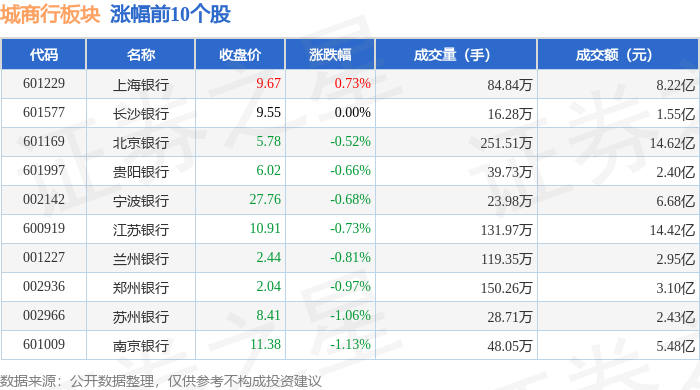
Core Insights - The city commercial bank sector experienced a decline of 0.77% on October 24, with Xiamen Bank leading the drop [1] - The Shanghai Composite Index closed at 3950.31, up 0.71%, while the Shenzhen Component Index closed at 13289.18, up 2.02% [1] Stock Performance - Shanghai Bank closed at 9.67, up 0.73% with a trading volume of 848,400 shares and a transaction value of 822 million [1] - Xiamen Bank closed at 6.68, down 1.76% with a trading volume of 153,100 shares and a transaction value of 103 million [2] - The majority of city commercial bank stocks showed negative performance, with notable declines in Beijing Bank (-0.52%) and Guizhou Bank (-0.66%) [1][2] Capital Flow - The city commercial bank sector saw a net outflow of 142 million from institutional investors, while retail investors contributed a net inflow of 55.9 million [2] - Jiangsu Bank had a net inflow of 70.84 million from institutional investors, while Shanghai Bank experienced a net outflow of 78.96 million from retail investors [3] Individual Stock Analysis - Chengdu Bank had a slight negative net flow from institutional investors of 19.75 million, but a positive inflow from retail investors of 596.99 million [3] - Lanzhou Bank saw a net inflow of 13.36 million from institutional investors, while it faced a net outflow of 1.48 million from retail investors [3]


A股午评:创业板指大涨2%,沪指刷新年内新高,存储芯片、军工皆强势
Ge Long Hui· 2025-10-24 03:45
Market Performance - The three major A-share indices collectively rose in the morning session, with the Shanghai Composite Index increasing by 0.42%, reaching a new year-high of 3946.16 points at its peak [1] - The Shenzhen Component Index rose by 1.3% to 13195 points, while the ChiNext Index saw the largest gain, closing up 2.09% at noon [1] - Over 2900 stocks in the Shanghai, Shenzhen, and Beijing markets were in the green, with a total transaction volume of 1.24 trillion yuan in the morning [1] Sector Performance - The storage chip and commercial aerospace sectors experienced a collective surge, with stocks like Purun Co. and Dawi Co. hitting the daily limit [1] - Commercial aerospace concept stocks such as Aerospace Zhizhuang and China Satellite also reached their daily limits [1] - Broader technology sectors, including quantum technology, military equipment, and brain-computer interface stocks, showed strong performance [1] - Stocks related to computing hardware, such as PCB and CPO, also saw gains, with companies like Shengyi Electronics and Kexiang Co. hitting the daily limit [1] Energy and Banking Sector - Conversely, the energy sector, including coal and gas, faced adjustments, with Baichuan Energy hitting the daily limit down and Yunmei Energy nearing the limit down [1] - Local Shenzhen stocks, which had surged previously, collectively corrected, with Shen Shui Gui Yuan dropping over 10% and leading declines in Shen Property A and Shen Textile A [1] - Most continuously rising bank stocks experienced declines, with Jiangyin Bank dropping over 3%, and several others, including Qingdao Bank and Chongqing Bank, falling over 1% [1] - Agricultural Bank turned positive after initially dropping about 2% in the morning session [1]

A股银行股普跌,江阴银行跌超3%
Ge Long Hui A P P· 2025-10-24 03:12
Group 1 - The A-share market saw a general decline in bank stocks, with Jiangyin Bank dropping over 3%, and several other banks including Xi'an Bank, Chongqing Bank, and Yunnan Rural Commercial Bank falling more than 1% [1] - Agricultural Bank was an exception, experiencing a slight increase of 0.5% [1] - The year-to-date performance of various banks shows Jiangyin Bank with a 22.07% increase, while Xi'an Bank and Chongqing Bank have year-to-date increases of 17.17% and 14.57% respectively [2] Group 2 - Jiangyin Bank's market capitalization is reported at 12.5 billion, while Xi'an Bank's is at 18.4 billion, and Chongqing Bank's is at 35.4 billion [2] - Other banks such as Qingdao Bank and Su Nong Bank also experienced declines of nearly 1%, with market capitalizations of 30.2 billion and 10.7 billion respectively [2] - The overall trend indicates a mixed performance among bank stocks, with some showing significant year-to-date gains despite the recent declines [2]




银行股涨势延续,农行登顶A股市值榜首,红利资产行情来了?
Sou Hu Cai Jing· 2025-10-23 12:45
Core Viewpoint - The banking sector in both Hong Kong and A-shares has shown strong performance, with several banks experiencing significant stock price increases, driven by a favorable market environment and investor sentiment towards dividend-paying stocks [1][3][4]. Group 1: Stock Performance - Postal Savings Bank (01658.HK) rose by 4.59%, while Minsheng Bank (01988.HK) increased by 2.39%, and Agricultural Bank of China (01288.HK) saw a rise of 1.88% in the Hong Kong market [1][2]. - In the A-share market, Postal Savings Bank (601658) gained 4.71%, Minsheng Bank (600016) increased by 2.72%, and several other banks also rose over 1%, although Agricultural Bank A-shares fell by 1.24% [2][4]. - The banking sector has experienced an 11-day consecutive rise in the A-share banking index and a similar trend in the Hong Kong banking stocks index [3]. Group 2: Market Capitalization - As of October 23, 2025, Agricultural Bank of China has solidified its position as the largest bank by market capitalization in A-shares, with a total market value of approximately 27,963.64 billion RMB, despite a recent decline of 1.24% [5][6]. - The overall market capitalization of the banking sector has been positively impacted, with Agricultural Bank's H-shares also showing a continuous upward trend [6]. Group 3: Dividend and Valuation - The banking sector's price-to-book ratio has improved, with Agricultural Bank's A-shares returning to a price-to-book ratio of 1 [6]. - The dividend yield for A-share banks has reached a range of 4%-5%, significantly higher than one-year deposit rates and ten-year government bond yields, enhancing the attractiveness of these stocks [6][7]. - Analysts suggest that the banking sector is supported by high dividend yield, valuation safety margins, and favorable capital allocation dynamics [7]. Group 4: Future Outlook - Morgan Stanley's recent report indicates that domestic bank stocks are expected to complete a natural cycle bottom without large-scale stimulus, supported by improvements in M1 growth and industrial profits [7]. - The upcoming dividend distributions and stable interest rates are anticipated to further support the revaluation of bank stocks in the fourth quarter [7].


农行破净7年终翻身!银行ETF天弘(515290)强势四连阳,近5日“吸金”3.15亿元
Xin Lang Cai Jing· 2025-10-23 07:43
Core Viewpoint - The banking sector is experiencing significant growth, with the Tianhong Bank ETF (515290) showing a notable increase in both price and trading volume, indicating strong investor interest and capital inflow [2][3]. Group 1: Bank ETF Performance - The Tianhong Bank ETF (515290) rose by 0.54%, achieving four consecutive days of gains, with a trading volume of 1.05 billion yuan [2]. - Over the past two weeks, the Tianhong Bank ETF has seen an increase of 1.244 billion yuan in scale and a growth of 568 million shares [2]. - In the last five trading days, there were net inflows on four days, totaling 315 million yuan, indicating strong demand for the ETF [2]. Group 2: Individual Bank Stocks - Key constituent stocks of the Tianhong Bank ETF, such as Postal Savings Bank (601658), Minsheng Bank (600016), and Industrial Bank (601166), have shown significant price increases of 4.71%, 2.72%, and 1.76% respectively [2]. - Agricultural Bank of China has been a standout performer, with its stock price rising significantly, breaking a long-standing "net asset value" issue and achieving a market capitalization exceeding 2.8 trillion yuan [3][4]. Group 3: Dividend Trends - As of October 22, at least 18 A-share companies have announced dividend plans, with a total payout exceeding 3.4 billion yuan, highlighting a growing focus on dividend stocks [5]. - The current market environment, characterized by increased volatility and a shift towards safer investments, has made dividend-paying assets attractive to investors seeking stable cash flows [5][6]. Group 4: Institutional Insights - Analysts note that the banking sector's characteristics of high dividends and low valuations are becoming more pronounced, with the A-share banking sector trading at a price-to-book (PB) ratio of 0.71 and H-share banks at 0.5 [6]. - The average dividend yield for H-share banks is around 5%, enhancing their appeal to risk-averse investors amid ongoing economic uncertainties [6].

南京银行频获增持,银行股价值拐点已至?
Jing Ji Guan Cha Wang· 2025-10-23 06:40
Core Viewpoint - The recent capital inflow into Nanjing Bank reflects a significant trend of shareholder increases across various banks, indicating a growing confidence in the banking sector's long-term value and stability [2][3][9] Group 1: Shareholder Actions - Nanjing Gaoke Co., Ltd. increased its stake in Nanjing Bank to 9.99% by investing approximately 1.684 billion yuan, marking the second major increase for the bank this year [2][3] - BNP Paribas raised its holdings in Nanjing Bank to 17.02% by acquiring 108 million shares, signaling international capital's endorsement of the bank's fundamentals [3] - Other banks, including Qingdao Bank, Suzhou Bank, Chengdu Bank, and Chongqing Bank, have also seen significant shareholder increases, showcasing a broader trend in the banking sector [2][5][7] Group 2: Capital Composition - The capital influx into Nanjing Bank includes contributions from foreign investors, domestic listed companies, and local state-owned enterprises, indicating a rare alignment of interests among diverse capital sources [3][4] - Local state-owned capital, such as Jiangsu Transportation Holding Co., Ltd., has optimized its shareholding structure by transferring shares to enhance management efficiency [4] Group 3: Market Trends - The trend of shareholder increases in 2025 is characterized by a diverse range of investors, including local state-owned platforms, central state-owned enterprises, foreign QFII, and industrial capital [8] - The banking sector is experiencing a shift in valuation logic, with investors increasingly focusing on structural advantages such as customer base, regional economic resilience, and asset quality stability [9] - The current market environment is transitioning from speculative trading to a focus on stable returns, positioning bank stocks as attractive investments for long-term capital [8][9]


银行股延续强势,银行ETF基金(515020)一键布局
Mei Ri Jing Ji Xin Wen· 2025-10-23 06:32
Core Viewpoint - Agricultural Bank has experienced a 15-day consecutive rise since September 25, with a cumulative increase of nearly 25%, reaching a historical high, alongside other banks like Postal Savings Bank, Qingdao Bank, Nanjing Bank, and Minsheng Bank also showing upward trends [1] Group 1: Market Performance - Bank stocks continue to show strong performance, with the Bank ETF fund (515020) performing well [1] - The recent surge in bank stocks is attributed to various favorable policies and financial tools being implemented rapidly [1] Group 2: Investment Opportunities - A new policy financial tool has been launched, with 500 billion yuan expected to be deployed through policy banks, potentially driving over 1 trillion yuan in total investment [1] - This "leverage effect" is significant, as the 500 billion yuan in capital could stimulate 4 trillion to 5 trillion yuan in total investment, creating substantial credit demand in the market [1] - The banking sector is expected to benefit directly from this, leading to growth in high-quality loan business [1] - Current bank valuations are at a bottom range, presenting a good opportunity for investment [1]
精准发力推动科技金融创新发展 积极引导资本活水灌溉科技创新沃土
Jin Rong Shi Bao· 2025-10-23 06:12
中国证券监督管理委员会青岛监管局(以下简称"青岛证监局")根据上级政策部署,深入贯彻国家 创新驱动发展战略,紧密结合辖区实际,通过优化政策环境、强化市场培育等多项举措,发挥监管效 能,支持科技创新,助力科技型企业借助资本市场实现高质量发展。 精准施策 构建科技金融服务"新生态" (一)强化政策引领,完善制度保障。青岛证监局推动出台《发挥基金引领作用促进高质量发展行 动方案(2025-2027年)》,联合青岛市科技局等5部门印发《加强科技财政金融协同支持企业创新发展的 若干政策措施》,针对成长性好、创新性强的科技型企业,在孵化培育等方面做好扶持服务;联合人行 青岛市分行等10部门出台《青岛市科技金融服务能力提升专项行动工作方案》,提高金融支持科技创新 的针对性、精准性和实效性,为加快培育发展新质生产力、完善现代化产业体系贡献金融力量。 (二)深化机构指导,提供专业服务。指导青岛证券期货业协会组织召开行业机构年度交流培训 会,发出《充分发挥金融机构功能 支持新质生产力发展》倡议书,指导各机构加大对战略性产业的行 业研究,精准识别科技创新型企业,为科创企业上市融资、并购重组、股权激励等提供专业服务,把自 身发展战略 ...