中国人民银行

Search documents
央行:创设证券、基金、保险互换便利和股票回购增持再贷款两项工具
Bei Jing Shang Bao· 2025-12-26 12:44
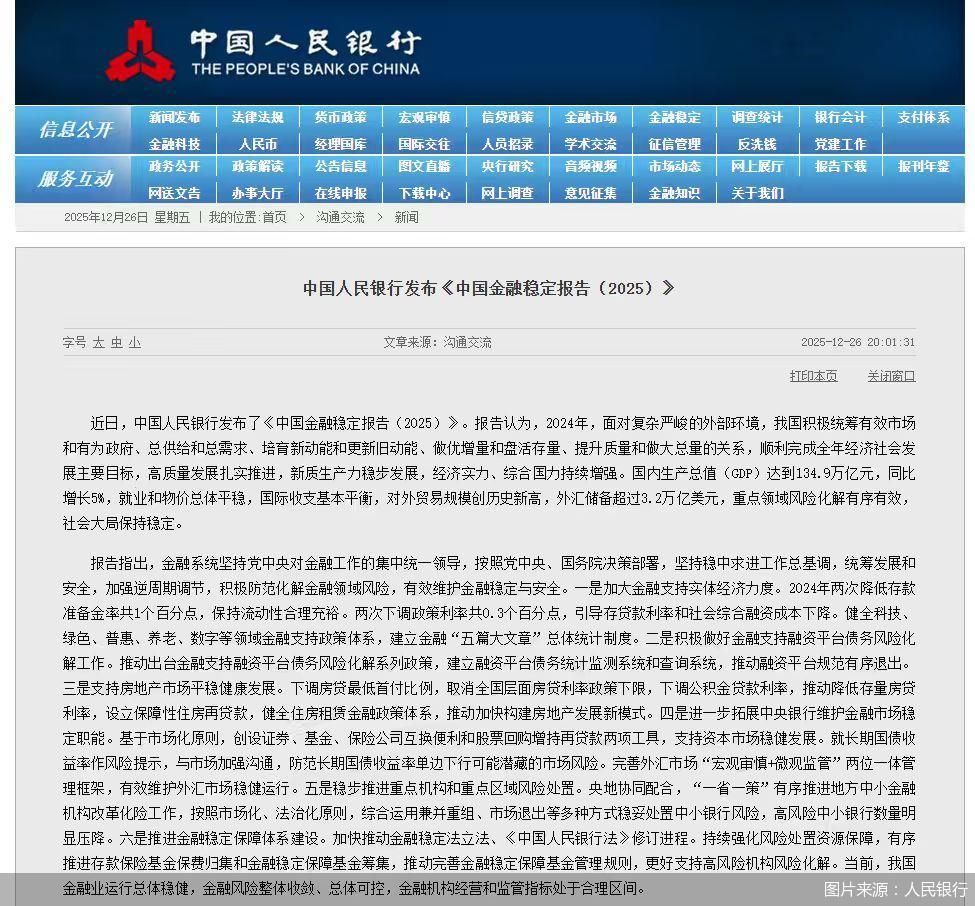
Core Insights - The People's Bank of China (PBOC) has released the "China Financial Stability Report (2025)", emphasizing the expansion of its role in maintaining financial market stability [4] Group 1: Financial Market Stability - The PBOC aims to create tools such as securities, fund, and insurance company swap facilities, as well as stock repurchase and increased loan support to promote stable development in the capital market [4] - The report highlights the need for improved communication with the market regarding long-term government bond yields to mitigate potential market risks associated with a unilateral decline in these yields [4] Group 2: Foreign Exchange Market Management - The PBOC is enhancing the "macro-prudential + micro-regulation" management framework for the foreign exchange market to ensure its stable operation [4]

事关外汇市场,央行重要新规
Xin Lang Cai Jing· 2025-12-26 12:21
Core Viewpoint - The People's Bank of China (PBOC) has released new regulations for the interbank foreign exchange market to standardize and develop the market, enhance high-level openness, protect legal rights, prevent risks, and better serve the real economy, effective from February 1, 2026 [1][3]. Group 1: Regulatory Framework - The new regulations aim to strengthen supervision of the interbank foreign exchange market by clarifying requirements across various areas such as trading venues, qualification conditions, pricing norms, transaction clearing rules, information management, data services, and self-regulation, achieving comprehensive business oversight [1][3]. - The regulations emphasize that transactions in the interbank foreign exchange market must adhere to principles of openness, fairness, justice, and good faith, prohibiting fraud, market manipulation, and insider trading that could disrupt market order and harm participants' legal rights [1][3]. Group 2: Market Stability - The regulations are designed to maintain the stable operation of the foreign exchange market by standardizing the rights and obligations of market infrastructure, domestic and foreign financial institutions, currency brokers, and financial information service providers, while also requiring adherence to principles of openness, fairness, justice, and good faith to protect participants' legal rights [2][4]. Group 3: High-Quality Development - The regulations promote high-quality development of the interbank foreign exchange market by supporting the infrastructure to continuously enrich trading and clearing varieties, currencies, and methods based on market demand, facilitating financial institutions in providing foreign exchange services to clients [5]. - The PBOC and the State Administration of Foreign Exchange (SAFE) plan to continuously improve the management of the interbank foreign exchange market and deepen its development to maintain stable operations [5].
央行报告:加强房地产金融宏观审慎管理,稳妥有序完善房地产信贷基础性制度
Zheng Quan Shi Bao Wang· 2025-12-26 12:19
Core Viewpoint - The People's Bank of China emphasizes the importance of monitoring the real estate market and financial conditions, aiming to implement policies that support stable and healthy development in the real estate sector [1] Group 1 - The People's Bank of China will continue to implement the directives from the Central Committee and the State Council regarding financial stability [1] - There will be a focus on the marginal changes in the real estate market and financial conditions [1] - The bank plans to enhance macro-prudential management of real estate finance and improve the foundational credit system for real estate [1] Group 2 - The implementation of financial policies such as the re-loan for affordable housing will be prioritized [1] - The goal is to promote a new model of real estate development [1]
中国人民银行发文规范CIPS业务行为
Xin Hua Wang· 2025-12-26 12:15
Core Viewpoint - The People's Bank of China announced the revision of the Cross-Border Interbank Payment System (CIPS) business rules, which will take effect on February 1, 2026, to better accommodate the development of cross-border RMB business and enhance management practices [1]. Group 1: Regulatory Changes - The revised rules aim to address the inadequacies of the previous regulations in meeting the expanding needs of participants and managing the CIPS business effectively [1]. - The new regulations will standardize various operational aspects, including account opening for participants and operational institutions, settlement fund ownership, and liquidity management [1]. Group 2: Business Operations - The updated rules clearly define the types of business participants can engage in and regulate actions such as message permission applications, system logins, business type entries, and query verifications [1]. - The new regulations also establish a settlement mechanism that governs queue management, business cancellations and returns, as well as participant accounting and reconciliation processes [1].
中国人民银行发布《中国金融稳定报告》
Zheng Quan Shi Bao Wang· 2025-12-26 12:10
Core Viewpoint - The People's Bank of China released the "China Financial Stability Report (2025)", highlighting the complex changes in the development environment during the "14th Five-Year Plan" period, characterized by both strategic opportunities and risks, with increasing uncertainties [1] Economic Environment - China's economic foundation is stable, with multiple advantages, strong resilience, and significant potential, maintaining long-term positive support conditions and trends [1] - The advantages of the socialist system with Chinese characteristics, large-scale market, complete industrial system, and abundant human resources are becoming more prominent [1] Financial System Outlook - The financial system will maintain ample liquidity, aligning the growth of social financing scale and money supply with economic growth and price level expectations [1] - Continuous efforts will be made to create a conducive monetary and financial environment, aiming to reduce the comprehensive financing costs for society [1] Exchange Rate Management - The market will play a decisive role in the formation of the exchange rate, maintaining exchange rate flexibility and strengthening expectation guidance to prevent excessive fluctuations [1] - The goal is to keep the RMB exchange rate stable at a reasonable and balanced level [1] Financial Development Focus - Emphasis on developing five key areas of finance: technology finance, green finance, inclusive finance, pension finance, and digital finance, to support major national strategies and key areas of economic and social development [1] Risk Management - A comprehensive macro-prudential management system will be established to enhance monitoring and assessment of systemic financial risks [1] - Focus on preventing and resolving financial risks in key areas, including supporting the resolution of financing platform debt risks and managing risks in small and medium-sized financial institutions [1] - Ensuring macro-prudential management in real estate finance to firmly maintain the bottom line of preventing systemic financial risks [1]
央行印发业务规则 规范人民币跨境支付系统(CIPS)业务行为
Xin Lang Cai Jing· 2025-12-26 10:50
(来源:财闻) 运营机构不得在商业银行开立账户存放CIPS参与者办理CIPS业务的结算资金、不得形成清算资金沉 淀。 12月26日,央行发布公告,为适应跨境人民币业务发展需要,加强人民币跨境支付系统(CIPS)业务 管理,中国人民银行修订了《人民币跨境支付系统业务规则》。 运营机构不得在商业银行开立账户存放CIPS参与者办理CIPS业务的结算资金、不得形成清算资金沉 淀。直接参与者可根据清结算需求,通过其自身或其资金托管行在中国人民银行开立的清算账户对 CIPS账户进行流动性管理。 相关链接:人民币跨境支付系统业务规则 其中提到,运营机构为直接参与者开立的CIPS账户应当为零余额账户,该账户不计息、不得透支,场 终(日终)余额为零。CIPS账户内资金属于开立该账户的直接参与者,不属于运营机构自有财产。运 营机构应当统一管理参与者的账户。一个直接参与者在CIPS只能开立一个零余额账户。间接参与者在 CIPS不开立账户。 根据CIPS业务需要,运营机构可在中国人民银行开立清算账户,用于集中存放参与者办理CIPS业务的 结算资金,与运营机构其他用途资金分户核算。直接参与者依据其CIPS账户余额享有相应权益。该账 户 ...
央行发布《银行间外汇市场管理规定》 自2026年2月1日起施行
Shang Hai Zheng Quan Bao· 2025-12-26 10:26
Core Viewpoint - The People's Bank of China has revised the interim regulations on the interbank foreign exchange market to enhance regulation, promote high-level opening-up, and ensure the protection of legal rights and interests of all parties involved, effective from February 1, 2026 [1] Group 1: Regulatory Enhancements - The new regulations aim to strengthen supervision of the interbank foreign exchange market by establishing comprehensive requirements across various areas including trading venues, qualification conditions, pricing norms, transaction clearing rules, information management, data services, and self-regulation [1] - The regulations will ensure full coverage of business supervision in the foreign exchange market [1] Group 2: Market Stability and Participant Protection - The regulations are designed to maintain the stable operation of the foreign exchange market by standardizing the rights and obligations of market infrastructure, domestic and foreign financial institutions, currency brokers, and financial information service providers [1] - Participants in the market are required to adhere to principles of openness, fairness, justice, and good faith to protect their legal rights [1] Group 3: Development of the Foreign Exchange Market - The regulations promote the high-quality development of the interbank foreign exchange market by supporting the continuous enrichment of trading and clearing varieties, currencies, and methods based on market demand [1] - Financial institutions are encouraged to provide foreign exchange services to clients more conveniently [1]
科创债ETF鹏华(551030)收涨6bp实现8连涨,全年MLF净投放超1万亿持续呵护市场流动性
Sou Hu Cai Jing· 2025-12-26 10:09
Group 1 - The core viewpoint of the news highlights the performance and market activity of the Penghua Sci-Tech Bond ETF, which has seen an increase of 0.06% and achieved eight consecutive gains, with a trading volume of 8.3 billion yuan [1] - The Penghua Sci-Tech Bond ETF has experienced a net inflow of funds totaling 1.118 billion yuan over the last four days, with a peak single-day net inflow of 499 million yuan, indicating strong market interest [1] - The People's Bank of China (PBOC) has implemented a net liquidity injection of 188.8 billion yuan through reverse repos and MLF operations, maintaining a stable liquidity environment and supporting market confidence [1] Group 2 - The Penghua Sci-Tech Bond ETF tracks the Shanghai AAA Technology Innovation Company Bond Index, which includes bonds rated AAA and above, providing advantages such as low fees, low trading costs, and high transparency [2] - Huaxi Securities believes that the policy benefits will expand the market space for sci-tech bonds, and the ETF's unique index-based nature will enhance its long-term value and market influence [2] - Penghua Fund aims to establish itself as a "fixed income index expert" by actively developing a range of fixed income products, including bond index ETFs and credit bond indices, since the second half of 2018 [2]
中国人民银行发布《银行间外汇市场管理规定》,2026年2月1日起施行
Bei Jing Shang Bao· 2025-12-26 09:57
Core Viewpoint - The People's Bank of China (PBOC) has revised the interim regulations on the interbank foreign exchange market to enhance regulation, promote high-level opening, and ensure the market serves the real economy effectively [1] Group 1: Regulatory Framework - The new regulations will take effect on February 1, 2026, and aim to create a systematic regulatory framework for the interbank foreign exchange market [1] - The regulations will strengthen oversight across various areas including trading venues, qualification requirements, pricing norms, transaction clearing rules, information management, data services, and self-regulation [1] Group 2: Market Stability and Participant Rights - The regulations are designed to maintain the stable operation of the foreign exchange market by clarifying the rights and obligations of market infrastructure, domestic and foreign financial institutions, currency brokers, and financial information service providers [1] - The principles of openness, fairness, justice, and good faith are emphasized to protect the legitimate rights and interests of market participants [1] Group 3: Development of the Foreign Exchange Market - The regulations aim to promote high-quality development of the interbank foreign exchange market by encouraging the diversification of trading and clearing products, currencies, and methods based on market demand [1] - Financial institutions will be facilitated in providing foreign exchange services to their clients [1] Group 4: Future Management - The PBOC and the State Administration of Foreign Exchange will continue to improve the management of the interbank foreign exchange market and deepen its development to maintain stable market operations [2]
央行发新规,促进外汇市场服务实体经济
Wind万得· 2025-12-26 09:37
Group 1 - The core viewpoint of the article is the revision of the interim regulations on the interbank foreign exchange market by the People's Bank of China, aimed at standardizing and developing the foreign exchange market, enhancing high-level openness, and safeguarding the legitimate rights and interests of all parties involved [2] Group 2 - The new regulations will take effect on February 1, 2026, and are designed to create a systematic regulatory framework and requirements based on the development and regulatory practices of China's interbank foreign exchange market [2] - The regulations emphasize strengthening supervision of the interbank foreign exchange market, covering areas such as trading venues, qualification conditions, pricing norms, transaction clearing rules, information management, data services, and self-regulation [2] - The regulations aim to maintain the stable operation of the foreign exchange market by standardizing the rights and obligations of market infrastructure, domestic and foreign financial institutions, currency brokers, and financial information service providers, ensuring adherence to principles of openness, fairness, justice, and good faith [2] - The regulations promote high-quality development of the interbank foreign exchange market by supporting the continuous enrichment of trading and clearing varieties, currencies, and methods based on market demand, facilitating financial institutions in providing foreign exchange services to clients [2] - The People's Bank of China and the State Administration of Foreign Exchange will continue to improve the management of the interbank foreign exchange market and deepen its development to maintain stable operations [2]