
人民币跨境支付

Search documents
资金面整体平稳向宽,债市偏强震荡
Dong Fang Jin Cheng· 2026-01-26 06:42
Report Summary 1. Market Conditions on January 21 - The overall liquidity situation was stable and loose; the bond market showed a moderately strong oscillation; the main convertible bond market indices rose collectively, with most individual convertible bonds posting gains; yields of U.S. Treasuries across various maturities generally declined, while yields of 10-year government bonds in major European economies generally increased [1][2] 2. Core Viewpoints - The bond market was influenced by better-than-expected liquidity during the tax payment period, showing a moderately strong oscillation. The convertible bond market followed the equity market's upward trend [16][22] 3. Summary by Directory 3.1 Bond Market News - **Domestic News**: - The central bank aims to accelerate the construction of the RMB cross - border payment system and promote high - quality development of the modern payment system [4] - In 2025, the industrial and information technology sectors contributed over 40% to economic growth, with various industries showing positive growth trends [5] - The tax policies for innovative enterprise CDRs during the pilot phase are extended to December 31, 2027 [7] - The Ministry of Housing and Urban - Rural Development plans to stabilize the real estate market this year and implement relevant systems [7] - **International News**: - Trump announced an agreement framework on Greenland with NATO, suspending planned tariffs on Europe [8] - **Commodities**: - International crude oil futures prices rose, and the international natural gas price increased by nearly 30% [9][10] 3.2 Liquidity - **Open Market Operations**: - On January 21, the central bank conducted 363.5 billion yuan of 7 - day reverse repurchase operations, with a net injection of 122.7 billion yuan [12] - **Funding Rates**: - The overall liquidity was stable and loose. DR001 decreased by 5.00bp to 1.321%, and DR007 increased by 0.04bp to 1.495% [13] 3.3 Bond Market Dynamics - **Interest - Rate Bonds**: - **Yield Trends**: - Due to better - than - expected liquidity during the tax payment period, the bond market was moderately strong. As of 20:00, the yield of the 10 - year Treasury active bond 250016 decreased by 0.05bp to 1.8335%, and that of the 10 - year CDB active bond 250215 decreased by 0.45bp to 1.9455% [16] - **Bond Tendering**: - Multiple bonds were issued on January 21, with details such as issue scale, winning yield, and multiples provided [17] - **Credit Bonds**: - **Secondary - Market Transaction Anomalies**: - Four industrial bonds had a price deviation of over 10%, including significant drops and a sharp increase [18][19] - **Credit Bond Events**: - Various companies had bond - related events such as bond extensions, cancellations of bond issuance, and performance announcements [21] - **Convertible Bonds**: - **Equity and Convertible Bond Indices**: - The A - share market rose, with the Shanghai Composite Index, Shenzhen Component Index, and ChiNext Index increasing by 0.08%, 0.70%, and 0.54% respectively. The convertible bond market also rebounded, with the CSI Convertible Bond, Shenzhen Convertible Bond, and Shanghai Convertible Bond indices rising by 0.90%, 0.89%, and 0.90% respectively [21][22] - **Convertible Bond Tracking**: - Some convertible bonds announced online subscriptions, potential downward revisions of conversion prices, and early redemptions [24] - **Overseas Bond Markets**: - **U.S. Bond Market**: - Yields of U.S. Treasuries across various maturities generally declined, with the 10 - year yield decreasing by 4bp to 4.26%. The yield spreads between 2 - year and 10 - year, and 5 - year and 30 - year Treasuries narrowed [25] - **European Bond Market**: - Yields of 10 - year government bonds in major European economies generally increased, except for the UK where it remained unchanged [27] - **Price Changes of Chinese - Issued Dollar Bonds**: - Details of daily price changes of Chinese - issued dollar bonds as of the close on January 21 were provided [29]

央行:加快建设人民币跨境支付体系,推进跨境支付互联互通
Zheng Quan Shi Bao Wang· 2026-01-21 11:05
Core Viewpoint - The People's Bank of China emphasizes the continuous improvement of regulations and services in the payment sector since 2025, marking a new phase of high-quality development in the payment industry [1] Group 1: Regulatory and Development Progress - The meeting highlighted the advancements in regulatory frameworks and service levels in the payment sector, contributing to a safer and more efficient cross-border payment system [1] - Significant breakthroughs have been achieved in the interconnectivity of domestic and international payment systems [1] Group 2: Future Goals and Strategies - The 2026 payment settlement work will align closely with the "14th Five-Year Plan" and the goals of building a strong financial nation, focusing on the high-quality development of a modern payment system [1] - There is a push to accelerate the construction of a cross-border payment system for the renminbi, promoting interconnectivity and diversification in cross-border payment systems [1] Group 3: Regulatory Measures and Industry Health - The meeting called for strict implementation of penetrating supervision of payment institutions and functional regulation of payment services, aiming to create a compliant and healthy industry ecosystem [1] - Continuous optimization of payment services is essential, with a focus on providing convenient and secure payment options [1] - Enhancing the quality and efficiency of payment system services through innovation is a priority for the industry [1]
人民币跨境支付系统新规出炉,明年2月1日起施行
Sou Hu Cai Jing· 2025-12-30 14:36
Core Viewpoint - The People's Bank of China has officially issued the revised "Rules for Cross-Border Payment System of Renminbi" (referred to as the new "Business Rules"), which will take effect on February 1, 2026, replacing the previous version from 2018. The revision aims to better accommodate the expansion and management needs of participants in the Cross-Border Interbank Payment System (CIPS) and to align with the ongoing development of CIPS services and functionalities [1][2]. Group 1 - The new "Business Rules" consists of six chapters: "General Principles," "Account Management," "Business Processing," "Settlement Mechanism," "Risk Management and Emergency Handling," and "Appendices," divided into thirty articles [2]. - The revised rules eliminate the dedicated chapter on "Participant Management," instead requiring operating institutions to establish participant management methods within the "General Principles" chapter, addressing participant entry and exit management, reporting requirements, and risk management [2]. - As of now, CIPS has 190 direct participants and 1,567 indirect participants, with significant representation from Asia (1,150), Europe (261), Africa (65), North America (34), South America (33), and Oceania (24) [2]. Group 2 - The new rules clarify that foreign institutions applying to become direct participants can appoint qualified direct participants as their fund custodians, a change from the previous requirement that mandated foreign institutions to designate domestic bank-type direct participants for this role [3].
一位武汉老股民的2025:A股创十年新高,账户盈利超30%
Sou Hu Cai Jing· 2025-12-29 10:11
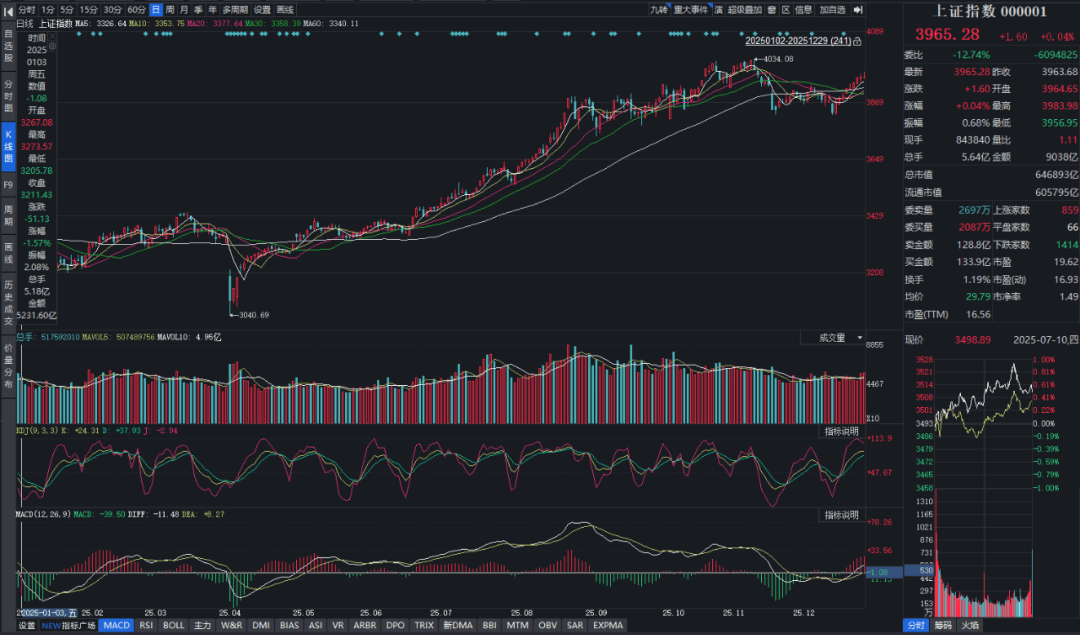
Core Viewpoint - The A-share market has experienced significant fluctuations in 2023, characterized by a structural bull market driven by policy changes, technological revolutions, and macroeconomic shifts, with the Shanghai Composite Index reaching a peak of 4034 points [2][11]. Group 1: Market Performance - The Shanghai Composite Index rose from a low of 3040 points to a peak of 4034 points within the year, reflecting a volatile market influenced by major events such as the introduction of the DeepSeek technology and various policy measures [2][11]. - The market saw a notable recovery after a period of decline, with the index hitting a low of 2689 points in August 2022 before rebounding significantly due to policy interventions [2][4]. Group 2: Investment Strategies - Investors are advised to focus on stocks with strong performance metrics and to avoid speculative trading, as the market has shown a clear distinction between stocks with solid fundamentals and those driven purely by hype [3][12]. - The importance of aligning investment choices with policy directions, industry trends, and company performance is emphasized, indicating that successful investors are those who adopt a value investment approach [3][12]. Group 3: Sector Insights - The technology sector, particularly in AI and computing power, has emerged as a key area for investment, with companies like DeepSeek leading the charge in innovation and market disruption [8][12]. - The commercial aerospace sector is highlighted as a promising investment area, benefiting from a confluence of policy support, technological advancements, and capital investment [12][13]. Group 4: Lessons Learned - The experience of investors in 2023 underscores the necessity of long-term investment strategies over short-term trading, with a focus on companies that demonstrate core technological capabilities and sustainable growth paths [13][12]. - The shift in market dynamics from a policy-driven narrative to an emphasis on industrial execution and performance is noted, suggesting a more mature investment landscape moving forward [11][13].





央行印发新规!明年2月1日起正式实施!
Jin Rong Shi Bao· 2025-12-28 22:49
Core Viewpoint - The People's Bank of China has issued revised rules for the Cross-Border Interbank Payment System (CIPS), effective from February 1, 2026, to adapt to the rapid development of CIPS and enhance risk prevention measures [1] Group 1: Regulatory Framework - The revised rules aim to standardize the operations of CIPS and ensure the forward-looking and scientific nature of regulatory documents [1] - The rules apply to CIPS operating institutions and participants, with the operating institutions being approved by the People's Bank of China to provide cross-border RMB clearing and settlement services [2] Group 2: Participant Structure - CIPS participants are categorized into direct and indirect participants, with direct participants holding CIPS accounts and having a CIPS bank number [3] - Direct participants include banks and certain financial market infrastructure institutions, while indirect participants do not hold accounts but can conduct business through direct participants [3] Group 3: Account Management - Direct participants can only open one zero-balance account in CIPS, which does not accrue interest and cannot be overdrawn, ensuring that the end-of-day balance is zero [4][5] - The rules stipulate that CIPS accounts belong to the direct participants and not to the operating institutions, enhancing the safety of funds [5] Group 4: Business Processing - The new rules specify operational requirements for different types of participants, with bank direct participants processing payments based on customer instructions or through indirect participants [6] - Financial market infrastructure direct participants must organize or participate in fund settlements through CIPS according to their transaction systems and are prohibited from expanding service scope without consent [7] - The revisions are designed to address the challenges faced by the previous rules and to better accommodate the growing scale and management needs of CIPS participants [7]
央行印发业务规则 规范人民币跨境支付系统(CIPS)业务行为
Xin Lang Cai Jing· 2025-12-26 10:50
Core Viewpoint - The People's Bank of China has revised the rules for the Cross-Border Interbank Payment System (CIPS) to enhance the management of cross-border RMB business and ensure that CIPS accounts are zero-balance accounts, which do not accrue interest or allow overdrafts [1] Group 1: CIPS Account Management - Operating institutions must open zero-balance accounts for direct participants in CIPS, which will not earn interest and must maintain a zero balance at the end of the day [1] - Funds in the CIPS accounts belong to the direct participants and are not considered the operating institution's assets, which must manage the participants' accounts uniformly [1] - Each direct participant is allowed to open only one zero-balance account in CIPS, while indirect participants are not permitted to open accounts [1] Group 2: Liquidity Management - Operating institutions may open a clearing account at the People's Bank of China to manage settlement funds for CIPS business separately from other funds [1] - Direct participants can manage liquidity for their CIPS accounts through their own or their custodian bank's clearing accounts at the People's Bank of China [1] - The clearing account must not allow overdrafts and must also maintain a zero balance at the end of the day [1]
ETF盘中资讯|快手攻击事件催化,网络安全板块活跃!信创ETF基金(562030)逆市涨近1%,盘中收复20日线、年线
Sou Hu Cai Jing· 2025-12-25 05:42
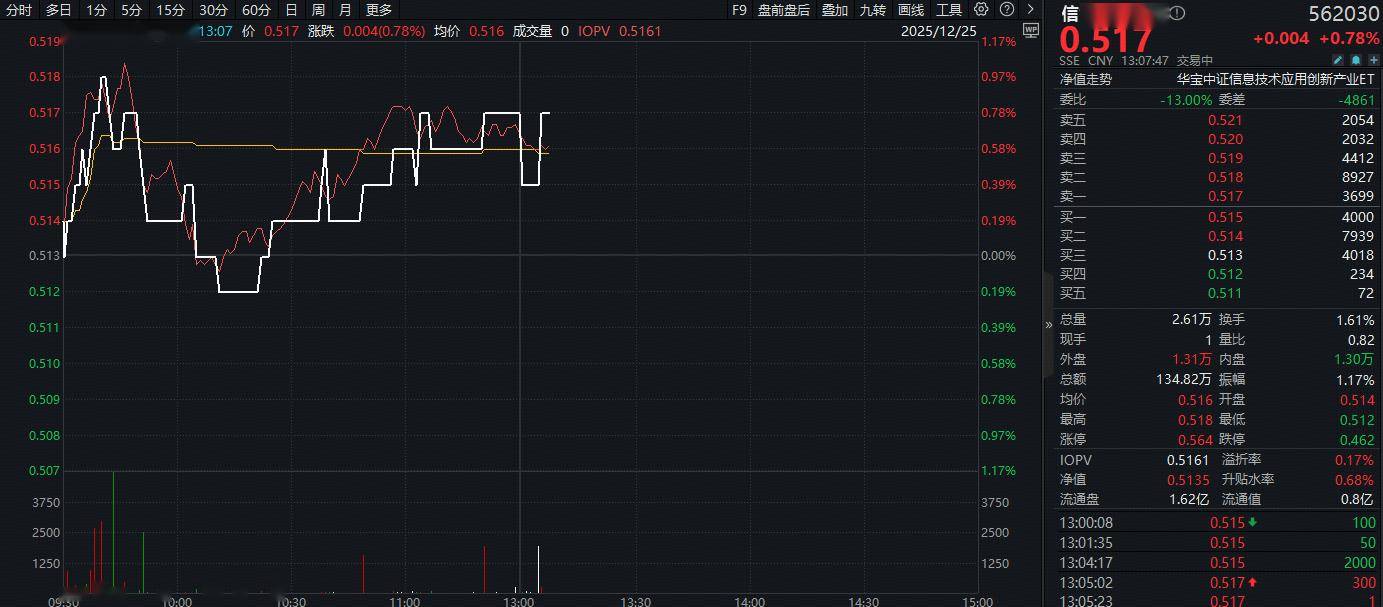
Core Viewpoint - The news highlights the active performance of the Xinchuang ETF fund (562030) in the information technology self-controllable sector, with a price increase of nearly 1% at one point and currently up by 0.78%, recovering key moving averages and showing potential for further gains [1][3]. Group 1: Market Performance - The Xinchuang ETF fund has seen significant activity, with key stocks such as Chengdu Huami leading with a rise of 10.48%, followed by Nandian Information at 5.10%, and others like Yaxin Security and Xin'an Century increasing by over 2% [3]. - The fund's underlying index includes core segments of the Xinchuang industry chain, covering hardware, software, application software, information security, and external devices, indicating high growth and elasticity characteristics [6]. Group 2: Policy and Industry Outlook - Eight departments have issued a document to support the construction of the Western Land-Sea New Corridor, promoting cross-border payment opportunities, with predictions of rapid growth in global retail cross-border payment scale by 2032 [4]. - Analysts from CITIC Securities and Guotai Junan Securities suggest that the Xinchuang industry is poised for unexpected growth due to favorable policies and the urgent need for self-controllable technology, with hardware and software localization rates currently low [4][7]. - The Xinchuang sector is characterized by recovery in market conditions, improved product performance, and leadership in domestic computing power, with significant orders expected to accelerate in the next two years due to supportive policies [4][7]. Group 3: Investment Strategies - Investment opportunities in the Xinchuang sector can be categorized into three main lines: core participants in the Huawei supply chain, leading companies in the Xinchuang ecosystem, and urgent demand in specific fields such as domestic computing power and industrial software [4][7]. - The current geopolitical climate and the trend towards de-globalization emphasize the necessity for self-controllable technology, which is expected to receive strong support from the government and accelerate industry development [6][7].

A股盘前播报 | 美国未来18月停止对华芯片加征额外关税 北京出台楼市“组合拳”
智通财经网· 2025-12-25 00:36
Group 1: Industry News - The U.S. government has decided to end the previous administration's investigation into Chinese chips and will not impose additional tariffs on Chinese chips for at least 18 months, signaling a desire to stabilize U.S.-China relations [1] - Beijing has announced a new real estate policy that reduces the social security or tax payment requirement for non-Beijing families purchasing homes within the Fifth Ring Road from three years to two years, which is expected to be followed by similar policies in other cities like Shanghai and Shenzhen [2] - The People's Bank of China has committed to maintaining a moderately loose monetary policy and increasing counter-cyclical and cross-cyclical adjustments, focusing on financial support for key areas such as domestic demand, technological innovation, and small and medium-sized enterprises [3] - Eight departments, including the central bank, have issued guidelines to support the construction of the Western Land-Sea New Corridor, promoting the use of the RMB in cross-border payments and facilitating trade and investment [4] Group 2: Market Insights - Analysts from Galaxy Securities expect a spring rally and recommend focusing on defensive stocks while being optimistic about policy benefits and industry prosperity in the coming year [7] - Huaxi Securities suggests that the current market uptrend may not be temporary, with the market's height depending on the acceptance of new narratives [8] - Dongwu Securities predicts that the market will continue to rebound towards the end of the year, with technology themes remaining a primary investment focus in the next year [9] Group 3: Market Trends - The humanoid robot sector is experiencing significant catalysts, with companies like Cloud Deep and Ubtech making strides in innovation and potential IPOs, indicating a transformative product similar to computers and smartphones [10] - Samsung and SK Hynix are expected to raise prices for HBM3E memory by nearly 20% next year, driven by increasing demand from the AI industry, suggesting a positive outlook for storage-related sectors [11] - The Tianlong-3 reusable rocket is set to launch, marking a shift towards a new era of commercial reusable rockets in China, with significant developments anticipated in low-orbit satellite internet construction by mid-2026 [12]
多渠道广覆盖的人民币跨境支付体系基本建成
Guo Ji Jin Rong Bao· 2025-10-30 02:31
Group 1 - The total assets of financial institutions in China exceeded 520 trillion yuan as of September 2025, with commercial banks' capital adequacy ratio at 15.36% and non-performing loan ratio at 1.52% [1] - The comprehensive solvency adequacy ratio for insurance companies is 186%, while the average risk coverage ratios for securities and futures companies are 295% and 226% respectively [1] - A multi-channel and widely covered cross-border payment system for the renminbi has been established, with significant roles played by the CIPS and various non-bank payment institutions [1] Group 2 - Cross-border payment businesses face three main challenges: complex regulations, settlement and exchange rate risks, and difficulties in local operations due to cultural and institutional differences [2] - Recommendations for overcoming these challenges include establishing local compliance capabilities, collaborating with local banks, and optimizing payment processes to manage currency risks [2] - The demand for flexible settlement and local payments is driven by the growth of cross-border e-commerce, SMEs, and digital trade, with technological innovations providing opportunities for cost reduction and efficiency improvement [3] Group 3 - The trend of strengthening cooperation among cross-border payment institutions is emerging, with a focus on achieving synergy between capital flow, logistics, and information flow [3] - Key factors for Chinese enterprises going global include market selection and layout capabilities, cross-border payment and fund management abilities, local compliance and operational support, as well as risk control and exchange rate management [3]
人民币国际使用遭低估?权威业内人士解析
Di Yi Cai Jing Zi Xun· 2025-10-24 07:42
Core Insights - As of September 2025, the RMB has risen to the fifth position in the global payment currency ranking, accounting for 3.17% of total payments, with a 15.53% increase in payment amounts compared to August 2025 [1] - The SWIFT statistics on RMB payments only include offshore payment messages and some cross-border payment messages, indicating that a significant amount of RMB cross-border transactions are not captured by SWIFT [1] - The People's Bank of China (PBOC) considers a broader scope of data, including the Cross-Border Interbank Payment System (CIPS) and domestic bank systems, leading to a more accurate representation of the RMB's status as the third-largest global payment currency [1] Group 1 - The RMB's global payment currency ranking has improved, now at fifth place with a 3.17% share [1] - The increase in RMB payment amounts is significantly higher than the overall increase in all currencies, which is 6.74% [1] - The PBOC's comprehensive assessment includes additional data sources, reinforcing the RMB's position as the third-largest payment currency globally [1]