
南京银行

Search documents
26家银行密集分红!总额超2600亿,工商银行居首,多家首次推出中期方案
Sou Hu Cai Jing· 2025-12-16 05:23
Core Viewpoint - As of December 15, 2025, 26 A-share listed banks have announced mid-term or quarterly dividend plans, with a total expected payout exceeding 260 billion yuan [1]. Group 1: Major Contributors - The six major state-owned banks are the main contributors to this dividend distribution, with Industrial and Commercial Bank of China leading at 50.396 billion yuan, followed by China Construction Bank at 48.605 billion yuan, Agricultural Bank of China at 41.823 billion yuan, Bank of China at 35.250 billion yuan, Postal Savings Bank of China at 14.771 billion yuan, and Bank of Communications at 13.811 billion yuan [3]. - The total cash dividend from these six major banks exceeds 200 billion yuan [3]. Group 2: Other Banks - Among joint-stock banks, both Industrial Bank and CITIC Bank are expected to distribute over 10 billion yuan in dividends, specifically 11.957 billion yuan and 10.461 billion yuan respectively [3]. - Everbright Bank and Minsheng Bank are also projected to exceed 5 billion yuan in dividends [3]. - Several regional small and medium-sized banks are actively participating in mid-term dividends, with Shanghai Bank, Nanjing Bank, Hangzhou Bank, Shanghai Rural Commercial Bank, and Ningbo Bank leading in dividend amounts [3]. - Notably, banks like Industrial Bank and Ningbo Bank are introducing mid-term dividend plans for the first time [3]. Group 3: Dividend Implementation - Several banks have specified the dates for dividend distribution, with Industrial and Agricultural Banks set to distribute cash dividends on December 15, 2025 [3]. - Bank of Communications has announced that it expects to distribute mid-term cash dividends to A-share shareholders on December 25, 2025 [3].





南银法巴消金增资至60亿元,增幅约15%
Xin Lang Cai Jing· 2025-12-16 02:42
Core Viewpoint - On December 12, 2023, Nanyin Fabre Consumer Finance Co., Ltd. increased its registered capital from 5.215 billion RMB to 6 billion RMB, marking an approximate 15% increase, alongside changes in several senior management positions [1][2]. Company Overview - Nanyin Fabre Consumer Finance Co., Ltd. was established in May 2015 and is legally represented by Zhang Weinian. The company's business scope includes issuing personal consumer loans, accepting deposits from domestic subsidiaries and shareholders, and borrowing from domestic financial institutions [3][4]. - The company is jointly owned by Nanjing Bank Co., Ltd., BNP Paribas, the International Finance Corporation, and BNP Paribas Personal Finance [3][5]. Shareholder Information - Nanjing Bank Co., Ltd. holds a 64.16% stake in the company, while BNP Paribas owns 30.22%. The International Finance Corporation holds 4.12%, and the remaining 1.5% is held by other entities [5].
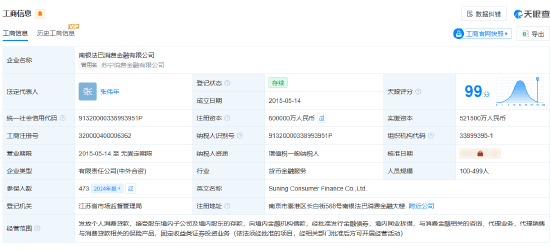
南银法巴消费金融公司增资至60亿元,增幅约15%
Sou Hu Cai Jing· 2025-12-16 02:39
该公司成立于2015年5月,法定代表人为张伟年,经营范围包括发放个人消费贷款、接受股东境内子公 司及境内股东的存款、向境内金融机构借款等,由南京银行股份有限公司、法国巴黎银行(BNP PARIBAS)、国际金融公司、法国巴黎银行个人金融集团(BNP PARIBAS PERSONAL FINANCE)共 同持股。 天眼查App显示,12月12日,南银法巴消费金融有限公司发生工商变更,注册资本由52.15亿人民币增至 60亿人民币,增幅约15%,同时,多位高管发生变更。 ...
26家A股银行分红2600亿元
Shen Zhen Shang Bao· 2025-12-15 22:55
Group 1 - The core viewpoint of the articles highlights that A-share listed banks in China are distributing significant cash dividends, with the six major state-owned banks leading the way, collectively announcing a total cash dividend of 204.657 billion yuan for the mid-term [1][2] - By December 15, 2025, 26 A-share listed banks are expected to disclose mid-term or quarterly dividend plans, with total dividends projected to exceed 260 billion yuan, where the six major state-owned banks account for 78.7% of the total dividends [1][2] - The major state-owned banks, including Industrial and Commercial Bank of China, Agricultural Bank of China, and others, have maintained a dividend payout ratio of 30% or more of their net profit [2] Group 2 - The Industrial and Commercial Bank of China leads the dividend distribution with 50.396 billion yuan, followed by other major banks with significant amounts, indicating a strong trend in dividend payouts among these institutions [2] - In the joint-stock bank category, several banks, including Industrial Bank and China CITIC Bank, are also participating in dividend distributions, with some like Industrial Bank and Ningbo Bank introducing mid-term dividend plans for the first time [2] - The banking sector has shown strong performance in the A-share market, with the overall bank sector rising by 10.71% this year, and specific banks like Agricultural Bank of China seeing a remarkable increase of 48.88% in their stock prices [3]



2026年银行板块投资策略:从业务与业绩角度看稳健性,两条选股主线
ZHONGTAI SECURITIES· 2025-12-15 13:25
Group 1: Credit Momentum Analysis - Credit growth is expected to continue a slight downward trend, supported by new infrastructure, new industrialization, and technology finance [5][10] - New infrastructure loans are anticipated to rebound, with structural adjustments continuing, as new infrastructure takes on momentum [5][10] - Manufacturing loans are expected to maintain resilience, with a market space of 10 trillion yuan over five years for traditional industry upgrades [5][10] - Technology finance loans are likely to sustain high growth, with high-tech enterprise loans currently only accounting for about 10% of total loans, indicating room for improvement [5][10] Group 2: Bank Revenue and Profitability - Interest income is expected to recover, leading to a projected 2.5% year-on-year increase in revenue for listed banks in 2026, with net profit expected to rise by 2.3% [5][10] - The net interest margin is projected to decline by 2.5 basis points in 2026, but the decline is expected to be significantly smaller than in 2025 [5][10] - Non-interest income is expected to see growth, particularly from wealth management fees, as deposit migration continues [5][10] Group 3: Funding Analysis - The estimated total investment from insurance funds, mutual funds, and wealth management into the banking sector is projected to be 224.4 billion yuan, potentially driving a 7.3% increase in the sector [5][10] - Insurance funds are expected to contribute 125 billion yuan to the banking sector, leading to a 4.1% upward potential [5][10] - Mutual funds are projected to bring in an additional 254 billion yuan from active funds and 706 billion yuan from passive funds [5][10] Group 4: Asset Quality - Overall asset quality remains stable, with corporate loans being continuously optimized while retail risks are gradually revealing [5][10] - The non-performing loan ratio for retail loans is 1.27%, showing a slight increase compared to the beginning of the year, but the growth rate remains stable [5][10] - The current high loan-to-value (LTV) ratio for mortgages is estimated to be between 1.9% and 4.1%, indicating manageable risk levels [5][10] Group 5: Investment Recommendations - The report suggests focusing on high-quality regional city commercial banks and high-dividend stocks as dual investment lines [5][10] - The banking sector is expected to maintain strong certainty, with a stable return on equity (ROE) projected at 8% by 2028 [5][10] - Recommended banks include Jiangsu Bank, Nanjing Bank, and Qilu Bank for their high ROE and resilience [5][10]
华联期货股指年报:预计股指中期攀升格局未改
Hua Lian Qi Huo· 2025-12-15 11:05
Report Industry Investment Rating No relevant content provided. Core Viewpoints of the Report - The mid - term upward trend of stock index remains unchanged, but the growth rate may slow down. The core driving force for the mid - term rise of the stock index is the confirmation of the performance bottom and the profit repair. The significant entry of incremental funds and favorable policies also contribute to the market's upward movement. With the introduction of year - end favorable policies and the stimulation of the 14th Five - Year Plan, the stock index may enter a cross - year layout market from December to January, and the spring market is worth looking forward to. It is recommended to focus on the CSI 500, SSE 50, CSI 300, and CSI 1000 indices and buy call options [14]. Summary According to Relevant Catalogs 1. Annual Viewpoint and Strategy - **Market Review**: In 2025, the market first fluctuated and adjusted, then rose significantly and exceeded the previous year's high, showing an overall upward trend. All four major indices rose, with small and medium - cap stock indices leading the gains. In terms of style indices, growth and cyclical indices had the largest increases, with the former rising over 35%. The stable - style index hardly rose, and the financial and consumer - style indices had relatively low increases. In the Shenwan industry, most industries rose, but some declined. TMT and cyclical sectors such as communication, non - ferrous metals, electronics, and comprehensive led the gains, with the first two having annual increases of over or close to 80%. Industries with lower increases included real estate, commercial trade, public utilities, building decoration, and banking. Declining industries were food and beverage, coal, and transportation [9]. - **Economic Situation**: In November 2025, the manufacturing PMI was 49.2%, up 0.2 percentage points from the previous month; the non - manufacturing PMI was 49.5%, down 0.7 percentage points from the previous month. In terms of sub - items, both supply and demand in the manufacturing PMI rebounded slightly in November, with new export orders rebounding by 1.7%, which was related to the easing of Sino - US tariffs. Factory prices and raw material purchase prices rebounded after two months of decline [9]. - **Policy Situation**: The Political Bureau set the tone for the real estate market to stop falling and stabilize and boost the capital market. The State Council issued the new Nine - Article Guidelines to strengthen investor returns. The central bank created two new monetary policy tools. The implementation plan for promoting the entry of medium - and long - term funds into the market was officially released, which is expected to add 800 billion yuan of long - term funds to the A - share market annually [9]. - **Performance Situation**: A - share performance showed signs of stabilization in the first quarter. After the implementation of reciprocal relations with the US in April, which increased by 30%, performance declined in the second quarter and showed fluctuations. Performance continued to stabilize and rebound in the third quarter, and the performance of the four major indices rebounded again in Q3 2025 [9]. 2. Index and Industry Trend Review - The market in 2025 first fluctuated and adjusted, then rose significantly and exceeded the previous year's high, showing an overall upward trend. All four major indices rose, with small and medium - cap stock indices leading the gains. In terms of style indices, growth and cyclical indices had the largest increases, with the former rising over 35%. The stable - style index hardly rose, and the financial and consumer - style indices had relatively low increases. In the Shenwan industry, most industries rose, but some declined. TMT and cyclical sectors such as communication, non - ferrous metals, electronics, and comprehensive led the gains, with the first two having annual increases of over or close to 80%. Industries with lower increases included real estate, commercial trade, public utilities, building decoration, and banking. Declining industries were food and beverage, coal, and transportation [20][26]. 3. Main Contracts and Basis Trends - The four major indices fluctuated and rebounded, exceeding the previous year's high. Except during quarterly contract roll - overs, the basis was at a reasonable level. In terms of arbitrage among main contracts, IC/IF and IC/IH first adjusted and then rebounded, showing an overall upward trend; IH/IF first rose and then fell sharply, with significant fluctuations; IM/IF and IM/IH showed wide - range fluctuations; IM/IC first fluctuated repeatedly and then declined [32][36]. 4. Economic Policy - **Economic Situation** - In November 2025, the manufacturing PMI was 49.2%, up 0.2 percentage points from the previous month; the non - manufacturing PMI was 49.5%, down 0.7 percentage points from the previous month. In terms of sub - items, both supply and demand in the manufacturing PMI rebounded slightly in November, with new export orders rebounding by 1.7%, which was related to the easing of Sino - US tariffs. Factory prices and raw material purchase prices rebounded after two months of decline [42]. - Generally, PPI leads the inventory cycle (by 1 to 12 months, with an average of about half a year). PPI bottomed out and rebounded in June 2023, weakened after two months, and since March 2024, the decline has been continuously narrowing. From July 2024, the decline of PPI expanded again, and since November 2024, it has been narrowing until it expanded for five consecutive months until March 2025. Since August 2025, the decline has been narrowing, and currently it remains weak. In October 2025, industrial enterprise revenues fell to 1.8%, inventory continued to rise to 3.7%, demand declined, and there was passive inventory replenishment [45]. - China's social financing scale in November 2025 was 248.85 billion yuan, an increase of 15.28 billion yuan compared with 233.57 billion yuan in the same period last year. New RMB loans were 40.53 billion yuan, a decrease of 11.7 billion yuan compared with the same period last year, mainly due to a 20.63 - billion - yuan decrease in household loans, a decrease of 47.63 billion yuan compared with the same period last year. Short - term household loans decreased by 3.7 billion yuan, a decrease of 17.88 billion yuan compared with the same period last year, and medium - and long - term household loans increased by 1 billion yuan, a decrease of 29 billion yuan compared with the same period last year. Government bonds were 120.41 billion yuan, a decrease of 10.6 billion yuan compared with the same period last year [48]. - The growth rate of medium - and long - term credit has been falling since reaching a high of 12.94% in May 2023 after starting to stabilize and rebound from 10.21% in November 2022. As of November 2025, it has fallen for 30 consecutive months to 5.89% and continues to decline [7][53]. - **Policy Situation** - **New Nine - Article Guidelines**: In April 2024, the "Several Opinions on Strengthening Supervision, Preventing Risks, and Promoting the High - Quality Development of the Capital Market" (New Nine - Article Guidelines) were issued. It tightened the "entry threshold" and smoothed the "exit channel" by raising the listing standards for each sector and accelerating the clearance of inferior enterprises through stricter delisting indicators. It also strengthened investor returns by strengthening the supervision of cash dividends of listed companies and restricting major shareholders' share - reduction for companies that have not paid dividends for many years or have a low dividend ratio [55][58]. - **Implementation Plan for Promoting the Entry of Medium - and Long - Term Funds into the Market**: It aims to increase the actual investment ratio. For public funds, it is required that the market value of A - shares held by public funds should increase by at least 10% annually in the next three years. For commercial insurance funds, large - state - owned insurance companies are expected to invest 30% of their newly - added premiums in A - shares annually starting from 2025, which means adding at least several hundred billion yuan of long - term funds to the A - share market each year. The second - batch pilot project of long - term stock investment by insurance funds will be implemented in the first half of 2025, with a scale of no less than 10 billion yuan, and the scale will be gradually expanded. It also extends the assessment period. By implementing a long - cycle assessment, it can effectively smooth the impact of short - term market fluctuations on performance and improve the stability of medium - and long - term funds' investment behavior [61]. - **Political Bureau's Policy Orientation**: The Political Bureau meeting pointed out that efforts should be made to boost the capital market, guide medium - and long - term funds to enter the market, and remove obstacles for funds such as social security, insurance, and wealth management to enter the market. It also emphasized increasing the counter - cyclical adjustment of fiscal and monetary policies, ensuring necessary fiscal expenditures, and doing a good job in the "three guarantees" at the grass - roots level. It proposed to issue and use ultra - long - term special treasury bonds and local government special bonds, reduce the deposit reserve ratio, and implement significant interest rate cuts. It also aimed to promote the real estate market to stop falling and stabilize, control the increment of commercial housing construction, optimize the stock, and improve the quality [62]. - **Central Bank's New Monetary Policy Tools**: The central bank created a structural monetary policy tool to support the capital market for the first time. One is the swap facility for securities, funds, and insurance companies, which allows eligible institutions to use their bonds, stock ETFs, and SSE 300 constituent stocks as collateral to exchange for high - liquidity assets such as treasury bonds and central bank bills from the central bank. The initial scale of the swap facility operation is 500 billion yuan. The central bank also created a re - loan for stock repurchase and increase, guiding commercial banks to provide loans to listed companies and major shareholders for stock repurchase and increase. The initial scale is 300 billion yuan [63]. - **Debt Resolution Measures**: In November 2024, the National People's Congress Standing Committee announced a large - scale debt resolution measure. The total debt resolution scale mainly includes three parts: 6 trillion yuan of local debt limits, all arranged as special debt limits, approved at once and implemented over three years; starting from 2024, 800 billion yuan will be allocated from new local special bonds for five consecutive years to replenish government fund financial resources, with a cumulative replacement of 4 trillion yuan of implicit debt; and 2 trillion yuan of implicit debt from shantytown reconstruction due after 2029 will be repaid according to the original contract. The first two parts will directly increase 10 trillion yuan of local debt resolution funds [64]. - **Accelerating the Building of First - Class Investment Banks and Investment Institutions**: At the Eighth Member Congress of the Securities Association of China, it was proposed that securities companies should shift from price competition to value competition. Appropriate "relaxation" measures will be taken for high - quality institutions to optimize risk - control indicators, expand capital space and leverage limits, and improve capital utilization efficiency. Differentiated supervision will be explored for small - and medium - sized securities companies and foreign - funded securities companies in terms of classification evaluation and business access to promote their characteristic development. Strict supervision will be carried out for a small number of problematic securities companies [65]. - **14th Five - Year Plan**: The 14th Five - Year Plan is a crucial period that connects the past and the future, with multiple strategic goals (such as carbon peaking and reform) to be achieved. A multi - polar trade system is gradually taking shape, and China's voice in global economic and trade fields is expected to further increase. Sino - US competition remains the core variable affecting the global political and economic landscape, and it is becoming "normalized" and "complicated". The reconstruction of the global supply chain has entered the second half, with geopolitics and strategic security as the main lines. China will focus on developing new - quality productive forces and upgrading industries, promoting anti - involution and building a unified national market, and expanding domestic demand and boosting consumption [68]. - **US Mid - term Elections**: In 2026, the US mid - term elections will be held. The schedule includes the primary elections in August 2026 and the main election period from September to November, with November 3rd as the final voting date. The fiscal bill requires that the Trump administration is prohibited from laying off federal government employees before January 30th, which is expected to ease the situation of significant employment reduction. It is expected that fiscal support will continue during the mid - term elections [71]. 5. Revenue and Net Profit of Each Index - The core factor affecting the long - term trend of the stock index is the performance of listed companies. Since the coordinated efforts of monetary and fiscal policies in the third quarter of last year, the policy effects have gradually been transmitted to the real economy. The first - quarter report of 2025 showed that the performance of A - share listed companies had initially shown signs of stabilization, and the profit bottom was likely to have been confirmed. Although affected by external factors such as "reciprocal tariffs" in the second quarter, performance fluctuated, the third - quarter report data confirmed that corporate profits had returned to an upward channel. The continuous rebound of performance in Q3 2025 strengthened the market's confidence in the start of the profit cycle, providing strong internal impetus for the mid - term rise of the stock index [77][82]. 6. Valuation - The valuation of the Shanghai Composite Index is 16.2398, with an upper - limit value of 15.64, and it is at the 83.45th percentile since 2010, indicating a relatively high valuation level since 2010. However, as performance rises, the valuation will decline. The valuation of the ChiNext Index is relatively low [100][102]. 7. Interest Rates - Interest rates are in a downward channel. According to the Fed's December interest - rate meeting forecast, from 2025 to 2028, variables such as real GDP growth, unemployment rate, PCE inflation, and core PCE inflation are expected to show certain trends, and the federal funds rate is also expected to decline [88]. 8. Capital Flows - **Overall Capital Inflow**: In 2025, the A - share market is expected to have a capital inflow (including scale growth) of 4.3505 trillion yuan, which is not much different from the increase in non - bank deposits and bank wealth - management scale. Excluding the scale - growth factor, the A - share market is expected to have a net capital inflow of 1.8311 trillion yuan in 2025 (with an expected net inflow of 300 billion yuan from retail investors in the third quarter) [105]. - **Margin Trading and Short Selling**: In 2024, the net inflow of margin trading and short - selling funds was 27.48 billion yuan. As of December 14, 2025, the net inflow in 2025 was 62.96 billion yuan, indicating active leverage funds [12][109]. - **Private Securities Investment Funds**: The scale of private securities investment funds increased by 1.7946 trillion yuan this year, with a significant increase of 1.040028 trillion yuan in October. The current total scale is 7.0076 trillion yuan. The newly - registered scale this year is 38.6 billion yuan, with registration scales of 7.92 billion yuan in July, 4.28 billion yuan in August, 3.68 billion yuan in September, and 4.29 billion yuan in October [12][113]. - **Insurance Funds**: In the third quarter of 2025, the market value of A - shares held by insurance funds increased by 55.24 billion yuan, a month - on - month increase of 18.00%, while the SSE 300 Index rose by 17.90% during the same period. In the first three quarters of 2025, the market value of A - shares held by insurance funds increased by 119.3 billion yuan, and after excluding the scale - growth factor, it increased by 75.84 billion yuan. The proportion of stock and fund investment by insurance funds in the total insurance fund balance continued to rise to 14.93% [115][116]. - **Newly - Established Funds**: As of September 30, 2025, the newly - established share of stock - type funds was 323.3 billion yuan, with 137 billion yuan in the third quarter; the newly - established share of hybrid funds was 103.6 billion yuan, with 53 billion yuan in the third quarter. In 2025, index funds had a net inflow of 104.9 billion yuan, while active equity funds had a net outflow of 444.9 billion yuan, and equity funds had a net outflow of 340 billion yuan [126][130]. - **Other Capital Flows**: In October 2025, the deposits of non - bank financial institutions increased by 1.8574 trillion yuan again, and the total increase in deposits of non - bank financial institutions this year was 6.6688 trillion yuan. Overall, funds are flowing from the banking system to non - bank channels such as the capital market and wealth - management products. In terms of secondary - market shareholder share - reduction, important shareholders in the A - share market had a net share - reduction of 307.3 billion yuan in 2025. The IPO financing in 2023 was 356.5 billion
守护“膝”望:南京银行上海分行金融活水赋能医疗科技企业稳健前行
2 1 Shi Ji Jing Ji Bao Dao· 2025-12-15 06:09
Core Viewpoint - The article emphasizes the rapid development of the medical technology industry in China, particularly in the orthopedic joint replacement sector, driven by innovation and financial support, showcasing the capabilities of companies like KuanYue Medical on a global stage [1][5]. Group 1: Company Overview - KuanYue Medical was founded in 2015 by Wang Junwen, who aimed to create a "Chinese Johnson & Johnson," with a unique strategy of "overseas R&D, Chinese manufacturing, and global sales" [2]. - The company has established an international R&D center led by top scientists, ensuring its technology aligns with global standards [7]. Group 2: Market Potential - The orthopedic joint replacement market is undergoing structural changes, with increasing disposable income and health awareness leading to a shift in patient attitudes from "having to undergo surgery" to "choosing to improve quality of life" [3]. - The penetration rate of joint replacement surgeries in China is approximately 0.01%, which is only one-tenth of that in the U.S., indicating significant growth potential [4]. Group 3: Competitive Advantage - KuanYue Medical has set a high internal testing standard of 30 million cycles for its artificial joints, far exceeding the FDA's requirement of 5 million cycles, demonstrating its commitment to product durability and quality [6][7]. - The company has successfully penetrated 15 global markets and is the first domestic company to achieve actual implantations in the U.S., with international sales accounting for over 60% of its revenue [5]. Group 4: Financial Empowerment - KuanYue Medical's growth has been supported by strategic investments from various financial institutions, including a significant partnership with Nanjing Bank, which has evolved from a small credit line to a comprehensive financial support system [8]. - The collaboration with Nanjing Bank includes innovative financing models such as "loans + equity rights," enhancing the company's financial strategy as it aims for a Hong Kong listing [8][9]. Group 5: Future Outlook - The aging population in China and the substantial gap in joint replacement penetration compared to the U.S. present a promising growth trajectory for KuanYue Medical [9]. - Nanjing Bank is positioned to transition from a mere funding provider to a deep strategic partner, supporting KuanYue Medical throughout its industrial and capital cycles [9].

总数突破2600亿,26家上市银行官宣分红方案,多家银行首次分红
Guan Cha Zhe Wang· 2025-12-15 03:47
Group 1 - A total of 26 A-share listed banks have announced interim or quarterly dividend plans, exceeding the 24 banks that did so in 2024 [1] - The total expected dividend amount from these banks is over 260 billion yuan, with state-owned banks accounting for approximately 70% of this total [1] - Industrial and Commercial Bank of China leads with a proposed dividend of 50.396 billion yuan, followed by China Construction Bank, Agricultural Bank of China, Bank of China, Postal Savings Bank, and Bank of Communications with dividends of 48.605 billion yuan, 41.823 billion yuan, 35.250 billion yuan, 14.771 billion yuan, and 13.811 billion yuan respectively [1] Group 2 - Several banks, including Industrial Bank and Ningbo Bank, are announcing dividend plans for the first time [2] - Industrial Bank plans to distribute a cash dividend of 5.65 yuan per 10 shares, totaling 11.957 billion yuan, which represents 30.02% of its net profit attributable to ordinary shareholders for the first half of 2025 [2]

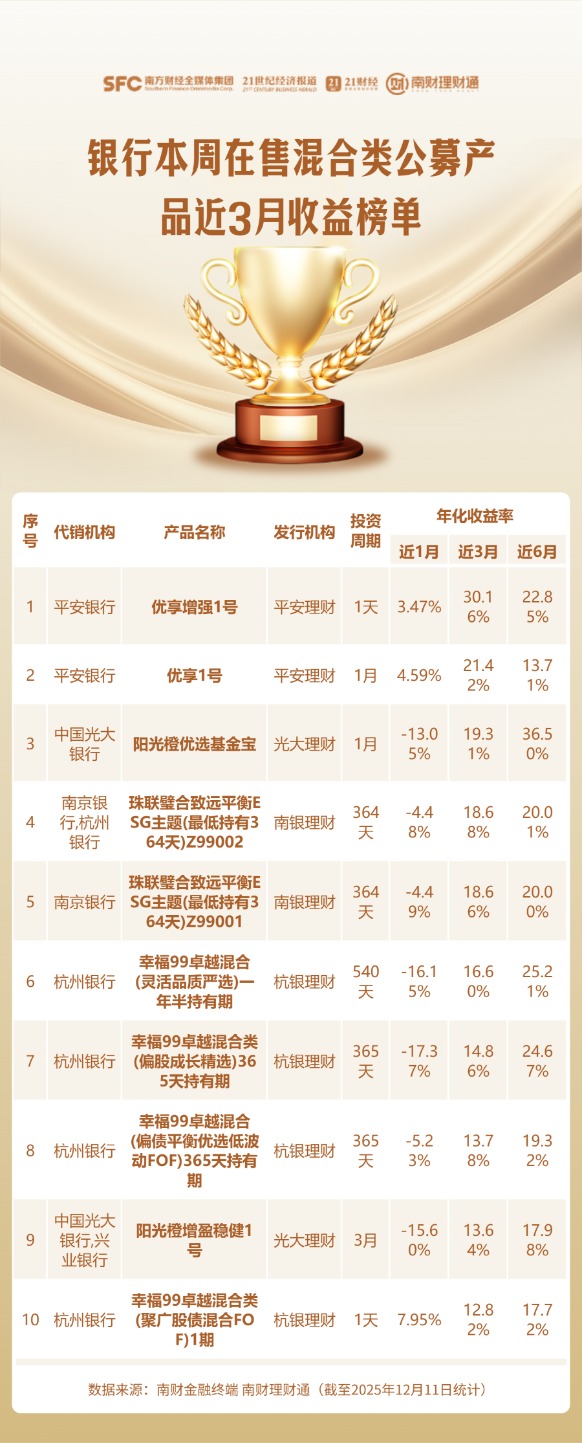
本周在售多只高收益混合类理财近1个月收益率转负
2 1 Shi Ji Jing Ji Bao Dao· 2025-12-15 01:05
Core Insights - The report focuses on mixed-asset products issued by wealth management companies, highlighting superior-performing products available for investors through distribution channels [1] - A ranking of products is provided based on their annualized performance over the last month, three months, and six months, reflecting their multidimensional performance amid recent market fluctuations [1] Group 1: Product Performance - The ranking showcases annualized returns for products over different time frames, with a specific emphasis on the three-month annualized yield for sorting [1] - The report includes a list of 28 distribution institutions, such as major banks like Industrial and Commercial Bank of China, Bank of China, and Agricultural Bank of China, among others [1] Group 2: Product Availability - The assessment of the "on-sale" status of wealth management products is based on their investment cycle projections, but actual availability may vary due to factors like sold-out quotas or differences in product listings for different clients [1] - Investors are advised to refer to the actual displays on the distribution bank's app for the most accurate product availability [1]


江苏发放首单数据“双质押”融资——押上两个“数” 贷来1000万
Xin Hua Ri Bao· 2025-12-14 23:09
Group 1 - The first "data intellectual property + data asset" dual pledge financing in Jiangsu was successfully implemented, with Nanjing Kaos Data Technology Co., Ltd. obtaining a loan of 10 million yuan from Nanjing Bank based on its core data set [1] - The People's Bank of China updated its movable property financing registration system to include "data asset pledge," marking a significant innovation in light asset evaluation and financial exploration of various data rights [1][2] - Nanjing Bank revised its internal policies to accept data assets and data intellectual property as collateral, addressing the challenges of what to pledge and how to evaluate these new asset types [2] Group 2 - The Yuhuatai District has been building a collaborative "public service ecosystem" to promote enterprise data governance, intellectual property registration, and financing through knowledge property pledges [3] - The district has established a knowledge property innovation and protection center to provide free guidance to enterprises, helping them avoid unnecessary costs and ensuring proper registration of data intellectual property [3] - Nanjing Bank launched a customized product called "Shuzhi Loan" to explore productization and standardization through case studies, while Kaos is testing a regional industrial internet platform to serve small and medium-sized enterprises [3]