
制造业贷款

Search documents
建设银行2025年度净利润3397.90亿元,核心指标均衡协调
智通财经网· 2026-03-27 17:34
Core Insights - Construction Bank reported a total operating income of 761.05 billion yuan for 2025, with a growth rate of 1.88%, and a net profit of 339.79 billion yuan, increasing by 1.04% [1] - The total assets of the group reached 45.63 trillion yuan, marking a 12.47% increase, with loans and financial investments accounting for nearly 90% of the total [1] - The bank's non-performing loan ratio remained stable at 1.31%, with a provision coverage ratio of 233.15%, indicating strong risk mitigation capabilities [1] Financial Performance - The net loan and advance amount was 26.93 trillion yuan, reflecting a growth of 7.53%, while financial investments reached 12.90 trillion yuan, up by 20.72% [1] - Total liabilities amounted to 41.95 trillion yuan, increasing by 12.68%, with deposits reaching 30.84 trillion yuan, a growth of 7.39% [1] - Key performance indicators include an average return on assets of 0.79%, a weighted average return on equity of 10.04%, and a capital adequacy ratio of 19.69% [1] Credit Resource Allocation - The bank actively supports economic recovery by enhancing credit resources across various sectors, with personal consumption loans increasing by 29.41% and private sector loans reaching 6.72 trillion yuan, up by 12.17% [2] - The "Good Construction and Smart Manufacturing" service plan has led to a loan balance of 3.52 trillion yuan directed towards the manufacturing sector [2] - Financing support for the digital supply chain totaled 1.32 trillion yuan, with a focus on regional coordinated development [2] Technological and Green Finance Initiatives - The bank has advanced its capabilities in technology finance, with a technology loan balance of 5.25 trillion yuan and the issuance of 719.84 billion yuan in technology innovation bonds [3] - Green loans reached 6.00 trillion yuan, with a diversified service system for green finance maintaining an MSCI ESG rating of AAA [3] - Inclusive finance initiatives have supported 3.69 million small and micro enterprises, with a loan balance of 3.83 trillion yuan [3] Corporate and Personal Financial Services - The bank has established a differentiated customer management model, serving 12.73 million corporate clients and managing over 23 trillion yuan in personal financial assets [4] - Non-cash payment transactions in corporate services grew by 13.97% year-on-year [4] - The asset management business scale reached 6.94 trillion yuan, with significant growth in direct financing services and wealth management [4] Integration and International Business - The bank has enhanced its integrated operations, with a 85.85% increase in non-financial corporate bond underwriting and a 24.01% rise in merger loan balances [4] - International business credit balance reached 1.45 trillion yuan, with cross-border RMB settlement volume at 6.50 trillion yuan [4] - The overseas institutions achieved a net profit of 12.04 billion yuan, while integrated subsidiaries reported a net profit of 9.45 billion yuan [4]

工商银行2025年新增信贷投放、债券投资4.8万亿元 创历史新高
Xin Hua Wang· 2026-03-27 15:37
Core Viewpoint - In 2025, Industrial and Commercial Bank of China (ICBC) significantly increased its support for the real economy, achieving a record high in new credit and bond investments totaling 4.8 trillion yuan [1] Group 1: Financial Performance - By the end of 2025, ICBC's total assets reached 53.48 trillion yuan, reflecting a year-on-year growth of 9.5% [1] - The bank's operating income for 2025 was 801.395 billion yuan, an increase of 1.9% compared to the previous year [1] - Net profit for 2025 was 370.766 billion yuan, showing a growth of 1.0% year-on-year [1] Group 2: Loan and Investment Highlights - As of the end of 2025, the balance of technology loans was approximately 6 trillion yuan, while loans directed towards the manufacturing sector amounted to 5.24 trillion yuan [1] - Green loan balance exceeded 6.7 trillion yuan, with a total of 125 billion yuan in green financial bonds issued in the domestic interbank market [1] - Agricultural loans surpassed 5 trillion yuan, and inclusive loans reached 3.6 trillion yuan, with a growth rate of nearly 23% [1] - Loans for core digital economy industries exceeded 1 trillion yuan [1] Group 3: Asset Quality and Capital Adequacy - By the end of 2025, ICBC's non-performing loan ratio was 1.31%, a decrease of 0.03 percentage points year-on-year [1] - The capital adequacy ratio stood at 18.76%, and the provision coverage ratio was over 210%, indicating a stable and reasonable level [1]

持续做好“五篇大文章”
Xin Lang Cai Jing· 2026-02-08 00:57
Core Insights - The financial development in Anhui has shown significant progress, with key indicators advancing notably [1] Group 1: Loan and Deposit Growth - The loan scale in Anhui has reached a new level, with the RMB deposit and loan balances both exceeding 9 trillion yuan last year [1] - Loans to technology enterprises have increased significantly, crossing seven hundred billion yuan milestones over the past five years, reaching 837.5 billion yuan, a growth of 4.5 times [1] - Manufacturing loans have maintained double-digit growth for five consecutive years [1] Group 2: Capital Market Developments - Anhui has made breakthroughs in its listing efforts, adding five new listed companies last year, ranking sixth nationally [1] - The total number of listed companies in Anhui has reached 186, ranking seventh nationally and first in Central China [1] - There has been a historic breakthrough in overseas listings, with 18 new applications for listing on the Hong Kong Stock Exchange, surpassing the total from the previous five years [1] Group 3: Financial Support for Enterprises and Citizens - Financial support for enterprises and the public has achieved new results, with growth rates for inclusive loans, small and micro loans, and consumer loans all exceeding the overall loan growth rate [1] - The average interest rate for corporate loans has decreased by 0.5 percentage points compared to the beginning of the year, making loans cheaper for businesses [1] - The average interest rate for personal housing loans has also dropped by 0.4 percentage points since the beginning of the year, improving the financing environment [1] - Anhui's financial business environment ranked fifth nationally in the latest evaluation of the national business environment [1]
兴业银行11万亿新起点
Xin Lang Cai Jing· 2026-01-22 11:24
Core Viewpoint - Industrial Bank's 2025 performance report highlights significant growth in total assets, revenue, and net profit, indicating a shift towards high-quality development and structural optimization [2][27][49]. Group 1: Financial Performance - Total assets reached 11.09 trillion yuan, a year-on-year increase of 5.57% [4][28]. - Operating income was 212.74 billion yuan, showing a slight increase of 0.24% compared to the previous year [3][28]. - Net profit attributable to shareholders was 77.47 billion yuan, reflecting a growth of 0.34% [3][28]. Group 2: Structural Highlights - In Q4 alone, total assets surged by 420.4 billion yuan, accounting for over 72% of the annual increase [4][29]. - Deposits grew by 7.18%, significantly outpacing the loan growth rate of 3.70%, indicating effective low-cost liability expansion [7][32]. - Loans in technology, green finance, and manufacturing sectors exceeded 50% of total loans, demonstrating a successful structural adjustment towards new productive forces [19][44]. Group 3: Risk Management and Asset Quality - The non-performing loan ratio stood at 1.08%, showing a slight increase but significant improvement from 1.25% in 2020 [10][35]. - The provision coverage ratio was 228.41%, maintaining a strong buffer despite a decrease from the previous year [12][37]. - The bank's risk management strategy includes agile teams focusing on key sectors, enhancing overall risk management effectiveness [13][38]. Group 4: Strategic Business and Profitability - The average return on equity (ROE) decreased to 9.15%, down 0.74 percentage points from the previous year, indicating pressure on capital returns [21][46]. - The bank's transformation towards lower capital consumption and stronger value creation is essential for future growth [23][48]. - Overall, the performance can be summarized as "total breakthrough, structural highlights, and profitability pressure," emphasizing the bank's stability and strategic execution capabilities [24][49].


兴业银行(601166):营收利润双增 业绩筑底回升
Xin Lang Cai Jing· 2026-01-22 06:33
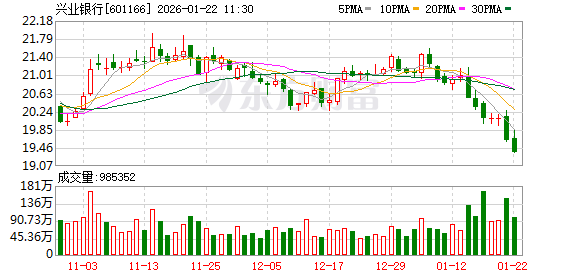
Core Viewpoint - Industrial Bank disclosed its preliminary performance report for 2025, showing positive growth in both revenue and profit. The operating income increased by 0.24% year-on-year, with a growth rate rebound of 2.1 percentage points compared to the first three quarters of 2025. The net profit attributable to shareholders grew by 0.3% year-on-year, with a growth rate rebound of 0.2 percentage points compared to the first three quarters of 2025. In Q4 2025, operating income increased by 7.3% year-on-year, with a significant growth rate rebound of 8.1 percentage points compared to Q3 2025, and net profit attributable to shareholders increased by 1.3% year-on-year, with a growth rate rebound of 1.4 percentage points compared to Q3 2025 [1]. Group 1: Financial Performance - In 2025, total assets and total loans increased by 5.6% and 3.7% year-on-year, respectively, with growth rates changing by +2.0 percentage points and -0.6 percentage points compared to the first three quarters of 2025. Total assets exceeded 11 trillion yuan [2]. - In Q4, the increase in assets primarily came from non-credit assets, with total loan scale decreasing by 41 billion yuan in a single quarter, a year-on-year decline of 36 billion yuan. Non-credit asset scale increased by 461.5 billion yuan, a year-on-year increase of 256 billion yuan [2]. - The credit structure is continuously optimized, with technology finance loans exceeding 1.12 trillion yuan (over 18.8% of total loans), green finance loans reaching 1.1 trillion yuan (approximately 18.5% of total loans), and manufacturing loans nearing 1 trillion yuan (approximately 16.8% of total loans), all leading among joint-stock banks [2]. Group 2: Asset Quality and Risk Management - The total liabilities at the end of 2025 increased by 5.9% year-on-year, with a growth rate improvement of 2.2 percentage points compared to the first three quarters of 2025. Total deposits increased by 7.2% year-on-year, with a growth rate decline of 0.4 percentage points compared to the first three quarters of 2025 [2]. - The increase in liabilities in Q4 mainly came from active liabilities, with total deposit scale growing by 94.8 billion yuan in a single quarter, a year-on-year decrease of 12.5 billion yuan. Active liabilities increased by 314 billion yuan, a year-on-year increase of 234.9 billion yuan [2]. - The asset quality remains strong, with a non-performing loan ratio of 1.08%, unchanged from the previous quarter. The provision coverage ratio is 228.41%, an increase of 0.60 percentage points from the end of Q3 2025. The provision-to-loan ratio is 2.47%, up 1 basis point from the end of Q3 2025. Risks in the three major areas of real estate, local government platforms, and credit cards are showing signs of convergence [2]. Group 3: Shareholder Returns - On January 20, the company held a temporary shareholders' meeting and approved an interim dividend, proposing to distribute a cash dividend of 5.65 yuan (pre-tax) for every 10 shares to all ordinary shareholders, with an expected total cash dividend of 11.957 billion yuan. Based on the net profit attributable to ordinary shareholders of 39.827 billion yuan disclosed in the 2025 semi-annual report, the interim dividend ratio is estimated to be 30.02% [3]. - Profit forecasts for 2026 and 2027 project net profit growth rates of 3.12% and 4.83%, respectively, with earnings per share (EPS) of 3.58 and 3.77 yuan per share. The current stock price corresponds to price-to-earnings (PE) ratios of 5.47X and 5.21X for 2025 and 2026, respectively, and price-to-book (PB) ratios of 0.49X and 0.46X for 2026 and 2027, respectively. Considering historical PB valuation and fundamental conditions, the company is given a reasonable value of 22.99 yuan per share at 0.60 times PB [3].
兴业银行总资产破11万亿元
Zhong Guo Jing Ying Bao· 2026-01-22 04:55
Core Viewpoint - The financial performance of Industrial Bank for the year 2025 shows moderate growth in total assets, revenue, and profits, indicating stability in its operations and a focus on key lending sectors [2] Financial Performance - As of the end of 2025, the total assets of Industrial Bank reached 11.09 trillion yuan, an increase of 5.57% compared to the end of 2024 [2] - The bank achieved an operating income of 212.741 billion yuan, reflecting a year-on-year growth of 0.24% [2] - The total profit amounted to 89.973 billion yuan, which is a 3.27% increase year-on-year [2] - The net profit attributable to shareholders was 77.469 billion yuan, showing a growth of 0.34% compared to the previous year [2] Loan and Deposit Growth - The balance of various loans increased by 3.70% to 5.95 trillion yuan compared to the end of 2024 [2] - Technology finance loans exceeded 1.12 trillion yuan, while green finance loans reached 1.1 trillion yuan, and loans to the manufacturing sector approached 1 trillion yuan [2] - The balance of deposits grew by 7.18% to 5.93 trillion yuan compared to the end of 2024 [2] Dividend Announcement - On January 20, the shareholders' meeting approved a mid-term dividend proposal, with a cash dividend of 5.65 yuan per 10 shares (pre-tax) to be distributed to all ordinary shareholders, amounting to an expected total cash dividend of 11.957 billion yuan [2]
兴业银行发布2025年业绩快报:总资产破11万亿 营收净利润“双增”
Zhong Jin Zai Xian· 2026-01-21 13:02
Group 1 - The core viewpoint of the news is that Industrial Bank has achieved stable growth in its financial performance for 2025, with total assets exceeding 11 trillion yuan and a focus on high-quality development aligned with China's financial strategy [1][2] - As of the end of 2025, total assets reached 11.09 trillion yuan, a year-on-year increase of 5.57% [1] - The bank reported operating income of 212.74 billion yuan, a slight increase of 0.24% year-on-year, and a net profit attributable to shareholders of 77.47 billion yuan, up 0.34% [1] Group 2 - The bank's loan balance increased by 3.70% year-on-year to 5.95 trillion yuan, with significant growth in technology finance loans exceeding 1.12 trillion yuan and green finance loans reaching 1.1 trillion yuan [1] - The deposit balance grew by 7.18% year-on-year to 5.93 trillion yuan, indicating a successful expansion of low-cost liabilities [1] - The non-performing loan ratio remained stable at 1.08%, with a high provision coverage ratio of 228.41%, reflecting strong asset quality and risk management [2] Group 3 - The bank's shareholders approved a cash dividend of 5.65 yuan per 10 shares, amounting to a total distribution of approximately 11.96 billion yuan to investors [2]
2025年聚焦外贸领域 进出口银行新发放贷款超1.2万亿元
Ren Min Ri Bao Hai Wai Ban· 2026-01-09 03:29
Core Viewpoint - The Export-Import Bank of China plans to support foreign trade by issuing over 1.2 trillion yuan in loans by 2025, focusing on enhancing quality and stabilizing volume in foreign trade [1] Group 1: Financial Support and Loan Distribution - The Export-Import Bank will allocate over 60% of its total loan issuance to foreign trade, emphasizing its role in policy-based finance [1] - New loans for the manufacturing sector are projected to reach nearly 860 billion yuan, with over 540 billion yuan designated for medium to long-term loans, accounting for more than 60% of the manufacturing loans [1] Group 2: Industry Focus and Strategic Areas - The bank will prioritize credit resources towards advanced manufacturing industries, including shipbuilding, marine engineering, and rail transportation equipment [1] - Support will also extend to emerging industries such as synthetic biology and new materials, as well as future industries like quantum computing and humanoid robotics [1] Group 3: Key Projects and Financial Tools - The bank aims to utilize new policy-based financial tools to support projects in key areas such as the digital economy and artificial intelligence [1] - There will be a focus on addressing financial needs in fundamental research, technological breakthroughs, and the transformation of achievements, particularly for key products like ships and new energy vehicles [1]
廿载风华映江淮 金融初心铸辉煌 ——徽商银行成立20周年发展掠影
Di Yi Cai Jing· 2025-12-28 01:31
Core Viewpoint - Huishang Bank celebrates its 20th anniversary, highlighting its commitment to serving the local economy and society while achieving significant growth and development in the banking sector [1][4]. Group 1: Historical Development - Established in December 2005, Huishang Bank was formed through the integration of local commercial banks and credit cooperatives, becoming the first bank of its kind in China [4]. - The bank went public on the Hong Kong Stock Exchange in November 2013, marking a significant milestone as the first city commercial bank in Central China to list [5]. - In 2020, Huishang Bank successfully acquired four branches of the former Baoshang Bank, demonstrating its commitment to national financial stability [5]. Group 2: Economic Contributions - Huishang Bank has provided over 30 trillion yuan in financial support to Anhui Province during the 14th Five-Year Plan period, with total assets reaching 2.3 trillion yuan and loans exceeding 1 trillion yuan [8]. - The bank has significantly contributed to the local economy, with loans to the manufacturing sector exceeding 160 billion yuan and support for the new energy vehicle industry amounting to 153.1 billion yuan [6]. - It has also focused on green finance, with a green credit balance of nearly 160 billion yuan, becoming one of the first banks to sign a declaration supporting biodiversity [6]. Group 3: Financial Performance - Over the past 20 years, Huishang Bank's assets have grown over 45 times, with deposits and loans increasing by 28 times and 35 times, respectively [8]. - The bank's non-performing loan ratio has improved to below 1%, significantly better than the industry average, while its core Tier 1 capital adequacy ratio stands at 9.62% [9]. - Huishang Bank ranks 101st in the Global 1000 Banks list, a significant rise of 672 places since 2008, and is recognized as the 23rd largest bank in China [9]. Group 4: Innovation and Digital Transformation - The bank is actively pursuing digital transformation, with technology investments exceeding 4% of revenue and a total of 3.65 billion yuan invested over the past three years [12]. - Huishang Bank has developed a comprehensive service network with 474 branches and 505 self-service areas, enhancing its regional presence [11]. - It has introduced innovative financial products, including the first science and technology bonds in the country, showcasing its commitment to innovation [13]. Group 5: Governance and Corporate Culture - The bank emphasizes high-quality governance and has established a robust supervisory system to ensure compliance and accountability [14]. - Huishang Bank integrates party leadership into its governance framework, enhancing its operational effectiveness and cultural cohesion [15]. - The workforce is highly educated, with over 94% of employees holding a bachelor's degree or higher, fostering a culture of excellence and innovation [15]. Group 6: Future Outlook - Huishang Bank aims to align with Anhui's development goals, focusing on key areas such as technological innovation and green industries [16]. - The bank is committed to providing comprehensive financial solutions that meet customer needs while maintaining a strong focus on risk management and compliance [17]. - As it enters its next phase, Huishang Bank seeks to solidify its position as a leading financial institution in China, contributing to the modernization of Anhui Province [17].

2026年银行板块投资策略:从业务与业绩角度看稳健性,两条选股主线
ZHONGTAI SECURITIES· 2025-12-15 13:25
Group 1: Credit Momentum Analysis - Credit growth is expected to continue a slight downward trend, supported by new infrastructure, new industrialization, and technology finance [5][10] - New infrastructure loans are anticipated to rebound, with structural adjustments continuing, as new infrastructure takes on momentum [5][10] - Manufacturing loans are expected to maintain resilience, with a market space of 10 trillion yuan over five years for traditional industry upgrades [5][10] - Technology finance loans are likely to sustain high growth, with high-tech enterprise loans currently only accounting for about 10% of total loans, indicating room for improvement [5][10] Group 2: Bank Revenue and Profitability - Interest income is expected to recover, leading to a projected 2.5% year-on-year increase in revenue for listed banks in 2026, with net profit expected to rise by 2.3% [5][10] - The net interest margin is projected to decline by 2.5 basis points in 2026, but the decline is expected to be significantly smaller than in 2025 [5][10] - Non-interest income is expected to see growth, particularly from wealth management fees, as deposit migration continues [5][10] Group 3: Funding Analysis - The estimated total investment from insurance funds, mutual funds, and wealth management into the banking sector is projected to be 224.4 billion yuan, potentially driving a 7.3% increase in the sector [5][10] - Insurance funds are expected to contribute 125 billion yuan to the banking sector, leading to a 4.1% upward potential [5][10] - Mutual funds are projected to bring in an additional 254 billion yuan from active funds and 706 billion yuan from passive funds [5][10] Group 4: Asset Quality - Overall asset quality remains stable, with corporate loans being continuously optimized while retail risks are gradually revealing [5][10] - The non-performing loan ratio for retail loans is 1.27%, showing a slight increase compared to the beginning of the year, but the growth rate remains stable [5][10] - The current high loan-to-value (LTV) ratio for mortgages is estimated to be between 1.9% and 4.1%, indicating manageable risk levels [5][10] Group 5: Investment Recommendations - The report suggests focusing on high-quality regional city commercial banks and high-dividend stocks as dual investment lines [5][10] - The banking sector is expected to maintain strong certainty, with a stable return on equity (ROE) projected at 8% by 2028 [5][10] - Recommended banks include Jiangsu Bank, Nanjing Bank, and Qilu Bank for their high ROE and resilience [5][10]