
芒果超媒

Search documents
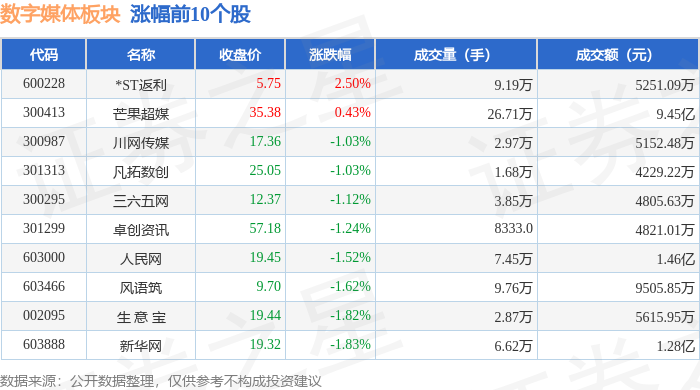
数字媒体板块9月26日跌1.45%,值得买领跌,主力资金净流出7440.12万元
Zheng Xing Xing Ye Ri Bao· 2025-09-26 08:48
Market Overview - On September 26, the digital media sector declined by 1.45%, with "Zhidingmai" leading the drop [1] - The Shanghai Composite Index closed at 3828.11, down 0.65%, while the Shenzhen Component Index closed at 13209.0, down 1.76% [1] Stock Performance - Notable stock performances included: - *ST Fanli: Closed at 5.75, up 2.50% with a trading volume of 91,900 shares and a turnover of 52.51 million yuan [1] - Mango Super Media: Closed at 35.38, up 0.43% with a trading volume of 267,100 shares and a turnover of 945 million yuan [1] - Worth Buying: Closed at 37.20, down 8.49% with a trading volume of 151,000 shares and a turnover of 576 million yuan [2] Capital Flow - The digital media sector experienced a net outflow of 74.40 million yuan from institutional investors, while retail investors saw a net inflow of 56.52 million yuan [2] - The capital flow for individual stocks showed: - Mango Super Media: Net inflow of 62.25 million yuan from institutional investors [3] - Worth Buying: Net outflow of 16.11 million yuan from institutional investors [3] Summary of Individual Stocks - The following stocks had significant capital movements: - *ST Fanli: Institutional net inflow of 609,600 yuan, retail net inflow of 636,900 yuan [3] - New China Net: Institutional net outflow of 12.69 million yuan, retail net inflow of 10.27 million yuan [3] - Grassroots Information: Retail net inflow of 666,020 yuan despite institutional and speculative net outflows [3]


我国已建成广播电视和网络视听大国
Ren Min Ri Bao· 2025-09-26 08:24
Core Viewpoint - The news highlights the significant achievements in the broadcasting and online audio-visual industry during the "14th Five-Year Plan" period, emphasizing China's emergence as a major player in this sector in terms of users, content, and industry scale [1] Group 1: Governance and User Experience - The State Administration of Radio and Television (SARFT) initiated a "dual governance" approach in August 2023 to enhance user experience and service levels [2] - Key initiatives include the deployment of millions of micro set-top boxes and integrated TVs, the promotion of a unified remote control for TV viewing, and the expansion of services to various institutions such as hotels and hospitals [2] - The governance efforts have led to 93% of smart TV models allowing users to disable startup ads, with a permanent opt-out option available [2] Group 2: Content Creation and Quality - The broadcasting and online audio-visual sectors have seen a flourishing of content creation, with a focus on high-quality productions that convey mainstream values and resonate emotionally with audiences [3] - Notable works include commemorative productions for the 80th anniversary of the victory in the War of Resistance, such as the series "Our Rivers and Mountains" and documentaries like "Victory" [3] - The domestic animation sector has also made significant strides, with popular series like "Panda+" and "Chinese Folktales" achieving substantial production growth [3] Group 3: Regulatory Framework and Industry Environment - SARFT is committed to creating a favorable environment for content creation by combining top-down and bottom-up approaches, enhancing policy precision, and regulating industry order [4] - Ongoing revisions to regulations, including the "Television Drama Management Measures," aim to provide a solid legal foundation for industry governance [4] Group 4: Ultra-High Definition Development - The development of ultra-high definition (UHD) broadcasting has been prioritized, with new policies supporting its expansion [5] - By 2024, new UHD channels are being launched across various platforms, with a significant increase in UHD content expected [5] - The total number of UHD set-top boxes for cable and IPTV has surpassed 280 million units, with standards for mobile UHD displays and video distribution being developed [6] Group 5: International Outreach and Cultural Exchange - The broadcasting and online audio-visual sectors are playing a crucial role in promoting cultural dialogue and international friendship, with a 40% increase in the export scale of audio-visual programs during the "14th Five-Year Plan" [7] - Chinese audio-visual content has reached over 200 countries, generating an estimated annual overseas revenue exceeding $63 billion [7] - Collaborative initiatives with various countries and regions are being strengthened, enhancing the global presence of Chinese media [8]
官宣国内首个AI剧场,爱奇艺要做技术务实派
Bei Jing Shang Bao· 2025-09-26 07:01
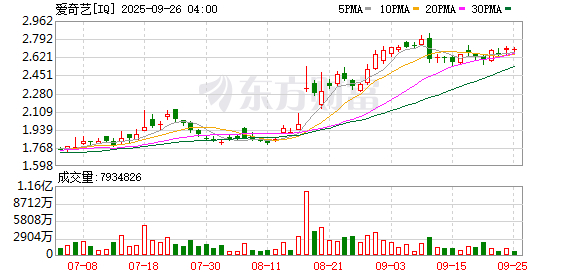
Core Insights - The core message conveyed by iQIYI's founder, Gong Yu, emphasizes a rational yet optimistic approach to the integration of AI in the film and television industry, highlighting the potential for AI to enhance rather than replace existing processes [2][3] Group 1: AI Integration in the Industry - AI is expected to disrupt both long and short video formats, but this disruption will focus on enhancing the industry rather than complete replacement [2] - iQIYI's strategy involves avoiding broad R&D traps and instead tailoring AI to meet specific business needs, such as improving advertising effectiveness by 30% and significantly reducing design workload [3] - The "Baudry-iQIYI AI Theater" initiative aims to gather global creators' AI film story ideas, with selected teams receiving support and guidance, leading to potential releases as early as Q1 2026 [3] Group 2: Human-AI Collaboration - The approach to AI development at iQIYI prioritizes human collaboration, with AI designed to alleviate repetitive tasks, allowing creators to focus on unique ideas [4] - AI is positioned as an "experience optimizer" in user interactions, enhancing viewing experiences without compromising emotional value [4] - Gong Yu acknowledges the rapid evolution of AI technology, comparing its current state to that of a graduate student, while emphasizing that no AI model can fully replace human creativity [3][4] Group 3: Market Position and Competitive Landscape - As of July 2025, iQIYI has 358 million monthly active users, closely trailing Tencent Video's 365 million, indicating a competitive landscape among leading platforms [5] - The industry is witnessing a shift towards practical AI applications, with a focus on solutions that can be effectively implemented rather than theoretical models [5]

权威发布·高质量完成“十四五”规划丨我国已建成广播电视和网络视听大国
Ren Min Ri Bao· 2025-09-26 02:57
Core Insights - The "14th Five-Year Plan" period has seen significant achievements in the development of broadcasting, television, and online audio-visual sectors in China, establishing the country as a major player in these industries [1] Group 1: Governance and User Experience - The State Administration of Radio and Television (SARFT) initiated a "dual governance" approach in August 2023 to enhance user experience and service levels [2] - Key initiatives include the deployment of millions of micro set-top boxes and integrated TVs, the promotion of a unified remote control for television, and the expansion of governance to various institutions such as hotels and hospitals [2] - The SARFT has addressed user concerns regarding automatic renewal of subscriptions by shifting to a model of voluntary renewal, and has implemented features to disable startup advertisements on smart TVs [2] Group 2: Content Creation and Quality - The broadcasting and online audio-visual sectors have experienced a flourishing of content creation during the "14th Five-Year Plan," with a focus on producing high-quality works that convey mainstream values and resonate emotionally with audiences [3] - Notable productions include commemorative works for the 80th anniversary of the victory in the War of Resistance Against Japan, as well as a variety of documentaries and animated series that reflect cultural heritage and contemporary themes [3] - The SARFT is committed to creating a conducive environment for high-quality content production, aligning with the directives from the 20th National Congress of the Communist Party of China [3][4] Group 3: Ultra-High Definition Development - The development of ultra-high definition (UHD) broadcasting has been prioritized, with new policies supporting its expansion [5] - By 2024, new UHD channels are being launched across various platforms, including 4K channels from multiple provincial broadcasters [5][6] - The total number of UHD set-top boxes has exceeded 280 million, and standards for mobile UHD displays are being established to enhance viewing experiences [6] Group 4: International Engagement and Cultural Exchange - The broadcasting and online audio-visual sectors are playing a crucial role in promoting cultural dialogue and international friendship, with significant growth in the export of audio-visual content [7] - The scale of exported broadcasting services has increased by over 40%, with Chinese content reaching over 200 countries and generating substantial overseas revenue [7] - Collaborative initiatives with various countries and regions are being strengthened, including media cooperation forums and cultural exchange programs [8]
中原证券晨会聚焦-20250926
Zhongyuan Securities· 2025-09-26 01:14
Core Insights - The report highlights a positive outlook for the semiconductor industry, with domestic companies showing strong performance in AI computing power and significant growth in revenue and profit [36][38]. - The automotive sector is experiencing a rebound, with notable increases in production and sales, particularly in the electric vehicle segment, supported by favorable policies [22][23]. - The report emphasizes the importance of the technology bond market in supporting innovation, particularly for private enterprises, which currently have low participation rates [10][12]. Domestic Market Performance - The A-share market showed slight fluctuations, with the Shanghai Composite Index closing at 3,853.30, down 0.01%, while the Shenzhen Component Index rose by 0.67% to 13,445.90 [3][4]. - The average P/E ratios for the Shanghai Composite and ChiNext are 15.72 and 50.19, respectively, indicating a suitable environment for medium to long-term investments [9][14]. Industry Analysis - The semiconductor industry reported a 23.84% increase in August, outperforming the Shanghai Composite Index, with integrated circuits rising by 31.47% [36]. - The automotive industry saw a production and sales increase of 8.66% and 10.15% respectively in August, with electric vehicle sales maintaining strong growth [22][23]. - The technology bond market has evolved since its inception in 2015, with state-owned enterprises dominating issuance, while private enterprises account for only 10% [11][12]. Investment Recommendations - The report suggests focusing on sectors with stable fundamentals and high dividend yields, such as engineering machinery and mining equipment [19][20]. - It recommends monitoring investment opportunities in the semiconductor and automotive sectors, particularly in AI computing and electric vehicles [14][36]. - The report advises investors to remain cautious and avoid blind chasing of high prices, while looking for structural optimization opportunities [9][14].

帮主郑重:A股结构性分化藏良机!三招布局节前黄金坑
Sou Hu Cai Jing· 2025-09-26 00:54
Market Overview - A-share market shows divergence with the ChiNext index rising 1.58% to a new high for the year, while the Shanghai Composite Index remains stagnant, with over 3,800 stocks declining [1] External Market - U.S. stock markets have experienced three consecutive days of decline, particularly in technology stocks, with Oracle dropping 5.6%. However, Chinese concept stocks have shown resilience, with the Nasdaq Golden Dragon China Index slightly up by 0.42%, and companies like NIO and Xpeng Motors rising over 4%. The fluctuations in external markets are expected to have limited impact on A-shares, potentially accelerating foreign capital allocation into undervalued Chinese assets [3] Policy Environment - The China Securities Regulatory Commission (CSRC) chairman stated that foreign ownership of A-shares has reached 3.4 trillion yuan during the 14th Five-Year Plan period, with 13 new foreign-controlled institutions entering the market. The establishment of a digital RMB international operation center in Shanghai and the launch of cross-border payment and blockchain platforms are expected to attract foreign investment and pave the way for sectors like technology and green finance [4] Capital Flow - Despite a net outflow of 23.6 billion yuan in main capital, the computer industry attracted 1.195 billion yuan, followed by power equipment and media. Foreign capital remains cautious, with a net outflow of 1.2 billion yuan from northbound funds. This indicates that domestic investors are focusing on AI applications (gaming, video) and new energy (energy storage, wind power), while foreign investors are opting to stay on the sidelines ahead of the holiday [5] Technical Analysis - The ChiNext index has reached a new high, with a daily MACD golden cross, but there is a risk of a rapid death cross triggering a daily top divergence. The Shanghai Composite Index is experiencing low-volume fluctuations around the 3,850-point mark, with support at 3,841 points and resistance at the previous high of 3,867 points. It is anticipated that trading volume will not increase significantly before the holiday, and any breakthroughs will depend on capital returning after the holiday [6] Market Sentiment - Market sentiment is cautious, with only 52 stocks hitting the daily limit up and 9 stocks hitting the limit down. Investors are advised to be wary of three types of "trap stocks": 1. High-position consecutive limit-up stocks (e.g., Hangdian shares facing consecutive limit downs) 2. Stocks with a high proportion of financing (vulnerable to the withdrawal of leveraged funds before the holiday) 3. Technology stocks with questionable performance (e.g., Changchuan Technology, despite a projected 131% increase, has negative operating cash flow) [8] Investment Strategy - The company suggests a three-step approach for the holiday period: - Maintain a position below 60% to keep cash available for post-holiday volatility - Focus on main lines: AI applications (gaming, video content) benefiting from generative AI, with companies like Kunlun Wanwei and Mango Media as potential beneficiaries - Post-holiday opportunities may arise in digital RMB cross-border payments and supply-side reforms in copper smelting, with companies like Jiangxi Copper and Northern Copper expected to be new hotspots [9]


我国已建成广播电视和网络视听大国(权威发布·高质量完成“十四五”规划)
Ren Min Ri Bao· 2025-09-25 23:48
Core Viewpoint - The news highlights the significant achievements in the broadcasting and network audio-visual industry during the "14th Five-Year Plan" period, establishing China as a major player in both broadcasting and network audio-visual sectors [1] Group 1: Governance and User Experience - The State Administration of Radio and Television (SARFT) initiated a "dual governance" approach in August 2023 to enhance user experience and service levels [2] - Key initiatives include the deployment of millions of micro set-top boxes and integrated TVs, the promotion of a unified remote control for TV viewing, and the expansion of services to various institutions such as hotels and hospitals [2] - The governance efforts have led to 93% of smart TV models enabling a "one-click close" feature for startup ads, with options for permanent ad closure [2] Group 2: Content Creation and Quality - The broadcasting and network audio-visual sectors have seen a flourishing of content creation, with a focus on high-quality productions that convey mainstream values and resonate emotionally with audiences [3] - Notable productions include commemorative works for the 80th anniversary of the victory in the War of Resistance, such as the series "Our Rivers and Mountains" and documentaries like "Victory" [3] - The domestic animation sector has also made significant strides, with popular series like "Panda+" and "Chinese Folktales" achieving substantial production increases [3] Group 3: Regulatory Framework and Industry Environment - SARFT is committed to creating a favorable environment for content creation by combining top-down and bottom-up approaches, enhancing policy support, and regulating industry order [4] - Ongoing revisions to regulations, including the "Television Drama Management Measures," aim to provide a solid legal foundation for industry governance [4] Group 4: Ultra-High Definition Development - The development of ultra-high definition (UHD) broadcasting has been prioritized, with new policies supporting its expansion [5] - By 2024, new productions in various formats are expected to achieve UHD standards, with multiple 4K channels already launched across different regions [5][6] - The total number of UHD set-top boxes has surpassed 280 million, and standards for mobile UHD displays are being established to enhance user experience [6] Group 5: International Outreach and Cultural Exchange - The broadcasting and network audio-visual sectors are playing a crucial role in promoting cultural dialogue and international friendship, with significant growth in the export of audio-visual services [7] - The scale of audio-visual service exports has increased by over 40%, with Chinese content reaching over 200 countries and regions, generating annual overseas revenue exceeding $63 billion [7] - Collaborative initiatives with various countries and regions are being strengthened, including the "China-Africa Broadcasting and Television Innovation Cooperation Plan" [8]
内容创作持续繁荣 我国已建成广播电视和网络视听大国
Ren Min Ri Bao· 2025-09-25 23:33
Core Viewpoint - The news highlights the significant achievements in the broadcasting and network audio-visual industry during the "14th Five-Year Plan" period, emphasizing China's emergence as a major player in this sector, both in terms of user base and content production [1] Group 1: Governance and User Experience - The "dual governance" initiative launched by the National Radio and Television Administration (NRTA) aims to enhance user experience and service quality, with a focus on achieving millions of micro set-top boxes and integrated TVs [2] - The NRTA has implemented measures to address user concerns, such as transforming "automatic renewal" into "self-renewal" and enabling 93% of smart TV models to disable startup ads with a single button [2] Group 2: Content Creation and Quality - The broadcasting and network audio-visual sectors have seen a flourishing of content creation, with a focus on high-quality productions that convey mainstream values and resonate emotionally with audiences [3] - Notable productions include various commemorative works for the 80th anniversary of the victory in the War of Resistance Against Japan, as well as successful series and documentaries that reflect traditional culture and contemporary society [3] Group 3: Regulatory Framework and Industry Environment - The NRTA is committed to creating a healthy and orderly development environment by strengthening policy support and regulatory frameworks, including the revision of key regulations like the "Television Drama Management Measures" [4] Group 4: Ultra-High Definition Development - The promotion of ultra-high definition (UHD) content is a priority, with new UHD channels launched across various provinces and a significant increase in UHD programming on major streaming platforms [5][6] - The total number of UHD set-top boxes for cable TV and IPTV has surpassed 280 million units, with ongoing efforts to establish standards for mobile UHD displays [6] Group 5: International Outreach and Cultural Exchange - The broadcasting sector has played a crucial role in promoting cultural dialogue and international friendship, with a 40% increase in the export scale of audio-visual programs during the "14th Five-Year Plan" [7] - Chinese audio-visual content has reached over 200 countries, generating significant overseas revenue, with notable successes in international viewership for specific programs [7][8]
用户体验持续提升 内容创作持续繁荣 我国已建成广播电视和网络视听大国(权威发布·高质量完成“十四五”规划)
Ren Min Ri Bao· 2025-09-25 22:00
Core Viewpoint - The news highlights the significant achievements in the broadcasting and network audio-visual industry during the "14th Five-Year Plan" period, emphasizing China's emergence as a major player in this sector in terms of users, content, and industry scale [1]. Group 1: Governance and User Experience - The National Radio and Television Administration (NRTA) initiated a "dual governance" approach in August 2023, focusing on enhancing user experience and service levels [2]. - Key initiatives include the deployment of millions of micro set-top boxes and integrated TVs, the promotion of a unified remote control for TV viewing, and the expansion of services to various institutions such as hotels and hospitals [2]. - The NRTA has addressed user concerns regarding automatic renewal of subscriptions, shifting to a model of voluntary renewal, and has improved the management of startup advertisements on smart TVs, with 93% of models now allowing users to disable these ads [2]. Group 2: Content Creation and Quality - The broadcasting and network audio-visual sectors have seen a flourishing of content creation, with a focus on producing high-quality works that convey mainstream values and resonate emotionally with audiences [3]. - Notable productions include various commemorative works for the 80th anniversary of the victory in the War of Resistance Against Japan, as well as successful documentaries and animated series that reflect cultural heritage and contemporary themes [3]. - The NRTA is committed to fostering a conducive environment for creative works, aligning with the goals set forth in the 20th National Congress of the Communist Party of China [3][4]. Group 3: Ultra-High Definition Development - The development of ultra-high definition (UHD) broadcasting has been prioritized, with new policies supporting its expansion [5]. - By 2024, new UHD channels are being launched across various provinces, and major streaming platforms are increasing their UHD content offerings, with an expected average of over 40% of new programs being UHD by the end of the year [5]. - The total number of UHD set-top boxes for cable and IPTV has surpassed 280 million, and standards for mobile UHD displays are being established to enhance user experience [6]. Group 4: International Engagement and Cultural Exchange - The broadcasting and network audio-visual sectors are playing a crucial role in promoting cultural dialogue and international friendship, with significant growth in the export of audio-visual content [7]. - The NRTA has facilitated the global dissemination of Chinese programs, with exports increasing by over 40% during the "14th Five-Year Plan" period, and has reached audiences in over 200 countries [7]. - Collaborative initiatives with various countries and regions are being strengthened, including the establishment of forums and partnerships to enhance media cooperation [8].
湖南芒果创展科技有限公司成立
Zheng Quan Ri Bao Wang· 2025-09-25 12:39
本报讯(记者袁传玺)天眼查App显示,近日,湖南芒果创展科技有限公司成立,法定代表人为成浩,注 册资本8000万元,经营范围包括网络文化经营、互联网信息服务、在线数据处理与交易处理业务等。股 东信息显示,该公司由长沙马栏山投资开发建设有限公司、芒果超媒(300413)、芒果传媒有限公司、 中广天择传媒股份有限公司共同持股。 ...