
三环集团

Search documents
发现报告:洁美科技机构调研纪要-20260128
发现报告· 2026-01-28 12:39
Summary of the Conference Call for Zhejiang Jiemai Electronic Technology Co., Ltd. Company Overview - Zhejiang Jiemai Electronic Technology Co., Ltd. was established in 2001 and specializes in producing thin carrier tape series products and release films for integrated circuits and chip electronic components. The company is recognized as a national high-tech enterprise and offers a complete industrial chain, providing one-stop services and overall solutions to global customers. The main products include paper carrier tape, upper and lower adhesive tapes, plastic carrier tapes, and supporting cover tapes, release films, and cast films [3][4]. Industry Insights - The current industry climate is described as high, with the company's core product, electronic packaging materials, operating at full production and sales capacity. The utilization rate of electronic-grade film materials is gradually increasing. The acceleration of global digitalization, coupled with policies such as "new infrastructure" and "replacement of old electronic products," is driving demand in markets like 5G networks, cloud computing, data centers, new energy vehicles, AR/VR, industrial internet, AI terminals, and consumer electronics. This broad downstream demand provides a solid foundation for the development of the electronic components industry and supports the company's stable growth [7]. Pricing Strategy - The company will consider industry conditions and raw material price fluctuations when adjusting product prices. With the strong demand from emerging applications such as AI servers, new energy vehicles, robots, drones, and wearable devices, downstream customers have begun to raise prices. The company will monitor market changes and customer price increases to determine the timing for price adjustments [9]. Competitive Advantages - The company has several competitive advantages in the release film market: 1. **Customer Advantage**: A large number of high-quality customers in the electronic information industry, with overlapping customer bases for paper carrier tape and release film, facilitating product testing and supply. 2. **First-Mover Advantage**: One of the earliest companies in China to develop and produce release films for MLCC (Multi-Layer Ceramic Capacitors), with stable supply to major clients like Yageo, Walsin, and others. 3. **Technical Advantage**: Extensive experience in precision coating technology and a strong talent pool. The company has introduced domestic and high-end production lines from Korea and Japan, and is advancing two optical-grade BOPET film production lines to achieve vertical integration in the release film industry [10]. Production Capacity and Expansion - The MLCC release film products have achieved stable supply to major clients and have completed the transition to self-manufactured base films. The company has also successfully validated and supplied products to major Korean and Japanese clients, with gradual volume increases. The company is breaking the foreign monopoly on high-end MLCC release films and has begun stable supply of thin-layer and high-capacity products [11][12]. - The Tianjin production base is currently in the equipment debugging phase, with trial production expected to start within the first quarter. This facility will enhance the company's ability to supply strategic customers like Samsung in North China and significantly increase shipments and market share among Korean clients [12]. Financial Health and Capital Expenditure - The company has sufficient bank credit limits and maintains a normal debt ratio, excluding the impact of convertible bonds. Future capital expenditures will be aligned with the pace of release film expansion and market conditions, with potential refinancing considered as needed [14]. Joint Venture Insights - The company holds a 22.5% stake in Beijing Critical Domain Technology Co., Ltd., which focuses on high-temperature superconducting materials. The company has a strong R&D team with over 30 years of experience and aims to break foreign technology monopolies. The first production line for high-quality copper-based superconducting powder and related materials is expected to be operational by mid-year [15]. Conclusion - The conference call highlighted the robust demand in the electronic components industry, the company's strategic advantages, and its plans for expansion and innovation. The focus on maintaining competitive pricing and enhancing production capabilities positions the company well for future growth in a rapidly evolving market [16].

洁美科技:MLCC用离型膜已在国巨、华新科等主要客户稳定批量供货,韩系客户海外基地正逐步放量
2 1 Shi Ji Jing Ji Bao Dao· 2026-01-28 09:33
南财智讯1月28日电,洁美科技在投资者关系活动中表示,MLCC用离型膜产品已在国巨、华新科、风 华高科、三环集团等主要客户稳定批量供货且基本完成了自制基膜的产品切换,并在宇阳科技、微容电 子等知名国内客户端实现批量供货;同时也顺利完成了韩日系大客户(三星、村田)的验证和批量供 货,其中韩系客户海外基地通过了对公司产品的认证测试,目前正在逐步放量中。 ...
元件板块1月28日跌0.48%,科翔股份领跌,主力资金净流出13.68亿元
Zheng Xing Xing Ye Ri Bao· 2026-01-28 08:56
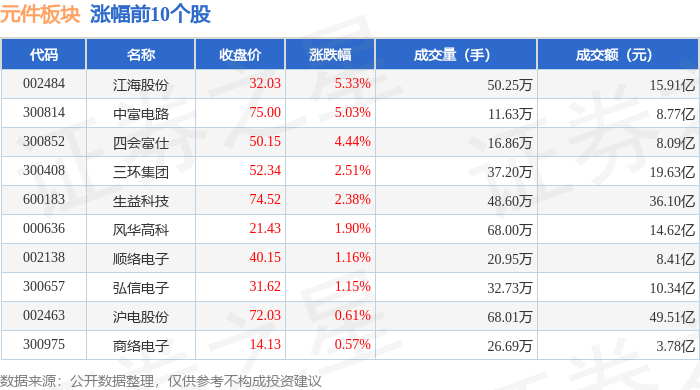
Market Overview - The component sector experienced a decline of 0.48% on January 28, with Kexiang Co. leading the drop [1] - The Shanghai Composite Index closed at 4151.24, up 0.27%, while the Shenzhen Component Index closed at 14342.9, up 0.09% [1] Top Performers in the Component Sector - Jianghai Co. (002484) closed at 32.03, with a rise of 5.33% and a trading volume of 502,500 shares, totaling 1.591 billion yuan [1] - Zhongfu Circuit (300814) closed at 75.00, up 5.03%, with a trading volume of 116,300 shares, totaling 877 million yuan [1] - Sihui Fushi (300852) closed at 50.15, increasing by 4.44%, with a trading volume of 168,600 shares, totaling 809 million yuan [1] Underperformers in the Component Sector - Kexiang Co. (300903) closed at 27.66, down 5.11%, with a trading volume of 470,500 shares, totaling 1.317 billion yuan [2] - ST Dongjing (002199) closed at 9.16, down 4.98%, with a trading volume of 15,000 shares, totaling 13.6974 million yuan [2] - Yihau New Materials (301176) closed at 25.00, down 4.94%, with a trading volume of 39,800 shares, totaling 101 million yuan [2] Capital Flow Analysis - The component sector saw a net outflow of 1.368 billion yuan from major funds, while retail investors contributed a net inflow of 1.293 billion yuan [2] - Major funds showed a net inflow in several companies, including Shengyi Technology (600183) with 429 million yuan, and Jianghai Co. (002484) with 77.32 million yuan [3] - Retail investors had significant net inflows in companies like Shengyi Technology (600183) and Jianghai Co. (002484), while experiencing outflows in others like Huafeng High-Tech (000636) [3]




未知机构:国联民生电子电子板块的全面通胀领导好前期我们团队重点推荐-20260128
未知机构· 2026-01-28 02:00
Summary of Conference Call Notes Industry Overview - The focus is on the electronics sector, particularly the inflationary trends driven by AI in storage, devices, and packaging/testing segments [1][2]. Key Points and Arguments 1. **Price Increases Across Segments**: - Recent price hikes have been observed in various sub-segments: - Passive components: Resistors from Yageo increased by 15-20% - Power components: Multiple companies reported price increases of 10-20% - LED drivers: Richtek saw price increases of over 10% - MCU companies: Zhongwei Semiconductor's MCUs and NOR flash prices rose by 15-50% [2][2]. 2. **Drivers of Price Increases**: - Different segments have unique drivers for price increases: - Downstream demand turning point and inventory clearance in channels - Rising costs in packaging/testing and foundry services necessitating cost pass-through - Supply-side pressures combined with a demand-side inventory buildup cycle - Current valuations of related stocks are considered low, presenting an opportunity for investment [2][2]. 3. **Long-term Outlook**: - The AI industry wave presents transformative opportunities for power, passive, and MCU sectors: - For passive components, new demands arise in various AI applications: - SOFC (Solid Oxide Fuel Cell): Significant power shortages in North America create demand for high-capacity, high-voltage MLCCs - Vertical Power Delivery (VPD): Google’s adoption of VPD indicates a shift towards more efficient power solutions, increasing requirements for high-voltage film capacitors, high-frequency power inductors, and non-inductive resistors - The electronics sector is entering a significant inflationary period, with previous increases in storage, devices, and packaging/testing expected to be followed by a wave of price adjustments in other electronic components [2][2]. 4. **Investment Strategy**: - It is recommended to prioritize positions and select stocks that actively participate in industry transformations and embrace the AI wave [2][2]. Important but Overlooked Content - Specific companies mentioned in various segments: - MCU: Zhaoyi Innovation, Puran, Guomin Technology, Zhongwei Semiconductor - Power components: Xinjieneng, JieJie Microelectronics, Yangjie Technology - Passive components: Shunluo Electronics, Sanhuan Group - Lead frames: Kangqiang, Xinhenghui [3][3].
牛!这家上市电子材企宣布:核心产品电子封装材料满产满销
Sou Hu Cai Jing· 2026-01-27 05:38
Core Viewpoint - Jiemai Technology aims to become a leading provider of one-stop services and overall solutions for electronic component packaging materials and processes, focusing on electronic-grade film materials, electronic chemicals, and materials related to new energy [3]. Group 1: Company Developments - Jiemai Technology has been actively engaging with numerous institutions for research since January 16, including Shanxi Securities, Huatai Securities, and Tianhong Fund [1]. - The company has achieved a leading global market share in paper carrier tape, breaking the near monopoly held by foreign companies [3]. - Jiemai Technology is expanding its product offerings from electronic packaging materials to include electronic-grade film materials, achieving mass production of products such as release films and composite current collectors [3]. Group 2: Market Conditions - The electronic packaging materials sector is currently experiencing high demand, with core products operating at full production capacity [4]. - The acceleration of global digitalization, coupled with policies like "new infrastructure" and "old-for-new" electronic product exchanges, is driving demand in markets such as 5G, cloud computing, and new energy vehicles [4]. - The industry is in a period of explosive growth, with effective supply-demand matching being crucial for market capture [4]. Group 3: Pricing and Supply Chain - Recent price increases from downstream clients like Yageo and Walsin indicate a potential for Jiemai Technology to adjust its product prices in response to rising demand in sectors such as AI servers and new energy vehicles [5]. - Jiemai Technology has successfully transitioned to stable mass supply of MLCC release films to major clients, completing product validation with Korean and Japanese customers [5][6]. - The company has signed strategic supply agreements with major polarizer manufacturers for release films and is continuously developing high-end release films to replace foreign products [6]. Group 4: Acquisition and New Products - Jiemai Technology completed the acquisition of Jiangxi Rouzhen Technology, which specializes in polymer-metal composite film materials, enhancing its product portfolio for lithium-ion batteries [6][7]. - The new products from Rouzhen Technology, including composite aluminum and copper foils, are aimed at various battery applications, with a planned annual production capacity of 5 million square meters [7].
开源证券:成本端驱动涨价潮 被动元件高端需求开启新周期
Zhi Tong Cai Jing· 2026-01-26 05:55
Core Viewpoint - The global passive component market is entering a new upcycle driven by price increases announced by leading companies since 2025, primarily due to rising upstream metal raw material prices and increased labor/power costs, with inflation being a dominant factor [1] Price Increase Situation - Major companies such as Yageo, Walsin, Panasonic, Fenghua, and Sunlord have announced price hikes, with Yageo starting from the second half of 2025, increasing prices for various capacitor and resistor products by 10%-30% [2] - Panasonic has notified dealers of price increases for 30-40 models of tantalum capacitors by 15%-30%, effective February 1, 2026 [2] - Fenghua announced price increases for inductor products by 5%-25% and for various capacitor products by 10%-30% starting November 2025 [2] - Walsin plans to adjust prices for resistor products due to rising costs, effective February 1, 2026 [2] Supply Side - The continuous rise in upstream metal raw material prices, including silver, palladium, ruthenium, tin, and copper, is a major driver of the price increases in passive components [4] - The production costs have significantly increased due to the rise in metal prices, which is being passed down through the supply chain [4] - The operating rates of major manufacturers have remained high since 2025, with a trend of further improvement [4] Demand Side - Demand from emerging sectors such as AI servers, new energy vehicles, and industrial control is strong, which may lead to a longer upcycle for the passive component industry compared to previous cycles [5] - For instance, each AI server is equipped with approximately 15,000 to 25,000 MLCCs, with the market for MLCCs in AI servers expected to grow at an annual rate of 30%, reaching 3.3 times the 2025 level by 2030 [5] Target Companies - Companies to watch include SanHuan Group, Sunlord Electronics, JiangHai Co., and Fala Electronics [6] - Beneficiary companies include Fenghua, Placo New Materials, Jiemai Technology, and Maijie Technology [6]


行业点评报告:被动元件:成本端驱动涨价潮,高端需求开启新周期
KAIYUAN SECURITIES· 2026-01-26 03:14
Investment Rating - The industry investment rating is "Overweight" (maintained) [1] Core Insights - The current price increase in passive components is driven by rising upstream metal raw material prices and increased costs related to labor and electricity, with inflation being a dominant factor [8] - Demand from emerging sectors such as AI servers, new energy vehicles, and industrial control is robust, suggesting that the current upcycle in the passive components industry may last longer than previous cycles [7][8] Summary by Sections Price Increase Situation - Major passive component manufacturers like Yageo, Panasonic, and Walsin have announced price increases for various products, with increases ranging from 5% to 30% starting from early 2026 [5] - Yageo has raised prices for multiple capacitor and resistor products by 10%-30% since the second half of 2025, citing significant increases in wafer costs [5] - Other manufacturers, including Walsin and Huazhong, have also issued price hikes due to rising costs of labor, electricity, and materials [5] Supply Side - The prices of upstream metal raw materials such as silver, palladium, ruthenium, tin, and copper continue to rise, significantly impacting production costs for passive component manufacturers [6] - The operating rates of major manufacturers have remained high since 2025, with an upward trend expected [6] Demand Side - Traditional demand from consumer electronics remains stable, while new sectors like AI servers and new energy vehicles are experiencing strong growth, indicating a potentially longer upcycle for the passive components industry [7] - For instance, each AI server is estimated to require 15,000 to 25,000 MLCCs, with the market for MLCCs in AI servers expected to grow at an annual rate of 30%, reaching 3.3 times the 2025 market size by 2030 [7] Investment Recommendations - The report suggests focusing on companies such as Sanhua Group, Sunlord Electronics, Jianghai Co., and Farah Electronics, with beneficiaries including Walsin, Placo New Materials, Jiemai Technology, and Maijie Technology [8]
巨头提价!被动元件接连涨价,高增长概念股出炉
Xin Lang Cai Jing· 2026-01-23 00:20
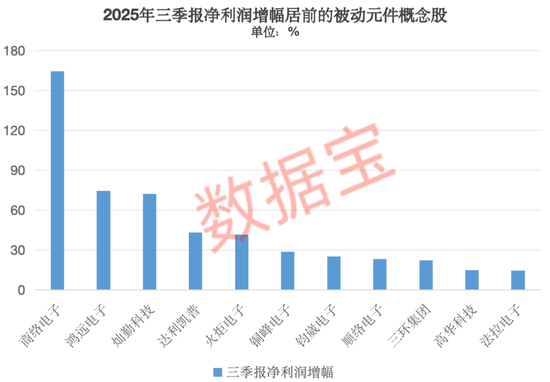
Core Viewpoint - The passive component industry is experiencing price increases due to rising raw material costs, with major companies like Huaxinke and Guoju announcing price adjustments for their products [1][2][14]. Price Increases - Huaxinke announced a price adjustment for resistors ranging from sizes 0201 to 1206, effective February 1, with expected increases around 20% [1][14]. - Guoju has also issued a price increase notice for certain resistor products, with adjustments between 15% and 20% [1][14]. - Panasonic plans to raise prices for some tantalum capacitors by 15% to 30% starting February 1, 2026 [1][14]. - The price hikes are attributed to the rising costs of core metal materials such as silver, palladium, tin, and copper, which have intensified cost pressures [2][14]. Market Dynamics - The demand for passive components is being driven by the rapid development of AI technologies, which is significantly increasing the usage of MLCCs (multi-layer ceramic capacitors) in AI server motherboards, with usage rising to 3000-4000 units, over 100% more than traditional servers [2][14]. - The structural changes in demand are leading to increased prices for MLCC products and exacerbating supply-demand conflicts in the industry [2][14]. Market Size and Growth - The passive component market in China was valued at 123.765 billion yuan in 2023, with projections to reach 258.359 billion yuan by 2030, reflecting a compound annual growth rate (CAGR) of 11.09% from 2023 to 2030 [3][15]. Stock Performance - Over 20 listed companies in the passive component sector have shown positive stock performance, with leading company Fenghua Gaoke's stock price increasing over 26% this year [4][17]. - Other companies like Guoci Materials and Dali Kaipu have also seen stock price increases exceeding 15% [4][17]. Profit Growth - Many companies reported significant year-on-year profit growth in their Q3 2025 reports, with Shangle Electronics doubling its net profit with an increase of over 160% [5][18]. - Other companies such as Hongyuan Electronics and Canqin Technology reported profit increases exceeding 70% [5][18]. Institutional Predictions - Among 10 concept stocks rated by four or more institutions, Torch Electronics is predicted to have a net profit of around 500 million yuan in 2025, with an expected growth rate of over 157% [7][20]. - Hongyuan Electronics is forecasted to achieve a net profit of approximately 339 million yuan in 2025, with a growth rate exceeding 120% [7][20]. Institutional Research - In January 2026, Junwei Electronics was investigated by 11 institutions, revealing progress in its current sensor business, which is being integrated into projects with major clients in the new energy vehicle and AI server sectors [10][21]. - Sunluo Electronics was also investigated by three institutions, indicating strong market acceptance and ongoing progress in supplying various tantalum capacitor products [11][22].
强势股追踪 主力资金连续5日净流入88股
Zheng Quan Shi Bao Wang· 2026-01-22 09:44
Core Viewpoint - The report highlights the significant inflow of main capital into various stocks, with specific companies showing remarkable performance in terms of net capital inflow and stock price changes [1][2]. Group 1: Main Capital Inflow - A total of 88 stocks have experienced a net inflow of main capital for five consecutive days or more, indicating strong investor interest [1]. - Hangzhou Bank leads with 16 consecutive days of net inflow, followed by Yunnan Baiyao with 14 days [1]. - Midea Group has the highest total net inflow amounting to 1.582 billion yuan over seven days, while Hangzhou Bank follows closely with 1.489 billion yuan over 16 days [1]. Group 2: Performance Metrics - The stock with the highest net inflow ratio relative to trading volume is Fenglong Co., which has surged by 359.76% over the past 16 days [1]. - Other notable stocks include Guotai Junan Securities with a net inflow of 1.109 billion yuan over 11 days and China Ping An with 1.074 billion yuan over six days, although their stock prices have seen declines of 2.46% and 3.28% respectively [1]. - The report includes a detailed table of stocks with their respective net inflow amounts, inflow ratios, and cumulative price changes, providing a comprehensive overview of market trends [1][2].





20cm速递|“十五五”促进中小企业发展规划,创业板50ETF华夏(159367)上涨0.93%,同类产品最低费率档
Mei Ri Jing Ji Xin Wen· 2026-01-21 06:14
Group 1 - The A-share market saw all three major indices rise on January 21, with the ChiNext 50 ETF (Hua Xia, 159367) increasing by 0.93%. Notable stocks included Sanhuan Group, which rose over 6%, Xiechuang Data, which increased over 5%, and Jingjia Micro, which gained over 4% [1] - The State Council's press conference highlighted a positive outlook for small and medium-sized enterprises (SMEs) in China by 2025, with key indicators showing significant growth: the added value of industrial SMEs increased by 6.9% year-on-year, and the SME export index has been in an expansion zone for 21 consecutive months [1] - The cultivation of specialized and innovative enterprises has yielded substantial results, with 17,600 "little giant" enterprises and over 140,000 specialized and innovative SMEs established, alongside more than 600,000 technology and innovation-oriented SMEs. The R&D intensity of "little giant" enterprises reached 7%, with an average of 26.6 invention patents per entity [1] Group 2 - The ChiNext 50 Index focuses on sectors such as information technology, new energy, financial technology, and pharmaceuticals, primarily consisting of leading technology companies in areas like optical modules, chips, new energy batteries, and innovative drugs. These sectors align with national policy directions and global technological trends, showcasing high growth potential and innovation [2] - The ChiNext 50 ETF (Hua Xia, 159367) offers two core advantages: a 20% price fluctuation limit, providing greater trading flexibility compared to traditional broad-based indices, and low management fees of 0.15% and custody fees of 0.05%, which effectively reduce investment costs [2]
