
中国星网

Search documents
史无前例,我国20万颗卫星申报背后的“大棋局”
3 6 Ke· 2026-01-14 07:25
Core Viewpoint - China's recent application to the International Telecommunication Union (ITU) for over 200,000 satellite frequency resources marks a record-breaking action in both the number of applications and the total scale of satellites, indicating a strategic move to secure orbital and frequency resources for future development [1][3][10]. Group 1: Record-Breaking Application - The application includes over 190,000 satellites from a newly registered entity called the "Radio Spectrum Development and Technology Innovation Research Institute," which significantly exceeds previous applications and is several times larger than the current largest constellation, SpaceX's Starlink with 72,000 satellites [1][4]. - In 2025, China submitted 73 frequency coordination applications to the ITU, with a peak of 34 applications in December alone, showcasing unprecedented activity in satellite frequency coordination [4][10]. Group 2: Strategic Intent - The large-scale application is viewed as a "resource positioning" action, aimed at ensuring China has a sufficient "resource pool" of orbital and frequency resources for the next decade or longer [3][10]. - The initiative reflects China's strategic determination to secure more orbital positions and frequencies, which are critical for the development of commercial space and the goal of integrated "space-ground" communication systems, particularly for 6G [3][6][13]. Group 3: Role of Key Institutions - The Radio Spectrum Innovation Institute, established by several key organizations, is positioned as a core research and technical support entity for satellite communication standards and resource management, indicating a strong national strategic intent [6][11]. - The collaboration between the Radio Spectrum Innovation Institute and China SatNet highlights a dual approach where one focuses on demand integration and the other on technological innovation and resource reserve [6][10]. Group 4: Involvement of Telecom Operators - Major telecom operators, including China Telecom and China Mobile, are also involved in the satellite application process, marking a significant step in their satellite internet business and indicating a shift towards integrated communication services [11][12]. - China Telecom aims to complement its existing geostationary satellite capabilities with low Earth orbit satellites to enhance its service offerings, while China Mobile seeks to establish its own satellite constellation to maintain competitive advantages in future communication technologies [11][12][13].




2026年卫星入轨有望迈向“航班化”时代,一键布局卫星全产业链的卫星ETF广发(512630)涨超4%
Xin Lang Cai Jing· 2026-01-14 05:12
Group 1 - The successful launch of the Long March 8A rocket on January 13, 2023, marks a significant achievement in China's commercial space endeavors, with 18 low-orbit satellite internet satellites deployed into their designated orbits [1] - The Long March 8A rocket's testing process has been streamlined to 18 days, with future goals set for a "7 days launch, 7 days recovery" cycle [1] - The Sichuan Province's "14th Five-Year" basic surveying and mapping plan aims to enhance the Beidou satellite navigation system's service capabilities and coverage [1] Group 2 - China has submitted plans for multiple satellite constellations to the International Telecommunication Union, totaling 203,000 satellites, indicating an accelerated strategic layout in the low-orbit satellite sector [2] - The year 2026 is projected to be a pivotal year for China's commercial space launches, with an expected increase in launch frequency to over 100 times [2] - Breakthroughs in rocket recovery technology are anticipated to reduce launch costs by 70% to 90%, facilitating a shift towards a more routine satellite deployment model [2] Group 3 - As of January 14, 2026, the CSI Satellite Industry Index has risen by 4.23%, with the Guangfa Satellite ETF increasing by 4.33%, reflecting strong market performance [3] - The Guangfa Satellite ETF has reached a new high of 2.045 billion yuan in scale, with a total of 1.109 billion shares, indicating robust investor interest [3] - The CSI Satellite Industry Index focuses on the upstream manufacturing segment of the satellite industry, with over 25% weight in aerospace equipment, positioning it to benefit from industry acceleration [4] Group 4 - The top three constituent stocks of the CSI Satellite Industry Index account for nearly 30% of the index, indicating a concentrated investment in leading companies [4] - Higher consensus growth expectations for the index suggest a greater potential for explosive returns as the industry matures [4] - Continuous advancements in high-capacity rockets are expected to alleviate operational bottlenecks, further enhancing the certainty of industry growth [4]
蓝箭航天与中国星网、垣信卫星签署正式发射服务合同,将提供批量发射服务
Guan Cha Zhe Wang· 2026-01-14 00:54
Core Viewpoint - Blue Arrow Aerospace has received acceptance for its IPO on the Sci-Tech Innovation Board, indicating a significant step towards capitalizing on the growing commercial space industry in China [2] Group 1: Company Overview - Blue Arrow Aerospace was established in June 2015 and is primarily focused on providing commercial rocket launch services using its self-developed liquid oxygen-methane rockets [2][3] - The company’s main product is the "Zhuque" series of rockets, particularly the Zhuque-3, which is a medium to large reusable launch vehicle [5] - The actual controller of the company is Zhang Changwu, and it has not yet achieved profitability [6] Group 2: Contracts and Partnerships - Blue Arrow has signed formal launch service contracts with China Star Network and Yuanxin Satellite, positioning itself as a core supplier for major satellite internet projects in China [2] - The company has been selected for the 2025 launch service procurement project by Yuanxin Satellite, which involves launching 18 satellites in one mission [2] Group 3: Market and Product Demand - The company aims to meet the strategic needs of large satellite internet projects, specifically the "GW Constellation" and "Qianfan Constellation," which involve deploying thousands of satellites [2] - The GW Constellation plans to launch approximately 12,992 satellites, with 10% of the deployment expected within five years, while the Qianfan Constellation plans to launch around 15,000 satellites [2] Group 4: Financials and Future Plans - As of June 30, 2025, Blue Arrow's undistributed profits are approximately -4.84 billion yuan, indicating financial challenges [6] - The company plans to raise 7.5 billion yuan through its IPO to enhance the production capacity and technology of its reusable rockets [6] - In the first half of 2025, Blue Arrow's sales to a single customer accounted for about 98% of its revenue, highlighting a high customer concentration risk [6] Group 5: Industry Insights - Industry experts emphasize the importance of capital support for the sustainable development of commercial space ventures, suggesting that companies need to balance idealism with practical market needs [6][7] - The focus should be on developing proven technologies like reusable rockets to reduce costs and meet immediate market demands, while gradually working towards larger goals [7]

蓝箭航天与中国星网、垣信卫星签署正式发射服务合同
Guan Cha Zhe Wang· 2026-01-14 00:49
Core Viewpoint - Blue Arrow Aerospace has received acceptance for its IPO on the Sci-Tech Innovation Board, indicating a significant step towards capitalizing on the growing commercial space industry in China [1] Company Overview - Blue Arrow Aerospace was established in June 2015 and is primarily focused on providing commercial rocket launch services using its self-developed liquid oxygen-methane rockets, particularly the "Zhuque" series [1][2] - The company is controlled by Zhang Changwu and aims to meet the strategic needs of major satellite internet projects in China [1] Product and Services - The core product is the "Zhuque" series of liquid oxygen-methane rockets, which includes the medium-sized Zhuque-2 and the larger reusable Zhuque-3 rockets [4] - The company has successfully executed four liquid-fueled rocket launch missions during the reporting period [4] - Blue Arrow's services primarily cater to the launch needs of near-Earth orbit satellites for communication and remote sensing, with a focus on exclusive launch services [4] Financial Performance - Blue Arrow Aerospace has not yet achieved profitability, with an undistributed profit of approximately -4.84 billion yuan as of June 30, 2025 [5] - The sales volume of the Zhuque-2 series rockets from 2022 to the first half of 2025 was relatively low, with a high customer concentration, as 98% of the revenue in the first half of 2025 came from a single client [5] Market Context - The commercial space industry in China is increasingly reliant on capital support for sustainable development, with companies needing to balance strategic communication and market understanding [6] - Industry experts emphasize the importance of achieving clear milestones in technology and commercialization before going public to gain pricing power [6][7] - The focus for many domestic commercial space companies is on developing practical launch vehicles that address real market demands, particularly in the low Earth orbit satellite sector [7]

国泰海通:天地一体化建设提速 关注卫星制造与火箭发射端龙头
智通财经网· 2026-01-13 13:29
Group 1 - The core point of the article highlights that China has submitted an application for 203,000 new satellites covering 14 constellations, marking a significant increase in satellite applications and indicating a new era in low Earth orbit (LEO) satellite construction [1][2] - The application includes two major constellations, CTC-1 and CTC-2, which account for nearly 193,000 satellites, reflecting a strategic intent to secure frequency resources for future 6G integrated networks [2][3] Group 2 - The entry of traditional telecom operators like China Mobile and China Telecom into the satellite sector signifies a shift from a single professional satellite operator model to a diversified structure involving national teams, commercial aerospace, and traditional operators [3] - This integration is expected to accelerate the commercial viability of satellite internet services, facilitating the Direct to Cell business model by leveraging the operators' extensive user base and ground infrastructure [3] Group 3 - The new satellite constellations face strict deployment timelines as per ITU regulations, requiring the first satellite to be launched within seven years and full deployment within 14 years, necessitating a significant increase in satellite manufacturing and rocket launch capabilities [4] - The industry must achieve an exponential increase in production capacity to meet the demand for launching thousands of satellites annually over the next decade [4]

国泰海通|机械:20万颗“星海”压境,商业航天格局优化
国泰海通证券研究· 2026-01-13 13:20
报告导读: 中国新增申请 20 万颗卫星覆盖 14 个星座,含中国移动、中国星网、垣信卫 星等。本轮申报数量激增近一个数量级,未来可能引发全球对太空战略资源的新一轮关注 事件: 近日,中国向国际电信联盟( ITU )提交了新增 20.3 万颗的卫星申请,此次申报涵盖 14 个卫星星座,其中 CTC-1 和 CTC-2 两个星座各自申请 96,714 颗,成为本轮申报的主力。除中国星网、垣信卫星等专业卫星运营商外,申报主体首次广泛包括无线电创新院、银河航天、国电高科等商业航天企 业,以及中国移动、中国电信等传统通信运营商。 申报超 20 万颗,抢占频轨资源 " 制高点 " 。 此次中国向 ITU 提交的 20.3 万颗卫星申报,规模远超此前 "GW 星座 " (约 1.3 万颗)与 " 千帆星座 " (约 1.5 万颗)的总和,标志着中国低轨星座建设从 " 千星 " 迈向 " 十万星 " 量级的新纪元。其中, CTC-1 与 CTC-2 两个超大星座合计申报近 19.3 万颗,成为绝对主力。在近地轨道( LEO )频轨资源日益拥挤的背景下,这种 " 饱和式申报 " 体现了国家级战略意志,旨在通过 " 占频保轨 ...


低轨卫星行业加速,陶瓷管壳有望快速扩容
Changjiang Securities· 2026-01-13 09:14
Investment Rating - The industry investment rating is "Positive" and is maintained [12] Core Insights - The low Earth orbit (LEO) satellite industry is accelerating, with the ceramic shell for T/R components expected to expand rapidly due to the high added value of the products and broad prospects [6][8] - The global active satellite count is projected to exceed 12,000 by July 2025, with LEO satellites accounting for 67.5% (over 8,100 satellites) [6][18] - The global satellite internet market is expected to reach $30 billion by 2025, continuing to grow at a high rate [6][18] - The domestic market for ceramic shells used in low Earth orbit satellites is projected to reach 3.8 billion yuan by 2030, with a compound annual growth rate (CAGR) of 94.4% from 2024 to 2030 [8][42] Summary by Sections Low Earth Orbit Satellite Industry - The satellite internet is recognized as a new generation of communication infrastructure, providing ubiquitous network services globally [6][18] - Countries are actively deploying LEO satellite communication systems, with notable players including SpaceX, OneWeb, and domestic companies like China Star Network and Kuiper [6][19] T/R Components and Radar Technology - T/R components are critical for satellite signal transmission and reception, with a significant portion of the cost attributed to these components in radar systems [7][30] - Active phased array radar systems, which utilize T/R components, are becoming mainstream due to their advantages in speed, anti-jamming capabilities, and multi-target tracking [7][30] Market Potential for Ceramic Shells - The ceramic shell's value in a single low Earth orbit satellite is estimated at around 1.1 million yuan, contributing to the overall satellite manufacturing cost [8][42] - The market for ceramic shells is expected to grow significantly, driven by advancements in technology and increasing demand for satellite communication systems [8][42] Company Spotlight: Guoci Materials - Guoci Materials is a leading player in high-end ceramic materials, focusing on the development and production of various ceramic products, including those for satellite applications [9][51] - The company has established a comprehensive innovation system and aims to become a leading platform in the precision ceramic industry [9][51]

新增 20 万颗卫星申请,我国太空战略提速进行 2] 时
Changjiang Securities· 2026-01-13 09:08
丨证券研究报告丨 行业研究丨点评报告丨软件与服务 [Table_Title] 新增 20 万颗卫星申请,我国太空战略提速进行 时 报告要点 [Table_Summary] 1 月 9 日消息,据国际电信联盟(ITU)官网显示,2025 年最后一周,我国向 ITU 申报了多个 卫星星座计划,申报总规模达 20.3 万颗.此次申报涵盖 14 个卫星星座,其中 CTC-1 和 CTC-2 两个星座各自申请 96,714 颗,成为本轮申报的主力。此次大规模申请或反映了我国在太空领 域的战略提速,后续太空资源竞争仍有望加速,进而惠及全产业链。建议关注商业航天产业链 各环节的核心供应商,重点关注 1)我国商业航天龙头企业供应商;2)我国卫星组装企业及核 心零部件供应商;3)卫星应用相关标的。 分析师及联系人 [Table_Author] 宗建树 陈耀文 SAC:S0490520030004 SAC:S0490525070002 SFC:BUX668 请阅读最后评级说明和重要声明 %% %% %% %% research.95579.com 软件与服务 cjzqdt11111 [Table_Title 新增 20 万颗卫星 ...
2026开年最强赛道,引爆下一场星辰大海?
Ge Long Hui· 2026-01-13 08:45
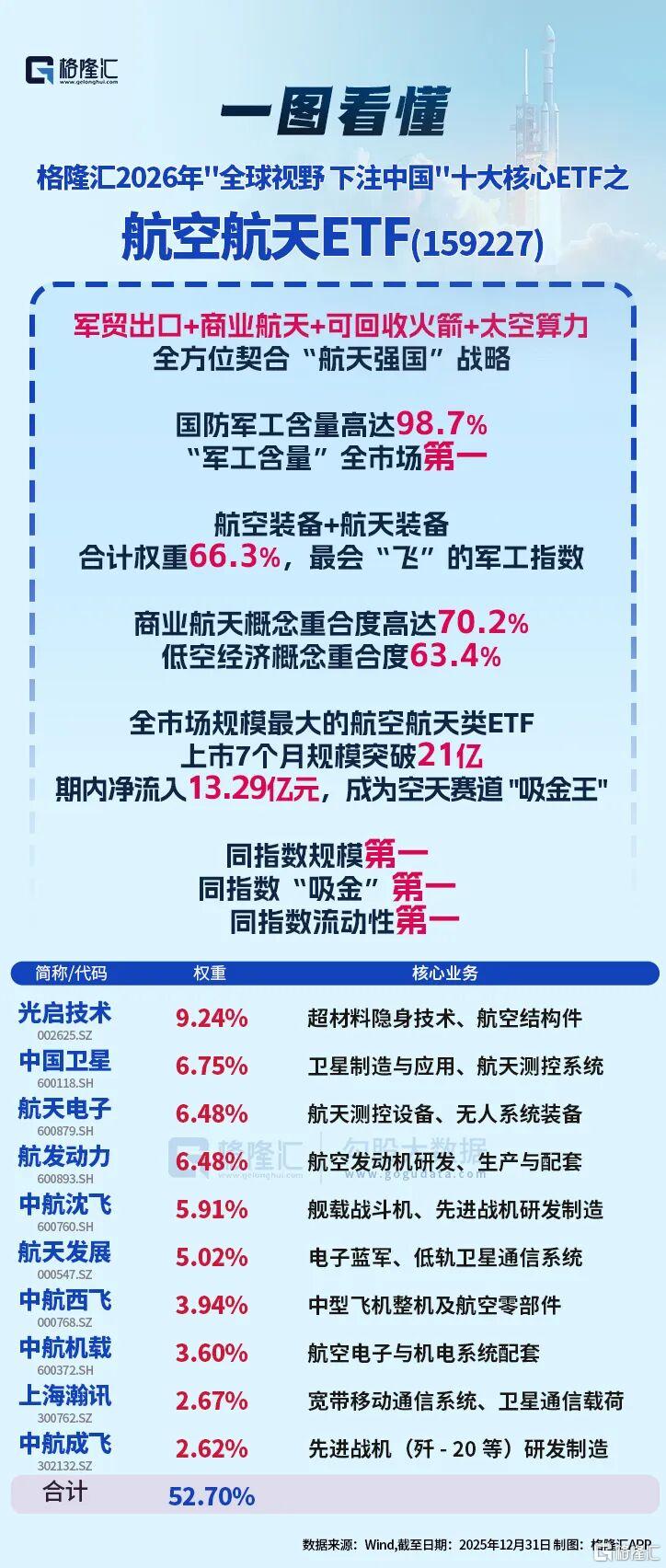
近期,全球对稀缺太空战略资源争夺白热化。 中国向国际电信联盟(ITU)一次性提交了涉及约20.3万颗卫星的频谱与轨道资源申请,覆盖14个星座,创下国内单次申报纪录。 美国联邦通信委员会(FCC)也批准了SpaceX新增部署7500颗第二代星链卫星。 马斯克提出了航天业有史以来最雄心勃勃的制造目标之一:每年生产1万艘星舰飞船。 广州推动商业航天人才、资本和企业集聚广州,构建完整商业航天产业生态。 过去一个多月,航空航天板块一直是市场焦点,表现甚至超过AI等科技板块。 其中,航空航天ETF(159227)自2025年11月24日-2026年1月12日的34个交易日上涨53.33%,净值屡创新高。 航空航天的爆发,源于一场深刻且持久的产业变革,是一场由大国战略、市场爆发与技术革命共同催生的黄金机会。 基于这些逻辑,航空航天ETF(159227)入选了2026年格隆汇"全球视野 下注中国"十大核心ETF。 | of the Come In below in | 6. 1- 10 | 上星制道与应用、机大测径系统 | | --- | --- | --- | | 600118 SH | | | | 新京 FF | 6.4 ...
中国新增多个星座计划申请 商业航天再掀涨停潮
Xin Lang Cai Jing· 2026-01-12 23:09
最大规模国际频轨集中申报 此次我国新增超20万颗卫星申请,从规模上来看,这一数字与中国此前申报的规模相比,有数量级增 长。此前占据中国申报版图主要地位的中国星网(GW星座)与垣信卫星(千帆星座),其规划发射量 分别为1.2992万颗和超1.5万颗,均已通过发射初步锁定了频轨资源。 国际电信联盟(ITU)是负责信息通信技术事务的联合国专门机构,负责分配卫星的频轨资源。各成员 国如果想发射通信卫星,需要按照《无线电规则》向ITU登记卫星网络资料,以获得国际上对空间频率 指配的认可,并保护其频率不受干扰。 商业航天再迎催化剂。 1月10日,国际电信联盟(ITU)官网显示,2025年12月25日到31日期间,我国正式向ITU提交新增20.3 万颗卫星的频率与轨道资源申请,涵盖14个卫星星座,包括中低轨卫星。 这是我国迄今规模最大的一次国际频轨集中申报行动,申报主体包括中国星网、垣信卫星等。 值得注意的是,本次申报除卫星运营商,还包括商业航天企业、电信运营商等机构,如无线电频谱开发 利用和技术创新研究院(下称"无线电创新院")、中国移动、中国电信等。其中,无线电创新院申报的 CTC-1与CTC-2两个星座,各申请了96 ...


