
小米汽车

Search documents
【新能源】2026年1月新能源乘用车厂商批发销量快讯
乘联分会· 2026-02-04 08:31
Core Viewpoint - The article predicts a 25% growth in sales for Chinese new energy passenger vehicle manufacturers by 2025, aligning with the growth expectations set for the "14th Five-Year Plan" period [2]. Group 1: Market Predictions - The end of the new energy vehicle purchase tax exemption policy in December 2025 is expected to lead to a recovery period in January 2026, with some consumers likely to make purchases in December to benefit from the policy [2]. - January 2023 saw a decline of 8% in new energy vehicle sales due to the withdrawal of subsidies, while January 2024 experienced a positive growth despite the anticipated policy changes [2]. - The late timing of the 2026 Spring Festival and contributions from exports have positively influenced January's sales performance [2]. Group 2: Sales Data - According to the latest data from the Passenger Car Association, manufacturers with sales exceeding 10,000 units in December accounted for 93% of the total new energy passenger vehicle wholesale sales for that month [3]. - Preliminary data for January indicates that these manufacturers achieved sales of 830,000 units, leading to an estimated total of 900,000 new energy passenger vehicles sold nationwide in January, reflecting a 1% year-on-year growth [4][3]. Group 3: Leading Manufacturers - Key manufacturers such as GAC Aion, XPeng Motors, and Great Wall Motors reported significant sales figures in January, with GAC Aion leading at 21,635 units sold [8]. - Other notable performances include XPeng Motors with 20,011 units, Great Wall Motors with 18,019 units, and FAW Hongqi with 8,265 units [8]. - The total estimated sales for manufacturers exceeding 10,000 units in January amounted to 832,461, representing 93% of the total market share for that month [8].







重仓新能源的车厂们
投中网· 2026-02-04 07:13
Core Viewpoint - The Chinese automotive market in January 2026 is characterized by a stark contrast, with most automakers experiencing negative growth, particularly in the new energy vehicle (NEV) sector, highlighting the importance of having a diversified product lineup that includes both fuel and electric vehicles [5][6][7]. Sales Performance Summary - In January, the retail sales of passenger cars are expected to reach 1.8 million units, a month-on-month decline of 20.4%, with NEV sales around 800,000 units, marking a penetration rate drop to 44.4%, nearly 10 percentage points lower than the peak at the end of 2025 [6][7]. - Traditional automakers like SAIC, Geely, and GAC Toyota reported stable sales due to their dual strategy of offering both fuel and NEVs, with SAIC's total sales reaching 327,400 units, a year-on-year increase of 23.94% [10][11]. - Geely's total sales were 270,167 units, with fuel vehicles contributing significantly to its performance, while BYD faced a 30.11% decline in NEV sales, indicating the challenges faced by companies heavily reliant on NEVs [12][15]. Market Dynamics - The differentiation in sales performance among automakers is attributed to their strategic choices, particularly the presence of a fuel vehicle base, which enhances resilience against market fluctuations [9][19]. - The demand for fuel vehicles surged during the pre-Spring Festival period, as consumers preferred mature technology and the convenience of fuel vehicles for long-distance travel, further supported by the limited impact of policy changes on fuel vehicles [19][20]. Export Growth - Exports have become a crucial support for many leading automakers, with companies like Chery and SAIC reporting significant increases in overseas sales, indicating a dual strategy of maintaining domestic stability while expanding globally [17][18]. Future Outlook - The current market conditions signal a shift from policy-driven growth to market-driven dynamics, emphasizing the need for automakers to maintain a balanced portfolio of fuel and NEVs to navigate future uncertainties [22]. - Companies that can effectively manage their fuel vehicle base while rapidly advancing in the NEV sector are likely to emerge as market leaders, while those focusing solely on NEVs may face greater risks during market fluctuations [21][22].



比亚迪稳夺1月新能源汽车销冠,头部格局进一步分化
Xin Lang Cai Jing· 2026-02-04 06:54
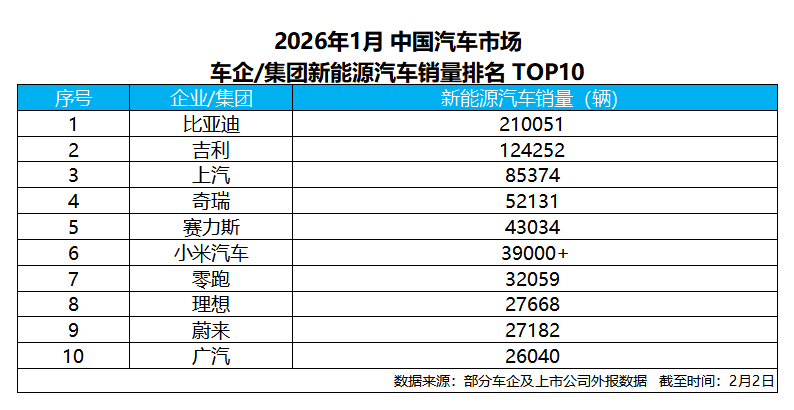
| 序 | 企业/集团 | 新能源汽车销量(辆) | | --- | --- | --- | | 1 | 比亚迪 | 210051 | | 2 | 吉利 | 124252 | | 3 | 上汽 | 85374 | | ব | 奇瑞 | 52131 | | 5 | 塞力斯 | 43034 | | e | 小米汽车 | 39000+ | | 1 | 零跑 | 32059 | | 8 | 理想 | 27668 | | 9 | 蔚来 | 27182 | | 10 | 广汽 | 26040 | | | | 数据来源:部分车企及上市公司外报数据 截至时间:2月2日 | 新年伊始,中国新能源汽车市场的竞争轮廓迅速显现,头部车企之间的差距在1月销量榜单中被进一步拉开。截 至2月2日,根据部分车企及上市公司对外披露的数据,比亚迪以超21万辆的新能源汽车销量位居行业首位,展现 出强大的市场竞争力,继续稳居中国新能源市场头部位置,并在主要车企中拉开明显差距。(深圳新闻网) ...

同比普涨、环比普跌,1月车企销量“开门红”成色不足
经济观察报· 2026-02-03 12:15
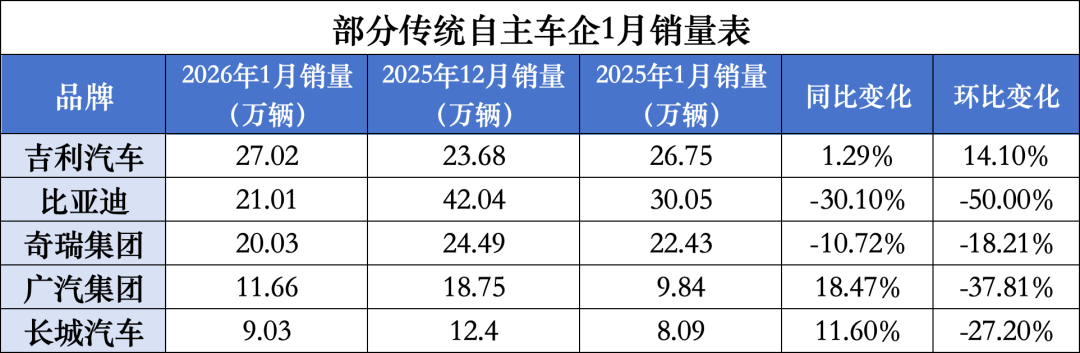
进入2026年1月后,新能源汽车购置税开始减半征收,车企购 置税兜底政策也随之结束。另外,1月各地具体的购车补贴细 则尚未全部出台,导致消费者存在观望情绪,影响了车市终端 销售情况。 作者:王帅国 封图:图虫创意 2月1日,各家车企相继发布了1月销量。从整体上看,汽车行业实现2026年"开门红",大多数车 企1月销量同比取得正增长,但这一同比增长是由于2025年春节在1月,去年同期的新车销售基数 较低。 环比数据上,大多数车企1月销量下滑明显,主要原因在于2025年12月新能源汽车还享受购置税 全额减免政策,同时车企为年底冲量,在12月出台了许多其他优惠政策。进入2026年1月后,新 能源汽车购置税开始减半征收,车企购置税兜底政策也随之结束。另外,1月各地具体的购车补贴 细则尚未全部出台,导致消费者存在观望情绪,影响了车市终端销售情况。 广汽集团1月销量为11.66万辆,同比增长18.47%,环比下滑37.79%。其中自主品牌销量超4.9 万辆,同比增长87.58%;海外销量同比增长68.59%。分品牌来看,昊铂+埃安销量2.16万辆, 同比大增171.63%;传祺品牌销量2.77万辆,同比增长51.06%; ...



销冠易主,小鹏垫底,车市开年大洗牌
Guo Ji Jin Rong Bao· 2026-02-03 10:41
Core Insights - January saw a significant reshuffling in the domestic automotive market, with new energy vehicle (NEV) purchase tax reinstatement and demand being pulled forward due to promotions leading to changes in rankings among new players [1] - New energy vehicle companies showed a clear divergence in January sales, with Zeekr, NIO, and Xiaomi Auto experiencing over 90% year-on-year growth, while Li Auto and Xpeng faced declines [1][2] Sales Performance - Hommage Zhixing delivered 57,900 vehicles in January, with the AITO brand contributing 40,000 units, accounting for 69.1% of total deliveries [2] - Xiaomi Auto delivered over 39,000 vehicles, marking a 95% year-on-year increase, despite a 22% month-on-month decline [2] - Leap Motor's January deliveries reached 32,100 units, with plans to hit a sales target of 1 million vehicles in 2026 [2] - Li Auto's deliveries were 27,700 units, entering a self-adjustment phase due to supply chain issues affecting production [3] - NIO delivered 27,200 vehicles, with a significant year-on-year increase of 163% driven by the new ES8 model [3] - Xpeng delivered approximately 20,000 vehicles, focusing on new product launches for 2026 [4] Traditional Automakers - Geely topped the sales chart in January with 270,200 units sold, a 1.29% year-on-year increase and a 14.08% month-on-month increase, driven by the Zeekr brand [5][6] - BYD's sales fell to 210,100 units, a 30.11% year-on-year decline, primarily due to weak domestic demand [6] - GAC Group reported sales of 116,600 units, an 18.47% year-on-year increase, although it faced a 37.81% month-on-month decline [7][8] - Chery Group's total sales were 190,000 units, down 10.7% year-on-year, with only the Chery brand showing growth [8] - Great Wall Motors sold 90,300 vehicles, an 11.60% year-on-year increase, with a notable 30% growth in NEV sales [9]
车车科技荣获2025新浪金麒麟“年度卓越保险科技公司”奖
Xin Lang Cai Jing· 2026-02-03 08:44
Core Insights - Car Car Technology has been awarded the title of "Outstanding Insurance Technology Company of the Year" at the "2025 Sina Golden Unicorn Insurance Industry Awards" organized by Sina Finance, recognizing its excellence in the insurance technology sector [1][6]. Company Overview - Car Car Technology (NASDAQ: CCG) was established in 2014 and focuses on the research and innovation of AI technology in insurance, positioning itself as a pioneer in China's insurance technology industry [3][8]. - The company aims to become a global leader in next-generation AI insurance technology, providing end-to-end AI solutions for the insurance sector, particularly in the context of smart connected vehicles [3][9]. Recent Developments - In September 2023, Car Car Technology successfully went public on NASDAQ under the ticker symbol CCG [4][9]. - The company has developed a range of core products, including a smart connected vehicle insurance platform, a smart claims platform for new energy vehicles, AI pricing and anti-fraud models, and SaaS services for the insurance industry [4][9]. Strategic Partnerships - Car Car Technology has established strategic partnerships with 20 leading new energy vehicle manufacturers, including Xiaomi Auto, Li Auto, NIO, and Volkswagen Anhui, gaining access to the insurance service entry points of these manufacturers [4][9]. - The integration of its self-developed insurance transaction platform into vehicle manufacturers' apps creates a natural flow advantage, allowing for a "buy car and insure" model that provides one-stop insurance services to users [4][9]. Financial Performance - The company's total premium scale exceeded 11.5 billion yuan in the first half of 2025, with new energy vehicle insurance premiums growing by 150% year-on-year to reach 2.6 billion yuan [4][9]. Technological Advancements - Car Car Technology has built an AI-driven customer service system that automates 90% of claim reporting, with small claims processed from reporting to payment in just 8 minutes [5][10]. - The intelligent claims system utilizes AI image recognition and online loss assessment technologies, enabling instant claims processing and significantly reducing the claims cycle time [5][10].

2026年1月季节性淡季致内需承压,静待地方政策落地与需求回补
BOCOM International· 2026-02-03 05:20
Investment Rating - The report assigns a "Buy" rating to several companies in the automotive sector, indicating an expectation of total returns exceeding the relevant industry over the next 12 months [8]. Core Insights - The automotive market in January 2026 experienced a seasonal downturn, with a notable decline in demand due to the impact of subsidy policies and adjustments in purchase tax. Most new energy vehicle manufacturers saw a significant month-on-month sales drop of 43.9% [3][4]. - Despite the overall weak performance in the first quarter of 2026, the continuation of the vehicle replacement policy is expected to support market recovery as local subsidy details are finalized [4]. - Companies to watch include: - Xpeng Motors (9868 HK/XPEV US) with new models launching and increasing overseas production [4]. - Geely Automobile (175 HK) focusing on internal resource integration post-privatization of Zeekr [4]. - BYD (1211 HK) benefiting from increased overseas production capacity and high growth in international sales [4]. Summary by Relevant Sections Sales Performance - BYD's January sales were 205,518 units, down 30.7% year-on-year and 50.4% month-on-month. However, exports surged by 43.3% to 100,009 units, with overseas sales accounting for 47.6% of total sales [6][7]. - NIO delivered 27,182 vehicles in January, a 96.1% year-on-year increase but a 43.5% month-on-month decline. The introduction of new financing options is expected to ease purchasing barriers [6][7]. - Xpeng delivered 20,011 vehicles, down 34.1% year-on-year and 46.6% month-on-month, with the new X9 model showing significant growth [6][7]. - Li Auto's deliveries were 27,668 units, reflecting a slight decline due to product cycle impacts [6][7]. - Xiaomi's deliveries exceeded 39,000 units, marking a 95% year-on-year increase [6][7]. Company Ratings and Price Targets - The report includes various companies with their respective ratings and target prices, indicating potential upside: - BYD (1211 HK) with a target price of 133.00, representing a 36.06% upside [8]. - NIO (9866 HK) with a target price of 62.75, indicating a 62.48% upside [8]. - Xpeng (9868 HK) with a target price of 134.69, suggesting an 87.98% upside [8].
同比普涨、环比普跌,1月车企销量“开门红”成色不足
Jing Ji Guan Cha Wang· 2026-02-03 02:34
2月1日,各家车企相继发布了1月销量。从整体上看,汽车行业实现2026年"开门红",大多数车企1月销量同比取得正增长,但这一同比增长是由于2025年春 节在1月,去年同期的新车销售基数较低。 环比数据上,大多数车企1月销量下滑明显,主要原因在于2025年12月新能源汽车还享受购置税全额减免政策,同时车企为年底冲量,在12月出台了许多其 他优惠政策。进入2026年1月后,新能源汽车购置税开始减半征收,车企购置税兜底政策也随之结束。另外,1月各地具体的购车补贴细则尚未全部出台,导 致消费者存在观望情绪,影响了车市终端销售情况。 具体来看,问界汽车1月交付约4万辆,同比增长83%,环比下滑30.74%;小米汽车1月交付超3.9万辆,去年同期为超2万辆,去年12月为超5万辆;零跑汽车 1月全系交付达3.21万辆,同比增长27%,环比下滑46.94%。 比亚迪1月销售21.01万辆,其中海外销量表现亮眼,乘用车及皮卡海外销售10万辆,同比增长43.3%。分品牌来看,比亚迪品牌销售17.75万辆;方程豹品牌 销售2.16万辆;腾势品牌销售6002辆;仰望品牌销售413辆。 长城汽车1月销售新车9.03万辆,同比增长11. ...
1月车市分化加剧:自主品牌座次洗牌 新势力环比普降
Zhong Guo Zheng Quan Bao· 2026-02-02 23:03
Core Insights - The automotive market in January 2026 shows a clear distinction between traditional domestic brands, which are performing strongly, and new energy vehicle (NEV) startups, which are facing challenges [1][5] Traditional Domestic Brands Performance - Major traditional automakers like SAIC, Geely, and Chery reported over 20% year-on-year sales growth in January 2026, with SAIC leading the market [2][3] - SAIC sold 327,400 vehicles in January, a 23.9% increase year-on-year, with 214,000 units from its own brands, marking a 39.6% increase [2] - Geely's sales reached 270,200 units, a 1% year-on-year increase, with NEV sales contributing significantly [2] - Chery's sales totaled 200,300 units, with exports accounting for 119,600 units, a 48.1% increase year-on-year [3] - GAC Group saw a significant increase in sales, reaching 116,600 units, up 18.47% year-on-year, driven by its new energy and overseas sales [3] New Energy Vehicle Startups Challenges - In contrast, nine major NEV startups experienced a collective decline in sales, with month-on-month drops ranging from 21.2% to 47.0% [5][6] - Despite the downturn, some brands like NIO and Zeekr reported year-on-year growth exceeding 95% [6][7] - The decline in NEV sales is attributed to short-term factors such as policy changes and seasonal demand fluctuations [6][7] - The market is expected to stabilize post-policy transition, with a potential recovery in sales anticipated in February and March 2026 [7] Market Dynamics and Future Outlook - The automotive industry is witnessing a restructuring of brand rankings, with traditional brands solidifying their positions while new entrants face increasing competition [1][5] - The long-term growth logic of the NEV sector remains intact, with expectations for a gradual recovery as new products are launched and market conditions improve [7]

1月车市分化加剧: 自主品牌座次洗牌 新势力环比普降
Zhong Guo Zheng Quan Bao· 2026-02-02 20:51
截至2月2日,国内主流车企2026年1月产销数据陆续披露。整体市场呈现"传统自主强势领跑、新势力普 遍承压"的鲜明格局:上汽、吉利、奇瑞等头部车企销量同比多实现20%以上增长,自主品牌座次因新 能源与出口表现差异出现重构。 1月传统自主车企集团凭借完善的产品矩阵与全球化布局,交出亮眼成绩单,头部阵营座次因各板块增 长动能差异出现显著调整。 具体来看,上汽集团(600104)延续领跑态势,1月实现整车批售32.74万辆,同比增长23.9%,终端零 售36.3万辆,批发与零售双双领跑行业。分板块来看,自主品牌表现尤为突出,销量达21.4万辆,同比 增长39.6%,占集团总销量比重升至65.3%。 其中,上汽乘用车销售7.7万辆,同比增幅达53.8%;上汽通用五菱销售10.5万辆,同比增长37%。新能 源与海外市场成为核心增长引擎,1月新能源汽车销量8.5万辆,同比增长39.7%;海外销量10.5万辆, 同比增长51.7%,仅MG品牌在欧洲市场就交付近2.6万辆,同比增长15%。 吉利汽车以27.02万辆的销量位居次席,同比增长1%,环比增长14%,新能源业务成为重要支撑。1月新 能源汽车销量达12.43万辆,同比 ...