今世缘

Search documents
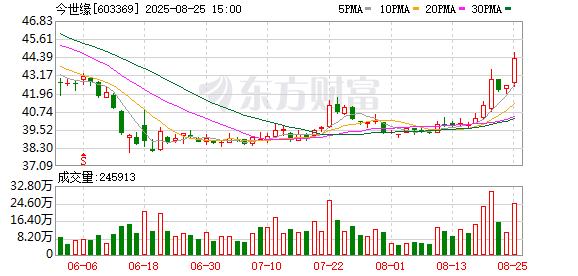
今世缘:2025年上半年净利润22.29亿元,同比下降9.46%
Xin Lang Cai Jing· 2025-08-25 09:18
今世缘公告,2025年上半年营业收入为69.5亿元,同比下降4.84%;净利润为22.29亿元,同比下降 9.46%。 ...

今世缘:上半年净利润22.29亿元 同比下降9.46%
Mei Ri Jing Ji Xin Wen· 2025-08-25 09:15
(文章来源:每日经济新闻) 每经AI快讯,8月25日,今世缘(603369.SH)公告称,上半年营业收入为69.5亿元,同比下降4.84%;净 利润为22.29亿元,同比下降9.46%。 ...

今日53只股长线走稳 站上年线
Zheng Quan Shi Bao Wang· 2025-08-25 04:31
Market Overview - The Shanghai Composite Index closed at 3858.59 points, above the annual line, with a change of 0.86% [1] - The total trading volume of A-shares reached 2101.933 billion yuan [1] Stocks Breaking Annual Line - A total of 53 A-shares have surpassed the annual line today, with notable stocks showing significant deviation rates [1] - The stocks with the highest deviation rates include: - Bona Film Group (8.84%) - Longyuan Construction (5.53%) - TeFa Service (5.32%) [1] Detailed Stock Performance - The following table summarizes the performance of selected stocks that broke the annual line: | Stock Code | Stock Name | Daily Change (%) | Turnover Rate (%) | Annual Line (Yuan) | Latest Price (Yuan) | Deviation Rate (%) | |------------|----------------|------------------|--------------------|--------------------|---------------------|---------------------| | 001330 | Bona Film | 10.04 | 7.11 | 5.14 | 5.59 | 8.84 | | 600491 | Longyuan Con. | 6.09 | 4.96 | 3.63 | 3.83 | 5.53 | | 300917 | TeFa Service | 6.90 | 8.90 | 47.49 | 50.02 | 5.32 | | 000402 | Financial St. | 4.62 | 2.51 | 3.03 | 3.17 | 4.48 | | 300833 | Haoyang Co. | 5.54 | 5.25 | 37.39 | 38.88 | 3.99 | | 300900 | Guanglian Air. | 3.72 | 9.60 | 21.02 | 21.74 | 3.43 | | 002025 | Aerospace Elec. | 2.79 | 2.12 | 51.18 | 52.37 | 2.33 | | 600094 | Daming City | 4.52 | 1.68 | 3.39 | 3.47 | 2.28 | | 002459 | Jinko Solar | 2.20 | 2.09 | 12.31 | 12.54 | 1.88 | | 002304 | Yanghe Brewery | 3.09 | 0.51 | 73.10 | 74.39 | 1.77 | | 603260 | Hoshine Silicon | 2.17 | 0.56 | 52.82 | 53.68 | 1.64 | | 605117 | Deyang Co. | 3.79 | 2.33 | 59.76 | 60.73 | 1.63 | | 688646 | ST Yifei | 4.53 | 3.21 | 32.01 | 32.51 | 1.55 | | 002521 | Qifeng New Mat.| 2.39 | 2.24 | 9.28 | 9.42 | 1.47 | | 600622 | Everbright | 2.91 | 4.84 | 3.13 | 3.18 | 1.44 | | 600657 | Xinda Real Est. | 4.37 | 1.95 | 4.24 | 4.30 | 1.44 | | 300310 | Yitong Century | 4.44 | 11.96 | 7.19 | 7.29 | 1.41 | | 300087 | QuanYin High | 2.44 | 3.63 | 9.51 | 9.64 | 1.37 [1]




A股异动丨白酒股拉升,舍得酒业涨停,水井坊、迎驾贡酒涨超6%
Ge Long Hui A P P· 2025-08-25 03:21
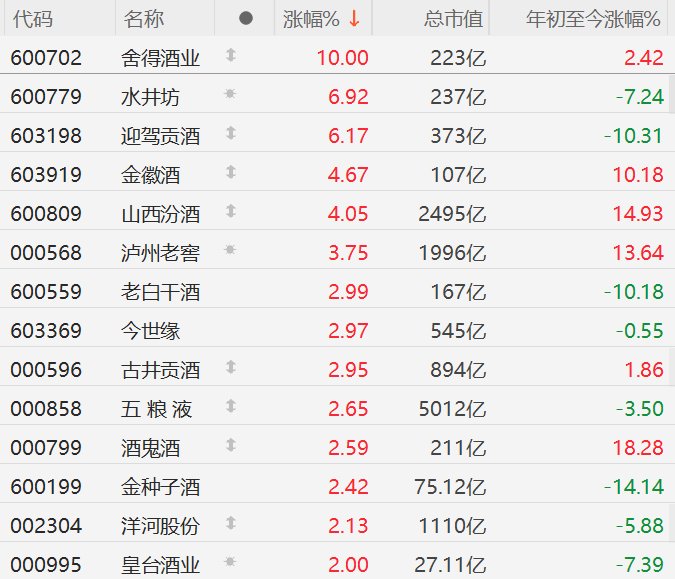
Group 1 - A-shares in the liquor sector experienced significant gains, driven by favorable factors such as clear valuation advantages and the upcoming Mid-Autumn Festival [1] - Shede Liquor reached the daily limit, while Shui Jing Fang and Ying Jia Gong Jiu rose over 6%, and other notable brands like Jin Hui Jiu and Shanxi Fen Jiu increased by over 4% [1] - Major brands such as Luzhou Laojiao and Wuliangye also saw increases, with Guizhou Moutai rising over 1% [1] Group 2 - The market capitalization and year-to-date performance of several liquor companies were highlighted, with Shede Liquor at 22.3 billion and a year-to-date increase of 2.42% [2] - Shui Jing Fang had a market cap of 23.7 billion but a year-to-date decline of 7.24%, while Ying Jia Gong Jiu's market cap was 37.3 billion with a decline of 10.31% [2] - Shanxi Fen Jiu showed strong performance with a market cap of 249.5 billion and a year-to-date increase of 14.93% [2]




A股白酒股普涨,舍得酒业涨超7%
Ge Long Hui A P P· 2025-08-25 02:07
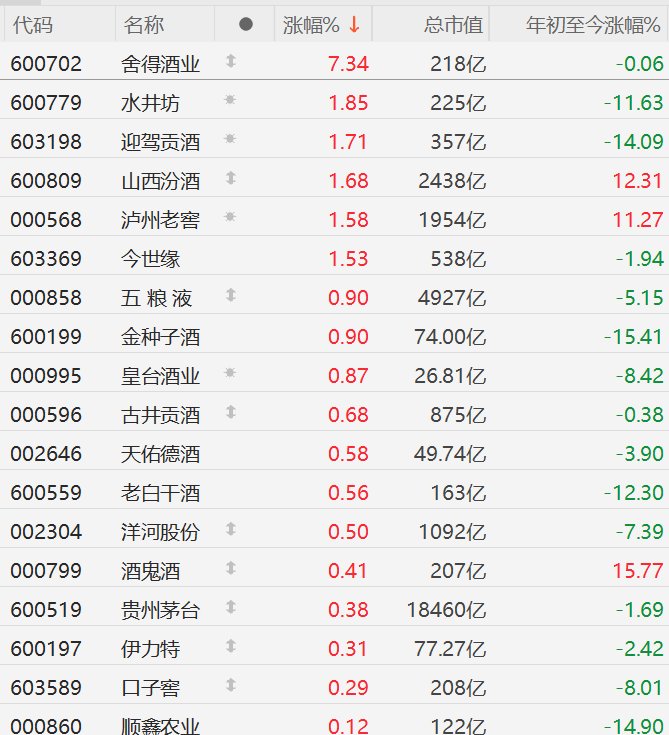
Group 1 - The core viewpoint of the article highlights a significant increase in the A-share market for liquor stocks, with Shede Liquor leading the gains by over 7% [1] - Other notable performers include Shui Jing Fang, Shanxi Fen Jiu, Ying Jia Gong Jiu, and Luzhou Laojiao, all experiencing gains of over 1% [1] Group 2 - Shede Liquor (600702) saw a rise of 7.34%, with a total market capitalization of 21.8 billion and a year-to-date change of -0.06% [2] - Shui Jing Fang (600779) increased by 1.85%, with a market cap of 22.5 billion and a year-to-date decline of -11.63% [2] - Ying Jia Gong Jiu (603198) rose by 1.71%, with a market cap of 35.7 billion and a year-to-date decline of -14.09% [2] - Shanxi Fen Jiu (600809) increased by 1.68%, with a market cap of 243.8 billion and a year-to-date increase of 12.31% [2] - Luzhou Laojiao (000568) rose by 1.58%, with a market cap of 195.4 billion and a year-to-date increase of 11.27% [2] - Other companies such as Jinzhongzi Jiu (600199) and Gujing Gong Jiu (000596) also showed minor increases, with market caps of 7.4 billion and 87.5 billion respectively [2]


白酒企业瞄准光瓶酒赛道
Zhong Guo Chan Ye Jing Ji Xin Xi Wang· 2025-08-25 00:42
Core Insights - The light bottle liquor segment has become a significant focus for the Chinese liquor industry in 2023, with many companies targeting this market to capture lower-tier consumers [1][2] - The market for light bottle liquor is projected to grow from 988 billion yuan in 2021 to over 1500 billion yuan in 2024, with a compound annual growth rate of 13.8% [2] Industry Trends - Major liquor companies such as Jiangsu Yanghe Brewery Co., Ltd., Luzhou Laojiao Co., Ltd., Anhui Gujing Distillery Co., Ltd., and Jiangsu Jinshiyuan Liquor Co., Ltd. have launched new products in the light bottle liquor category this year [1] - The shift in consumer demand towards light bottle liquor is driven by a combination of rational consumption, the rise of younger demographics, and an upgrade in quality expectations [1][2] Market Dynamics - The light bottle liquor market is currently characterized by a fragmented competitive landscape, with no clear leading groups among participants [2] - The price range for light bottle liquor is expanding, with products now available from tens to hundreds of yuan, indicating a transition from being perceived as low-end to quality liquor [2]

荣续ESG智库:2025年白酒行业ESG白皮书
Sou Hu Cai Jing· 2025-08-24 04:51
Group 1 - The report titled "2025 White Liquor Industry ESG White Paper" focuses on the development of the white liquor industry and its ESG practices, providing a comprehensive overview and future direction for practitioners and researchers [1][2] - The white liquor industry is a unique symbol of Chinese traditional culture and economic life, evolving from workshop-style brewing to industrial production, and expanding from regional consumption to national and global markets [1][8] - The report presents data on grain production, including a total planting area of 119,319.1 thousand hectares, a total yield of 70,649.9 million tons, and a yield per unit area of 5,921.1 kg/hectare, which serves as a reference for understanding the raw material supply for the white liquor industry [1][26] Group 2 - The ESG development section highlights the importance of ESG principles in the white liquor industry, emphasizing the need for companies to balance economic benefits with social value while enhancing long-term competitiveness through ESG practices [2][7] - The report analyzes the ESG practices of leading companies such as Kweichow Moutai, Wuliangye, and Shanxi Fenjiu, focusing on their carbon neutrality plans, greenhouse gas emission verification, and environmental information disclosure [2][3] - The white paper discusses the role of organizations like the Shanghai Modern Service Industry Association and the Hongxing ESG Research Institute in promoting ESG principles and providing solutions for companies [3][7] Group 3 - The white liquor industry is characterized by strong resource constraints, relying heavily on natural endowments such as quality water sources and specific grain materials, which creates a unique regional exclusivity [15][16] - The industry has a significant environmental impact, with high water usage and waste management challenges, particularly in regions like the Chishui River basin [17][18] - The production process of white liquor is complex, involving multiple stages from raw material selection to final product, with strict quality control measures in place [29][30] Group 4 - The competitive landscape of the white liquor industry shows a "Matthew effect," where leading companies are rapidly increasing their market share, with the top firms holding a significant portion of the market [50][51] - Financial performance data for leading companies in the industry indicates a clear tiered structure, with Kweichow Moutai leading with a revenue of 120.7 billion yuan and a net profit of 60.8 billion yuan [53][56] - The market share analysis reveals that the industry is becoming increasingly concentrated, with the top two companies holding a combined market share of 30% [57][59] Group 5 - The report identifies key trends in the white liquor industry, including diversification of consumption scenarios, innovation driven by younger consumer groups, and the acceleration of digital marketing and channel transformation [59][60] - The internationalization of the white liquor industry is gaining momentum, with companies exploring markets in Southeast Asia and Europe, leveraging cultural similarities and trade policies to expand their reach [61][62]




真慌了!一线价格崩盘,二线卖不动,白酒三巨头还剩几个能挺住?
Sou Hu Cai Jing· 2025-08-22 22:45
Core Viewpoint - Yanghe, once a leading player in the Chinese liquor industry, is facing unprecedented challenges, including a significant decline in market position and brand image [1][3]. Financial Performance - In 2024, Yanghe's parent company reported a profit drop of 33% and a revenue decrease of 13% [3]. - Yanghe's ranking among Chinese liquor brands has fallen to fifth place, overtaken by Shanxi Fenjiu and Luzhou Laojiao [3]. Management Changes - The sudden departure of former chairman Zhang Liandong has raised concerns within the industry, especially given the quick succession of a new chairman [3]. - Zhang's tenure lasted only four years, which is shorter than the typical five-year term for high-level executives [3]. Market Competition - Yanghe is facing intense competition from local brands like Jinshiyuan, which is encroaching on its market share in Jiangsu by offering affordable products [5]. - Luzhou Laojiao surpassed Yanghe in net profit in 2022, and Shanxi Fenjiu pushed Yanghe out of the top three in 2023 with nearly 32 billion yuan in revenue [7]. Historical Context - Yanghe has a rich history dating back to the Han Dynasty, with a strong reputation for its unique brewing environment [9]. - The company underwent significant expansion and modernization after the establishment of the People's Republic of China, becoming a major state-owned enterprise [9]. Strategic Shifts - In the early 2000s, Yanghe reformed its product offerings to cater to changing consumer preferences, focusing on a "soft" taste that appealed to social drinking [11]. - The "Blue Classic" series was launched, leading to a significant increase in brand recognition and sales, with annual growth rates exceeding 100% from 2003 to 2011 [11]. Current Challenges - Post-2020, the liquor industry has faced pressures, including high inventory levels and price discrepancies, particularly affecting Yanghe's premium products [12]. - The company is perceived to be struggling due to frequent management changes and the intense competition within the liquor sector [12]. Future Outlook - Yanghe must adapt and innovate to survive in a rapidly changing market, as falling out of the top three is a critical warning sign for the company [12].
“苏酒老大”洋河股份,迎来上市后的至暗时刻?
Guan Cha Zhe Wang· 2025-08-22 09:48
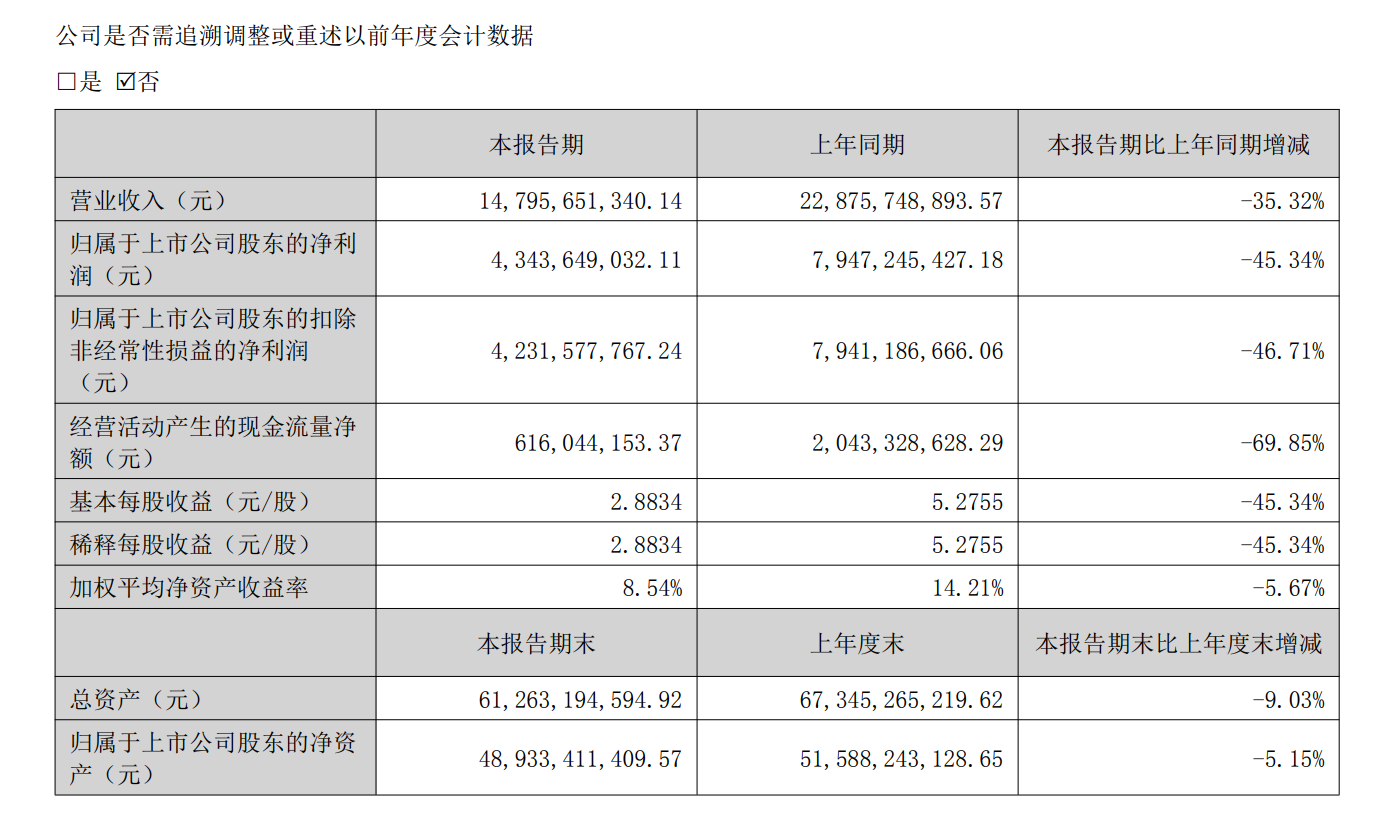
Core Viewpoint - The performance report of Jiangsu Yanghe Brewery Co., Ltd. reveals significant declines in revenue and net profit, indicating a potential reshuffling of the industry landscape, with Yanghe falling behind competitors [1][6]. Financial Performance - In the first half of 2025, Yanghe reported revenue of 14.8 billion yuan, a year-on-year decrease of 35.32%, and a net profit of 4.34 billion yuan, down 45.34% [2][6]. - The decline in revenue and net profit is the largest since the company went public in 2009 [2][6]. - The company's total assets decreased to approximately 61.26 billion yuan from 67.35 billion yuan at the end of the previous year [2]. Market Position - Yanghe has dropped from the third to the fifth position in the industry, overtaken by Shanxi Fenjiu and Luzhou Laojiao [6]. - The company was the only one among the top five liquor firms to report negative growth last year [6]. Sales Breakdown - Revenue from mid-to-high-end liquor decreased by 36.52% to 12.67 billion yuan, while ordinary liquor revenue fell by 27.24% to 1.84 billion yuan [11][12]. - The sales volume and revenue decline is attributed to market conditions affecting liquor sales [2][11]. Distribution Challenges - The number of distributors decreased by 257, with a significant drop in the number of out-of-province distributors [13][14]. - Revenue from out-of-province markets plummeted by 42.68% to 7.39 billion yuan, compared to a 25.79% decline in provincial sales [12][13]. Strategic Adjustments - Yanghe is undergoing a transformation in its distribution strategy, shifting from a deep distribution model to a more diversified approach to enhance distributor engagement [15]. - The company has initiated a focus on controlling inventory and stabilizing prices, including halting online sales of certain products [17][19]. Competitive Landscape - Yanghe faces increasing competition from rivals such as Gujing Gongjiu and Jianshu Yuer, which are gaining market share [16]. - The company is also responding to the growing trend of "light bottle liquor," which has seen significant market growth and consumer interest [20][22]. Future Outlook - Yanghe's management changes and strategic pivots are critical as the company seeks to regain its competitive edge in a challenging market environment [19][25]. - The market response to Yanghe's new product offerings, particularly in the light bottle segment, will be crucial for its recovery [20][24].
邀请函|国泰海通证券2025消费品年会-上海
国泰海通证券研究· 2025-08-22 09:08
Core Viewpoint - The article discusses the upcoming 2025 Consumer Goods Annual Conference organized by Guotai Junan Securities, highlighting key trends and opportunities in various consumer sectors, including beauty, health, jewelry, and technology [3][6]. Summary by Sections Conference Agenda - The conference will take place on September 2-3, 2025, at the Jin Mao Hotel in Shanghai, featuring a series of presentations and discussions on consumer trends and industry insights [3][6]. - Key topics include consumption trends in the longevity era, the resurgence of domestic beauty brands, the era of functional health products, and the jewelry industry in the new consumption age [6]. Afternoon Sessions - Afternoon sessions will cover topics such as the development trends of AI and smart glasses, the growth of cleaning appliances, luxury brand trends, and the second-hand e-commerce market in China [7][8][9]. - Experts from various fields will provide insights into the pet industry, AI applications in the internet sector, and the evolving landscape of consumer demand driven by policy and technology [10]. Participating Companies - The conference will feature discussions with representatives from notable companies across various sectors, including food and beverage, cosmetics, social services, retail, agriculture, textiles, and light industry [10]. - Specific companies mentioned include Xianle Health, Shanghai Jahwa, and various educational and retail firms, indicating a broad representation of the consumer goods landscape [10].