大疆

Search documents
云鲸中国区负责人王俊刚离职,扫地机行业巨头竞争再添变数?
Nan Fang Du Shi Bao· 2025-11-27 14:22
Core Viewpoint - The departure of Wang Jun, the head of Yunji's China region, is sudden and may impact the company's market performance and strategic direction as it approaches a Pre-IPO funding round [1][4][9]. Company Overview - Yunji Intelligent, established in October 2016, focuses on home robotics and has made significant technological advancements in areas such as SLAM, AI object recognition, and big data applications [2]. - The company has been recognized as one of China's top 50 technology robotics firms and has appeared on the Hurun Global Unicorn List for four consecutive years [2]. Product Development - Yunji has launched several innovative products, including the NARWAL J1, which redefined consumer perceptions of floor-cleaning robots, and the J4, which features a suction power of 7800Pa [3]. - The company has also expanded into the floor washing machine market with models like the S1 and S1 Max [3]. Market Performance - During the 2024 Double 11 shopping festival, Yunji achieved a sales revenue of over 1.7 billion, marking a 200% year-on-year increase [4]. - As of Q3 2025, Yunji held a 14.7% market share in China's online vacuum cleaner market, ranking fourth behind major competitors [4]. Industry Context - The vacuum cleaner industry is highly competitive, with the top five brands holding 89.2% of the domestic market share, while the penetration rate in Chinese households is only 6.9% [5]. - The global market for vacuum cleaners is projected to grow, with a shipment volume of 20.6 million units in 2024, reflecting an 11.2% year-on-year increase [5]. Competitive Landscape - Major players like Ecovacs and Roborock are intensifying competition, with Ecovacs holding a 25.4% market share in China [6][7]. - New entrants like DJI are leveraging their technology from the drone sector to enhance vacuum cleaner capabilities, although they face challenges in pricing and production [8]. Impact of Leadership Change - Wang Jun's departure is significant as it occurs during a critical phase for Yunji, potentially affecting its market strategy and performance [9][10]. - His experience in the industry and previous role at Roborock may have contributed to Yunji's operations, raising concerns about the company's future direction and leadership succession [10].
我们离实现“无人机灭火”还有多远?
财联社· 2025-11-27 09:48
Core Viewpoint - The current state of drone technology for firefighting, especially in high-rise buildings, is still lacking in practical application and standardization, facing numerous technical and regulatory challenges [1][11]. Group 1: Current Market Situation - Sales of firefighting drones are low, contributing minimally to the overall revenue of companies involved in this sector [3]. - Companies like Helen Zhe (300201.SZ) have reported selling only three units of their first-generation firefighting drone, indicating a very small market presence [4]. - Other companies, such as Chen An Technology (300902.SZ) and Qingniao Firefighting (002960.SZ), also express that their drone business has not yet formed stable revenue streams and remains in the research and development phase [4][5]. Group 2: Technical Limitations - The current technical paths for firefighting drones have physical limitations, particularly in high-rise fire scenarios where traditional ground equipment has blind spots [5]. - The main methods of firefighting include "water-based extinguishing" and the use of fire extinguishing projectiles, with the latter being more common for smaller drones [6][7]. - Small drones face challenges in carrying sufficient extinguishing projectiles, while larger drones struggle with the weight of water hoses and the effects of air currents [8][9]. Group 3: Future Development and Challenges - The industry requires a comprehensive approach to address the challenges of high-rise firefighting, including the need for drone swarms to effectively combat large fires [9][10]. - There is a call for the establishment of a management system for airspace and a collaborative command structure to enhance the operational effectiveness of firefighting drones [11]. - The development of high-power firefighting drones and the integration of extinguishing agents with drone technology are critical areas that need attention for future advancements [11].


中石科技:公司坚持大客户市场战略
Zheng Quan Ri Bao Zhi Sheng· 2025-11-27 08:41
Core Viewpoint - The company, Zhongshi Technology, emphasizes its long-term commitment to serving major clients in North America and other leading companies in the industry, focusing on high-performance and reliable product solutions [1] Group 1: Client Strategy - The company adheres to a major client market strategy, providing long-term services to top clients such as Samsung, Microsoft, Google, Amazon, and others [1] - The company actively participates in the cutting-edge research and development processes of its clients' new products [1] Group 2: Product Offerings - The main products offered by the company include high thermal conductivity graphite products, thermal interface materials, heat pipes, heat spreaders, thermal modules, EMI shielding materials, adhesive materials, and sealing materials [1]

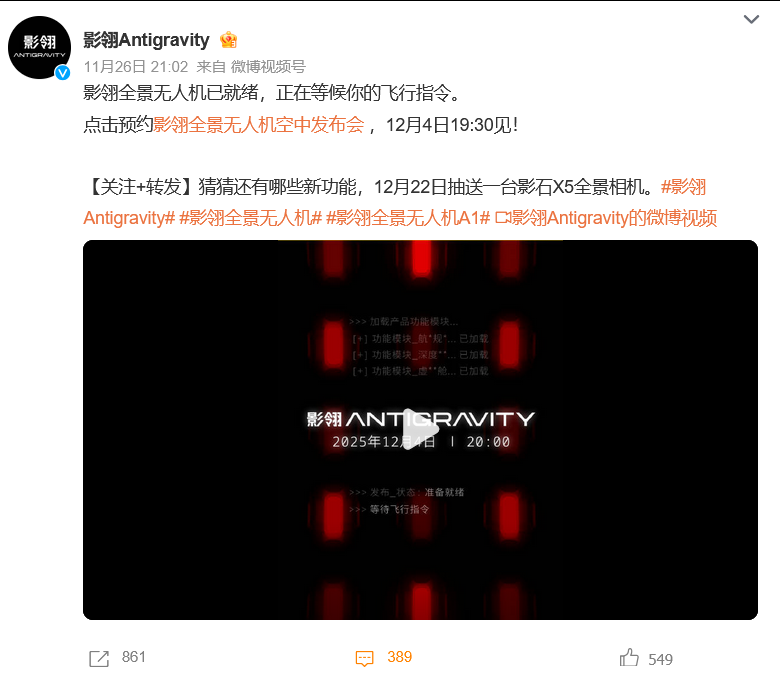
影石Insta360加速布局无人机市场 全球首款8K全景机型开启预定
Xin Hua Cai Jing· 2025-11-27 08:17
Core Insights - Insta360 has officially announced the pre-order for its first product under the Antigravity brand, the Antigravity A1, which is the world's first 8K panoramic drone, set to be unveiled on December 4 [1][4] - The pre-order period has started earlier than the previously anticipated January timeline, indicating the company's confidence in its product [4] - The launch of the Antigravity A1 marks Insta360's full entry into the consumer drone market after completing technology validation and market cultivation [4] Company Overview - Insta360 holds a 67.2% global market share in the panoramic imaging sector, leveraging its technological expertise to introduce a new category of panoramic drones [4] - The Antigravity A1 features a dual panoramic fisheye lens design, integrating Insta360's panoramic stitching technology, and is referred to as a "flying panoramic camera" [4] Industry Context - The introduction of the Antigravity A1 is expected to create a new niche in the consumer drone market, injecting innovation into the industry [4] - Competition in the consumer drone and smart wearable camera sectors is anticipated to intensify, especially with DJI's entry into the panoramic camera market [4]

中石科技(300684.SZ):长期服务于北美大客户、微软、谷歌、H客户等行业内头部客户
Ge Long Hui· 2025-11-27 07:32
Core Viewpoint - The company, Zhongshi Technology, emphasizes its long-term strategy of serving major clients in North America and other leading companies in the industry, focusing on high-performance and reliable product solutions [1] Group 1: Client Strategy - The company adheres to a major client market strategy, providing long-term services to top clients such as Samsung, Microsoft, Google, Amazon, and others [1] - The company actively participates in the cutting-edge research and development processes of its clients' new products [1] Group 2: Product Offerings - The main products offered by the company include high thermal conductivity graphite products, thermal interface materials, heat pipes, heat spreaders, thermal modules, EMI shielding materials, adhesive materials, and sealing materials [1]
深圳研发投入强度全国居首
Xin Lang Cai Jing· 2025-11-27 04:36
Core Insights - Shenzhen enterprises are increasingly excelling in cutting-edge innovation, with significant contributions from major companies like Huawei and BYD, as well as emerging champions like DJI and YingShi Innovation [1] R&D Investment Overview - In 2024, Shenzhen's R&D expenditure exceeded 240 billion yuan, ranking second among major cities in China [1] - The proportion of corporate R&D investment reached 93.5%, maintaining above 90% for several consecutive years [1] - Shenzhen's R&D expenditure intensity ranks first in the country, providing strong momentum for high-quality economic development [1] Growth Metrics - The total R&D expenditure in Shenzhen for 2024 is reported at 245.31 billion yuan, reflecting a year-on-year growth of 9.7% [1] - Since the start of the 14th Five-Year Plan, Shenzhen's R&D expenditure has maintained rapid growth, averaging an annual increase of 12.9%, outpacing national (10.5%) and provincial (10.0%) growth rates [1]
超2400亿!深圳研发投入强度全国居首
2 1 Shi Ji Jing Ji Bao Dao· 2025-11-27 04:29
Core Insights - Shenzhen's R&D expenditure for 2024 is projected to exceed 240 billion yuan, maintaining its position as the second-largest among major cities in China, with an R&D intensity of 6.67%, ranking first nationally [1][2] - The contribution of enterprises to R&D funding in Shenzhen is significant, with companies accounting for 93.5% of total R&D expenditure, reflecting a consistent trend of over 90% for several years [1][4] - Shenzhen's R&D funding has seen substantial growth, with an average annual increase of 12.9% since the start of the 14th Five-Year Plan, outpacing national and provincial averages [2][4] R&D Funding Growth - In 2024, Shenzhen's R&D funding is expected to reach 245.3 billion yuan, marking a 9.7% year-on-year increase, and continuing a trend of being the second-largest in the country for two consecutive years [2] - Since 2015, Shenzhen's R&D funding has more than doubled, growing from less than 80 billion yuan to nearly 250 billion yuan in 2024 [2] - The R&D intensity in Shenzhen has increased from 3.97% in 2015 to 6.67% in 2024, achieving a significant leap in funding intensity [2] Enterprise Contributions - Enterprises in Shenzhen contributed approximately 229.4 billion yuan to R&D in 2024, a 10% increase, while research institutions and universities contributed 10.9 billion yuan and 4.8 billion yuan, respectively [4] - The average annual growth rate of enterprise R&D funding since the 14th Five-Year Plan is 13.0%, surpassing the national average of 10.9% [4] Sectoral Insights - The six major industries in Shenzhen with R&D expenditures exceeding 10 billion yuan account for 82.8% of the city's total R&D funding, with the computer, communication, and electronic equipment manufacturing sector leading at 53.6% [5][6] - The specialized equipment manufacturing sector has shown the fastest growth in R&D funding, nearly doubling, while the automotive and electrical machinery sectors also demonstrated significant increases [5] Innovation and Talent Development - Shenzhen's basic research funding reached 11.6 billion yuan in 2024, growing by 21.2%, indicating a strong focus on foundational innovation [3] - The city has seen a notable increase in high-level talent, with approximately 26,500 high-level professionals and around 100 full-time academicians contributing to its innovation capabilities [3]
文化投资正当时:大湾区浮现五大趋势四大赛道
21世纪经济报道· 2025-11-27 02:34
Core Insights - The article highlights the significant investment opportunities in the cultural industry of the Guangdong-Hong Kong-Macao Greater Bay Area, driven by a robust ecosystem and active financial investment atmosphere [2][6][8]. Investment Landscape - In the past five years, the Greater Bay Area has seen 720 financing events in the cultural industry, totaling approximately 56.41 billion yuan [2][11]. - The investment focus is primarily on the integration of culture and technology, digital creative production, cultural "intelligent" manufacturing, and new forms of cultural consumption [11][12]. Industry Advantages - The cultural industry in Guangdong is characterized by a large scale, leading cultural manufacturing, concentrated cultural services, and a well-connected urban ecosystem [6][8]. - Guangdong's cultural products and services have successfully entered over 160 countries, accounting for about 40% of the national total in cultural exports [6][8]. Future Trends - The report identifies five major development trends in the cultural industry: consumption stratification, cultural industrialization, product digitization, emerging scenarios, and market globalization [2][10]. - The cultural manufacturing sector has established a comprehensive chain covering upstream and downstream industries, with notable clusters in cities like Guangzhou and Shenzhen [7][8]. Investment Recommendations - The report suggests three main investment directions: investing in content aligned with government policies, focusing on technology in hard tech fields, and targeting platforms in cultural big data and vertical cultural platforms [12][13]. - A "3415 model" is proposed, which includes three major sectors, four key investment tracks, and a cultural industry corridor to enhance collaboration and innovation [13].

吴振国:企业坚守公平竞争底线,才能在全球竞争格局中站稳脚跟
Jing Ji Guan Cha Bao· 2025-11-27 01:16
Core Viewpoint - The importance of antitrust compliance for companies is emphasized, highlighting its role in ensuring fair competition, driving innovation, and supporting high-quality economic development [2][10]. Group 1: Antitrust Compliance as a Tool for Fair Competition - Antitrust compliance serves as a "pass" for ensuring equal competition among various market entities, preventing monopolistic practices that can harm small and medium enterprises [3][4]. - During the "14th Five-Year Plan" period, over 100 cases of monopolistic agreements and abuse of market dominance were addressed, resulting in fines exceeding 20 billion [3]. Group 2: Supporting Industrial Upgrading and High-Quality Development - Antitrust compliance acts as a catalyst for improving product quality and advancing industries towards higher-end development, preventing monopolistic entities from raising prices and stifling innovation [5]. - The enforcement of antitrust laws has led to significant actions in the pharmaceutical sector, where over 12% of all cases involved monopolistic behaviors that harmed consumer interests [5]. Group 3: Driving Innovation - Antitrust compliance is crucial for unleashing innovation and fostering economic growth, as a fair competitive environment encourages companies to innovate rather than rely on monopolistic advantages [6]. - Recent enforcement actions have targeted monopolistic practices in the data services market, promoting a more competitive landscape that stimulates innovation [6]. Group 4: Risk Management and Stable Operations - Antitrust compliance serves as an early warning system for companies to identify and manage risks within the supply chain, especially in a globally interconnected market [8]. - Investigations into major foreign companies have highlighted the importance of compliance in preventing monopolistic control over critical domestic industries [8]. Group 5: Expanding International Markets and Global Competitiveness - Antitrust compliance is essential for companies aiming to engage in international markets, as it helps mitigate legal risks associated with foreign antitrust laws [9]. - Historical cases illustrate the potential costs of non-compliance, emphasizing the need for a robust antitrust compliance framework to enhance global competitiveness [9]. Group 6: Regulatory Framework and Future Directions - The release of updated antitrust compliance guidelines by regulatory bodies aims to strengthen companies' risk management capabilities and promote a culture of fair competition [10]. - Companies are encouraged to integrate compliance into their operational frameworks to ensure sustainable growth and respect in the market [10].
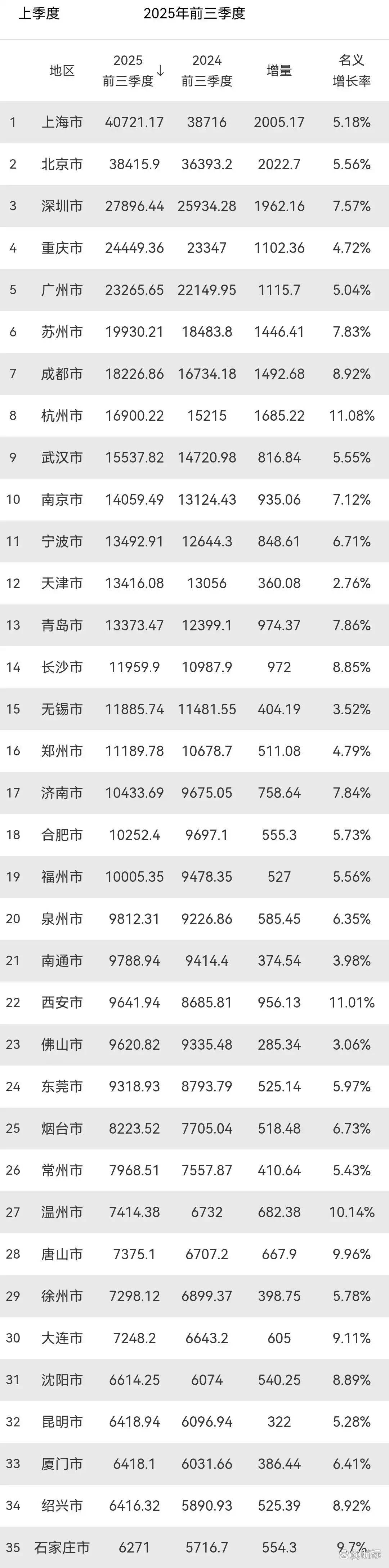
最新公开!全国GDP35强城市大洗牌:深圳近3万亿,宁波逆袭天津,徐州落后唐山!
Sou Hu Cai Jing· 2025-11-26 19:09
Core Insights - The economic landscape of Chinese cities is undergoing dynamic adjustments driven by regional coordination policies and new productive forces, with significant growth observed in the top 35 cities, highlighting the resilience of the Chinese economy [1] Group 1: Economic Performance - In the first three quarters of 2025, Shenzhen's GDP reached 27,896.44 billion, with a nominal growth rate of 7.57%, nearing the 30 trillion mark [2][4] - Shanghai and Beijing also showed strong performance, with GDPs of 40,721.17 billion and 38,415.9 billion respectively, reflecting growth rates of 5.18% and 5.56% [2][3] - Ningbo surpassed Tianjin with a GDP of 13,492.91 billion, achieving a growth rate of 6.71% compared to Tianjin's 2.76% [6][7] Group 2: Sectoral Insights - Shenzhen's growth is attributed to its strategic positioning as a "pilot demonstration zone" and the integration of technology, industry, and finance, with a notable increase in patent applications and digital trade [4][5] - Ningbo's economic surge is linked to its port and new manufacturing capabilities, with a significant increase in container throughput and a 15.4% growth in high-end petrochemical industry value [6][7] - Tangshan's growth is driven by the acceleration of traditional industry upgrades, particularly in steel production, while Xuzhou is experiencing a slower transition due to its reliance on traditional manufacturing [8][10]