京东方

Search documents
群智咨询:预计2026年电视面板市场增长重点转向大尺寸
智通财经网· 2025-12-16 12:08
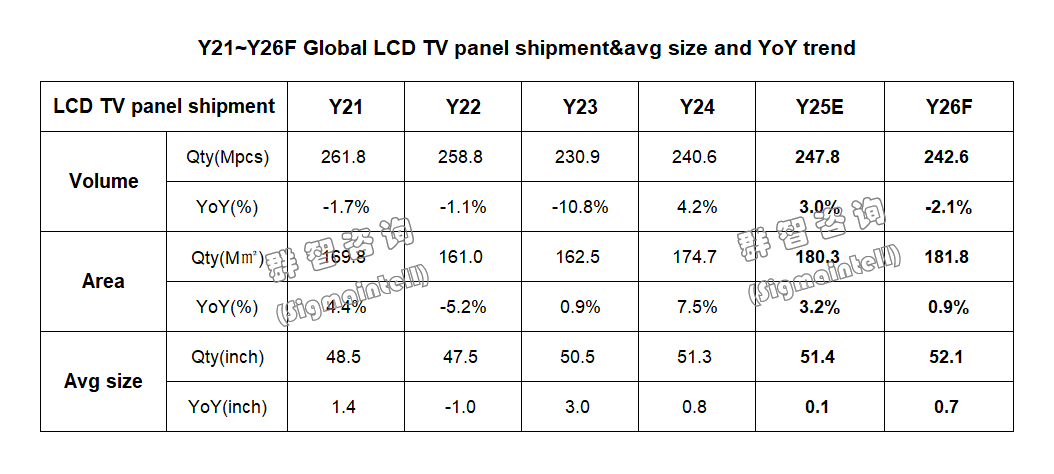
Core Insights - The global LCD TV panel shipment is expected to reach 248 million units in 2025, a 3.0% year-on-year increase, but is projected to decline to 243 million units in 2026, a 2.1% decrease, with a focus on larger sizes driving a 0.9% increase in shipment area [1][3] Market Overview - The demand for LCD TV panels is influenced by several factors, including the upcoming 2026 World Cup, which is expected to drive demand in late 2025 and early 2026 due to inventory preparations [1][2] - The North American market is expected to remain vibrant due to tax incentives and World Cup preparations, while the Chinese market faces challenges due to a sluggish real estate sector [2][3] Supply Chain Dynamics - The rising prices of storage devices present a dual effect on the TV panel market, potentially increasing short-term demand but also raising costs for manufacturers, which may lead to reduced orders for smaller panels [2][3] - Major panel manufacturers are planning production cuts during the Chinese New Year to stabilize prices and manage supply-demand dynamics [3][10] Company Strategies - BOE aims to enhance its operational strength by focusing on size structure upgrades, with plans to produce 65.32 million panels in 2026, increasing the proportion of large sizes [6] - TCL CSOT plans to maintain stable production levels while focusing on profitability and product structure optimization, with a target of 58.81 million panels in 2026 [6] - HKC is adopting a flexible capacity strategy to ensure steady growth, planning to produce 38.11 million panels in 2026, with a focus on larger sizes [7] Price and Demand Outlook - The first quarter of 2026 is expected to see a balance in supply and demand due to production cuts, with potential localized price increases for LCD TV panels [10] - The second quarter may face challenges as manufacturing costs rise, impacting promotional strategies for brands [10] Industry Growth Model - The concept of a growth flywheel is applicable to the TV industry, where various components, including panels, storage, and assembly, interact to drive growth [13] - The health of the growth flywheel may be threatened by rising storage prices and profit losses in the assembly segment, necessitating a collaborative approach to maintain value growth [13]

新一轮上升周期下面板行业信用风险研究
Lian He Zi Xin· 2025-12-16 11:43
1. Report's Industry Investment Rating The provided content does not mention the industry investment rating. 2. Core Viewpoints of the Report - Since 2024, the panel industry has entered a new upward cycle. The demand for high - end consumer electronics is the medium - to - long - term core driver for the industry's upward movement from 2026 - 2028, but the uncertainty of national subsidy policies may lead to demand fluctuations. - High - end panel production capacity is expanding rapidly, while low - end capacity remains stable, and panel prices are relatively stable. - Leading enterprises are expected to maintain stable profits and reduce leverage through demand recovery, technological iteration, and production control. In contrast, most small and medium - sized manufacturers have high leverage, low profitability due to the squeeze from leading enterprises, and some may be eliminated [1]. 3. Summary by Relevant Catalogs 3.1 Introduction - In the past few decades, the panel manufacturing industry has shifted to China. In 2024, the share of mainland China's LCD panels exceeded 70%. The industry's production capacity structure has been optimized, and high - end panel products have strong downstream demand. The future panel industry will feature multiple technological paths such as LCD, OLED, and Mini - LED [4]. 3.2 Panel Industry Cycle and Key Factors Affecting Credit Risk 3.2.1 Panel Industry Cycle - Since 2012, the panel industry has experienced three complete cycles and entered the fourth upward cycle since 2024. The industry is highly cyclical, with supply - demand changes, technological iteration, and competition pattern changes running through its development. In the upward phase, supply - demand and corporate performance improve; in the downward phase, there is over - supply, price decline, and an increase in the number of loss - making enterprises [5]. - **First cycle**: The upward phase was from September 2014 to June 2015, with growing LCD demand and rising prices. The downward phase was from July 2015 to August 2016, with over - supply due to the concentrated launch of LCD 8.5 - generation production lines and falling prices [6]. - **Second cycle**: The upward phase was from September 2016 to November 2017, driven by the demand for large - size LCD TVs and mobile phone OLED screens, and the contraction of Korean enterprises' LCD capacity. The downward phase was from December 2017 to December 2019, with over - supply due to the concentrated launch of high - generation LCD production lines and falling prices [6]. - **Third cycle**: The upward phase was from April 2020 to July 2021, due to the "stay - at - home economy" during the pandemic and the exit of Korean enterprises from the LCD field. The downward phase was from August 2021 to October 2022, with the decline of the "stay - at - home economy" and over - supply. The adjustment phase was from November 2022 to the end of 2023, with panel manufacturers controlling production and prices starting to rise in March 2023 [6][7]. - **Fourth cycle**: Since 2024, the upward cycle has been driven by the "trade - in" policy, with the demand for medium - sized OLED applications in vehicles and tablets continuously released. Leading panel manufacturers control production, and panel prices are stable [11]. 3.2.2 Core Factors Affecting Panel Industry Credit Risk - **Supply - demand situation**: Supply - demand changes cause panel price fluctuations, affecting corporate revenue, cash flow, and solvency. In the upward cycle, demand is strong, prices rise, and credit risk is low; in the downward cycle, over - supply leads to price drops and increased credit risk [12]. - **Technological iteration**: It helps reduce production costs and improve efficiency but also accelerates the elimination of old - technology production lines. Enterprises that fail to keep up with technological trends face product backlogs and increased credit risk [13]. - **Market competition**: In the upward cycle, competition is mild, and credit risk is controllable. In the downward cycle, leading enterprises squeeze the living space of small and medium - sized manufacturers, increasing their credit risk [15]. - **Financial leverage and profitability**: The panel industry is capital - intensive, and enterprises rely on debt financing for expansion, leading to high asset - liability ratios. In the upward cycle, profitability is strong, and credit risk is low; in the downward cycle, over - supply and high debt pressure increase credit risk [16]. 3.3 Changes in Credit Risk Factors in the Current Upward Cycle (2024 - present) 3.3.1 Supply - demand Situation - In the current upward cycle, panel demand is driven by the demand upgrade of consumer electronics and the national "trade - in" policy. The overall supply - demand is in a tight balance, with stable low - end capacity and rapidly expanding high - end capacity. Panel prices are basically stable [17]. - In 2024, the global display panel market size reached 1.3 trillion yuan, a 9.41% increase from the previous year, and is predicted to reach 1.4 trillion yuan in 2025. The average size of global LCD TV panels increased to 51.4 inches, the sales of Mini - LED TVs increased by 490.6%, the shipment of tablets increased by 9.2%, the shipment of monitors increased by 1.5%, and the shipment of smartphone display panels increased by 7%, with the shipment of OLED smartphones increasing by 26% [17][18][19]. - The government has issued a series of policies to support the development of the panel industry, including promoting technological research and expanding the scope of "trade - in" subsidies [20][21]. - In the future, high - end panel supply may face over - capacity risks after 2028 if new production capacity continues to be launched and demand growth is lower than expected [23]. - Panel prices are expected to start a general decline in November 2025, with mainstream - size panel prices expected to drop by $2 and larger - size panels having a more significant decline [24][26]. 3.3.2 Technological Iteration - The global display panel market shows a diversified development of technological routes. LCD dominates the low - to - mid - end market, OLED penetrates the mid - to - high - end market, Mini - LED fills the gap between them, and Micro LED has not been commercialized [28]. - In 2024, the market share of TFT - LCD was 56.25%, and that of OLED was 14.51%. In 2025, the demand for OLED panels in mobile phones and mid - sized IT products increased [31]. - Mini - LED has the advantages of long life and low cost, and its TV shipments exceeded those of OLED in 2025. Micro LED has excellent performance but is limited by high cost and technical bottlenecks [33]. 3.3.3 Market Competition - The panel industry is mainly dominated by Korean and Chinese enterprises, with a stable and highly concentrated competition pattern. Chinese enterprises have the right to speak in the LCD field, Korean manufacturers dominate the OLED field, and the competition situation between Chinese and Korean enterprises in the Mini - LED field varies in different industrial chain links [34]. - In the LCD field, mainland China's capacity accounted for 72.7% in 2024, and the concentration is increasing. In the OLED field, Korean manufacturers still have an advantage, while Chinese enterprises are making technological breakthroughs. In the Mini - LED field, Chinese and Korean enterprises are competing, and Chinese enterprises have achieved a breakthrough in the upstream of the industrial chain [34][35][36]. 3.3.4 Financial Leverage and Profitability - In the current upward cycle, panel enterprises' financial leverage remains high, with leading enterprises' total debt - to - capital ratio at around 50% and mid - to - tail enterprises' exceeding 60%. Profitability has improved through production control and price stabilization, but the gross profit margin is still low [38]. - In the first half of 2025, 4 out of 8 mainland Chinese panel enterprises achieved profitability. The gross profit margins of leading enterprises are between 13% - 16%, while those of mid - to - tail enterprises are below 7% or even negative [40][42]. - The new OLED 8.6 - generation production lines under construction by some enterprises will drag down their profitability in the short term but will have cost advantages in the long term, squeezing the profit space of non - layout enterprises [44]. 3.4 Summary and Outlook of Panel Industry Credit Risk in the Current Upward Cycle - The demand for high - end consumer electronics is the medium - to - long - term core driver for the industry's upward movement, but the uncertainty of national subsidy policies may lead to demand fluctuations [45]. - Low - end panel capacity is stable, and high - end capacity is expanding rapidly. High - end panels are expected to achieve supply - demand balance from 2026 - 2028, but there may be over - capacity risks after 2028 [45]. - The panel industry will present a multi - technology parallel pattern for a long time. LCD will maintain its mainstream position, OLED will penetrate the mid - to - high - end market, Mini - LED will fill the high - end niche market, and Micro LED will be difficult to become the mainstream in the short term [46]. - In the current upward cycle, Chinese enterprises monopolize the LCD market, and the concentration will continue to increase. The years from 2026 - 2028 will be crucial for the competition between Chinese and Korean high - generation OLED production lines. Chinese enterprises will expand their leading edge in the Mini - LED field [47]. - The financial leverage shows a differentiated trend. Leading enterprises will gradually reduce leverage, while most mid - to - tail enterprises have high leverage and high risks [48]. - The profitability is concentrated in leading enterprises. Leading enterprises' profitability will continue to increase, while mid - to - tail enterprises' profitability is low, and some may be eliminated [48][49].
京东方董事长陈炎顺赴韩与三星高管商谈LCD面板供应合作
Xin Lang Ke Ji· 2025-12-16 11:43
Core Viewpoint - BOE Technology Group's Chairman Chen Yanshun recently met with Samsung Electronics executives in Suwon, South Korea, to discuss potential collaboration, specifically the possibility of expanding LCD panel supply to Samsung [1]. Group 1 - The meeting involved discussions with Yong Seok-woo, head of Samsung's Visual Display (VD) division [1]. - Samsung and BOE recently reached a settlement regarding intellectual property in the display sector, leading to the withdrawal of the U.S. 337 investigation and related cases [1].


主力资金丨7股尾盘主力资金大幅净流出
Zheng Quan Shi Bao Wang· 2025-12-16 11:13
8股获主力资金净流入超3亿元 从个股来看,53股主力资金净流入超1亿元,8股获主力资金净流入超3亿元。 永辉超市主力资金净流入12.39亿元,今日零售概念再度活跃,永辉超市、百大集团、欧亚集团、红旗 连锁等涨停。消息面上,12月14日,商务部等三部门联合印发《关于加强商务和金融协同更大力度提振 消费的通知》。 航天发展主力资金今日净流入11.72亿元。龙虎榜数据显示,上榜营业部席位全天成交25.08亿元,合计 净卖出6886.28万元。 (原标题:主力资金丨7股尾盘主力资金大幅净流出) 今日有7个行业主力资金净流入。 A股三大指数今日(12月16日)集体回调。行业板块呈现普跌态势,贵金属、船舶制造、电源设备、风 电设备、有色金属、光伏设备、文化传媒、小金属、采掘行业跌幅居前,商业百货板块逆市走强。 从今日主力资金情况来看,沪深两市全天主力资金净流出520.66亿元。今日有7个行业主力资金净流 入,商贸零售行业主力资金净流入18.82亿元,远超其他行业;银行、纺织服饰行业主力资金净流入金 额分别为4.07亿元、1.98亿元;其他行业主力资金净流入金额均不超过亿元。 24个主力资金净流出行业中,电力设备行业主力资 ...





创建可持续品牌,9家中国领军企业走进联合国
2 1 Shi Ji Jing Ji Bao Dao· 2025-12-16 11:08
Group 1 - The "Creating Sustainable Brands" vision initiative was officially launched by nine leading Chinese companies at the UNEP headquarters in Nairobi, showcasing China's commitment to sustainable transformation on an international platform [1][5] - This initiative, also known as the "Geneva Vision Initiative," was co-launched by the Sustainable Business Leaders Forum (SBLF) and the China Standardization Association's Sustainable Business and Brand Committee (SBBC) [2] - The initiative aims to find representative cases that deeply integrate sustainable development with brand value creation, providing actionable methods for the global sustainable business ecosystem [5][7] Group 2 - The initiative outlines a systematic approach for companies to incorporate sustainable development into their business and brand value creation, advocating actions in five main areas: integrating sustainability into corporate strategy, establishing responsible business operations, leveraging technological innovation, enhancing product and service sustainability, and incorporating sustainability into brand building [7][8] - This five-dimensional framework addresses common challenges faced by companies in their sustainable exploration efforts [8]




3只个股尾盘主力资金大幅净流入
Zheng Quan Shi Bao Wang· 2025-12-16 09:47
Group 1 - The main market trend shows a net outflow of 5.516 billion yuan from the main funds in the Shanghai and Shenzhen stock markets at the end of the trading day on December 16 [1] - Specific stocks such as Aerospace Development, Feilihua, and Feilong Co. saw a net inflow of over 100 million yuan in main funds at the end of the day [1] - Other stocks including Haima Automobile, BOE Technology Group, Jingrui Electric Materials, and China Satellite also experienced a net inflow of over 40 million yuan in main funds [1] Group 2 - On the contrary, stocks like Reco Defense, Pingtan Development, and New Yisheng faced a net outflow of over 200 million yuan in main funds at the end of the day [1] - Additionally, stocks such as Zhongji Xuchuang, Sunshine Power, Shenghong Technology, and CATL also saw a net outflow of over 100 million yuan in main funds [1]




公司问答丨长阳科技:公司CPI项目正在建设中
Ge Long Hui A P P· 2025-12-16 09:19
Group 1 - The company is currently constructing its CPI (Colorless Polyimide) film project and is accelerating the development and validation process of the CPI film [1] - The company has received inquiries from investors regarding whether its CPI film has been validated by leading enterprises such as BOE and Huawei [1] - The company has not yet confirmed if its first CPI film production line is ready for production [1]

“以存代算”引爆存储涨价周期,消费电子ETF(561600)震荡蓄势
Xin Lang Cai Jing· 2025-12-16 02:44
Group 1 - The core viewpoint of the articles highlights a significant price surge in the global memory chip market, particularly in DRAM and NAND Flash, with prices increasing over 300% since September 2023, driven by the rise of AI applications [1][2] - The consumption electronics sector is expected to implement a combination of structural price increases and cost-sharing strategies with the supply chain, particularly as the demand for consumer electronics like smartphones and computers is projected to rise through 2026 [1] - The consumption electronics ETF closely tracks the performance of the China Securities Consumption Electronics Theme Index, which includes 50 listed companies involved in component production and brand design [2][3] Group 2 - The top ten weighted stocks in the China Securities Consumption Electronics Theme Index account for 56.39% of the index, indicating a concentration of investment in key players such as Luxshare Precision and Cambricon Technologies [3] - AI is enhancing the demand for consumer batteries, as the integration of AI in devices like smartphones and wearables is leading to increased power consumption and a higher demand for lithium batteries [2]



2025年电子信息行业发展大会在盐召开
Xin Hua Ri Bao· 2025-12-15 23:04
12月14日,由中国电子信息行业联合会、盐城市人民政府共同主办的2025年电子信息行业发展大会 在盐城召开。大会以"创新驱动 迈向高质量发展新征程"为主题,来自工信部、省工信厅、中国电子信 息行业联合会以及行业重点企业的近300名嘉宾参会,会议发布《2025年电子信息行业质量提升与品牌 建设典型案例》,举行第十四届中国创新创业大赛柔性电子技术专业赛颁奖仪式,"盐城市黄海东大柔 性电子科技创业投资基金"同时启动。 会上,专家学者代表围绕"中国电子信息制造业'十四五'发展回顾及'十五五'发展思考""面向生命健 康的智能柔性传感""高端装备的突破 中国显示产业发展之展望"作主题报告。京东方科技集团、新华三 集团等重点企业代表作交流分享。会上,盐城高新区作专题推介。作为盐城唯一的国家高新区,盐城高 新区汇聚电子信息行业重点企业130余家,产业规模超300亿元,年均增长20%以上。 通过技术研讨、成果发布、案例分享与项目路演,会议深度链接产学研用资源,吸引了全市各板 块、部门及招商团队参与。以此次大会为契机,盐城将在新一代智能终端、柔性电子、第三代半导体等 诸多领域加强合作,全面提升电子信息产业规模与能级。 ...
三十载扎根实体 北京银行为培育新质生产力厚植金融沃土
经济观察报· 2025-12-15 13:19
Core Viewpoint - Beijing Bank has successfully positioned itself as a key player in supporting innovation and the real economy over the past thirty years, focusing on nurturing new productive forces and fostering a symbiotic relationship with enterprises [1][12]. Group 1: Nurturing Innovation - The bank's long-term strategy in the technology innovation sector has allowed it to cultivate "seeds" of future productive forces, providing essential financial support to innovative SMEs and contributing to China's modernization [1][12]. - Beijing Bank acts as a financial intermediary, unlocking potential value in future industries while safeguarding the production value of traditional sectors [2][6]. Group 2: Supporting Emerging Industries - The bank emphasizes the importance of investing in "seeds" that can generate future growth momentum, accepting short-term uncertainties for long-term value [4][5]. - Beijing Bank has supported numerous seed enterprises in future industries, such as Digital Huaxia, which focuses on humanoid robots and intelligent hardware, by providing tailored financial products like "Lianchuang e-loan" [5][12]. Group 3: Partnership with Leading Enterprises - Beijing Bank has a long-standing partnership with leading companies like BOE Technology Group, providing comprehensive financial services that have supported the company's growth over two decades [8][9]. - The bank has actively participated in financing BOE's technological innovations, including issuing technology innovation bonds totaling over 1 billion yuan [9][12]. Group 4: Revitalizing Traditional Industries - Traditional industries serve as the foundation for future technological advancements, and financial support for their upgrade is crucial for maintaining their core value [11][12]. - Beijing Bank has provided significant financial backing to companies like Shenwan Innovation, facilitating their expansion and technological upgrades through products like "Kechuang e-loan" [12]. Group 5: Future Outlook - With the Chinese government's focus on high-level technological self-reliance and the development of new productive forces, Beijing Bank aims to deepen the integration of finance and technology, offering more flexible products and intelligent services [13].