
中国能建

Search documents
“能源绿色低碳转型”看山东之肥城:精心打造能源绿色低碳转型试点样板
Zhong Guo Fa Zhan Wang· 2026-02-04 06:43
Core Viewpoint - The city of Feicheng in Shandong Province is actively promoting the development of new energy and renewable energy sectors, achieving significant progress in green and low-carbon energy transformation, particularly in salt cavern energy storage and new battery electrode materials [1] Group 1: Energy Transformation Achievements - By 2024, the energy consumption per unit of GDP in Feicheng is expected to decrease by 26.2% [1] - As of September 2025, non-fossil energy consumption is projected to account for 31.5% of the total, with installed capacity of new and renewable energy reaching 1.6292 million kilowatts, representing 63.26% of total power generation capacity [1] - Feicheng's energy transformation has led to its recognition as a "Top Ten Industry" innovation leading area in the province, with its salt cavern energy storage industry cluster being selected as a first batch future industry cluster [1] Group 2: Organizational Leadership and Support - The municipal government has prioritized new energy initiatives in its 2025 government work report and established a dedicated industrial promotion committee to oversee the development of the new energy industry chain [2] - Specialized teams have been formed to focus on the salt cavern energy storage and new battery electrode materials sectors, facilitating coordinated development and addressing specific industry challenges [2] Group 3: Resource Allocation and Planning - Feicheng is focusing on gathering quality resources such as land and funding to support the new energy industry, with a comprehensive plan for salt cavern energy storage and gas utilization [3] - The city has secured significant funding for various projects, including a 100MW new carbon dioxide energy storage project and a 350MW compressed air energy storage project [3] Group 4: Traditional and New Energy Integration - The city is committed to maintaining stable energy production, with coal production expected to reach 1.0705 million tons in 2024 and significant coal storage capacity established [4] - New energy sources are also expanding, with total installed capacity for centralized and distributed solar power reaching 650,000 kilowatts and 600,000 kilowatts respectively, alongside wind power capacity of 195,000 kilowatts [4] Group 5: Salt Cavern Energy Storage and Lithium Battery Industry - Feicheng is developing a comprehensive salt cavern energy storage industry, with plans for a new energy storage industrial demonstration base covering over 2,500 acres and 22 ongoing projects [5][6] - The city is enhancing its lithium battery industry by establishing a complete industrial chain from lithium ore processing to battery recycling, with significant investments in new projects [7] Group 6: Technological Innovation and Low-Carbon Living - The city is fostering technological innovation in the energy sector through collaborations with numerous universities and research institutions, resulting in multiple awards and recognitions [8] - Efforts to promote low-carbon living include the development of green buildings, electric public transportation, and geothermal energy projects, contributing to a sustainable urban environment [9]


中国能建涨2.08%,成交额9.94亿元,主力资金净流入3185.14万元
Xin Lang Zheng Quan· 2026-02-04 06:23
Core Viewpoint - China Energy Construction Co., Ltd. (China Energy) has shown a mixed performance in stock price and financial metrics, with a recent increase in stock price but a decline in net profit year-on-year [1][3]. Group 1: Stock Performance - On February 4, China Energy's stock price increased by 2.08%, reaching 2.45 CNY per share, with a trading volume of 9.94 billion CNY and a turnover rate of 1.27%, resulting in a total market capitalization of 102.14 billion CNY [1]. - Year-to-date, the stock price has risen by 4.26%, with a slight decline of 0.41% over the last five trading days, a 3.38% increase over the last 20 days, and a 0.41% decrease over the last 60 days [1]. Group 2: Financial Performance - For the period from January to September 2025, China Energy reported a revenue of 323.54 billion CNY, reflecting a year-on-year growth of 9.62%. However, the net profit attributable to shareholders decreased by 12.43% to 3.16 billion CNY [3]. - Since its A-share listing, China Energy has distributed a total of 4.69 billion CNY in dividends, with 3.75 billion CNY distributed over the past three years [3]. Group 3: Company Overview - China Energy, established on December 19, 2014, and listed on September 28, 2021, primarily engages in construction contracting, operating through five business segments: surveying and design, engineering construction, equipment manufacturing, civil blasting and cement production, and investment and other businesses [2]. - The revenue composition of China Energy is as follows: engineering construction accounts for 81.18%, industrial manufacturing 7.42%, investment operations 6.80%, surveying and design 4.07%, and other businesses 0.53% [2].
氢能行业2026年度投资策略
2026-02-04 02:27
而从目前的氢气的需求来看的话,整个氢能的应用,目前主要还是集中在一些工业领域当 中。先以 2024 年的氢能利用结构来占比来看,合成氨占比大概在 26%。合成甲醇占比 27%,液化 17%,煤化工占比 11%。这些基本上都是偏向于工业领域当中的。而剩下的 这 99%的氢能占比,是分布在交通、供热,还有冶金等这些方向。所以整个的氢能,在工 业领域当中还是个最主要的一个战战场。但是,未来交通和建筑,也是一个相对来说比较 明显的一个增量市场,发展潜力也是相对比较大的。 然后我们之前在也写过一些深度报告,对远期的绿氢的需求,做了一个测算。那目前的话 整个氢气的存量替代主要是用在合成氨,还有甲醇制备的这些领域当中。增量的话主要是 在交通领域、清洁能源,还有建筑用能。我们之前测算整个沥青在远期的话,应该是可以 需需求量达到 9400 万吨以上的一个水平。基本上分散在各个行业当中。所以氢能的话, 其实是一个应用场景非常宽泛、非常灵活的一个能源。那第二个就是来介绍一下整个氢能 的一个政策上的情况。 其实最近最近这些年的话,习总书记也在多次将多次举风电光伏并列提及到氢能整个产业 链的一个发展。而且青岛的话,在过去 5 年其实是 ...
未知机构:海外持续景气叠加国产替代提速继续看多洁净室260118-20260204
未知机构· 2026-02-04 01:50
Summary of Conference Call Notes Industry and Company Involved - **Industry**: Semiconductor and Construction - **Key Companies**: TSMC (Taiwan Semiconductor Manufacturing Company), Micron, Samsung, Intel, Longxing Technology, SMIC (Semiconductor Manufacturing International Corporation), and others Core Points and Arguments 1. **Impact of AI on Semiconductor Capital Expenditure**: The rise of AI is driving increased capital expenditure in the semiconductor industry, which in turn affects the construction sector, particularly in cleanroom construction and IDC (Internet Data Center) bidding areas. This demand surge is attributed to the global tech industry's growth, especially in AI [1][2] 2. **Significant Capital Expenditure by TSMC**: TSMC's capital expenditure is projected to reach $40.9 billion in 2025 and $56 billion in 2026, marking a historical high. This reflects a broader trend of increased capital spending among major semiconductor firms [4][12] 3. **Global Semiconductor Investment Trends**: The semiconductor industry is experiencing a significant increase in capital expenditure, with major players like TSMC, Samsung, and Intel leading the charge. The U.S. and Taiwan have reached trade agreements that will facilitate a $250 billion investment in the semiconductor supply chain [4][12] 4. **Cleanroom and IDC Construction Opportunities**: Analysts recommend focusing on cleanroom construction and IDC bidding as these areas are expected to see high demand due to the tech industry's growth. Companies like China Energy Construction and Sensen Da A are highlighted for their advantages in IDC construction and cloud computing services [2][19] 5. **Challenges in the Construction Industry**: The construction sector faces challenges such as labor shortages, trade tensions, and the need for overseas subsidiaries. However, the industry is expected to benefit from increased demand driven by global manufacturing trends and resource security capital expenditure [3][11] 6. **Investment in IDC and Cloud Infrastructure**: Major internet companies and telecom operators in China are accelerating investments in IDC and cloud infrastructure, with Alibaba planning to invest 380 billion RMB in AI over the next three years. This trend is expected to continue into 2026 [19][20] 7. **Market Dynamics and Valuation Trends**: The cleanroom industry is viewed as a significant investment opportunity, with a focus on stock price positions, order expectations, and customer bidding forecasts rather than just performance metrics. The current market dynamics suggest a potential for valuation increases driven by industry trends [8][16] 8. **Domestic Semiconductor Companies' Growth**: Domestic semiconductor firms like Longxing Technology and SMIC are in a critical phase of expansion and technological upgrades, with capital expenditures expected to grow. The market is increasingly focusing on these companies due to their growth potential [14][15] Other Important but Possibly Overlooked Content - **Trade Agreements and Tariffs**: The U.S. has reduced tariffs on Taiwanese semiconductor products from 20% to 15% as part of a trade agreement, which is expected to facilitate investment in the semiconductor sector [12] - **Focus on Cleanroom and IDC Construction**: The emphasis on cleanroom and IDC construction reflects a broader trend in the construction industry, where demand is increasingly driven by technological advancements rather than traditional construction metrics [8][10] - **Emerging Companies in the IDC Space**: Companies like China Telecom's subsidiary and Sensen Da A are positioned as key players in the IDC construction and cloud computing sectors, indicating a shift in investment focus towards these emerging firms [17][18]

申万宏源证券晨会报告-20260204
Shenwan Hongyuan Securities· 2026-02-04 00:43
Core Insights - The report discusses the implementation of the "Tax Law Principle" and its implications for service industries such as internet and finance, indicating that current tax arrangements are unlikely to change significantly in the short term [2][3][12] - The real estate sector is experiencing a favorable shift in financing policies, with REITs and private placements opening new equity financing channels to alleviate financial pressures on real estate companies [3][13] Tax Law Implementation - The State Council approved the "Implementation Regulations of the Value-Added Tax Law of the People's Republic of China" on December 19, 2025, and subsequent announcements have clarified tax details, suggesting stability in tax arrangements for service industries [2][3][12] - The definition of "basic services" in telecommunications is evolving, with mobile data and internet broadband still classified as "value-added services" subject to a 6% VAT rate, while traditional voice services are recognized as "basic services" with a 9% VAT rate [2][3][12] Real Estate Sector Analysis - The financing environment for the real estate industry is improving, with a shift from debt financing to equity financing, including the introduction of REITs and private placements [3][13] - Recent regulatory changes, such as the gradual retreat from the "three red lines" policy, indicate a more supportive financing environment for real estate companies [13] - The report maintains a "positive" rating for the real estate sector, highlighting the potential for recovery in the industry as financing policies become more favorable [3][13] Investment Recommendations - The report recommends several quality real estate companies for investment, including China Jinmao, Poly Developments, and China Resources Land, among others, due to their potential for recovery and attractive valuations [13] - The report emphasizes the importance of monitoring the evolving financing landscape and the impact of government policies on the real estate market [3][13]





光热发电如何破解成本难题?
Ke Ji Ri Bao· 2026-02-04 00:35
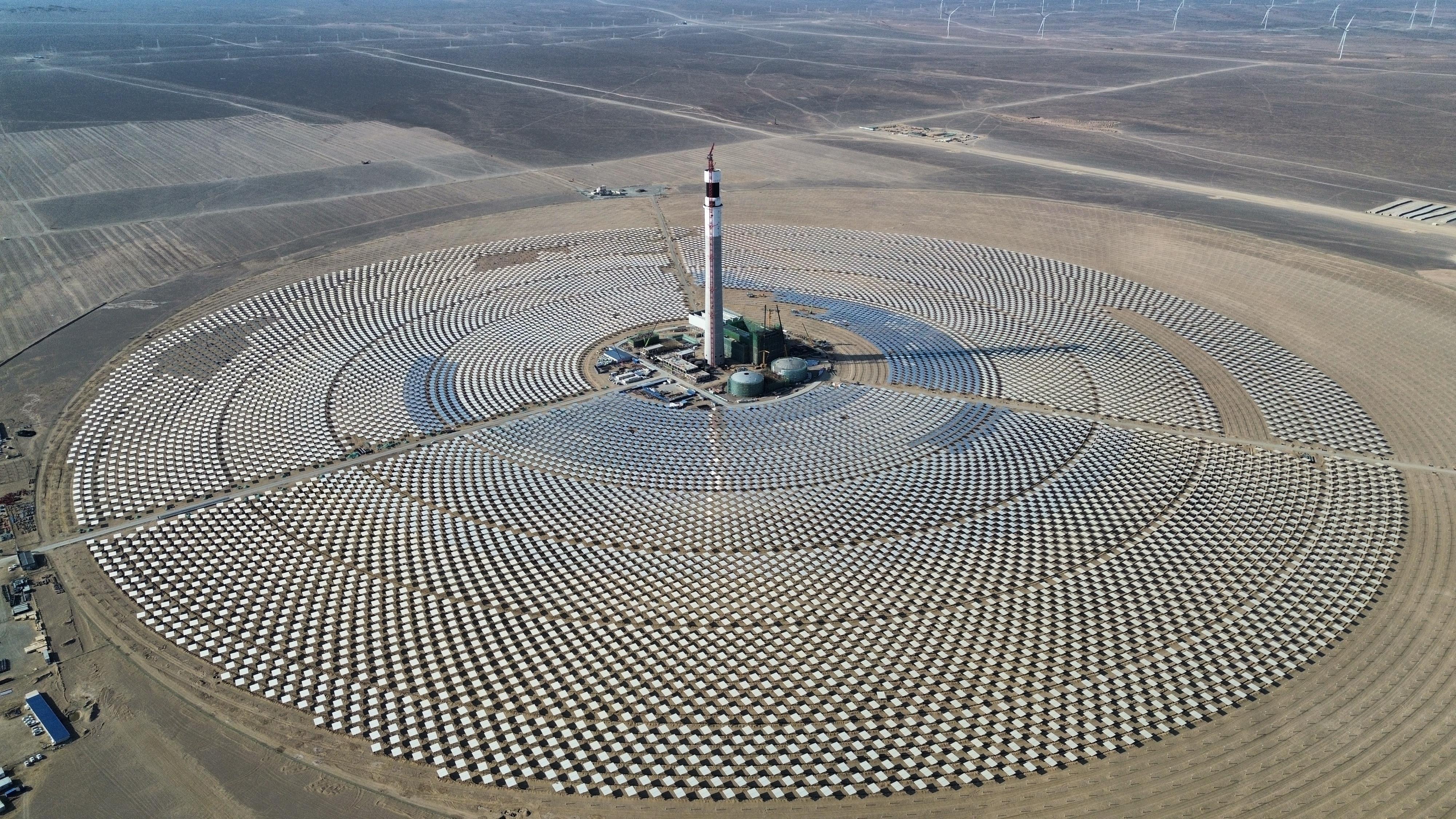
Core Viewpoint - The development of concentrated solar power (CSP) in China is gaining momentum, with a target of reaching 15 million kilowatts of installed capacity by 2030, while addressing challenges such as high initial investment and market competitiveness [1][6]. Group 1: Current Projects and Developments - The Qinghai Energy Group's Qingyu DC Phase II 100,000 kW CSP project is continuously supplying electricity to the grid, showcasing the ongoing advancements in CSP technology [1]. - The Hami "Solar (Thermal) Storage" 1500 MW base project integrates 150 MW of CSP with 1350 MW of photovoltaic (PV) capacity, demonstrating the synergy between CSP and PV technologies [2]. - As of the end of 2025, China's operational CSP capacity is expected to reach approximately 1.62 million kW, ranking third globally, with 2.7 million kW under construction, accounting for over 90% of global CSP construction [3]. Group 2: Technological Advancements - China has successfully mastered various CSP technologies, including tower, trough, and Fresnel systems, with ongoing innovations such as the 800 MW PV + 100 MW CSP integrated project in Tibet [4]. - The development of the "four towers and one machine" supercritical 350 MW unit is underway, aiming for over 3000 hours of annual electricity generation [5]. - The domestic production rate of equipment and materials for CSP is nearing 100%, positioning China as a leader in the global CSP market [5]. Group 3: Cost Challenges and Policy Support - The average total investment for CSP projects of 100 MW and above is approximately 15,000 yuan per kW, which is about three times that of equivalent PV projects, leading to financial losses under current pricing conditions [6]. - The recent policy document proposes compensation for reliable capacity of qualifying CSP projects, which could significantly enhance the cost competitiveness of CSP [6]. - Qinghai Province has set a fixed grid price of 0.55 yuan per kWh for CSP projects included in its development plan from 2024 to 2028, providing a degree of certainty for the industry [6]. Group 4: Future Outlook and Strategic Recommendations - The industry is exploring various avenues for cost reduction, including expanding unit sizes, developing new types of molten salts, and optimizing mirror field designs, with potential cost reductions of 0.13 yuan per kWh in the next 3-5 years [7]. - To achieve the target of 15 million kW, efforts must focus on planning, implementation, and ensuring support for land, finance, and policy [7]. - CSP is expected to transition from a backup option to a key support role in the energy system, contributing to carbon reduction in conjunction with coal power and providing green electricity for various industries [7].
光热发电如何破解成本难题?
Ke Ji Ri Bao· 2026-02-03 23:30
科技日报记者 王禹涵 国家能源集团青海共和公司青豫直流二期10万千瓦光热项目正源源不断地向电网输送电能,青海中控德令哈50兆瓦光热电站驱动汽轮机持续发电……这一朵 朵绽放的"太阳花",正照亮我国能源转型的新路径。 近日发布的《关于促进光热发电规模化发展的若干意见》(以下简称《若干意见》)提出,到2030年,光热发电总装机规模力争达到1500万千瓦左右,度电 成本与煤电基本相当。 项目火热推进,政策东风劲吹,但光热发电这个被寄予厚望的产业,仍面临着初始投资较高、市场竞争能力偏弱等"成长的烦恼"。在新能源全面平价的时 代,光热发电如何破解成本难题,实现规模化破局? "简单来说,光热发电设备就是一个巨型'太阳能炉灶+热水壶+蒸汽机'组合体。"中国能建中国电力工程顾问集团西北电力设计院有限公司(以下简称"中国 能建西北院")新疆哈密"光(热)储"1500兆瓦基地光热项目设计总工程师王鑫说,"比如,正在建设的哈密'光(热)储'基地项目,采用150兆瓦光热与1350 兆瓦光伏电站互补联动,通过配置熔盐电加热器,在光伏和光热储热部分之间建立能量转换的'桥梁',将光伏的弃电转化为热能存储,再通过光热汽轮机发 电上网。" "与 ...

建筑装饰行业2025年报前瞻题:投资趋缓,利润承压
Shenwan Hongyuan Securities· 2026-02-03 13:12
行 业 及 产 业 建筑装饰 2026 年 02 月 03 日 相关研究 证 券 研 究 报 告 证券分析师 袁豪 A0230520120001 yuanhao@swsresearch.com 唐猛 A0230523080003 tangmeng@swsresearch.com 研究支持 唐猛 A0230523080003 tangmeng@swsresearch.com 联系人 唐猛 A0230523080003 tangmeng@swsresearch.com 投资趋缓,利润承压 看好 ——建筑装饰行业 2025 年报前瞻题 本期投资提示: 请务必仔细阅读正文之后的各项信息披露与声明 本研究报告仅通过邮件提供给 博时基金 博时基金管理有限公司(researchreport@bosera.com) 使用。1 行 业 研 究 / 行 业 点 评 - ⚫ 2025 年固定资产投资增速放缓,基建、制造业、地产均呈现压力。基本面方 面,根据国家统计局数据,2025 年 1-12 月基础设施投资(全口径)同比- 1.5%,基础设施投资(不含电力)同比-2.2%。细分结构看,交通运输、仓储 和邮政业投资同比-1.2%, ...






基础建设板块2月3日涨1.49%,国晟科技领涨,主力资金净流入1.9亿元
Zheng Xing Xing Ye Ri Bao· 2026-02-03 09:03
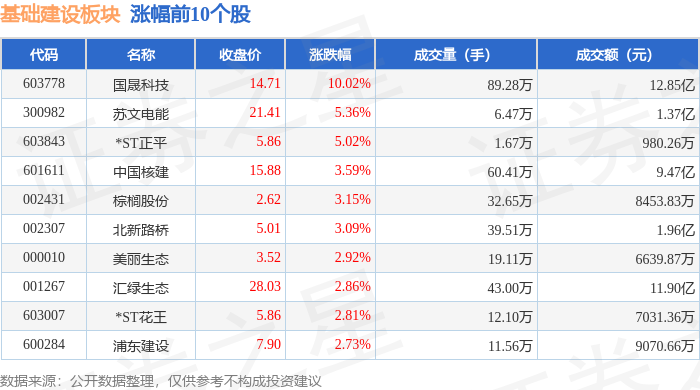
Market Overview - The infrastructure sector increased by 1.49% compared to the previous trading day, with Guosheng Technology leading the gains [1] - The Shanghai Composite Index closed at 4067.74, up 1.29%, while the Shenzhen Component Index closed at 14127.1, up 2.19% [1] Key Stocks Performance - Guosheng Technology (603778) closed at 14.71, up 10.02% with a trading volume of 892,800 shares [1] - Suwen Electric Power (300982) closed at 21.41, up 5.36% with a trading volume of 64,700 shares [1] - China Nuclear Engineering (601611) closed at 15.88, up 3.59% with a trading volume of 604,100 shares [1] - Other notable stocks include Palm Holdings (002431) up 3.15% and Beixin Road and Bridge (002307) up 3.09% [1] Capital Flow Analysis - The infrastructure sector saw a net inflow of 190 million yuan from institutional investors, while retail investors experienced a net outflow of 38.83 million yuan [2] - Major stocks like China Railway (601390) had a net inflow of 138 million yuan from institutional investors [3] - Guosheng Technology (603778) had a net inflow of 87.57 million yuan from institutional investors, but a net outflow of 69.54 million yuan from retail investors [3] Trading Volume and Value - The trading volume for Guosheng Technology reached 12.85 billion yuan, indicating strong investor interest [1] - The total trading value for the infrastructure sector was significant, with China Electric Power (601669) recording a trading value of 1.1 billion yuan [2]



“能源绿色低碳转型”看山东之中能建山东泰安压缩空气储能创新示范项目:创新思路举措,创造推广价值
Zhong Guo Fa Zhan Wang· 2026-02-03 08:36
Core Insights - The project by China Energy Construction in Tai'an, Shandong, focuses on a 350MW compressed air energy storage system utilizing abandoned salt caverns, aiming for world-leading efficiency and capacity [1][2] Group 1: Project Overview - The project is included in Shandong's new energy storage demonstration project list and is expected to participate in peak regulation services for the Shandong power grid by 2026 [2] - It aims to enhance the power system's regulation capability, efficiency, and safety, supporting the construction of a new power system aligned with national carbon neutrality goals [2][5] Group 2: Technological Innovations - The project features several "firsts," including advanced heat recovery techniques, a large flow axial-centrifugal compressor, and high-power synchronous motors [3] - It employs high-pressure compression technology and advanced heat recovery methods, achieving a comprehensive efficiency of approximately 72%, which is world-leading [4] Group 3: Environmental Impact - The project is projected to generate around 460 million kWh annually, saving 146,000 tons of standard coal and reducing CO2 emissions by 378,000 tons [1] - It plays a crucial role in the economic operation of the power system, facilitating the integration of renewable energy and supporting China's dual carbon goals [5]