
大成基金

Search documents
公募基金年内自购“申赎清单”:谁受宠?谁被弃?
3 6 Ke· 2025-08-12 11:19
Core Viewpoint - The recent surge in public fund self-purchases reflects a growing confidence in the Chinese capital market, with significant investments occurring as the market heats up rather than at traditional low points [1][2][3]. Fund Self-Purchase Trends - Southern Fund announced a self-purchase of at least 230 million yuan in its equity funds, demonstrating a strong commitment to the market [2]. - Other fund companies, including Huashang Fund and Dachen Fund, have also engaged in substantial self-purchases, indicating a broader trend of confidence among fund managers [4]. - The self-purchase trend is characterized by a focus on newly launched products, suggesting a promotional aspect alongside genuine market optimism [4]. Self-Purchase and Redemption Data - In the first half of the year, 126 fund managers engaged in self-purchases totaling 243.07 billion yuan, while 114 fund managers executed redemptions amounting to 133.42 billion yuan [5]. - The net self-purchase amount for public funds was 109.66 billion yuan, with non-monetary products contributing 5.25 billion yuan [6]. - Debt funds led the net self-purchase category with 2.83 billion yuan, while equity funds followed with 1.32 billion yuan [7]. Specific Fund Performance - Notable self-purchases included Tianhong Fund's equity products, which saw over 100 million yuan in self-purchases [7]. - Mixed funds also experienced significant self-purchases, with several funds exceeding 100 million yuan in net self-purchases [7]. - In contrast, certain funds faced significant redemptions, highlighting a mixed sentiment in specific segments of the market [8].
2月基金发行再遇冷 份额缩水近75%
Xin Hua Wang· 2025-08-12 06:30
Core Viewpoint - Despite a market recovery, February's fund issuance remains pessimistic, with significant declines in both the number and volume of new funds issued [1][2]. Group 1: Fund Issuance Data - In February, a total of 58 new funds were established, a decrease of approximately 60% compared to January's 148 funds [1]. - The total issuance volume for February was 29.415 billion units, a dramatic drop of 75% from January's 118.82 billion units [1]. - The average issuance volume per fund fell from 80.3 million units in January to 50.7 million units in February, marking the lowest level in the past 12 months [1]. Group 2: Fund Structure and Types - The issuance volume distribution for February was as follows: equity funds at 11.79%, mixed funds at 57.29%, and bond funds at 26.21% [1]. - The average issuance volume for bond funds was slightly higher than in January at 110.1 million units, while equity and mixed funds continued to decline, averaging 26.7 million units and 48.1 million units, respectively [1]. Group 3: Investor Preferences and Fund Failures - There is a noticeable increase in investor interest in more stable bond products, with only 4 funds exceeding 1 billion units in issuance, primarily bond funds [2]. - The top fund in February was the ICBC Credit Suisse One-Year Open Pure Bond Fund, with an issuance volume of 4.01 billion units [2]. - Five funds have announced failed issuances this year, including two equity ETFs, two bond funds, and one mixed fund [2].
今年来49家基金公司自购金额 超16亿元
Xin Hua Wang· 2025-08-12 06:30
Group 1 - The enthusiasm for fund companies' self-purchase has increased significantly this year, with 49 companies engaging in self-purchase totaling 1.664 billion yuan as of March 11, 2022 [1] - The self-purchase amounts for equity and mixed funds are relatively balanced at 630 million yuan and 638 million yuan respectively, while bond funds have a lower self-purchase amount of 325 million yuan [1] - The frequency of self-purchase has risen since March, with January, February, and March seeing 39, 23, and 26 instances respectively, and corresponding amounts of 790 million yuan, 320 million yuan, and 550 million yuan [1] Group 2 - Several newly issued funds have received self-purchase commitments from fund managers, including Yongying Fund, Wanjia Fund, and Anxin Fund, indicating confidence in the market [2] - On March 10, 2022, Baoying Fund announced that its fund manager Zhang Zhongwei personally invested 1 million yuan in two of its funds, committing to hold for at least one year [2] - Industry insiders note that self-purchase typically occurs during market downturns, reflecting institutional confidence in the long-term stability of the capital market, which can help stabilize market sentiment [2]
8家公募基金公司上报 首批碳中和ETF产品
Xin Hua Wang· 2025-08-12 06:27
Core Insights - The Shanghai Environment and Energy Exchange has announced that eight public fund companies, including E Fund, Huatai-PB Fund, GF Fund, and others, have submitted applications for the Carbon Neutrality ETF to the China Securities Regulatory Commission (CSRC), marking the first batch of carbon neutrality ETF products in China [1] Group 1: Carbon Neutrality ETF Development - The "China Securities Shanghai Environment Exchange Carbon Neutrality Index" was initiated in 2019 and officially approved by the CSRC in August 2021, with the index being publicly released in September 2021 [1] - The upcoming carbon neutrality ETFs will track this index, which is the first thematic index named after carbon neutrality [1] Group 2: Market Activity and Trends - As of April 22, the cumulative trading volume of carbon emission allowances (CEA) in the national carbon market reached 18.95 million tons, with a total transaction value of 8.2377 billion yuan [1] - The dual carbon goals in China have made carbon neutrality and ESG (Environmental, Social, and Governance) indices significant themes in the capital market, prompting many institutions to actively invest [1] - Since the second half of 2021, multiple fund companies have increased their pace in green investment, with a growing number of products featuring themes like "green," "environmental," "ESG," and "low carbon" [1]
发行市场回暖 三月权益类基金发行占比近七成
Xin Hua Wang· 2025-08-12 06:15
Core Insights - The issuance of equity funds has rebounded since March, with nearly 70% of newly launched funds being equity products, significantly higher than February's 48% [1][2] - The average issuance size of newly established stock funds is showing a continuous recovery, with some equity products targeting over 5 billion yuan in fundraising [1][3] Fund Issuance Trends - As of March 7, 41 funds have been publicly offered, with 29 being equity funds, marking a notable increase from February [2] - The total issuance of newly established funds in March reached 340.39 billion units, with an average issuance size of 10.64 million units per fund, indicating a recovery compared to previous months [2] Market Sentiment and Economic Outlook - Market participants express optimism regarding the equity market, anticipating stabilization and recovery in both the macro economy and A-share market, which could drive new capital inflows [4] - High-frequency economic data suggests stronger-than-expected recovery, with expectations for continued economic growth in the first quarter and beyond [4] Specific Fund Highlights - The BoShi Fund's BoShi Balanced Preferred Fund has surpassed 3 billion yuan in fundraising, likely becoming the largest actively managed equity fund of the year [3] - Several funds, including Huaxia Industry Selection A and Guotai Green Power Link A, have set ambitious fundraising targets of over 5 billion yuan [3] Investment Strategies and Sector Focus - Investment strategies are increasingly focused on domestic demand sectors, with an emphasis on identifying areas with improved supply-demand structures [5] - The macro environment is characterized by moderate recovery, low inflation, and a rebound in corporate earnings, which may favor growth stocks that underperformed last year [5][6]
有色牛市正在启动,大成有色ETF(159980.SZ)活跃上行,跟踪指数再次确立日线级别看涨
Sou Hu Cai Jing· 2025-08-12 03:48
Core Viewpoint - The Dachen Nonferrous ETF (159980.SZ) is experiencing upward momentum, supported by positive trends in the underlying nonferrous metal index and significant capital inflows, indicating a bullish outlook for the sector [1]. Group 1: Market Performance - As of August 12, 11:15, the Dachen Nonferrous ETF (159980.SZ) increased by 0.18% [1]. - The underlying index, the Nonferrous Metal Index (IMCI.SHF), has established a bullish trend on both daily and weekly levels [1]. - The ETF's latest scale reached 1.207 billion yuan, marking a three-month high [1]. Group 2: Capital Inflows - As of August 11, the Dachen Nonferrous ETF (159980.SZ) saw net capital inflows in 4 out of the last 5 trading days, totaling 79.6212 million yuan [1]. Group 3: Economic Context - Citic Construction Investment Securities noted that poor economic and employment data from the U.S., along with the nomination of a new Federal Reserve governor by Trump, has strengthened market expectations for a rate cut in September [1]. - The ongoing domestic "anti-involution" policy aims to optimize production factors, enhancing profitability across various sectors and improving market expectations, which is favorable for the transmission of rising metal prices to downstream industries [1]. - The valuation of the industrial metals sector is currently low, suggesting potential for upward correction [1].
年内自购的公募基金管理人,突破100家
21世纪经济报道· 2025-08-12 02:58
Core Viewpoint - Several public fund companies have recently announced self-purchase plans, indicating confidence in the current market valuations and long-term investment potential in China's capital market [1][6][9]. Group 1: Self-Purchase Announcements - On August 11, Southern Fund announced a self-purchase of at least 230 million yuan across three equity funds, committing to hold for at least one year [1][3]. - Four public fund companies, including Southern Fund, Industrial Bank of China Credit Fund, Taikang Fund, and Founder Fubon Fund, have initiated self-purchases since July 28, with total investments exceeding 260 million yuan [2][3]. - Southern Fund's self-purchase plan includes investments in specific equity funds, highlighting its commitment to the market [3][5]. Group 2: Market Sentiment and Valuation - The self-purchase actions by multiple fund companies are seen as a positive signal, reflecting institutional recognition of current market valuations [6][9]. - As of August 6, the price-to-earnings ratios for the CSI 300 and Hang Seng indices were 13.93 and 11.83, respectively, both lower than major mature markets, indicating a valuation advantage for Chinese stocks [6][9]. - The self-purchase trend is viewed as a strategy to stabilize investor sentiment and demonstrate confidence in the market's long-term health [6][9]. Group 3: Historical Context and Trends - The self-purchase trend has been ongoing, with over 100 public fund managers having implemented self-purchases in 2023 alone [8][9]. - Notably, some fund companies have made multiple self-purchase announcements within the year, indicating a sustained commitment to their products [8][9]. - The China Securities Regulatory Commission's policy encouraging fund companies to self-purchase a portion of their profits has contributed to this trend [9]. Group 4: Investor Considerations - While self-purchase is a positive indicator, it should not be the sole criterion for investment decisions, as it does not guarantee future performance [10][11]. - Investors are advised to consider the scale of self-purchases, the duration of holding commitments, and the credibility of the purchasing entity [10][11]. - Monitoring changes in holdings and fund performance through regular reports is recommended to avoid impulsive investment decisions [10][11].

ETF规模速报 | 上证50ETF净流入超19亿元,短融ETF净流出超11亿元
Sou Hu Cai Jing· 2025-08-12 02:11
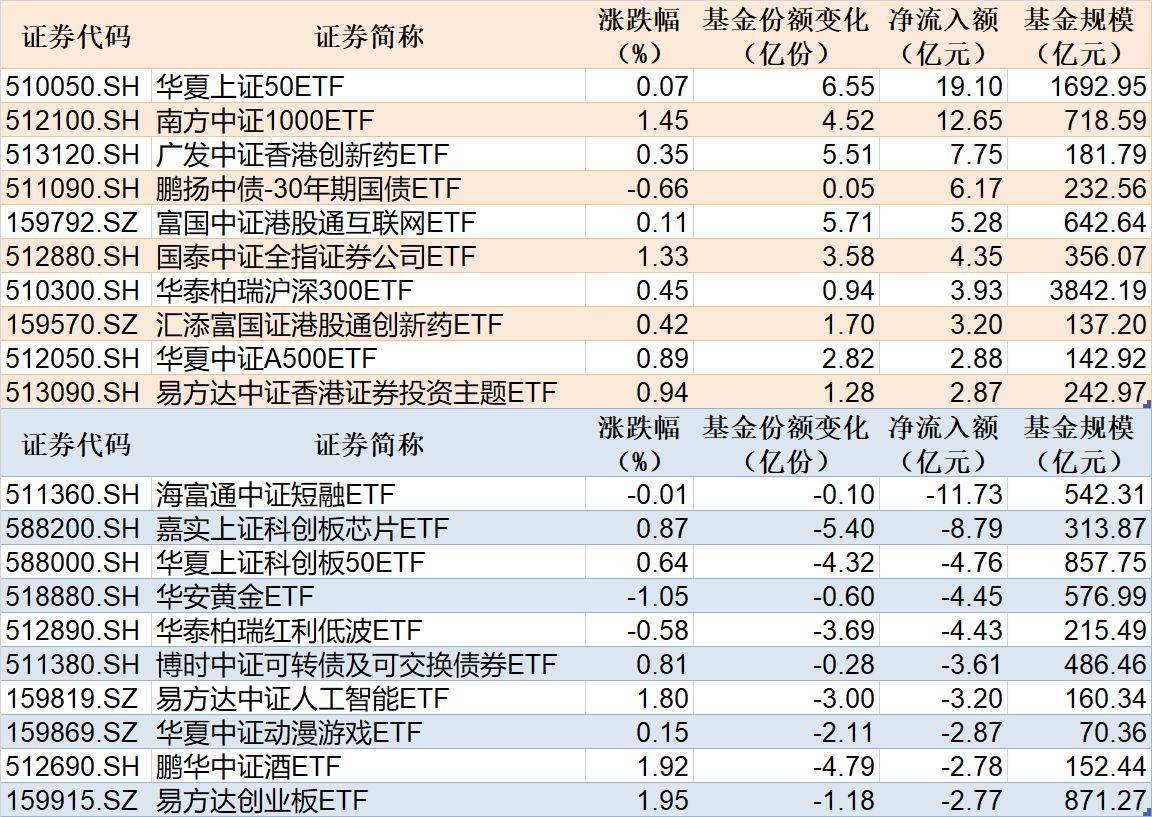
Market Overview - The market experienced a strong upward trend, with the ChiNext Index leading the gains, while both the Shanghai Composite Index and Shenzhen Component Index reached new highs for the year [1] - PEEK material concept stocks surged, computing hardware stocks showed strength, and lithium mining stocks collectively rose significantly [1] ETF Market Activity - On August 11, significant inflows were observed in the non-monetary ETF market, with the following net inflows: - Huaxia SSE 50 ETF saw an increase of 655 million shares and a net inflow of 1.91 billion yuan - Southern CSI 1000 ETF increased by 452 million shares with a net inflow of 1.265 billion yuan - GF CSI Hong Kong Innovative Drug ETF increased by 551 million shares with a net inflow of 775 million yuan [1][2] - Conversely, the following ETFs experienced outflows: - Hai Fudong CSI Short-term Bond ETF saw a decrease of 10 million shares and a net outflow of 1.173 billion yuan - Jiashi SSE Sci-Tech Chip ETF decreased by 540 million shares with a net outflow of 879 million yuan - Huaxia SSE Sci-Tech 50 ETF decreased by 432 million shares with a net outflow of 476 million yuan [2] Top ETFs by Net Inflows - As of August 11, the top 20 ETFs by net inflow included: - Fortune CSI Hong Kong Internet ETF with a net inflow of 3.590 billion yuan - Hai Fudong CSI Short-term Bond ETF with a net inflow of 3.423 billion yuan - GF CSI Hong Kong Innovative Drug ETF with a net inflow of 2.573 billion yuan [4] Overall ETF Market Statistics - The total ETF shares in the market reached 27,888.22 billion shares, with a total scale of 46,718.62 billion yuan as of August 11 [4] - The largest increase in shares was observed in the pharmaceutical sector, with 9 funds tracking it, while the securities company index saw the largest increase at +0.81% with 13 funds tracking it [4]
“真金白银”力挺A股 公募“接力”自购权益基金
2 1 Shi Ji Jing Ji Bao Dao· 2025-08-11 23:59
Core Viewpoint - Several large public fund companies have recently announced self-purchase plans, indicating confidence in the long-term stability and health of the Chinese capital market [1][4]. Group 1: Self-Purchase Announcements - On August 11, Southern Fund announced a self-purchase plan involving an investment of at least 230 million yuan in three equity funds, committing to hold for at least one year [1][2]. - In the past two weeks, four public fund companies, including Southern Fund, ICBC Credit Suisse Fund, Taikang Fund, and Founder Fubon Fund, have disclosed self-purchase plans, with total investments exceeding 260 million yuan [2][7]. - Southern Fund's self-purchase plan is particularly notable, targeting specific equity funds such as the Southern CSI A500 ETF and the Southern S&P China A-Share Large Cap Dividend Low Volatility ETF [2][3]. Group 2: Market Sentiment and Valuation - The self-purchase actions by multiple fund companies signal their recognition of the current market valuation's reasonableness and their confidence in the medium to long-term investment value [4][8]. - According to Wind data, as of August 6, the price-to-earnings ratios of the CSI 300 Index and the Hang Seng Index are 13.93 and 11.83, respectively, both lower than major mature market indices, indicating that the Chinese stock market is in a "valuation pit" [3][4]. Group 3: Implications for Investors - Fund companies' self-purchases are seen as a way to enhance trust and stabilize investor sentiment, as they align their interests with those of investors [4][9]. - While self-purchase can be a positive signal, it should not be the sole criterion for investment decisions; investors are advised to consider other factors such as fund manager capability and investment strategy [8][9]. - The trend of self-purchases has been ongoing, with over 100 fund management companies having implemented self-purchases this year, reflecting a regulatory push to encourage such actions [6][7].
公募豪掷逾140亿元参与定增
Shen Zhen Shang Bao· 2025-08-11 23:01
Group 1 - Public funds have shown high enthusiasm for participating in private placements this year, with 24 public institutions involved in 47 A-share companies, totaling approximately 14.2 billion yuan in allocations [1] - The electronics and chemical industries are particularly favored by public funds, with 36 stocks receiving over 100 million yuan in allocations [1] - The most favored stock for public fund placements is Haohua Technology, which received a total allocation of 1.628 billion yuan from three public institutions [1] Group 2 - Among the 24 public institutions participating in A-share private placements this year, 11 have been particularly active, with allocations of at least 100 million yuan [2] - Nord Fund has emerged as the leader in public fund placements this year, participating in 46 A-share private placements with a total allocation of 5.633 billion yuan [2]