
国泰基金

Search documents
盘点年内翻倍ETF:华宝创业板人工智能ETF规模超33亿,年内涨105%,重仓股覆盖算力至终端产业链
Xin Lang Cai Jing· 2025-12-10 09:05
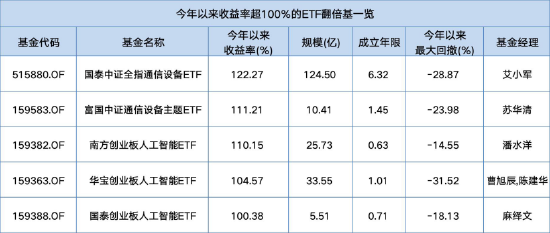
Core Viewpoint - The ETF market has seen a resurgence with five products achieving over 100% annual returns as of December 9, 2025, particularly in the technology sector, including communication equipment and artificial intelligence [1][8]. Group 1: ETF Performance - Five ETFs have surpassed 100% returns this year, with notable performances from communication and AI sectors [1][8]. - The top-performing ETFs include: - Guotai CSI All-Share Communication Equipment ETF with a return of 122.27% and a scale of 124.50 billion [2][9]. - Fuguo CSI Communication Equipment Theme ETF with a return of 111.21% and a scale of 10.41 billion [2][9]. - Southern Growth Enterprise Board AI ETF with a return of 110.15% and a scale of 25.73 billion [2][9]. - Huabao Growth Enterprise Board AI ETF with a return of 104.57% and a scale of 33.55 billion [2][9]. - Guotai Growth Enterprise Board AI ETF with a return of 100.38% and a scale of 5.51 billion [2][9]. Group 2: Huabao AI ETF Insights - The Huabao Growth Enterprise Board AI ETF, managed by Chen Jianhua and Cao Xucheng, has achieved a return of 104.57% since its inception on December 6, 2024, with a current scale of 33.55 billion [3][12]. - The fund's manager, Chen Jianhua, has delivered a return of 96.02% since the fund's establishment, with an annualized return of 94.60% [5][12]. - The fund's investment strategy focuses on the AI computing power industry chain, with major holdings in leading optical module companies, including Zhongji Xuchuang and Xinyi Sheng, which together represent a significant portion of the portfolio [5][12]. Group 3: Market Outlook - The fund's third-quarter adjustments were conservative, with increases in holdings ranging from 76% to 80% for most stocks [7][15]. - The fund managers expressed confidence in the sustained demand for AI, particularly in large models and computing power, which is expected to drive the performance of the AI sector [7][15]. - Future opportunities are anticipated in high-end computing cycles and new AI terminals, such as robotaxis and robots, which are at critical technological development stages [7][15].


英华号周播报|如何把握年底投资机会?个人养老基金究竟该怎么选?
Sou Hu Cai Jing· 2025-12-10 08:30
Group 1 - The article highlights the popularity of various investment funds and educational platforms, indicating a growing interest in investment education among ordinary investors [1][6][12] - Notable mentions include CITIC Prudential Fund and Invesco, which are recognized as leading media accounts in the investment sector [1][13] - The article emphasizes the potential of certain media accounts, such as Guotai Fund and Debang Securities, suggesting they may offer valuable insights for investors [1][15] Group 2 - The discussion includes insights from Yang Meng of Baodao Fund, who emphasizes the importance of a long-term investment perspective, suggesting that with proper stock selection, both active equity funds and quantitative enhancement funds can yield ideal excess returns [18] - The article suggests that there is no superior investment method, as long as the stock selection approach is sound, indicating a balanced view on investment strategies [18]

免税概念涨幅居前,18位基金经理发生任职变动
Sou Hu Cai Jing· 2025-12-10 08:19
Market Performance - On December 10, A-shares showed mixed performance, with the Shanghai Composite Index down 0.23% to 3900.50 points, the Shenzhen Component Index up 0.29% to 13316.42 points, and the ChiNext Index slightly down 0.02% to 3209.00 points [1] Fund Manager Changes - On December 10, 18 fund managers experienced changes in their positions, with 679 fund products having manager changes in the past 30 days [3] - Among the changes, 11 fund products announced manager departures on December 10, involving 6 fund managers, with 4 leaving due to job changes and 2 due to product expiration [3] - Notable fund manager Zhang Ming from Anxin Fund has managed a total asset scale of 3.496 billion yuan, with the highest return of 154.02% from the Anxin Enterprise Value Preferred Mixed A fund over 8 years and 221 days [3] New Fund Managers - On December 10, 33 fund products announced new fund manager appointments, involving 12 fund managers [4] - Notable new fund manager Su Huaqing from Fortune Fund manages a total asset scale of 28.259 billion yuan, with the highest return of 154.32% from the Fortune CSI Communication Equipment Theme ETF over 1 year and 116 days [4] Fund Research Activity - In the past month (November 10 to December 10), Huaxia Fund conducted the most company research, engaging with 46 listed companies, followed by Bosera Fund, Guotai Fund, and Huitianfu Fund with 46, 43, and 41 companies respectively [5][6] - The most researched industry was consumer electronics, with 250 research instances, followed by specialized equipment with 217 instances [5][6] Individual Stock Research - The most researched stock in the past month was Luxshare Precision, with 88 fund management companies participating in the research [7][8] - In the last week (December 3 to December 10), the most researched company was Canxin Technology, with 31 fund institutions involved [7][8]
英华号周播报|如何把握年底投资机会?个人养老基金究竟该怎么选?
中国基金报· 2025-12-10 08:04
Group 1 - The core viewpoint of the article emphasizes the importance of fundamental analysis, technology, new consumption trends, and overseas expansion in investment strategies for 2026 [2] - The article discusses the "slow bull" market trend, suggesting that investors should focus on genuine investment opportunities rather than speculative ones [2] - It highlights the significance of sectors such as technology and new consumption as key drivers for market performance in the upcoming years [2] Group 2 - The article mentions that the Japanese government bond yields are rising rapidly, which is impacting the yen's value [3] - It addresses the increasing market volatility and suggests that investors should consider systematic investment plans to seize year-end investment opportunities [3] - The article also points out the ongoing focus on AI applications within the technology sector, indicating that it remains a crucial market engine [3]

通信与AI赛道狂飙:5只ETF年内翻倍,国泰通信设备ETF涨122%领跑,南方、华宝人工智能ETF强势追击
Xin Lang Cai Jing· 2025-12-10 06:34
Core Viewpoint - The ETF market has seen a resurgence with five products achieving over 100% annual returns as of December 9, 2025, particularly in the technology sectors of communication equipment and artificial intelligence [1][5]. Group 1: Performance Overview - The top-performing ETF is the Guotai CSI All-Share Communication Equipment ETF (515880.OF) with a return of 122.27%, managing a scale of 12.45 billion and having been established for 6.32 years [2][3][7]. - Following closely is the Fortune CSI Communication Equipment Theme ETF (159583.OF) with an 111.21% return, a scale of 1.04 billion, and a 1.45-year establishment [3][7]. - In the artificial intelligence sector, three ETFs have shown remarkable performance: - Southern Growth Enterprise Board AI ETF (159382.OF) with a 110.15% return and a scale of 2.57 billion [3][8]. - Huabao Growth Enterprise Board AI ETF (159363.OF) with a 104.57% return and a scale of 3.36 billion [3][8]. - Guotai Growth Enterprise Board AI ETF (159388.OF) with a 100.38% return and a scale of 0.55 billion [3][8]. Group 2: Volatility and Market Outlook - The high returns are accompanied by significant volatility, with maximum drawdowns ranging from -15% to -31% for these ETFs, highlighting the risks involved [4][8]. - Looking ahead, Zhongyin Securities indicates that the securities industry is experiencing a "moderate opening of capital space and leverage limits," which may catalyze a "spring surge" in the market, particularly in technology and AI hardware sectors [4][8].
金融行业加速融入鸿蒙生态 超千款应用已上线
2 1 Shi Ji Jing Ji Bao Dao· 2025-12-10 03:01
Core Insights - The financial sector is increasingly integrating with the HarmonyOS ecosystem, driven by the need for digitalization and security in financial services [1][2][6] - As of now, over 1,000 financial applications have been launched on Huawei's app market, indicating significant adoption of HarmonyOS in the financial industry [1][2] - The collaboration between HarmonyOS and financial institutions has evolved from mobile application adaptation to multi-device collaboration and AI integration [1][2][3] Group 1: Industry Trends - The financial industry's dual demand for digitalization and self-controllability is influenced by the high frequency of mobile financial services and the need for enhanced user experience [2][6] - Regulatory requirements for data and terminal security have made financial institutions more cautious in their technology choices [2][6] - HarmonyOS is seen as a new opportunity for innovation and development in the financial sector through partnerships with various financial applications [2][5] Group 2: Technological Advancements - Financial institutions are leveraging HarmonyOS capabilities to reconstruct user experiences and service processes, such as integrating voice commands for transactions [3][4] - Security features like digital shields and AI fraud prevention have been integrated into HarmonyOS to enhance the safety of financial services [3][5] - The multi-device and AI capabilities of HarmonyOS are enabling financial institutions to create differentiated user experiences across various devices [3][5] Group 3: Institutional Adoption - Major banks, such as the Industrial and Commercial Bank of China, have fully adapted HarmonyOS for their internal systems, indicating its maturity for enterprise-level applications [4][6] - The transition of B-end office systems to HarmonyOS is seen as a critical test of the operating system's robustness and compliance with high security and stability standards [4][6] - The financial sector's complex service chain necessitates a higher level of system stability and risk control compared to other industries [5][6] Group 4: Future Outlook - HarmonyOS is expected to continue focusing on "full scene" and "intelligence" innovations in the financial sector [5][6] - The shift from terminal competition to ecosystem competition is anticipated, with HarmonyOS's "one development, multi-terminal deployment" advantage being a key factor [6] - As more institutions and developers join the ecosystem, HarmonyOS is poised to become a vital part of the next-generation digital infrastructure in the financial industry [6]

长江证券完成董事会换届,新增三位湖北国资代表董事;股混基金今年自购规模超40亿元 | 券商基金早参
Mei Ri Jing Ji Xin Wen· 2025-12-10 01:25
Group 1 - Guo Xun Securities has recommended Gu Xiangqing as the general manager of Wanhe Securities, marking the first executive appointment since Guo Xun became the major shareholder of Wanhe [1] - Gu Xiangqing has over 20 years of experience in brokerage business and has held various management positions, indicating her capability to enhance Wanhe Securities' brokerage operations [1] - This personnel change signals an acceleration in the integration process and may lead to a new round of consolidation among small and medium-sized brokerages in the industry [1] Group 2 - Changjiang Securities has completed a board reshuffle, adding three representatives from Hubei state-owned assets, which reflects the deepening involvement of local state capital in corporate governance [2] - The new board composition is expected to strengthen regional resource collaboration and promote business integration with the local economy, potentially providing long-term support for the stock price [2] - The strategic positioning of state-owned brokerages may attract market attention and lead to subtle adjustments in the industry landscape [2] Group 3 - Regulatory authorities have issued guidelines requiring fund company executives to invest a portion of their performance compensation in their own managed public products, with 136 public fund companies having initiated self-purchases totaling over 4 billion yuan this year [3] - This self-purchase trend is seen as a confidence booster for the market, enhancing investor trust in actively managed equity products and promoting the long-term healthy development of the asset management industry [3] - The self-purchase behavior is expected to improve brand image and product attractiveness for fund companies, injecting new capital expectations into the market [3] Group 4 - Over 200 announcements regarding premium risks for cross-border ETFs have been issued by 14 public fund institutions in December, indicating a significant influx of short-term capital leading to price deviations from net asset values [4][5] - Specific ETFs, such as the Southern S&P 500 ETF, have shown premium rates exceeding 3%, with some reaching as high as 5.58%, raising concerns about potential market volatility [4][5] - The ongoing premium phenomenon may divert funds from A-shares, particularly impacting financial and consumer sectors, while the eventual risk release could stabilize market sentiment and encourage rational capital allocation [4][5]


股混基金自购规模超40亿元 新规强化公募机构与投资者利益绑定
Zhong Guo Zheng Quan Bao· 2025-12-09 23:23
Core Viewpoint - The recent issuance of the "Guidelines for Performance Assessment Management of Fund Management Companies (Draft for Comments)" by regulatory authorities aims to enhance the long-term incentive and constraint mechanisms within the fund management industry, promoting a stronger alignment of interests between fund management companies and fund shareholders [2][6]. Group 1: Guidelines and Requirements - Fund management company executives and key business department heads are required to invest at least 30% of their total performance compensation in public funds managed by their company, while fund managers must invest at least 40% of their total performance compensation in the public funds they manage [2][4]. - The guidelines emphasize the concept of "performance compensation holding base," mandating that the holding period for these investments must be no less than one year [2][3]. Group 2: Self-Purchase Trends - As of December 7, 2023, 136 public fund companies have initiated self-purchases, totaling 8,400 instances, with net subscriptions for equity funds exceeding 4 billion yuan [4][6]. - Notably, Guotai Fund has recorded the highest number of self-purchases at 782 times, followed by Invesco Great Wall Fund with 607 times [4]. Group 3: Market Implications - The self-purchase trend reflects fund companies' confidence in their investment management capabilities and the long-term value of their products, which is expected to stabilize investor expectations and enhance confidence in holding [6][7]. - The focus on equity products for self-purchases indicates a positive outlook on market valuation recovery and economic fundamentals, suggesting that fund companies will prioritize long-term performance over short-term gains [6][7].
股混基金今年自购规模超40亿元
Zhong Guo Zheng Quan Bao· 2025-12-09 20:22
Core Viewpoint - The recent issuance of the "Guidelines for Performance Assessment Management of Fund Management Companies (Draft for Comments)" by regulatory authorities aims to enhance the long-term incentive and constraint mechanisms within the fund management industry, promoting better alignment of interests between fund management companies and fund shareholders [2][3]. Group 1: Regulatory Guidelines - The guidelines require senior management and key business department heads of fund companies to invest at least 30% of their annual performance compensation in public funds managed by their company, while fund managers must invest at least 40% of their performance compensation in the public funds they manage [2][3]. - The guidelines emphasize "performance compensation holding," mandating that the holding period for these investments must be no less than one year [2][3]. Group 2: Self-Purchase Trends - As of December 7, 2023, 136 public fund companies have initiated self-purchases, totaling 8,400 instances, with net subscriptions for equity mixed funds exceeding 4 billion yuan [3][4]. - Notably, Guotai Fund has the highest number of self-purchases at 782 times, followed by Invesco Great Wall Fund with 607 times, and several other companies exceeding 500 times [3]. Group 3: Investment Focus - The self-purchase trend indicates a strong focus on equity products, reflecting the industry's confidence in the long-term value of equity assets and expectations for market valuation recovery and economic improvement [4][5]. - Fund companies' self-purchase actions are seen as a commitment to long-term development, enhancing risk control and sustainable investment value, which may lead to improved long-term performance stability [5].
月内公募基金超200份公告提示跨境ETF溢价风险
Zheng Quan Ri Bao· 2025-12-09 16:16
Core Viewpoint - Multiple public fund institutions, including E Fund, Huaxia Fund, and Southern Fund, have issued warnings regarding the premium risk in the secondary market trading of their cross-border ETFs, highlighting significant price premiums over the net asset value [1][2] Group 1: Premium Risk in Cross-Border ETFs - As of December 9, the Southern S&P 500 ETF (QDII) closed at 1.804 yuan, reflecting a premium of 3.41% over its reference net asset value of 1.7445 yuan [1] - Other ETFs tracking the same index, such as Bosera S&P 500 ETF, Guotai S&P 500 ETF, and Huaxia S&P 500 ETF (QDII), also exhibited premiums of 5.58%, 4.87%, and 2.92% respectively [1] - A total of 14 public fund institutions have issued over 200 premium risk warning announcements since December [2] Group 2: Factors Contributing to Premiums - The premium phenomenon is attributed to supply-demand imbalances, limited arbitrage opportunities, and market sentiment [2] - Increased global allocation demand from domestic investors has led to a scarcity of popular products, exacerbating the premium situation [2] - The complexities of cross-border ETF trading, including time differences, exchange rates, and redemption costs, hinder effective arbitrage, contributing to persistent premiums [2] Group 3: Market Growth and Investor Behavior - The total scale of cross-border ETFs has surged from 424.22 billion yuan at the beginning of the year to 939.09 billion yuan by December 9, indicating a growing demand for diversified global asset allocation among domestic investors [2] - Investors are increasingly seeking to mitigate single market volatility risks and optimize portfolio returns through cross-border ETFs [2] Group 4: Recommendations for Investors - Investors holding or planning to invest in cross-border ETFs should analyze the premium situation rationally, as high premiums indicate prices above net asset values, which could lead to losses if premiums converge [3] - It is advised to avoid chasing high premiums and to monitor real-time net asset values and estimated values [3] - Investors may consider gradually selling or switching to similar products, and those looking to invest in cross-border ETFs might prioritize off-market QDII funds or alternative products, potentially using a dollar-cost averaging strategy [3][4]