
劲仔食品

Search documents
中国银河证券:东南亚零食市场快速扩容 国内零食企业或迎出海新机遇
Zhi Tong Cai Jing· 2025-11-14 08:43
Core Insights - The Southeast Asian snack market has surpassed 150 billion RMB, with a compound annual growth rate (CAGR) exceeding GDP growth over the past decade, presenting significant investment opportunities [1][2] - The market can be categorized into three segments: growth markets (Indonesia, Philippines, Vietnam), late growth markets (Thailand, Malaysia, Singapore), and nurturing markets (Laos, Myanmar, Cambodia) [1][2] Market Overview - Indonesia's snack market is valued at 50 billion RMB, with sweet snacks dominating but experiencing slowing growth, while flavored snacks are rapidly increasing [2] - The Philippines has a market size of 30 billion RMB, with a high concentration of local brands in the flavored snack segment [2] - Vietnam's market is worth 15 billion RMB, with a balanced share between sweet and flavored snacks, featuring a more fragmented market with a dominance of foreign brands [2] - Thailand's snack market is valued at 24 billion RMB, primarily driven by flavored snacks, with a fragmented market structure [2] - Malaysia's market is around 10 billion RMB, with a high proportion of sweet snacks and a relatively concentrated market [2] Company Strategies - Companies venturing into Southeast Asia can focus on markets with "market expansion," "undetermined structure," and "category adaptation," with Indonesia, Vietnam, and Thailand as primary targets for growth [2][3] - Successful companies like Calbee and Glico have adopted localized strategies, with Calbee focusing on local brand adaptations and partnerships in Indonesia and Thailand, while Glico emphasizes a unified market approach with localized product modifications [3][4] Domestic Implications - Notable Chinese snack companies such as Qiaqia Food, Ganyuan Food, and others are actively expanding into Southeast Asia, primarily targeting Thailand, Indonesia, and Vietnam [4] - These companies are leveraging their product strengths, localizing flavors and branding, and utilizing a combination of distribution channels including e-commerce and local partnerships [4]

食品饮料步入消费旺季 产业链上市公司乘风布局
Zheng Quan Ri Bao Wang· 2025-11-13 12:28
Group 1 - The food and beverage industry is entering its most important sales window, with capital expenditure growth of 15.15% year-on-year in November 2025, indicating proactive market positioning by listed companies [1] - The industry is experiencing a structural recovery, with significant online sales growth in the liquor sector during the National Day and Mid-Autumn Festival, including over 100% year-on-year growth on JD's platform and a 58% increase on Douyin [1] - Institutional research activity has surged, with 202 total investigations in the food and beverage sector over the past three months, particularly in the snack and seasoning segments [1] Group 2 - Individual companies such as Chongqing Fuling Zhacai, Angel Yeast, and Xiangpiaopiao have been the focus of institutional attention, each receiving multiple investigations in the last three months [2] - Li Gao Food's third-quarter earnings call attracted 88 institutions, showcasing a nearly 40% year-on-year growth in new channel revenue, indicating strong growth momentum [2] Group 3 - Companies are innovating in products, channels, branding, and supply chain capabilities to capitalize on the consumption peak, with examples including Jiu Gui Jiu's successful product launch and Jin Zai Food's channel innovation strategy [3] - Yanjinpuzi is leveraging local sports events to enhance brand visibility and sales, while ensuring stable production orders in preparation for the upcoming peak season [3] Group 4 - Absolute Food is optimizing its supply chain and market dispatch mechanisms to address regional demand fluctuations and market changes, ensuring stable product supply [4] - Research indicates that product innovation and new channel development are key growth strategies for consumer goods companies, with expectations of a fundamental turning point and policy catalysts for traditional consumer categories [4]




休闲食品板块11月12日跌0.01%,桂发祥领跌,主力资金净流出1.71亿元
Zheng Xing Xing Ye Ri Bao· 2025-11-12 08:42
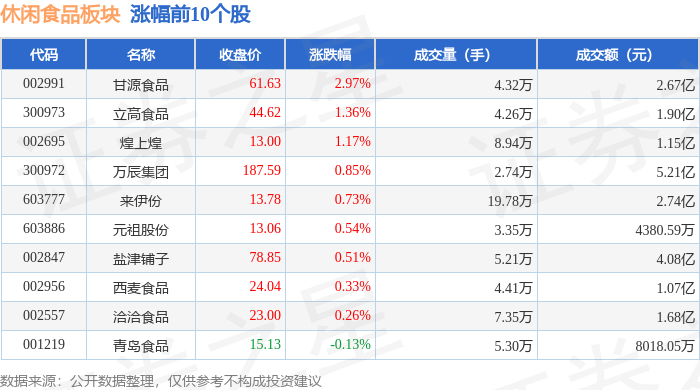
Market Overview - The leisure food sector experienced a slight decline of 0.01% on November 12, with Gui Faxiang leading the drop [1] - The Shanghai Composite Index closed at 4000.14, down 0.07%, while the Shenzhen Component Index closed at 13240.62, down 0.36% [1] Stock Performance - Notable gainers in the leisure food sector included: - Ganyuan Food: closed at 61.63, up 2.97% with a trading volume of 43,200 lots and a transaction value of 267 million [1] - Lihai Food: closed at 44.62, up 1.36% with a trading volume of 42,600 lots and a transaction value of 206.1 million [1] - Major decliners included: - Gui Faxiang: closed at 14.30, down 2.26% with a trading volume of 273,100 lots and a transaction value of 394 million [2] - Ziyan Food: closed at 19.27, down 2.18% with a trading volume of 29,900 lots and a transaction value of 58.19 million [2] Capital Flow - The leisure food sector saw a net outflow of 171 million from institutional investors, while retail investors contributed a net inflow of 249 million [2] - Specific stock capital flows included: - Ganyuan Food: net inflow of 17.70 million from institutional investors, with a net outflow of 12.58 million from speculative funds [3] - Lihai Food: net inflow of 10.29 million from institutional investors, with a net outflow of 7.30 million from speculative funds [3]



休闲食品行业专题报告之一:大浪淘沙,沉者为金
Guoxin Securities· 2025-11-11 11:18
Investment Rating - The report maintains an "Outperform" rating for the leisure food industry and specific companies such as Wei Long Mei Wei, Yan Jin Pu Zi, Jin Zai Food, and Wan Chen Group [4][5]. Core Insights - The leisure food market in China is projected to reach 1.344 trillion yuan in 2024, with a year-on-year growth of 5.3% and a CAGR of 4.4% from 2019 to 2024, expected to increase to 5.5% from 2025 to 2029 [1][15]. - The industry is characterized by a highly fragmented competitive landscape, with the top five and ten companies holding only 5.9% and 10.4% of the market share, respectively [1][22]. - Structural changes are reshaping the industry, including the rise of new retail channels, increased health consciousness among consumers, vertical integration in supply chains, and accelerated globalization efforts by leading companies [1][2][33]. Summary by Sections Industry Overview - The leisure food sector is a multi-billion market with diverse product categories, including snacks, nuts, and baked goods, focusing on fulfilling various consumer needs beyond mere hunger [15][18]. - The market is expected to continue expanding, with significant room for growth in per capita consumption, currently at 954.4 yuan, which is substantially lower than in the US and Japan [2][15]. Competitive Landscape - The industry is marked by intense competition and low concentration, with major players like Mars and Mondelez holding a small market share compared to their counterparts in the US [22][23]. - The competitive dynamics are shifting from price wars to differentiation and efficiency battles, as consumer demands become more diverse and nuanced [2][3]. Structural Changes - New retail formats such as bulk snack stores and instant retail are emerging, challenging traditional retail channels [33][34]. - Health awareness is driving innovation in product offerings, with a notable rise in demand for healthier snack options like konjac products, which are low in calories and high in dietary fiber [66][70]. Future Outlook - The report identifies three core drivers for industry growth: product innovation, scenario extension, and international expansion [2][3]. - Leading brands are expected to strengthen their market positions, with opportunities for both manufacturing and channel-focused companies to benefit from evolving consumer preferences and retail dynamics [2][3][4]. Company-Specific Insights - Wei Long Mei Wei and Yan Jin Pu Zi are highlighted as key players in the konjac snack segment, with significant revenue growth anticipated [3][70]. - Jin Zai Food is undergoing channel reforms and launching new products, while Wan Chen Group is expanding its discount supermarket presence, indicating potential for long-term growth [3][4].
劲仔食品:公司第三季度营业收入增长主要是渠道拓展所致
Zheng Quan Ri Bao Zhi Sheng· 2025-11-11 10:13
Core Insights - The company reported that the increase in third-quarter revenue was primarily due to channel expansion, with accounts receivable rising due to increased sales from direct customers [1] - The growth in sales expenses was attributed to higher brand and personnel costs [1] - The overall increase in business tax was slightly due to revenue growth and changes in tax policies applicable to certain subsidiaries [1] - The company's profit margins have fluctuated this year due to adjustments in channels and product structure, as well as increased market expenses, but it aims to continue high-quality development to enhance market scale and profitability [1]
休闲食品板块11月11日涨0.93%,黑芝麻领涨,主力资金净流入3460.97万元
Zheng Xing Xing Ye Ri Bao· 2025-11-11 08:37
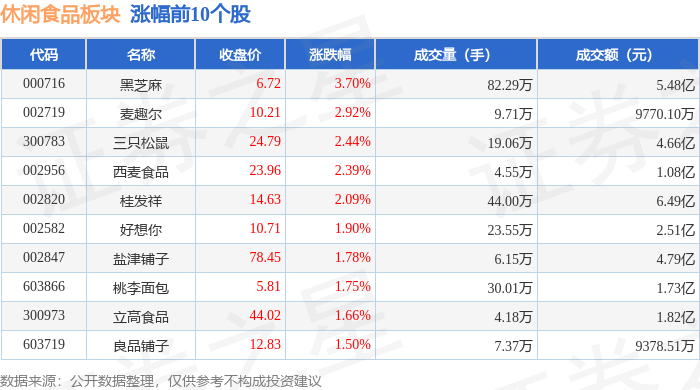
Market Overview - The leisure food sector increased by 0.93% on November 11, with Hei Zhima leading the gains [1] - The Shanghai Composite Index closed at 4002.76, down 0.39%, while the Shenzhen Component Index closed at 13289.0, down 1.03% [1] Stock Performance - Hei Zhima (000716) closed at 6.72, up 3.70% with a trading volume of 822,900 shares and a transaction value of 548 million [1] - Other notable performers include: - Mai Jiao Er (002719) at 10.21, up 2.92% [1] - San Zhi Song Shu (300783) at 24.79, up 2.44% [1] - Xi Mai Food (002956) at 23.96, up 2.39% [1] - Gui You Xiang (002820) at 14.63, up 2.09% [1] Capital Flow - The leisure food sector saw a net inflow of 34.61 million from main funds, while retail funds experienced a net outflow of 25.13 million [2] - The main funds' net inflow for Hei Zhima was 39.29 million, representing 7.17% of its total trading volume [3] - San Zhi Song Shu had a main fund net inflow of 30.52 million, accounting for 6.55% of its trading volume [3] Individual Stock Analysis - Hei Zhima experienced a significant net outflow from retail investors of 42.06 million, indicating a divergence in investor sentiment [3] - San Zhi Song Shu also faced a retail net outflow of 26.17 million, suggesting potential concerns among smaller investors [3] - Other stocks like Yan Jin Pu Zi (002847) and Xi Mai Food (002956) showed mixed capital flows, with Yan Jin Pu Zi having a net inflow from main funds of 13.91 million [3]

劲仔食品上新周鲜鲜低GI豆干
Bei Jing Shang Bao· 2025-11-09 12:16
Core Insights - The company, Jinzhai Foods, has recently launched a new product called "Zhou Fresh Low GI Tofu" which features 6 times the milk protein and is free from trans fats [1] - The product has a glycemic index (GI) of less than 40 and contains approximately 32 kcal per bag, making it a low-calorie option [1] - The packaging is designed for convenience, utilizing independent nitrogen-filled packaging [1]
休闲食品板块11月7日涨0.1%,好想你领涨,主力资金净流出2563.74万元
Zheng Xing Xing Ye Ri Bao· 2025-11-07 08:41
Market Overview - The leisure food sector increased by 0.1% on November 7, with "Hao Xiang Ni" leading the gains [1] - The Shanghai Composite Index closed at 3997.56, down 0.25%, while the Shenzhen Component Index closed at 13404.06, down 0.36% [1] Top Performers - "Hao Xiang Ni" (002582) closed at 10.17, up 2.01% with a trading volume of 136,900 shares and a turnover of 139 million yuan [1] - "Gui Fa Xiang" (002820) closed at 13.65, up 1.41% with a trading volume of 226,700 shares and a turnover of 310 million yuan [1] - "Mai Qu Er" (002719) closed at 696, up 1.04% with a trading volume of 58,400 shares and a turnover of approximately 56.37 million yuan [1] Underperformers - "Li Gao Food" (300973) closed at 40.34, down 1.22% with a trading volume of 16,100 shares and a turnover of approximately 65.46 million yuan [2] - "Xi Mai Food" (002956) closed at 22.24, down 1.20% with a trading volume of 22,600 shares and a turnover of approximately 50.49 million yuan [2] - "ST Jue Wei" (603517) closed at 13.52, down 0.88% with a trading volume of 67,400 shares and a turnover of approximately 91.68 million yuan [2] Capital Flow - The leisure food sector experienced a net outflow of 25.64 million yuan from institutional investors, while retail investors saw a net inflow of 21.83 million yuan [2] - The overall capital flow indicates a mixed sentiment within the sector, with institutional investors pulling back while retail investors are more active [2] Individual Stock Capital Flow - "Hao Xiang Ni" saw a net inflow of 15.22 million yuan from institutional investors, but a net outflow of 10.14 million yuan from retail investors [3] - "Yan Jin Pu Zi" (002847) had a net inflow of 8.44 million yuan from institutional investors, with retail investors also showing a net outflow [3] - "Mai Qu Er" experienced a slight net outflow from institutional investors, while retail investors contributed positively with a net inflow of 2.12 million yuan [3]


食品饮料行业2026年策略:从胜率和赔率角度看食品饮料行业投资机会
Dongxing Securities· 2025-11-07 08:26
Core Insights - The report emphasizes the investment opportunities in the food and beverage industry from the perspectives of win rate and odds, suggesting a transition from low win rates to high win rates driven by macroeconomic changes [4][13][22]. Investment Summary - The theoretical expected return formula is defined as expected investment = win rate × odds - (1 - win rate), where odds reflect valuation and potential upside versus downside risk, while win rate indicates the probability of successful investment based on fundamental momentum [4][13]. - The food and beverage sector is currently in a phase of high odds and low win rates, with the potential for improvement in win rates depending on macroeconomic conditions and overall demand changes [4][13][14]. - The report predicts that the food and beverage sector could achieve dual growth in fundamentals and valuations in 2026, contingent on macroeconomic recovery [4][14]. Investment Strategy - High win rate opportunities are primarily found in the mass consumer goods sector, particularly companies benefiting from new channels and product categories, such as leading snack food companies [5][14]. - The liquor sector is in a bottoming phase, with win rates expected to improve as fundamentals recover, representing an "odds-first" investment choice [5][14]. Valuation Perspective - The food and beverage sector's overall valuation is currently low, with the Shenwan Food and Beverage Index's price-to-earnings (PE) ratio at 21.29, which is in the 11.85th percentile historically, indicating limited downside potential and significant upside potential if fundamentals improve [15][16]. - The calculated odds for the food and beverage industry stand at 4.57, indicating a favorable risk-reward ratio [16]. Win Rate Analysis - The win rate is assessed through various dimensions, including profitability momentum, funding conditions, and macroeconomic policy environments, with a focus on how these factors influence the food and beverage sector [22][23]. - The report highlights a strong correlation between macroeconomic indicators and the revenue and net profit of the food and beverage sector, suggesting that macroeconomic changes will significantly impact industry performance [24][26]. Macroeconomic and Policy Impact - Recent macroeconomic policies aimed at boosting consumption and expanding domestic demand are expected to create a favorable environment for the recovery of the food and beverage sector [27][29]. - The report notes that as macroeconomic totals increase, food and beverage consumption is likely to follow suit, enhancing the certainty of growth in the sector [27][29]. Interest Rate Influence - The report discusses the negative correlation between interest rates and asset pricing in the food and beverage sector, indicating that a decrease in U.S. interest rates could positively impact domestic valuations [30][31]. Growth Momentum - The report identifies three underlying forces affecting the profitability momentum in the food and beverage sector: demand-side changes, cost-side pressures, and corporate governance [35]. - It emphasizes that the recovery of the macroeconomic environment will lead to improved demand, thereby enhancing the overall win rate for the food and beverage sector [35]. Conclusion on Investment Opportunities - The food and beverage sector is positioned for a transition from low to high win rates, with significant investment potential as macroeconomic conditions improve [36][40]. - Recommended companies include leading snack food firms such as Salted Fish and Sweet Potato, as well as liquor giants like Kweichow Moutai and Wuliangye [40].



劲仔食品(003000):基本面边际改善,培育新品有望重塑增长
Hua Yuan Zheng Quan· 2025-11-06 14:54
Investment Rating - The report assigns a "Buy" rating for the company, indicating a positive outlook based on fundamental improvements and potential for new product growth [5]. Core Insights - The company is expected to see a marginal improvement in its fundamentals, with new product development likely to reshape its growth trajectory. The projected net profits for 2025-2027 are estimated at 247 million, 296 million, and 343 million yuan, respectively, reflecting a year-on-year change of -15%, +20%, and +16% [5]. - The current price-to-earnings (P/E) ratios for the upcoming years are projected to be 22, 18, and 16 times [5]. Financial Performance Summary - The company reported a revenue of 2.065 billion yuan in 2023, with a year-on-year growth rate of 41.26%. The revenue is expected to grow to 2.412 billion yuan in 2024 and 2.504 billion yuan in 2025, with growth rates of 16.79% and 3.81%, respectively [6]. - The net profit for 2023 was 210 million yuan, with a significant year-on-year increase of 68.12%. However, a decline of 15.10% is expected in 2025, with profits projected at 247 million yuan [6]. - The company achieved a gross margin of 29.25% in the first three quarters of 2025, which is a decrease of 1.03 percentage points compared to the previous year [7]. - The company’s total market capitalization is approximately 5.43 billion yuan, with a circulating market value of about 3.62 billion yuan [3].