
顾家家居

Search documents
顾家家居:德烨嘉俊所持公司股份累计被冻结和司法标记约8847万股
Mei Ri Jing Ji Xin Wen· 2026-01-15 09:29
每经AI快讯,顾家家居1月15日晚间发布公告称,截至本公告披露日,杭州德烨嘉俊企业管理有限公司 持有顾家家居股份有限公司约8847万股股票,占公司总股本的10.77%;德烨嘉俊所持公司股份累计被 冻结和司法标记约8847万股,占其所持有公司股数的100%,占公司总股本的10.77%。TBHomeLimited 持有公司约4118万股股票,占公司总股本的5.01%;TBHome所持公司股份累计被冻结和司法标记约 4118万股,占其所持有公司股数的100%,占公司总股本的5.01%。 (记者 曾健辉) 每经头条(nbdtoutiao)——不到20万元,就能买特斯拉了?"廉价版"Model 3或进入中国市场,续航里 程480公里!关于自动驾驶,美国市场也有大调整 ...
顾家家居(603816) - 关于持股5%以上股东部分股份解除轮候冻结的公告
2026-01-15 08:45
证券代码:603816 证券简称:顾家家居 公告编号:2026-002 顾家家居股份有限公司 关于持股 5%以上股东部分股份解除轮候冻结的公告 本公司董事会及全体董事保证本公告内容不存在任何虚假记载、误导性陈述 或者重大遗漏,并对其内容的真实性、准确性和完整性承担法律责任。 重要内容提示: 截至本公告披露日,杭州德烨嘉俊企业管理有限公司(由顾家集团有限 公司变更名称而来,以下简称"德烨嘉俊")持有顾家家居股份有限公司(以下 简称"公司"或"本公司")88,471,483 股股票,占本公司总股本的 10.77%; 德烨嘉俊所持本公司股份累计被冻结(含轮候冻结)和司法标记 88,471,483 股, 占其所持有本公司股数的 100%,占本公司总股本的 10.77%。TB Home Limited (以下简称"TB Home")持有本公司 41,176,766 股股票,占本公司总股本的 5.01%; TB Home 所持本公司股份累计被冻结(含轮候冻结)和司法标记 41,176,766 股, 占其所持有本公司股数的 100%,占本公司总股本的 5.01%。 德烨嘉俊所持本公司 42,181,805 股股票被浙江省杭 ...
顾家家居:持股5%以上股东部分股份解除轮候冻结
Xin Lang Cai Jing· 2026-01-15 08:36
Core Viewpoint - The announcement from Gujia Home indicates that major shareholders, De Ye Jia Jun and TBHome, have their shares frozen, with a portion of De Ye Jia Jun's shares set to be unfrozen in January 2026 [1] Group 1: Shareholder Information - De Ye Jia Jun holds 88,471,483 shares, accounting for 10.77% of the total share capital [1] - TBHome holds 41,176,766 shares, representing 5.01% of the total share capital [1] - Both shareholders' shares are currently under full freeze (including pending freeze) and judicial marking [1] Group 2: Legal Developments - De Ye Jia Jun's 42,181,805 shares, which are subject to a pending freeze by the Hangzhou Intermediate People's Court, will be released from this status on January 13, 2026 [1] - The shares to be unfrozen represent 47.68% of De Ye Jia Jun's holdings and 5.14% of the company's total share capital [1]
宜家的撤退,与一代人“家”想象的终结
3 6 Ke· 2026-01-14 10:51
Core Insights - IKEA is closing seven stores in China, marking a significant shift away from its traditional large store model, reflecting changes in consumer behavior and market dynamics [1][2][10] - The company's sales in China have declined by 7.6% year-on-year for the fiscal year 2024, with a nearly 30% drop from its peak sales of 15.77 billion yuan in 2019 [2][10] - The global retail revenue for IKEA decreased by 1% to 44.6 billion euros, with operating profit dropping over 25% [2] Group 1: Strategic Shift and Market Dynamics - The closure of stores represents not just a business model optimization but a collective shift in consumer expectations towards personalized and functional home solutions [2][3] - The rise of local brands has reshaped the competitive landscape, with companies like Lin's Home and Source Wood focusing on personalized services and efficient supply chains, often offering products at 60%-70% of IKEA's prices [5][6] - The changing consumer landscape is driven by the Z generation, who prefer online shopping and personalized experiences over traditional retail formats [4][10] Group 2: New Consumer Behavior and Digital Ecosystem - Consumers are increasingly seeking unique and personalized home solutions, moving away from standardized offerings [4][11] - The digital ecosystem plays a crucial role in shaping consumer decisions, with platforms like Xiaohongshu and Taobao facilitating inspiration and transactions [7][8] - The integration of AI tools in design and the establishment of socialized installation networks are enhancing the overall consumer experience, making it easier to realize home aspirations [8][9] Group 3: Future Competitive Landscape - The future of home furnishing will depend on understanding diverse consumer needs, creating seamless online-offline service networks, and adding meaningful value beyond basic functionality [11][12] - Policies promoting home renovation and smart products are expected to provide opportunities for companies focusing on the existing housing market [11] - The closure of IKEA stores signifies a broader societal shift where consumers are taking control of their home narratives, moving from passive recipients to active participants in defining their living spaces [12]
悦己经济成中国消费市场提质升级重要引擎
Zheng Quan Ri Bao· 2026-01-12 17:18
Core Insights - The "self-pleasure economy" is gaining momentum in China, with the emotional economy market expected to reach 23,077.67 billion yuan in 2024 and surpass 45,000 billion yuan by 2029, indicating a significant growth trajectory [1] - The trend of self-pleasure consumption is evolving from a niche choice among young people to a consensus across all age groups, with a shift from product consumption to experience and service consumption [1][5] - Consumers are increasingly prioritizing emotional value in their purchasing decisions, leading to a rise in the emotional economy as a new market segment [2][3] Consumer Behavior - A growing number of consumers are willing to pay for emotional value, with 56.3% of the population expected to do so by 2025, reflecting a 16.2 percentage point increase from 2024 [3] - The shift in consumer behavior is characterized by a move from "material possession" to "experiential acquisition," with emotional value becoming a core driver of purchasing decisions [3] - Rational self-pleasure consumption is becoming mainstream, with consumers focusing on precise satisfaction and avoiding impulsive purchases [4] Industry Dynamics - The number of companies engaged in the self-pleasure consumption sector is increasing, with 35 related listed companies in the A-share market having a total market capitalization of 31.544 billion yuan [6] - In the first three quarters of 2025, these companies achieved a total revenue of 66.926 billion yuan and a net profit of 2.833 billion yuan, reflecting year-on-year growth of 3.74% and 50.16% respectively [6] - New business models and professions are emerging, driven by the demand for emotional value, with companies innovating through cultural empowerment and service upgrades [5][6] Emerging Trends - The rise of immersive experience service providers is notable, as they create complex consumption spaces centered around emotional healing and social interaction [5][7] - The industry is witnessing a fundamental transformation in supply chains and brand ecosystems, shifting from scale-based advantages to agile, responsive operations that cater to fragmented and personalized emotional needs [7][8] - Companies are encouraged to adopt a "small batch, quick response" model to reduce inventory risks and focus on building deep trust with consumers through private domain marketing strategies [9] Challenges and Recommendations - The self-pleasure consumption industry faces challenges such as uneven development and lack of standardization, which could hinder its progression towards high-quality growth [8] - Issues include low entry barriers leading to poor service quality and consumer protection difficulties, as well as a concentration of quality resources in first-tier cities [8] - Experts suggest that companies should focus on niche emotional needs and create differentiated value propositions to avoid homogenization and enhance competitive advantages [9]
西部证券:把握消费行业底部机会 重视“红利+”配置方向
智通财经网· 2026-01-12 02:56
Core Viewpoint - The market is expected to gradually refocus on the consumer sector due to the recovery of high-end consumption and certain mass-market products, along with the implementation of national subsidy policies and funding demands for "high-cut low" strategies [1] Group 1: Market Trends - High-end consumption, including luxury goods and gambling, shows improvement in demand, while some mass consumer goods like beer and dairy products are experiencing governance and structural enhancements [3] - The long-term policy encouragement and low interest rate environment are expected to boost equity allocation dynamics, particularly in high-dividend, stable performance stocks with valuation advantages [1][2] Group 2: Investment Opportunities - Companies with strong global competitive power, particularly in the white goods sector, are enhancing their operational models and supply chains, which is expected to positively impact overall performance [2] - The selected consumer sector stocks have an average dividend yield of over 5% and a projected PE ratio of 13X for 2026, indicating potential for long-term investment [4]





华西证券:内需赋能叠加出口扩容 轻工&美护行业有望企稳向好
智通财经网· 2026-01-11 22:53
Core Viewpoint - The light industry and beauty care sector is expected to stabilize and improve by 2026, driven by domestic demand policies and steady export growth, despite facing certain pressures in the broader environment [2] Domestic Demand - The "14th Five-Year Plan" year is anticipated to see an increase in domestic demand policies, coupled with a growing consumer pursuit of high-quality living, which opens up significant growth opportunities for the industry [2][3] Export Potential - The cross-border e-commerce penetration rate has substantial room for improvement, and the improvement of international relations along with the demand boost from emerging markets will further expand the market, injecting momentum into the industry's overseas expansion [2][3] Company Insights - Companies with core technology and brand advantages are expected to seize opportunities, with cutting-edge technology enhancing product competitiveness and brand strength breaking the price-performance competition [2] - These companies are likely to benefit from domestic demand and explore overseas markets through global layouts, leading the growth in the trend of high-quality industry development [2] Investment Focus - **Beauty Sector**: Focus on high-end skincare and makeup brands with Eastern cultural characteristics such as Maogeping (01318) and Lin Qingxuan (02657), as well as companies like Marubi Biotechnology (603983.SH) showing marginal improvements [3] - **Home Furnishing**: Attention on leading companies with strong channel capabilities and multi-category layouts like Oppein Home Group (603833.SH) and Kuka Home (603816.SH), as well as Man Wah Holdings (01999) benefiting from the anticipated recovery in the US real estate market due to Federal Reserve rate cuts [3] - **Two-Wheel & Motorcycle**: The two-wheeler market is generally stable with a natural replacement cycle, and companies like Yadea Technology (01585), Aima Technology (603529.SH), and Ninebot (689009.SH) are under focus as market expectations are currently pessimistic [3] Light Industry Consumption - **Personal Care**: Companies with a big product strategy and all-channel expansion capabilities such as Baiya Co., Ltd. (003006.SZ) and Weigao Medical (300888.SZ) are noteworthy [4] - **Stationery**: Product and channel optimization are key for stationery companies adapting to current consumer trends, with attention on Morning Glory (603899.SH) and Qixin Group (002301.SZ) [4] Jewelry Sector - Focus on Laopu Gold (06181), which is expected to see performance growth due to continuous channel expansion and market breakthroughs [5] Export Companies - Companies with significant technical barriers and brand advantages in high-demand segments such as Haoyang Co., Ltd. (300833.SZ) and Yiyi Co., Ltd. (001206.SZ) are of interest [5]

居然智家:汪林朋持有的中天基业100%股权已完成工商变更

Xin Lang Cai Jing· 2026-01-09 13:01
Group 1 - The original actual controller of the company, Wang Linpeng, has passed away, and his spouse, Yang Fang, has acquired the company shares through property division and inheritance, becoming the new actual controller [1] - The 100% equity of Zhongtian Jiyie, held by Wang Linpeng, has completed the industrial and commercial change, and Yang Fang now holds 100% equity of Zhongtian Jiyie [1] - The transfer procedures for the equity of Juran Holdings and Zhida Building Materials, directly held by Wang Linpeng, are still in process [1]
董宇辉卖爆的“亿元沙发”,什么来头?
3 6 Ke· 2026-01-09 11:29
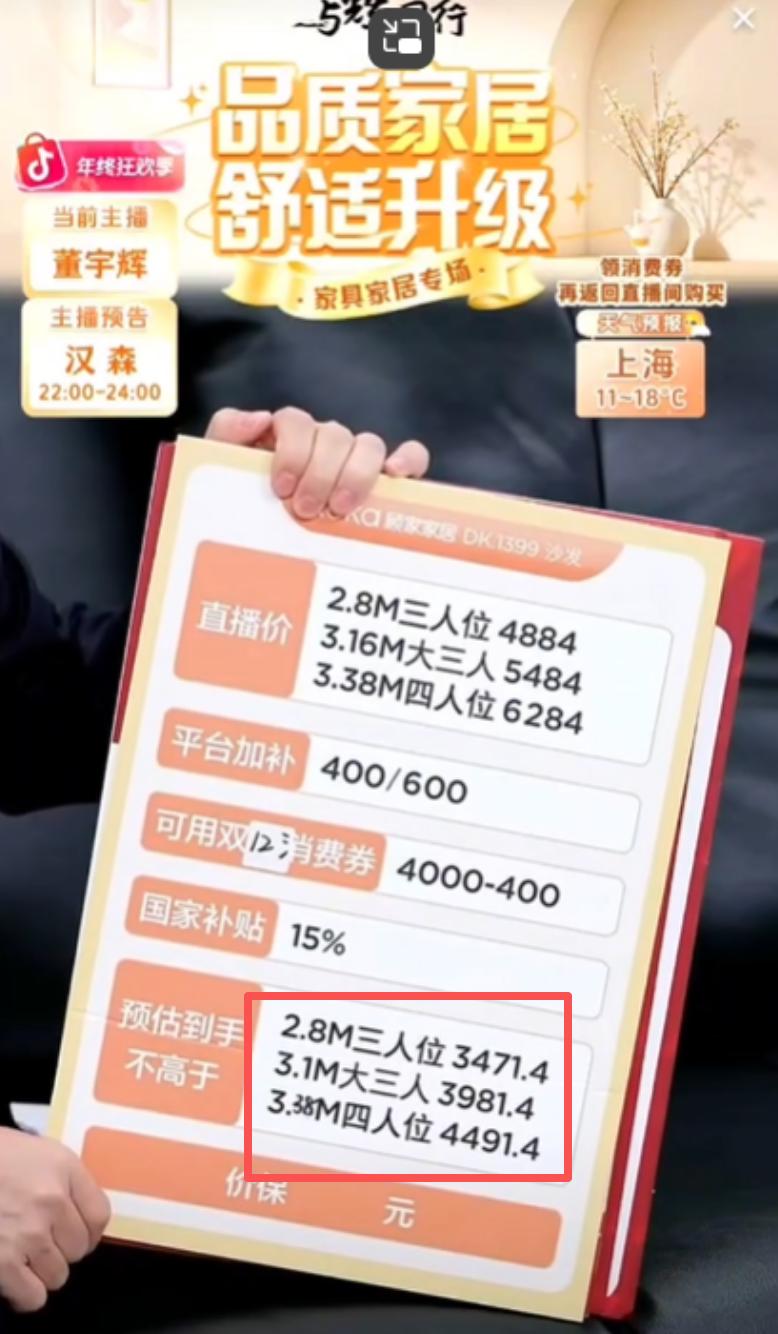
Core Viewpoint - The recent sales success of a sofa by Gujia Home, generating over 100 million yuan in revenue through a live-streaming event, has sparked both excitement and skepticism regarding the company's production capabilities and profit margins [1][3][5]. Sales Performance - Gujia Home's sofa sales during the live-stream event reached over 100 million yuan, with prices ranging from 3,471 to 4,491 yuan, indicating more than 20,000 families placed orders [1]. - The company's sofa business accounts for approximately 60% of total revenue, highlighting its significance as a core product [3]. Production and Profitability Concerns - There are concerns on social media about the authenticity of the orders, with rumors suggesting that no factories are willing to accept the orders due to low profit margins [3][5]. - The estimated production cost of the sofa is around 2,400 yuan, with additional logistics and installation costs bringing the total to nearly 3,000 yuan, leading to a gross margin of only about 16%, which is significantly lower than the reported 36% gross margin for sofas in the company's financial report [6][7]. Company Strategy and Market Position - Gujia Home is undergoing a transformation to adapt to changing market conditions, focusing on multi-channel sales and efficiency-driven strategies to enhance competitiveness [8][9]. - The company has recently experienced a decline in revenue and net profit, prompting a need to innovate and improve operational efficiency [7][8]. - The new ownership under He Jianfeng aims to drive the company towards greater scale and efficiency, with a strategic focus on retail transformation and global expansion [8]. Industry Context - The furniture industry is facing challenges due to reliance on traditional distribution channels, necessitating a shift towards online sales and competitive pricing strategies [8]. - The collaboration with popular live-streaming hosts is seen as a critical test of Gujia Home's supply chain and operational capabilities, as it must fulfill large orders efficiently [9][13].

顾家家居(603816) - 关于法院同意持股5%以上股东在重整期间继续营业并自行管理财产和营业事务的公告
2026-01-09 11:15
证券代码:603816 证券简称:顾家家居 公告编号:2026-001 顾家家居股份有限公司 关于法院同意持股 5%以上股东在重整期间继续营业 并自行管理财产和营业事务的公告 本公司董事会及全体董事保证本公告内容不存在任何虚假记载、误导性陈述 或者重大遗漏,并对其内容的真实性、准确性和完整性承担法律责任。 杭州市钱塘区人民法院于 2026 年 1 月 5 日收到德烨嘉俊管理人提交的《关 于提请人民法院许可债务人继续营业的报告》,经研究,许可德烨嘉俊在重整期 间继续营业。 2、《决定书》主要内容: 德烨嘉俊于 2026 年 1 月 5 日向杭州市钱塘区人民法院提出申请,请求杭州 市钱塘区人民法院许可德烨嘉俊在重整期间自行管理财产和营业事务。 杭州市钱塘区人民法院认为,债务人德烨嘉俊的内部治理机制仍正常运转, 债务人自行管理有利于其继续经营,目前也未发现债务人存在隐匿、转移财产或 者其他严重损害债权人利益的行为,在重整期间由其自行管理财产和营业事务有 利于重整工作的推进,德烨嘉俊的申请符合法律规定,杭州市钱塘区人民法院予 以准许。依照《中华人民共和国企业破产法》第七十三条规定,准许德烨嘉俊在 其管理人的监督下自行 ...