GitHub

Search documents
OpenAI的00后“叛徒”正在碾压华尔街“老江湖”
Hu Xiu· 2025-09-06 07:41
Core Insights - A new hedge fund, SALP, founded by 23-year-old Leopold Aschenbrenner, achieved a remarkable 47% return in just six months, significantly outperforming Wall Street averages by 700% [2][20][21] - Aschenbrenner, previously associated with OpenAI, was dismissed for raising concerns about security vulnerabilities, leading him to establish SALP focused entirely on AGI (Artificial General Intelligence) investments [3][12][14] Fund Overview - SALP is characterized as a pure AI-native fund, with 100% of its investments directed towards AI-related opportunities, distinguishing it from traditional funds that diversify across various sectors [4][22] - The fund's assets reportedly exceeded $1.5 billion by 2025, allowing for a concentrated investment strategy in a few high-confidence areas [23][24] Investment Philosophy - SALP operates under a mission-driven philosophy, focusing on AGI and its implications, rather than merely seeking high-growth companies [26][29] - The fund's strategy includes significant investments in AI infrastructure, such as computing power and energy, which are deemed essential for the future of AGI [32][34] Key Investments - SALP's notable investment includes Core Scientific, a cryptocurrency mining company that transitioned to AI computing services, highlighting the fund's ability to identify undervalued assets [3][35] - The fund also holds positions in major chip manufacturers like Broadcom and Intel, as well as energy companies like Vistra, anticipating a surge in demand for power due to AI advancements [35] Future Outlook - Aschenbrenner predicts that AGI could emerge around 2027, with a potential "intelligence explosion" following its realization, which would drastically alter economic and social structures [15][16][29] - The fund's approach is to leverage financial tools for both long and short positions, aiming to profit regardless of market conditions [27][28]



GPT-5:前端开发者的“选择自己的冒险路线”
3 6 Ke· 2025-09-05 10:33
Core Insights - OpenAI claims that GPT-5 excels in front-end coding, outperforming its predecessor in 70% of internal tests [2] - Mixed reviews from developers indicate that the initial excitement around GPT-5 may be overstated, with some users reporting a decline in performance [3][4] - A poll conducted by AI engineer Shawn Wang revealed that over 40% of respondents rated GPT-5 as "average" or "poor" [4] Developer Experiences - Influential developer Theo Browne initially praised GPT-5 but later expressed disappointment, stating that its performance had worsened over time [3] - A GitHub Copilot user criticized GPT-5 for its weak summarization and explanation capabilities, comparing it unfavorably to Claude Sonnet 4 [3] - Developers are exploring the potential of GPT-5 to create applications without traditional frameworks like React, suggesting a shift in front-end development practices [7][8] Performance Comparisons - The ability of GPT-5 to create websites without frameworks has impressed some developers, raising questions about the necessity of tools like React [8] - Differences in performance between various versions of GPT-5 have been noted, with some users experiencing less impressive results with non-premium versions [10] - A study by Sonar highlighted the varying coding styles and effectiveness of different AI models, indicating that GPT-5's coding personality is still being evaluated [11]

Copilot强塞马斯克Grok新模型,遭开发者集体“抵抗”!GitHub内部工程师曝:我们是被“胁迫”的
AI前线· 2025-09-03 09:36
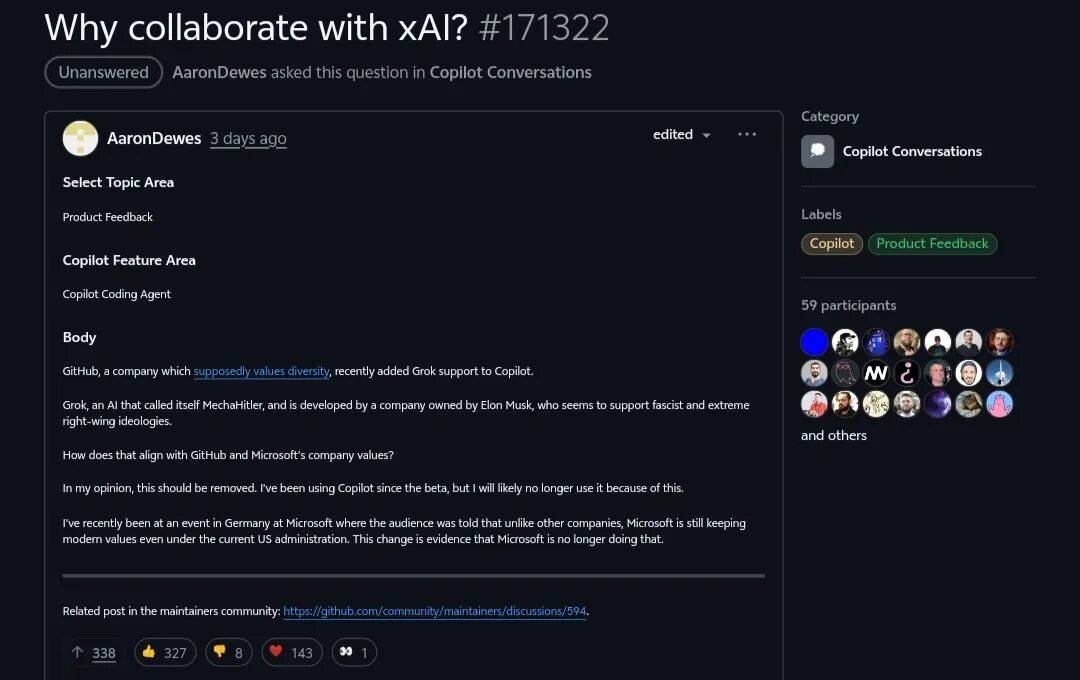
Core Viewpoint - GitHub is deepening its collaboration with xAI by integrating the Grok Code Fast 1 large language model into GitHub Copilot, but concerns have arisen regarding the model's safety testing and the working conditions of the engineering team [2][6][8]. Group 1: Integration of Grok Code Fast 1 - GitHub announced the optional public preview of Grok Code Fast 1 for users of GitHub Copilot Pro, Pro+, Business, and Enterprise plans, with free access until September 2, 2025 [3][4]. - Grok Code Fast 1 is designed specifically for coding tasks and provides visible reasoning trails in its responses, allowing programmers to iterate faster on complex projects [3][5]. - Users can enable Grok Code Fast 1 through the model selector in Visual Studio Code, with administrators needing to activate it for Business and Enterprise plans [4][5]. Group 2: Concerns and Complaints - A GitHub engineer, Eric Bailey, publicly criticized the rushed safety review process for Grok Code Fast 1, claiming the engineering team felt pressured to proceed against their values [6][8]. - Complaints about the Grok model focus on its lack of understanding, functional reasoning, and reliability, leading to frequent generation of non-functional code [6][8]. - GitHub has denied any shortcuts in the approval process, stating that Grok Code Fast 1 underwent a thorough internal review based on Microsoft's responsible AI standards [8][9]. Group 3: Developer Reactions - Developers have initiated discussions on GitHub, expressing their discontent with the integration of Grok and calling for its removal, with some considering migrating to alternative platforms [9][10][11]. - Some developers have canceled their Copilot subscriptions due to the partnership with xAI, while a minority believe that the collaboration could bring unique value to GitHub [11][12].


想成为一名合格的 AI PM,先抛弃过去那些让你成功的经验
Founder Park· 2025-09-02 12:26
Core Insights - The role of AI product managers (PMs) has evolved from merely adding features to designing systems that can learn and optimize over time, creating a compounding value system [2][4][12] - A well-defined and actionable AI product strategy is crucial for PMs to succeed in the current landscape [3][5] - Understanding the unique economic principles and product design philosophies brought by AI is essential for PMs to lead their companies towards sustainable success [12][13] Group 1: AI Product Strategy - Mastering AI product strategy is the primary skill required for PMs today, as highlighted by OpenAI's product lead Miqdad Jaffer [5] - AI product strategy involves insights into how AI can change unit economics, building feedback loops that compound value, and resisting homogenization [13][18] - The strategy must begin with selecting the right moat, as AI models are temporary while moats are enduring [19][21] Group 2: Unique Moats in AI - There are three primary moats in AI: data moat, distribution moat, and trust moat [32][36] - A data moat is built by generating unique, structured, high-quality data with each user interaction, which can be used to train better models and provide insights that competitors cannot access [25][26] - A distribution moat is critical for scaling AI products, as having a large user base allows for immediate adoption of new features [29][30] Group 3: Differentiation in AI Products - Differentiation is essential in a landscape where many products can access the same AI models; it focuses on user experience, workflow integration, and creating systems that accumulate value over time [42][45] - Successful AI products often integrate seamlessly into existing workflows, making them feel like invisible assistants rather than standalone tools [48][49] - The most effective differentiation strategies include building trust through transparency, governance, and community engagement [46][55] Group 4: Designing AI Products - Designing AI products requires a shift in mindset, recognizing that AI products are fundamentally different from traditional SaaS products due to their cost structures and user interactions [62][63] - Key design principles include considering cost implications, choosing the right workflow integration points for AI, and embedding safeguards from the outset [64][75] - The choice of product model (Copilot, Agent, Augmentation) significantly impacts user experience and cost management [72][78] Group 5: Deployment and Scaling - Deploying AI products involves balancing user growth with cost control, as each user interaction incurs costs that can escalate quickly [82][83] - Effective scaling strategies include starting small, controlling adoption curves, and building feedback loops that enhance product value [85][91] - Organizations must ensure that their internal capabilities grow in tandem with user growth to avoid operational failures [95] Group 6: Leadership in AI Integration - Leadership in AI requires PMs to view AI as a system that evolves and compounds value over time, rather than a set of features [96][103] - Establishing a structured experimental culture is vital for navigating the rapid changes in AI technology [105][110] - Clear communication of AI strategy and its business impact is essential for gaining support from stakeholders [104][109]

X @Avi Chawla
Avi Chawla· 2025-09-02 06:30
GitHub repo: https://t.co/wohmbgRpPi(don't forget to star it ⭐ ) ...
Copilot强塞马斯克Grok新模型,遭开发者集体“抵抗”!GitHub内部工程师曝:我们是被“胁迫”的
Sou Hu Cai Jing· 2025-08-30 06:49
Core Points - GitHub is deepening its collaboration with Elon Musk's xAI by integrating the Grok Code Fast 1 large language model into GitHub Copilot, raising concerns about safety testing and work conditions within the engineering team [1][4][5] Group 1: GitHub Copilot and Grok Code Fast 1 - Grok Code Fast 1 is being rolled out as an optional public preview for users of GitHub Copilot Pro, Pro+, Business, and Enterprise plans, with free access until September 2, 2025 [2][3] - The model is designed specifically for coding tasks and provides visible reasoning trails in its responses, allowing programmers to iterate faster on complex projects [2][3] - Users can enable Grok Code Fast 1 through the model selector in Visual Studio Code, with personal users having the option to use their own xAI API keys [3] Group 2: Internal Concerns and Developer Reactions - Eric Bailey, a senior engineer at GitHub, publicly criticized the rushed safety review process and claimed the engineering team felt pressured to integrate Grok Code Fast 1 against their values [4][5] - The integration has sparked significant backlash among developers, with many expressing intentions to migrate to alternative platforms due to dissatisfaction with the collaboration [5][6] - Some developers argue that the partnership with xAI could bring unique value to GitHub by enhancing tools for understanding model behavior and improving trust in automated workflows [6]
被OpenAI开除的00后搞投资,700%回报率降维暴击华尔街
Sou Hu Cai Jing· 2025-08-30 04:59
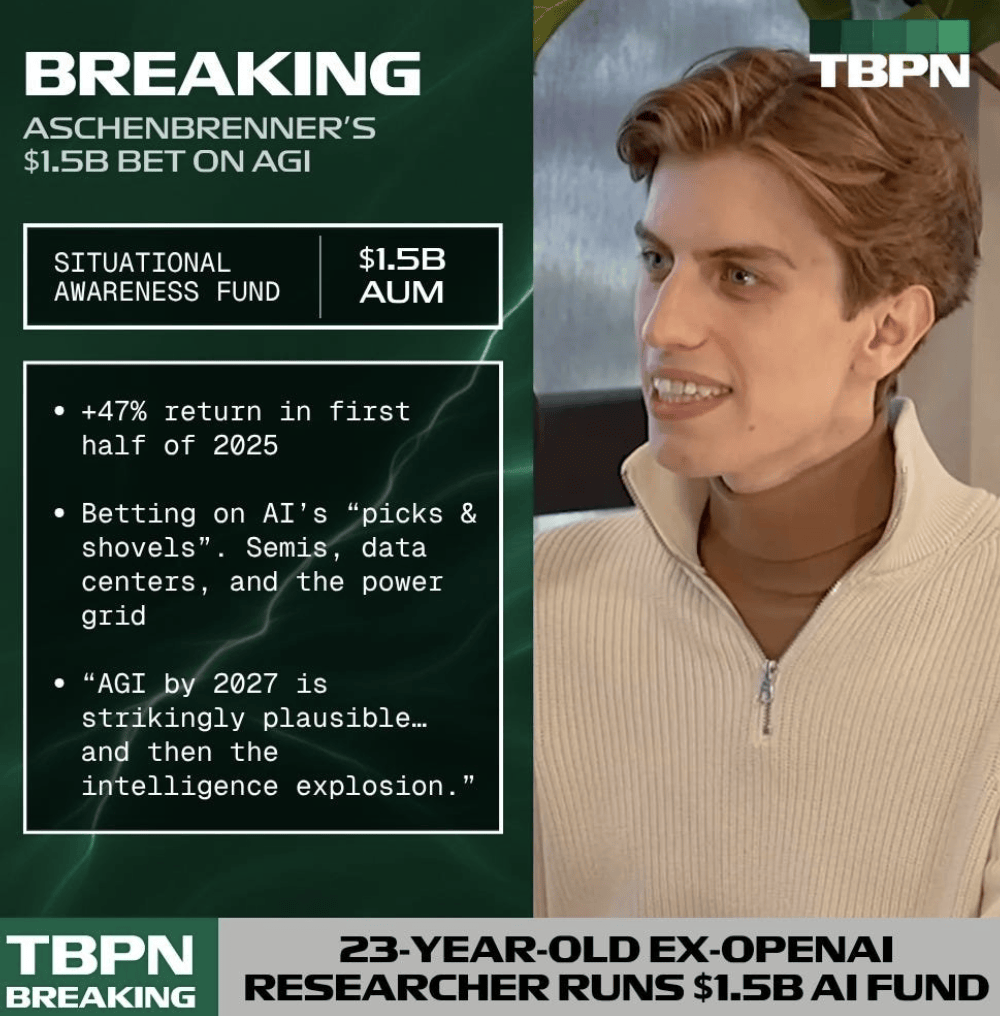
Core Insights - A 23-year-old named Leopold Aschenbrenner has rapidly grown his hedge fund, Situational Awareness, to manage $1.5 billion in assets within a year, achieving a remarkable 47% return in the first half of the year, significantly outperforming Wall Street averages [1][4][5]. Fund Overview - The fund, Situational Awareness, was founded in mid-2022 in San Francisco and focuses primarily on AI-related investments, particularly in AI semiconductors, infrastructure, and energy companies, while also investing in a few startups like Anthropic [4][5]. - The fund's return of 47% during the first half of 2023 starkly contrasts with the S&P 500's return of 6% and the technology hedge fund index's return of 7%, marking a 700% outperformance compared to the average Wall Street performance [4][5]. Investment Strategy - Leopold's investment strategy is straightforward, emphasizing an "ALL in AI" approach, with plans to hedge risks through smaller short bets against industries potentially disrupted by AI [5][6]. - The fund has attracted notable investors, including Patrick and John Collison (founders of Stripe) and Daniel Gross (from Meta's superintelligence team), indicating strong backing and credibility in the investment community [6]. Background of the Founder - Leopold Aschenbrenner, originally from Germany, graduated from Columbia University at 19 with degrees in mathematics, statistics, and economics. He briefly worked at OpenAI before being dismissed due to a security leak [6][8]. - His controversial report titled "Situational Awareness," which predicted the arrival of AGI by 2027, gained significant attention and laid the foundation for his investment philosophy [6][8].
被OpenAI开除的00后搞投资,700%回报率降维暴击华尔街
量子位· 2025-08-30 04:42
Core Insights - A 23-year-old individual, previously dismissed by OpenAI, has successfully grown his fund to over $1.5 billion within a year [1] - The fund achieved an impressive 47% return in the first half of the year, outperforming Wall Street's average by 700% [2][8] - The fund's investment strategy focuses on AI-related sectors, particularly AI semiconductors, infrastructure, and energy companies, along with some early-stage startups [10] Fund Performance - The fund's 47% return significantly surpasses the S&P 500's return of 6% and the technology hedge fund index's return of 7% during the same period [8] - The fund has attracted long-term investments from various notable investors, indicating strong confidence in its management and strategy [5] Investment Strategy - The fund's strategy, termed "ALL in AI," emphasizes investments in AI semiconductors and related sectors, while also planning small short bets to hedge against industries potentially disrupted by AI [10][12] - The fund is managed by Leopold, who has a background in mathematics, statistics, and economics, and has previously worked with OpenAI [16][18] Notable Backers - The fund has garnered support from prominent figures such as Patrick and John Collison (founders of Stripe) and Daniel Gross (from Meta's superintelligence team), enhancing its credibility [12] - The fund's name, "Situational Awareness," is derived from a report published by Leopold, predicting the arrival of AGI by 2027 [12][21] Background of the Manager - Leopold, who was born in Germany and graduated from Columbia University at 19, has a strong academic foundation [16] - After being dismissed from OpenAI for leaking internal security issues, he published a widely discussed report that contributed to his subsequent success in the investment field [19][21]

GitHub 被微软“吞并”,开源时代宣告终结?
Hu Xiu· 2025-08-25 08:04
Core Insights - GitHub's CEO Thomas announced his resignation on August 11, raising concerns among developers about the platform's future direction [1] - GitHub will no longer operate independently as it will be integrated into Microsoft's CoreAI division, signaling a significant shift in its operational model [1] - The independence of GitHub is questioned, as its role in supporting global developer collaboration may be impacted by this integration [1] Company Transition - The decision to merge GitHub into Microsoft's CoreAI department indicates a strategic move by Microsoft to align GitHub with its broader business objectives [1] - The historical context of GitHub's creation in a San Francisco bar highlights its grassroots origins and the evolution of its mission towards AI integration through tools like Copilot [1] - The implications of this transition for developers and the future of collaborative software development on GitHub remain uncertain [1]
氛围编程行不通,CTO们集体炮轰AI编程:不是失业,而是失控
3 6 Ke· 2025-08-25 01:13
Core Insights - The article discusses the challenges and limitations of "vibe coding," which relies heavily on AI-generated code without proper oversight or understanding of the underlying systems [2][4][12] - CTOs from various companies express that vibe coding can lead to significant issues in production environments, emphasizing the need for structured software engineering practices [3][5][20] Group 1: Challenges of Vibe Coding - CTOs describe vibe coding as a shortcut that ultimately leads to dead ends, with real-world examples of failures due to AI-generated code not being properly vetted [3][4][12] - Issues arise when AI-generated code is deployed without thorough testing, leading to critical failures in production systems, as seen in multiple case studies shared by CTOs [4][5][19] - The reliance on AI for coding can create a "trust debt," where experienced engineers must spend excessive time debugging and understanding poorly structured code [3][4][20] Group 2: Importance of Structured Software Engineering - The article emphasizes that writing code is not the same as developing production-grade software, which requires a deep understanding of system architecture and user needs [13][14][20] - Effective software engineering involves making numerous decisions about structure, dependencies, and trade-offs, which cannot be replaced by AI-generated code alone [14][15][20] - The need for skilled software engineers remains critical, as they are responsible for maintaining and improving complex systems, especially when issues arise [11][20][22] Group 3: Recommendations for Engineers - Engineers are encouraged to adopt practices that ensure their code is understandable and maintainable, which will facilitate better collaboration with AI tools [25][30][31] - Clear documentation and coding standards are essential for guiding AI in generating code that aligns with team expectations and project requirements [30][31] - Emphasizing code review skills and maintaining a structured development environment will enhance the effectiveness of AI in the coding process [25][26][30]