Shein

Search documents
德国财长刚喊完“不要中国垃圾”,法国也盯上中国,欧盟要下手了
Sou Hu Cai Jing· 2025-12-15 10:33
Group 1 - The European Union (EU) has agreed to implement a temporary tax of 3 euros on packages valued under 150 euros from non-EU countries starting July 2026, which will become a permanent tax after two years [1][3] - France and Germany played a crucial role in expediting this policy, originally planned for 2028, due to France's lobbying efforts [3][5] - The primary objective of this policy is to protect local industries and markets in France and Germany from the influx of low-cost goods from China [5][7] Group 2 - France is facing significant pressure on local retailers due to the influx of low-cost Chinese goods, with 91% of the 4.6 billion small packages received in 2024 coming from China [7][9] - Germany's concerns are similar, as platforms like Temu and Shein have increased competition for local textile and retail industries, prompting a strong response from the German finance minister [9][11] - The new tax will impact small sellers relying on low-priced goods, as the additional cost could erode their price advantage in the European market [11][15] Group 3 - Larger platforms like Shein and Temu have already established local warehouses in Europe, which may exempt them from the new tax, allowing them to maintain competitive pricing [13][15] - The policy is expected to have a limited short-term impact on consumers, but may lead to higher prices or reduced options for low-cost goods as some small sellers may exit the market [15][17] - The EU's new tax policy may inspire similar actions from other countries, potentially diminishing the "tax-free advantage" previously enjoyed by Chinese cross-border e-commerce [17][19] Group 4 - Chinese companies are encouraged to adapt by establishing overseas warehouses and focusing on higher-value products to remain competitive despite the new tax [19][21] - Compliance with EU regulations, including tax registration and product certification, will be essential for Chinese businesses to avoid penalties and maintain market access [21][23] - The tax policy reflects a broader trend of protecting local markets, but it also presents an opportunity for Chinese e-commerce to innovate and enhance competitiveness in the European market [23]


法国连开3枪,召集26国反华?中企被突袭调查,局势开始恶化
Sou Hu Cai Jing· 2025-12-15 04:11
Group 1 - The European Union (EU) has decided to impose a fixed tariff of 3 euros on all small packages imported directly from non-EU countries with a declared value below 150 euros, effective from July 1, 2026, paving the way for a permanent tariff arrangement [1][3][5] - This temporary measure is aimed primarily at Chinese platforms that rely on low-value direct mail, indicating a significant shift towards regular customs duties and increased regulatory scrutiny [3][5][12] - The EU received 4.6 billion low-value packages in 2024, with approximately 90% originating from China, highlighting the growing gap between regulatory capabilities and the volume of small packages [5][7] Group 2 - Recent enforcement actions include unannounced inspections of Temu's European headquarters in Dublin and investigations into Nuctech under the Foreign Subsidies Regulation, indicating a tightening regulatory environment for Chinese companies operating in Europe [3][7][12] - French President Macron has emphasized the need for stronger tools, including tariffs, to address the trade imbalance with China, reflecting a broader sentiment among EU member states regarding consumer protection and fair competition [8][10][12] - The EU's regulatory framework is evolving, with potential implications for compliance costs and operational transparency for platforms and supply chains, as the focus shifts from low-cost advantages to higher compliance requirements [13][15][19] Group 3 - The EU's approach may lead to a "political bargaining" scenario where platforms can negotiate compliance measures in exchange for regulatory predictability, while also addressing external competitive pressures [15][16] - If tariffs and enforcement actions expand to more product categories, European consumers may face price increases, and Chinese companies could experience tighter supply chain constraints, accelerating geographical reallocation of orders and investments [19][21] - The relationship between China and the EU may experience short-term friction, particularly in e-commerce and technology sectors, but the long-term trajectory will depend on the implementation of temporary tariffs and the handling of subsidy cases [21]
J&T EXPRESS(1519.HK):TAKEAWAYS FROM BANGKOK INVESTOR CALL
Ge Long Hui· 2025-12-13 05:35
Core Viewpoint - J&T has achieved profitability in Thailand and is confident in its growth potential in the Southeast Asia market, with expectations of parcel volume growth outpacing the industry average by 2026 [2][3] Group 1: Company Performance - J&T has ranked number one in Thailand, with parcel volume equal to the total volume of the second to fourth players combined [2][3] - The company has achieved a compound annual growth rate (CAGR) of over 40% in parcel volume over the past three years, currently serving 200,000 customers, including 20,000 non-e-commerce customers [3] - J&T has successfully reduced costs by 10% per annum since 2022, with a 30% cost reduction achieved by using self-owned trucks compared to leased ones [3] Group 2: Market Outlook - Management is optimistic about the growth potential in Thailand, particularly in e-commerce penetration and per capita parcel volume [2] - J&T expects its parcel volume growth in the Southeast Asia market to exceed the industry average by 2026 [2] - The company is also exploring new markets such as Brazil and the Middle East, indicating good potential for expansion [2] Group 3: Competitive Landscape - Major competitors in Thailand include Lazada Logistics and Shopee, but J&T believes its higher density network leads to better delivery efficiency and cost advantages [3] - J&T's largest customer in Southeast Asia is TikTok, while Shein is the largest customer in South America and the Middle East [2]
China's credit growth in November stays muted on low demand
The Economic Times· 2025-12-12 19:23
Credit Growth and Economic Indicators - Financial institutions extended ¥392 billion ($55.6 billion) of new yuan loans in November, falling short of the median forecast of ¥450 billion, indicating weak credit growth [1][6] - Household loans contracted for the second consecutive month, marking the first such occurrence since 2005, reflecting a trend of net debt repayment by residents due to a bleak job market and deteriorating housing market [1][6] - New medium- and long-term corporate loans weakened compared to the previous year, suggesting a lack of demand for business expansion [2][6] - Bill financing, a tool used by banks to inflate lending, more than doubled, indicating dire business demand [2][6] Future Outlook - Credit growth is expected to remain weak in the coming months, with subdued loan demand anticipated due to elevated real lending rates amid deflation [3][6] - The growth rate of the credit stock accelerated earlier in the year but has slowed recently, attributed to government bond sales and weakening economic momentum [6] EU Import Duties - The European Union finance ministers agreed to impose a three-euro duty on all small parcels imported into the bloc starting July 1, 2026, to address the influx of cheap imports, primarily from China [7][10] - This decision follows the removal of a duty exemption for packages valued under €150 ($174), which was commonly used for direct consumer imports from Chinese platforms [8][10] - In the previous year, 4.6 billion small packages entered the EU, with 91% originating from China, and the EU expects this number to rise [10]


X @Bloomberg
Bloomberg· 2025-12-12 09:51
From Pop Mart’s Labubus to Shein, Temu and Luckin, Chinese brands have become global consumer favorites and cultural ambassadors. With much of the credit going to TikTok, shoppers are hungry for more. https://t.co/XvOD6xXtFQ https://t.co/F6y9nCWcMa ...
X @Bloomberg
Bloomberg· 2025-12-12 09:00
From Pop Mart’s Labubus to Shein, Temu and Luckin, Chinese brands have become global consumer favorites and cultural ambassadors. With much of the credit going to TikTok, shoppers are hungry for more. https://t.co/XvOD6xXtFQ https://t.co/BwCGPY0j3D ...
From TikTok to Labubu: How Chinese Brands Are Going Global
Bloomberg Originals· 2025-12-12 09:00
Market Trends & Soft Power - Chinese soft power is emerging globally as China moves up the value chain [1][2] - Chinese companies are investing in overseas markets, similar to post-war American companies [3] - Chinese brands are winning over global consumers and changing perceptions [4] Company Performance & Expansion - Pop Mart's annual revenue has more than tripled since 2024, with overall sales growing as much as 250% [6] - Luckin became China's biggest coffee brand in 2023, surpassing Starbucks in sales revenue and store numbers, with three times as many stores in China as Starbucks as of October 2024 [9][10] - Meituan plans to invest $1 billion over the next five years to launch in Brazil [13] Challenges & Opportunities - Chinese companies face geopolitical uncertainties, including tariffs and data privacy scrutiny [15] - Factory deflation and intense competition in China are pushing companies to seek higher profit margins overseas [14][15] - Retention is a big issue for Shein and Temu, with Temu having a user retention rate in the 60% range compared to Amazon's 93% in the US [18][19] Consumer Behavior & Technology - TikTok has over 1 billion users worldwide, including over 170 million per month in the US alone, introducing a generation of young Americans to Chinese brands [7] - Approximately 40% of all retail payments in China are made using phones, indicating a mobile-first e-commerce environment [9]

知名电商平台停止运营
3 6 Ke· 2025-12-11 01:51
Core Viewpoint - The competitive landscape of global e-commerce platforms is intensifying, leading to an increasing number of exits from the market, exemplified by the closure of Ozsale, an Australian e-commerce platform, set for January 27, 2026 [1][8]. Group 1: Company Overview - Ozsale, known as the "overseas version of Vipshop," will cease operations, with unused points expiring after the shutdown date [1]. - The closure follows the earlier shutdown of its sister platform, NZSale, indicating a significant shift in the regional discount e-commerce model [2]. - Ozsale was founded in 2007 by Jamie and Carl Jackson, who capitalized on the demand for high-quality, affordable products through a membership-based flash sale model [3][4]. Group 2: Historical Performance - By 2012, Ozsale had over 2 million members and reported annual sales of £102 million (approximately 1 billion RMB), marking a 40% year-on-year growth [5]. - The peak of MySale's operations included 12 websites across five countries, with significant user growth and plans for expansion into the UK and US markets [5][6]. - However, the company faced a 43% decline in sales and a 50% drop in gross profit by late 2019, indicating a downturn in performance [6]. Group 3: Market Dynamics - The closure of Ozsale reflects broader trends in the global e-commerce sector, with over ten platforms facing bankruptcy or forced acquisition between 2024 and November 2025 [8]. - Competitors like Amazon, Temu, and Shein have significantly impacted regional platforms, leading to a decline in market share for local e-commerce sites [9]. - Ozsale's delivery complaints increased by 180% over three years, with over 30% of users reporting order delays, highlighting operational inefficiencies [9][10]. Group 4: Future Implications - The decline of platforms like Ozsale and Catch illustrates the challenges faced by e-commerce businesses that fail to adapt to evolving market conditions and consumer preferences [10]. - In contrast, domestic beauty brands in China are thriving through established platforms like Tmall and JD, as well as emerging channels like Douyin, indicating a shift in competitive strategies [11]. - The e-commerce landscape is transitioning towards a focus on user engagement, operational efficiency, and differentiated experiences, necessitating a reevaluation of traditional business models [11].
日本10%消费税落地!TikTok Shop美国站保证金暴涨至1500美元!
Sou Hu Cai Jing· 2025-12-10 13:09
Core Viewpoint - Japan's ruling Liberal Democratic Party has proposed a tax reform that will eliminate the consumption tax exemption for imported goods valued under 10,000 yen starting in 2026, requiring all goods entering Japan to pay a 10% consumption tax [1][3]. Group 1: Tax Policy Changes - The new tax policy will abolish the special regulation that taxed personal imports at 60% of the overseas price, shifting to full taxation based on actual transaction prices [3][4]. - Online platforms with annual sales exceeding 5 billion yen will be required to act as tax agents for consumption tax [3][4]. - The proposal includes key details such as the responsibility of large e-commerce platforms for tax collection and the 5 billion yen sales threshold [3][4]. Group 2: Impact on Cross-Border E-commerce - The new tax regime is expected to diminish the price advantage of low-cost goods, increasing operational costs for platforms by 30%-50% for those with sales over 10 billion yen [4][6]. - The number of low-value imports has surged, with approximately 170 million items valued under 10,000 yen expected in 2024, accounting for 90% of all import licenses [4][6]. - The policy aims to promote fair competition and enhance customs regulation, addressing complaints from domestic businesses about unfair competition from overseas sellers [6][10]. Group 3: Cost Implications - For a typical product priced at 8,000 yen, the new tax will add 800 yen in consumption tax, raising the total price to 8,800 yen, with potential additional customs fees of about 300 yen [9][10]. - The operational costs for sellers relying on low-price direct shipping models may be significantly impacted, potentially eroding profit margins [9][10]. Group 4: Global Context - Similar tax reforms are being implemented globally, with the U.S. and EU also moving to eliminate tax exemptions for low-value imports, indicating a broader trend of tightening regulations on cross-border e-commerce [11][12][14]. - Countries like the UK, France, and Vietnam are also reviewing or have enacted similar policies, marking the end of the "tax-free era" for cross-border e-commerce [14][16]. Group 5: Strategic Recommendations for Sellers - Sellers are advised to reassess their pricing strategies, operational models, and tax compliance management in light of the new regulations [16][20]. - Transitioning to an overseas warehouse model is recommended to mitigate the impact of the new tax regime and improve logistics efficiency [20][30]. - Understanding the new tax collection mechanisms and obtaining a Japanese Consumption Tax registration number (JCT) is crucial for compliance and operational success [20][30].

债墙高筑的阿根廷,为何成为拉美新增长引擎?
3 6 Ke· 2025-12-10 08:38
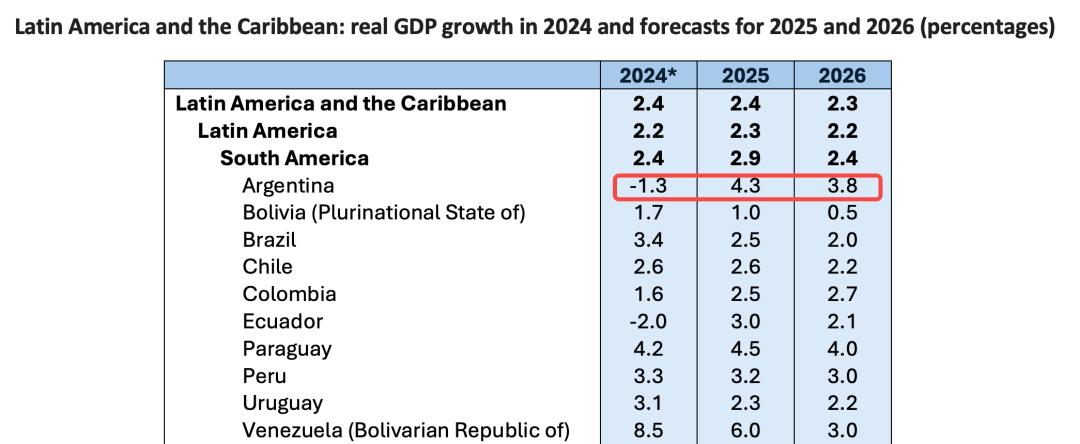
说起阿根廷,这个拉美国家最鲜明的注脚,莫过于居高不下的通胀和一泻千里的汇率。 过去数年,阿根廷持续处于货币崩溃、通胀飙升、中央银行近乎破产的经济状态中。2023年底,阿根廷年通胀率超200%、有着近2771亿美元的巨额外债 以及外贸和财政的双赤字。 而如今,这一印象亟待被刷新。 2023年12月10日,主张经济自由放任主义的Javier Milei(米莱)正式宣誓就任阿根廷总统府,成为阿根廷新任总统,其主张大幅削减政府部门开支、大幅 贬值本币比索、推进经济自由化与私营市场主导,一系列经济改革政策为陷于经济泥沼多年的阿根廷带来希望。 2025年已经过去的前两个季度,阿根廷GDP同比增长分别是5.8%和6.3%。而就在去年,这一数字还是负值。 Economic Commission for Latin America and the Caribbean (CEPAL) 的2025年报告展望中,阿根廷在南美国家中被列为增长最快,其 2025年GDP增速预测为 约4.3%。并且,在未来1–2年的区域增长预期中,阿根廷被广泛视作西半球表现最亮眼的经济体。 | | 2024* | 2025 | 2026 | | --- ...