
春秋航空

Search documents
民航华东局对春秋航空扬州公司开展维修单位体系监察
Zhong Guo Min Hang Wang· 2025-09-18 02:53
Core Insights - The Civil Aviation Administration of China (CAAC) conducted an annual inspection of Spring Airlines Aircraft Engineering Yangzhou Co., focusing on the maintenance system and safety management [1][2] Group 1: Inspection Findings - A joint inspection team verified the company's maintenance system compliance through document reviews, on-site checks, and personnel interviews, identifying safety management blind spots and weaknesses in on-site management [1] - The Jiangsu Regulatory Bureau is responsible for organizing the issues found during the inspection and tracking the rectification progress [2] Group 2: Recommendations for Improvement - The Jiangsu Regulatory Bureau proposed five improvement suggestions for the company's safety development, including enhancing the professional qualifications of key personnel, improving training management effectiveness, optimizing production support efficiency, refining management methods, and strengthening risk control and hazard identification [2] - The East China Bureau acknowledged the company's efforts in fine-tuning the entire maintenance process and suggested focusing on typical maintenance errors in the industry, assessing maintenance capabilities against company development, and advancing smart maintenance initiatives [3]

东兴证券:8月航空机场供给低增长 客座率环比改善
智通财经网· 2025-09-17 09:19
Core Viewpoint - The report from Dongxing Securities indicates a cautious approach from airlines regarding capacity deployment in domestic routes, with improvements in passenger load factors observed in August, supported by the introduction of the self-discipline convention by the China Air Transport Association [1][5]. Domestic Routes - In August, the capacity deployment for domestic routes by listed companies increased by approximately 1.7% year-on-year and 0.8% month-on-month, with growth rates declining to a lower level [2]. - The three major airlines maintained a capacity deployment level in August that was largely unchanged from July, with year-on-year growth rates declining compared to July [2]. - The overall passenger load factor for listed companies improved by about 0.9 percentage points year-on-year and increased by 3.3 percentage points month-on-month, indicating a significant recovery in load factors [2]. - Airlines adjusted their strategies in response to lower-than-expected demand, shifting focus from maximizing load factors to balancing capacity and pricing for better profitability [2][3]. International Routes - For international routes, capacity deployment by listed airlines increased by approximately 14.6% year-on-year and 1.0% month-on-month in August [4]. - The passenger load factor for international routes remained stable year-on-year, with a month-on-month increase of about 2.8 percentage points [4]. - Notable increases in load factors were observed for Spring Airlines and China Eastern Airlines, both based in Shanghai, reflecting strong seasonal demand in the region [4]. Industry Policy Changes and Investment Recommendations - The introduction of the self-discipline convention by the China Air Transport Association in August has laid the groundwork for reducing market chaos and improving operational standards, contributing to revenue enhancement [5]. - The ongoing effort to combat internal competition is seen as a long-term initiative that will aid in the rebalancing of the industry and improve overall profitability [5]. - Large airlines are expected to benefit more significantly from these changes, suggesting a focus on these companies for investment opportunities [5].

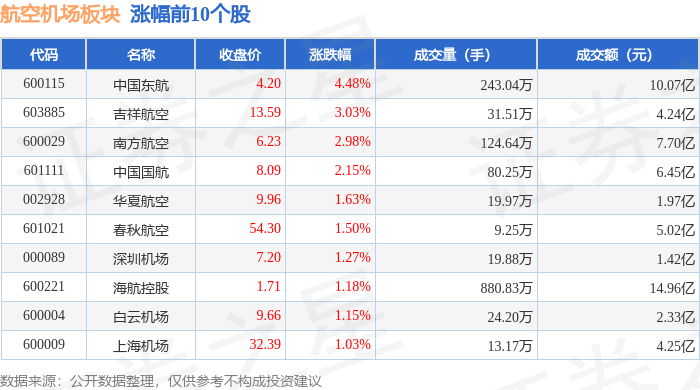
航空机场板块9月17日涨2.16%,中国东航领涨,主力资金净流入1.06亿元
Zheng Xing Xing Ye Ri Bao· 2025-09-17 08:45
Core Insights - The aviation and airport sector experienced a 2.16% increase on September 17, with China Eastern Airlines leading the gains [1] - The Shanghai Composite Index closed at 3876.34, up 0.37%, while the Shenzhen Component Index closed at 13215.46, up 1.16% [1] Stock Performance - China Eastern Airlines (600115) closed at 4.20, up 4.48% with a trading volume of 2.43 million shares and a turnover of 1.007 billion [1] - Xiamen Airport (600897) saw a slight decline of 0.14%, closing at 14.70 with a trading volume of 29,500 shares [2] - The highest gainers included China Eastern Airlines, Xiamen Airlines, and Southern Airlines, with respective increases of 4.48%, 3.03%, and 2.98% [1][2] Capital Flow - The aviation and airport sector saw a net inflow of 106 million in main funds, while retail funds had a net inflow of 103 million [2] - The main funds showed a net outflow of 210 million, indicating a mixed sentiment among institutional investors [2] Individual Stock Capital Flow - China Eastern Airlines had a net outflow of 50.94 million from main funds but a net inflow of 34.51 million from retail investors [3] - China Southern Airlines experienced a net inflow of 6.64 million from main funds, indicating positive retail sentiment despite overall mixed capital flow [3] - Xiamen Airport faced a significant net outflow of 15.59 million from main funds, suggesting weaker institutional interest [3]





免税店概念下跌1.60%,7股主力资金净流出超5000万元
Zheng Quan Shi Bao Wang· 2025-09-17 08:45
Group 1 - The duty-free store concept index declined by 1.60%, ranking among the top declines in the concept sector, with companies like Bubugao, Zhongxin Tourism, and ST Huayang experiencing significant drops [1][2] - Among the duty-free store concept stocks, only four saw price increases, with Spring Airlines, Baiyun Airport, and Shanghai Port Group rising by 1.50%, 1.15%, and 1.07% respectively [1][2] - The duty-free store sector experienced a net outflow of 1.049 billion yuan in capital today, with 27 stocks seeing net outflows, and seven stocks experiencing outflows exceeding 50 million yuan [2][3] Group 2 - Bubugao led the net capital outflow with 284 million yuan, followed by Caesar Travel and Zhongxin Tourism with net outflows of 196 million yuan and 90.66 million yuan respectively [2][3] - The stocks with the highest net inflows included Spring Airlines, with 58.46 million yuan, followed by China Merchants Shekou and Dalian Commercial Group with 5.90 million yuan and 4.86 million yuan respectively [2][3] - The trading volume for Bubugao was 17.30%, with a price drop of 5.50%, indicating significant trading activity despite the decline [2][3]


航空机场8月数据点评:供给低增长,客座率环比改善
Dongxing Securities· 2025-09-17 07:55
Investment Rating - The industry investment rating is "Positive" [2] Core Viewpoints - The report highlights that the aviation industry is experiencing low growth in supply, while passenger load factors have improved significantly month-on-month in August [3][12] - The cautious approach of airlines towards capacity deployment is influenced by the unsatisfactory load factors in July and the ongoing trend of industry self-regulation [4][5][7] - The report emphasizes the importance of maintaining supply constraints to achieve a balance between supply and demand, which is crucial for alleviating operational pressures on airlines [5][21] Summary by Sections Domestic Routes - In August, the capacity deployment for domestic routes by listed airlines increased by approximately 1.7% year-on-year and 0.8% month-on-month, indicating a slowdown in growth [4][17] - The overall passenger load factor for listed companies improved by about 0.9 percentage points year-on-year and 3.3 percentage points month-on-month, reflecting a recovery in demand during the peak season [4][35] - Airlines are shifting their focus from maximizing load factors to balancing pricing and volume, prioritizing profitability over market share [4][42] International Routes - For international routes, capacity deployment increased by approximately 14.6% year-on-year and 1.0% month-on-month in August, with load factors remaining stable [6][57] - Notably, airlines based in Shanghai, such as Spring Airlines and Eastern Airlines, saw significant improvements in load factors, exceeding 4% month-on-month [6][59] - The report indicates that the demand in the Shanghai region is relatively strong, as evidenced by the higher growth rates in international passenger throughput compared to other major airports [6][71] Industry Policy Changes and Investment Recommendations - The publication of the "Self-Regulation Agreement for Air Passenger Transport" by the China Air Transport Association in August is seen as a foundational step towards curbing market chaos and improving revenue levels [7][16] - The report suggests that the ongoing self-regulation efforts are essential for achieving long-term balance in the industry, with larger airlines expected to benefit more significantly from these changes [7][16]
信达证券:8月航司客座率维持高位 座收或超预期
Zhi Tong Cai Jing· 2025-09-17 07:47
Core Insights - The airline industry is experiencing high passenger load factors and a slowdown in capacity growth, with a focus on increasing international routes [1][4] - Domestic flight turnover has shown steady growth, while international turnover has significantly recovered to pre-pandemic levels [1][4] - Average ticket prices have seen a narrowing decline, indicating potential improvements in revenue per seat for airlines [2][5] Supply and Demand - The industry passenger load factor remains high, with a year-on-year capacity growth slowdown. As of July 2025, the industry’s ASK and RPK increased by 5.5% and 6.1% year-on-year, respectively, with a load factor of 84.5%, up 0.5 percentage points year-on-year [1] - Domestic flight turnover increased by 3.9% year-on-year, while international and regional flights have returned to 100.3% of 2019 levels [1] Ticket Pricing - Average ticket prices for the year-to-date (as of September 15, 2025) are 864 RMB, down 8.8% year-on-year. The average ticket price during the summer travel period in July and August fell by 8.8% and 7.3% year-on-year, respectively, with a narrowing decline in August [2] Fuel and Exchange Rates - The average price of aviation fuel in Q3 decreased by 11.2% year-on-year, with the domestic aviation fuel price dropping to 5545 RMB per ton in September, down 7.6% year-on-year [3] - The Chinese yuan has appreciated against the US dollar, with the exchange rate moving from 7.1884 RMB at the end of 2024 to 7.1027 RMB by September 16, 2025 [3] Operational Performance - From January to August 2025, most airlines saw slight increases in domestic capacity, with Spring Airlines showing a growth rate of 4.7%. The passenger load factor for major airlines has shown significant year-on-year increases, with Eastern Airlines up by 3.5 percentage points [4] - In August, Air China had the highest net increase in aircraft, adding six planes, while other airlines also reported net increases [4] Investment Recommendations - The industry is expected to see improvements in unit revenue due to high passenger load factors and narrowing ticket price declines. The implementation of measures to reduce price competition may further support ticket price recovery [5] - Airlines such as China Southern Airlines, China Eastern Airlines, Air China, Spring Airlines, and Juneyao Airlines are recommended for investment focus [5]


【盘中播报】57只个股突破半年线
Zheng Quan Shi Bao Wang· 2025-09-17 06:52
Market Overview - The Shanghai Composite Index closed at 3876.38 points, above the six-month moving average, with an increase of 0.38% [1] - The total trading volume of A-shares reached 1,956.132 billion yuan [1] Stocks Breaking the Six-Month Moving Average - A total of 57 A-shares have surpassed the six-month moving average today [1] - Notable stocks with significant deviation rates include: - United Optoelectronics: 3.70% [1] - Longxin General: 3.64% [1] - *ST Nanzhi: 3.60% [1] - Other stocks with smaller deviation rates that just crossed the six-month line include Honghai Technology, Rhine Biology, and Qijing Machinery [1] Top Stocks by Deviation Rate - The following stocks have the highest deviation rates from the six-month moving average: - United Optoelectronics (300691): 5.42% increase, trading at 19.64 yuan [1] - Longxin General (603766): 7.15% increase, trading at 13.04 yuan [1] - *ST Nanzhi (002305): 4.91% increase, trading at 2.35 yuan [1] - Other notable stocks include: - Huangting International (000056): 6.31% increase, trading at 3.20 yuan, deviation rate of 3.29% [1] - Berteli (603596): 6.65% increase, trading at 54.39 yuan, deviation rate of 3.11% [1] Additional Stocks with Positive Performance - Other stocks with positive performance and deviation rates include: - Airong Software (920799): 4.29% increase, trading at 60.76 yuan, deviation rate of 2.91% [1] - Yingshisheng (300377): 4.65% increase, trading at 24.77 yuan, deviation rate of 2.59% [1] - Zhengfan Technology (688596): 4.28% increase, trading at 37.01 yuan, deviation rate of 2.42% [1]


春秋航空空地联动争分夺秒 3通电话化解火灾危机
Zhong Guo Min Hang Wang· 2025-09-17 06:44
《中国民航报》、中国民航网 记者胡夕姮 报道:近日,由上海浦东飞往新加坡的春秋航空9C8549航班 正在平稳巡航。一名旅客突然向机组求助,称其离家前可能未关闭家中燃气灶,且灶上正煮着鸡蛋,恐 引发火灾。随后,一场空地联动的远程救援随即展开,最终春秋航空客服凭借三通关键电话成功化解险 情。 在第二次通话中,冯军利以更加诚恳的态度耐心说明事态紧急性与信息真实性,最终说服物业工作人 员。对方记录下业主房号及进门密码,承诺立即派人上门查看。十分钟后,冯军利第三次致电询问进 展,得知物业人员已进入旅客家中,确认燃气灶仍处于开启状态,锅内鸡蛋早已烧焦并冒出浓烟。工作 人员迅速关闭燃气阀门、开窗通风——一场可能发生的火灾事故被成功阻止。得知家中险情被排除,该 名旅客在航班上连声道谢。 凭借迅速响应、专业沟通和持续跟进,春秋航空守护旅客于千里之外。整个救援过程仅历时20分钟,体 现了春秋航空机组与地面团队在应急处置中的高效协作能力与责任感。(编辑:陈虹莹 校对:李佳洹 审核:韩磊) 事发时,航班正处于万米高空平稳飞行阶段。该名旅客匆忙中想起家中燃气灶可能未关后,马上向客舱 机组反映。机长迅速将该情况传递至春秋航空客服中心,并 ...
西北民航“国际首乘”经济效益显著 相关产品销售额突破1.5亿元
Zhong Guo Min Hang Wang· 2025-09-17 06:31
Core Insights - The Northwest Civil Aviation sector is focusing on enhancing service-oriented consumption and expanding the international aviation market through the "International First Flight" service product, achieving significant sales growth [1][2][3] Group 1: Market Performance - From January 2024 to August 2025, the sales revenue of the "International First Flight" products from major airlines in Northwest China is expected to exceed 150 million yuan, contributing positively to the activation of the aviation market [1] - Airlines such as Spring Airlines, Eastern Airlines, Southern Airlines, and Chang'an Airlines are offering discounted tickets and promotional coupons for first-time outbound travelers [2] Group 2: Service Innovations - The "International First Flight" service includes a comprehensive package of "ticket + service," tailored to meet the diverse needs of first-time international travelers [2] - Specific services offered include assistance with documentation, customs procedures, and exclusive amenities such as priority boarding and a dedicated lounge area for first-time travelers [2] Group 3: Economic Impact - The initiatives related to the "International First Flight" product are expected to enhance the willingness of the public to travel internationally, support the construction of international aviation hubs, and promote the development of the local open economy [3]
客座率维持高位,座收或超预期
Xinda Securities· 2025-09-17 06:11
Investment Rating - The investment rating for the aviation transportation industry is "Positive" [2] Core Insights - The industry has maintained a high passenger load factor since the beginning of 2025, with a low growth rate in domestic capacity and a focus on increasing international routes. The net growth rate of airline fleets is below 3%, indicating a tight supply situation. The passenger load factor has improved compared to the same period last year and 2019, particularly in domestic routes. Domestic turnover has shown steady growth, while international turnover has significantly recovered to levels close to 2019 [13][14] - During the summer travel season, the industry experienced a high passenger load factor, and the decline in ticket prices has narrowed. This is expected to lead to a significant improvement in airlines' unit revenue. Additionally, the implementation of measures to curb "involution" and the "Self-Regulation Convention" by the China Air Transport Association is anticipated to reduce malicious price competition, potentially leading to a recovery in ticket prices and further boosting airlines' unit revenue [3][14] - The average ticket price in China for 2025 has been 864 yuan, down 8.8% year-on-year. The average ticket prices during the summer travel season in July and August were down 8.8% and 7.3% year-on-year, respectively, with a narrowing decline in August compared to the previous month [4][30] Summary by Sections 1. Investment Recommendations - The report suggests a positive outlook for airlines, particularly focusing on Southern Airlines, China Eastern Airlines, Air China, Spring Airlines, and Juneyao Airlines [3][14] 2. Capacity Growth and Passenger Load Factor - The industry has seen a high passenger load factor with a slowdown in capacity growth. In July 2025, the industry’s ASK and RPK increased by 5.5% and 6.1% year-on-year, respectively, with a passenger load factor of 84.5%, up 0.5 percentage points year-on-year [18][22] 3. Ticket Prices - The decline in ticket prices has narrowed, with the average ticket price in September showing a year-on-year decrease of 6.2%. The average ticket price for the first half of September was down 3.8% year-on-year [4][30] 4. Fuel Prices and Exchange Rates - The average price of aviation fuel in Q3 decreased by 11.2% year-on-year, with the domestic aviation fuel price in September dropping to 5545 yuan per ton, down 7.6% year-on-year. The exchange rate of the RMB has appreciated since the beginning of 2025 [5][42]
