
南京银行

Search documents
摩根士丹利中债1-5年政策性金融债指数证券投资基金基金份额发售公告
Shang Hai Zheng Quan Bao· 2025-11-11 19:10
Fund Overview - The fund is named Morgan Stanley China Government Bond Index Fund (1-5 Years) and is categorized as a bond-type open-ended fund [12] - The fund's initial share value is set at RMB 1.00, with no upper limit on the fundraising scale [12][16] - The fundraising period is from November 17, 2025, to January 15, 2026, with the possibility of adjustments based on subscription conditions [16] Subscription Details - The minimum initial subscription amount is RMB 10, and additional subscriptions must also be at least RMB 10 [25][41] - Investors can subscribe through designated sales institutions, and the fund management company may add new sales institutions during the fundraising period [5][12] - The fund offers two classes of shares: Class A, which incurs subscription fees, and Class C, which does not charge subscription fees but deducts service fees from the fund's assets after the contract takes effect [19][20] Investor Eligibility - The fund is open to individual investors, institutional investors, qualified foreign investors, and other investors permitted by laws and regulations [12][16] - Investors must ensure that their funds for subscription are legally sourced and free from any legal or contractual restrictions [3][8] Fund Management and Custody - The fund is managed by Morgan Stanley Fund Management (China) Co., Ltd., and the custodian is Nanjing Bank Co., Ltd. [12][50] - The fund management company is responsible for the overall management and operation of the fund assets [50] Fund Operation and Risk Management - The fund primarily invests in policy financial bonds, which may involve credit risks and liquidity risks associated with policy banks [8] - The fund's net asset value may fluctuate due to market conditions, and investors should be aware of the inherent risks of investing in securities [8][9] Fund Registration and Compliance - The fund's registration has been approved by the China Securities Regulatory Commission (CSRC), but this does not guarantee the fund's investment value or market prospects [1][12] - The fund's contract will take effect once it meets the regulatory requirements, including a minimum of 200 investors and a total subscription amount of at least RMB 20 million [16][49]

重要股东、董监高齐出手!什么信号?
Shang Hai Zheng Quan Bao· 2025-11-11 15:17
Core Viewpoint - The frequent share buybacks by shareholders and executives of listed banks this year indicate confidence in future growth prospects and recognition of long-term investment value in the banking sector [1][2][4]. Group 1: Shareholder and Executive Buybacks - Su Nong Bank announced that three executives plan to increase their holdings by at least 1.8 million yuan in A-shares within six months from the announcement date [2]. - Qilu Bank reported that some directors and executives have already increased their holdings by approximately 3.15 million yuan, achieving 90% of their planned buyback amount [2]. - Qingdao Bank's major shareholder, Guoxin Chanquan Holdings, increased its H-share holdings by 2.43 billion shares, totaling 9.57 billion yuan, raising its stake to 19.17% [2][3]. Group 2: Market Signals and Investment Value - The concentrated buybacks from shareholders and executives signal that the banking sector's valuation is at historical lows, highlighting its long-term investment value [4][5]. - The overall profitability of listed banks has improved, with 35 out of 42 banks reporting year-on-year net profit growth in the first three quarters, and seven banks achieving double-digit growth [4]. - The banking sector's "high dividend, low valuation" characteristics have become more pronounced, making it attractive to institutional investors seeking stable returns [4][5]. Group 3: Institutional Investment Trends - Insurance funds have shown a strong preference for long-term investments in the banking sector, increasing their holdings by 8.36 billion shares in the third quarter [5]. - As of the end of September, insurance funds were invested in 23 banks, with 10 experiencing increased holdings, indicating a growing commitment to the sector [5]. - The outlook for insurance funds suggests continued investment in the banking sector due to stable dividends, low valuations, and the potential for improved profit margins through equity methods [5].
三季度公募含“银”量创五年新低,四季度银行股修复动能渐显
第一财经· 2025-11-11 14:59
Core Viewpoint - The article highlights the significant changes in the banking sector, particularly focusing on the increasing shareholding of local state-owned enterprises and insurance funds in various banks, while public funds and northbound capital are reducing their holdings. The overall market sentiment for bank stocks is showing signs of recovery in the fourth quarter after a challenging third quarter [3][10][12]. Group 1: Shareholding Changes - Action Person's total shareholding ratio has risen to 19.17%, making it the largest shareholder of Qingdao Bank [3]. - Many city commercial banks and national banks have disclosed shareholding increase plans or have already implemented them, including Chengdu Bank, Nanjing Bank, and Postal Savings Bank [3]. - The number of shareholders in banks like China Merchants Bank and Beijing Bank has increased significantly, indicating a rise in retail investor participation alongside a decline in institutional holdings [5][6]. Group 2: Fund Holdings and Market Performance - Public funds' exposure to bank stocks has dropped to a five-year low, with a decrease in their overall holdings [4][6]. - The banking sector saw a decline of 8.68% in the third quarter but rebounded with an increase of 8.23% in the fourth quarter as of November 11 [3]. - Northbound capital inflow into banks decreased by 31.66% in the third quarter, with only a few banks like Ningbo Bank and Chengdu Bank seeing net inflows [7]. Group 3: Institutional Investment Trends - Insurance funds and state-owned capital have maintained relatively stable holdings in bank stocks, with state-owned funds holding a total market value of 4.5 trillion yuan [8]. - The increase in local state-owned capital investments in city commercial banks reflects a strategy to strengthen regional financial resource control and capitalize on low valuations [9]. - The investment sentiment in the banking sector is expected to improve in the fourth quarter, with several banks announcing share buyback plans [10][11]. Group 4: Future Outlook - The article suggests that the banking sector may experience structural recovery opportunities in the fourth quarter, driven by high dividend yields and the resilience of regional banks [10][12]. - Analysts believe that the combination of increased institutional investment and favorable market conditions could lead to a stabilization phase for bank stocks [11][12].



三季度公募含“银”量创五年新低 四季度银行股修复动能渐显
Di Yi Cai Jing· 2025-11-11 13:51
Core Viewpoint - Qingdao Guoxin Financial Holdings has become the largest shareholder of Qingdao Bank with a total holding of 19.17% [1] - The banking sector is experiencing a mixed performance with increased shareholder activity, particularly from local state-owned and industrial capital, while facing pressure from public funds and northbound capital [1][2] Group 1: Shareholder Activity - Multiple city commercial banks and national banks have reported significant shareholder increases this year, including Chengdu Bank, Nanjing Bank, and Postal Savings Bank [1] - Public funds have reduced their holdings in bank stocks, with the proportion of public fund investment in bank stocks dropping to 1.78%, the lowest level in five years [2][3] - Northbound capital has also decreased its investment in banks, with a 31.66% decline in total market value held by northbound funds [3] Group 2: Market Performance - The banking sector saw an 8.68% decline in Q3 but rebounded with an 8.23% increase in Q4 as of November 11 [1] - The overall market style shift has led to a significant reallocation of funds from low-volatility bank stocks to high-growth sectors, with the Wind All A Index rising by 19.5% during the same period [4] Group 3: Institutional Investment Trends - Insurance and state-owned funds have maintained stable holdings in bank stocks, with state-owned funds holding a total market value of 4.5 trillion yuan [5][6] - Local state-owned and industrial capital are increasingly investing in city commercial banks, driven by regional financial resource integration needs and attractive valuations [6] Group 4: Future Outlook - There is a growing sentiment of recovery in the banking sector, with several banks announcing share buyback plans and improved core revenue capabilities [7] - Analysts suggest that Q4 presents structural recovery opportunities, particularly for quality regional banks and high-dividend state-owned banks [8]
三季度公募含“银”量创五年新低,四季度银行股修复动能渐显
Di Yi Cai Jing· 2025-11-11 13:40
Core Viewpoint - Qingdao Guoxin Chanin Holdings has become the largest shareholder of Qingdao Bank with a total holding of 19.17% [1] - The banking sector is experiencing a mixed performance with significant shareholder activity, particularly in the context of third-quarter financial reports [1][2] Shareholder Activity - Multiple city commercial banks and national banks have reported shareholding increases, including Chengdu Bank, Nanjing Bank, and Postal Savings Bank [1] - Public funds have reduced their holdings in bank stocks, with the proportion of public funds in bank stocks dropping to 1.78%, a decrease of 2.55 percentage points [2][3] Market Performance - The banking sector saw a decline of 8.68% in the third quarter but rebounded with an increase of 8.23% in the fourth quarter as of November 11 [1] - The overall market style shift has led to a significant reallocation of funds from low-volatility bank stocks to high-growth sectors [4] Fund Composition - Active funds have reduced their positions in major banks like China Merchants Bank and Jiangsu Bank, while some banks like Ningbo Bank and Chengdu Bank saw an increase in holdings [3] - Passive funds also exhibited a reduction in bank stock holdings, with a total market value of 841.12 billion yuan, down 5.67 percentage points [3] Institutional Investment Trends - Insurance and state-owned funds have maintained stable holdings in bank stocks, with state-owned funds holding a total market value of 4.5 trillion yuan [5][6] - Local state-owned capital is increasingly investing in city commercial banks, driven by regional financial resource integration needs and attractive valuations [6] Future Outlook - The fourth quarter has seen a wave of share buyback announcements from bank executives and major shareholders, signaling positive investment sentiment [7] - Analysts believe there are structural recovery opportunities in the banking sector, particularly for regional banks and high-dividend state-owned banks [7][8]
波段难做,多家银行相关投资收益下降,拖累前三季度非息收入
Zheng Quan Shi Bao· 2025-11-11 12:58
Core Viewpoint - The bond market faced significant pressure from strong commodity and equity market performances in Q3, leading to increased volatility and a notable rise in interest rates, which adversely affected banks' non-interest income due to unrealized losses on bond holdings [1] Group 1: Impact on Non-Interest Income - Many banks reported a decline in non-interest income due to reduced investment returns from the bond market, with at least ten banks showing a year-on-year decrease in non-interest income for the first three quarters [2][5] - China Merchants Bank's non-interest income fell by 11.42% year-on-year, primarily due to decreased bond and fund investment returns, with a cumulative loss of 8.827 billion yuan in fair value changes compared to a gain of 3.099 billion yuan in the same period last year [2] - Ping An Bank's investment income dropped nearly 50% year-on-year in Q3, with a total investment income of 16.275 billion yuan for the first three quarters, down approximately 11.41% from the previous year [2] Group 2: Market Conditions and Trends - The bond market experienced significant fluctuations, with yields on various bonds rising above 1.8% in September, marking a notable increase compared to the previous month [4] - The overall bond market has shown wide fluctuations this year, contrasting with last year's bullish trend, making it challenging for banks to execute effective trading strategies [4][5] - A report indicated that the other non-interest income of listed banks grew by only 5.4% year-on-year, with a significant decline in the growth rate attributed to bond market volatility [3] Group 3: Strategic Responses - Banks are advised to enhance their trading capabilities and consider increasing the use of derivative hedging and fixed-income assets to mitigate risks associated with bond market fluctuations [5][6] - China Merchants Bank plans to maintain a reasonable bond investment ratio of around 30%, optimize asset allocation, and improve trading operations to enhance income [5] - Recommendations include utilizing government bond futures and interest rate swaps to construct hedging portfolios and accurately identify market trends for better timing in trading [6]


城商行板块11月11日跌0%,上海银行领跌,主力资金净流入2.41亿元
Zheng Xing Xing Ye Ri Bao· 2025-11-11 08:46
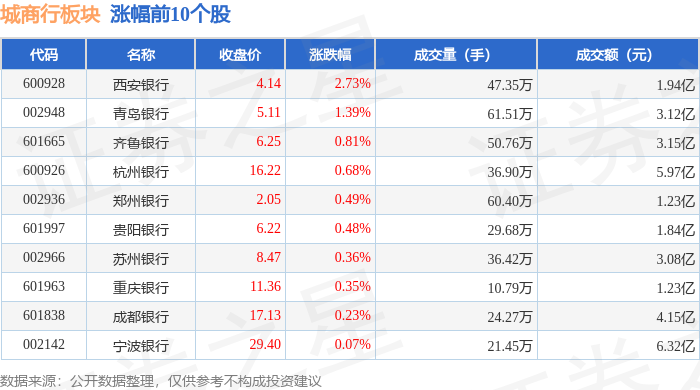
Market Overview - The city commercial bank sector experienced a slight decline of 0.0% on November 11, with Shanghai Bank leading the drop [1] - The Shanghai Composite Index closed at 4002.76, down 0.39%, while the Shenzhen Component Index closed at 13289.0, down 1.03% [1] Individual Bank Performance - Xi'an Bank saw the highest increase in share price, closing at 4.14 with a rise of 2.73% [1] - Qingdao Bank and Qilu Bank also reported positive performance, with increases of 1.39% and 0.81% respectively [1] - Shanghai Bank, on the other hand, closed at 10.13, down 0.98%, indicating a significant decline in its stock price [2] Trading Volume and Capital Flow - The city commercial bank sector recorded a net inflow of 241 million yuan from institutional investors, while retail investors saw a net outflow of 290 million yuan [2] - Jiangsu Bank attracted the highest net inflow from institutional investors at 113 million yuan, representing 11.75% of its trading volume [3] - In contrast, Zhengzhou Bank experienced a net outflow of 421,280 yuan from institutional investors, indicating a negative sentiment towards its stock [3]




创历史新高!红利低波ETF(512890)流通规模超260亿元
Xin Lang Ji Jin· 2025-11-11 04:23
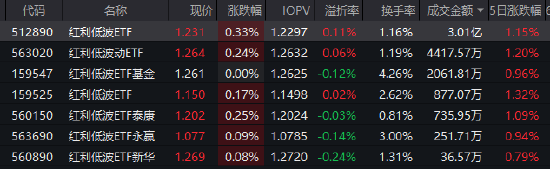
Core Viewpoint - The market opened high but closed lower on November 11, with the three major indices collectively declining. In contrast, the Dividend Low Volatility ETF (512890) rose by 0.33%, closing at 1.231 yuan, indicating strong investor interest in this ETF despite broader market trends [1]. Fund Performance - The Dividend Low Volatility ETF (512890) achieved a price of 1.231 yuan with a 0.33% increase and a turnover rate of 1.16%, leading its category in trading volume with a half-day transaction amount of 3.01 billion yuan [2][3]. - The ETF has seen significant capital inflows, with a total circulating scale reaching 26.073 billion yuan as of November 10, 2025. Over the past 5, 10, 20, and 60 days, it recorded net capital inflows of 580 million yuan, 910 million yuan, 3.37 billion yuan, and 3.39 billion yuan, respectively, indicating strong medium to long-term investment interest [2][3]. Holdings and Market Sentiment - The top ten holdings of the ETF showed mixed performance, with COFCO Sugar reaching a daily limit up of 9.99%, while other banks experienced slight increases or declines. The overall market sentiment reflects a cautious but optimistic outlook on dividend-paying stocks [3][4]. - The total market value of the top ten holdings amounts to approximately 5.50 billion yuan, representing 27.47% of the ETF's total market value [4]. Industry Insights - Analysts from Huatai Securities express a positive outlook on the allocation value of dividend assets, noting that insurance capital is accelerating its allocation to dividend stocks, with the potential allocation demand for dividend assets estimated between 0.8 trillion to 1.6 trillion yuan over the next two to three years [4]. - The core of dividend investment lies in obtaining stable cash flows, with high-dividend assets typically associated with mature and stable profit-generating companies, offering both defensive and cyclical profit-driving characteristics [4]. Investment Strategy - The Dividend Low Volatility ETF (512890) was established in December 2018 and has shown stable historical performance. It is recommended for investors seeking steady returns through methods like dollar-cost averaging. Investors without stock accounts can also access it through its off-market linked funds [5].
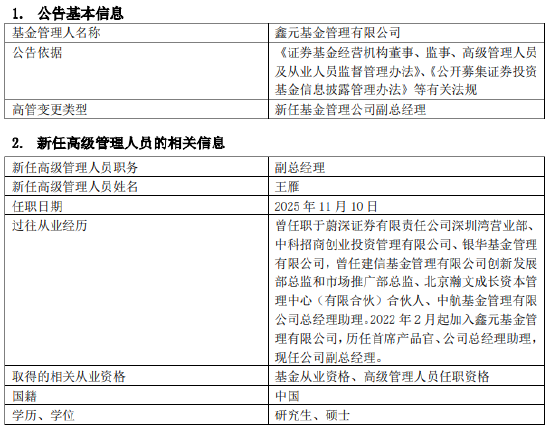
王雁履新鑫元基金副总经理,资深产品官掌舵能否引领公司新突破?
Xin Lang Ji Jin· 2025-11-11 04:05
11月11日,鑫元基金发布基金行业高级管理人员变更公告,宣布任命王雁为公司副总经理,任职日期自 2025年11月10日起。这一重要人事变动,是鑫元基金在年内完成管理层新老交替后,进一步强化核心领 导团队的关键举措,引发了市场对这家银行系基金公司未来发展战略的广泛关注。 | 基金管理人名称 | 鑫元基金管理有限公司 | | --- | --- | | 公告依据 | 《证券基金经营机构董事、监事、高级管理人员 | | | 及从业人员监督管理办法》、《公开募集证券投资 | | | 基金信息披露管理办法》等有关法规 | | 高管变更类型 | 新任基金管理公司副总经理 | | 新任高级管理人员职务 | 副总经理 | | --- | --- | | 新任高级管理人员姓名 | 王雅 | | 任职日期 | 2025年11月10日 | | 过往从业经历 | 曾任职于蔚深证券有限责任公司深圳湾营业部、 | | | 中科招商创业投资管理有限公司、银华基金管理 | | | 有限公司,曾任建信基金管理有限公司创新发展 | | | 部总监和市场推广部总监、北京瀚文成长资本管 | | | 理中心(有限合伙)合伙人、中航基金管理有限 | | ...
中信建投:资金面和市场因素共同引导 稳健+高股息属性银行更受青睐
智通财经网· 2025-11-11 03:48
Core Viewpoint - The macroeconomic environment in 2025 is expected to continue a weak recovery, with no significant improvement in the banking sector's fundamentals, leading to a sustained focus on high dividend strategies [1][2] Economic Environment - The A-share market has shown a significant divergence between "dividend" and "technology growth" styles, creating a "seesaw pattern" [2] - In uncertain external conditions, funds are flowing into stable cash flow and high-dividend sectors for immediate certainty, while risk appetite recovery leads to a shift towards technology growth for future high returns [2] Banking Sector Fundamentals - The banking sector's fundamentals are expected to continue bottoming out, with credit growth maintaining around 7%-8% and a gradual slowdown in the trend of deposit regularization [2] - Cost optimization on the liability side is expected to mitigate the impact of policy interest rate cuts, leading to a further narrowing of interest margin declines [2] - Non-interest income is anticipated to improve due to a recovering capital market, although other non-interest income may be dragged down by low bond market volatility and high baselines [2] - Asset quality is stable, with non-performing loan ratios remaining steady, but retail risks are still emerging, particularly concerning real estate-related risks [2] Dividend Strategy - Several banks have successfully implemented mid-term dividends, showcasing stability and sustainability in their dividend policies [2] - The focus remains on high dividend yield strategies, with specific recommendations for state-owned banks and high-yield private banks such as China Merchants Bank and regional banks like Hangzhou Bank and Jiangsu Bank [3] - There is an emphasis on banks with limited refinancing dilution risks and those that can quickly recover through profit releases, as well as those with strong cyclical attributes [3]
