中国铁建

Search documents
深度复盘建筑十六年行情:政策筑基,主题焕新
GOLDEN SUN SECURITIES· 2025-09-02 07:05
Investment Rating - The report maintains a "Buy" rating for the construction and decoration industry, highlighting specific companies as key investment targets [4][7]. Core Insights - The construction sector has experienced significant fluctuations over the past sixteen years, with eight winning phases (40% of the time) and seven losing phases (60% of the time) [1][12]. - The current market environment is characterized by a gradual easing of policies since late 2021, which has historically correlated with better performance in the construction sector [1][3]. - The report emphasizes the importance of thematic influences, such as the "Belt and Road Initiative" and "PPP" projects, which have driven substantial short-term excess returns in the sector [2][3]. Summary by Sections 1. Historical Review of the Construction Sector - The report divides the historical performance of the construction sector from June 2008 to December 2024 into fifteen phases based on excess returns relative to the CSI 300 index [11]. - Winning phases include significant periods of policy easing and economic recovery, while losing phases often coincide with tighter monetary policies [1][12]. 2. Policy Cycle and Market Trends - The report identifies four major policy cycles since 2008, with the current phase being a gradual easing that began in late 2021 [1][3]. - The correlation between excess returns and macroeconomic indicators is noted to be weak, with expectations of policy changes being more influential [1][3]. 3. Thematic Characteristics and Valuation - The construction sector's valuation is currently low, with a price-to-book ratio (PB) of 0.8, which is below historical averages and indicates potential for rebound [2][3]. - The report highlights that the sector's performance is sensitive to thematic catalysts, suggesting that upcoming regional initiatives could provide investment opportunities [3][4]. 4. Comparison with Banking Sector - The construction sector is compared to the banking sector, noting similarities in business models and sensitivity to credit environment changes [3]. - The current price-to-book ratio of the construction sector relative to banks is at a critical point, suggesting potential for significant excess returns if historical patterns hold [3]. 5. Investment Recommendations - Key investment targets include leading companies benefiting from strategic infrastructure projects, such as Sichuan Road and Bridge, China Metallurgical Group, and China Communications Construction [4][7]. - The report also suggests monitoring local leaders in Xinjiang and companies involved in coal chemical projects as potential high-return investments [4].




央企发挥分红示范引领作用,13家公司分红超百亿,纯央企投资标的:国企共赢ETF备受关注
Sou Hu Cai Jing· 2025-09-02 05:45
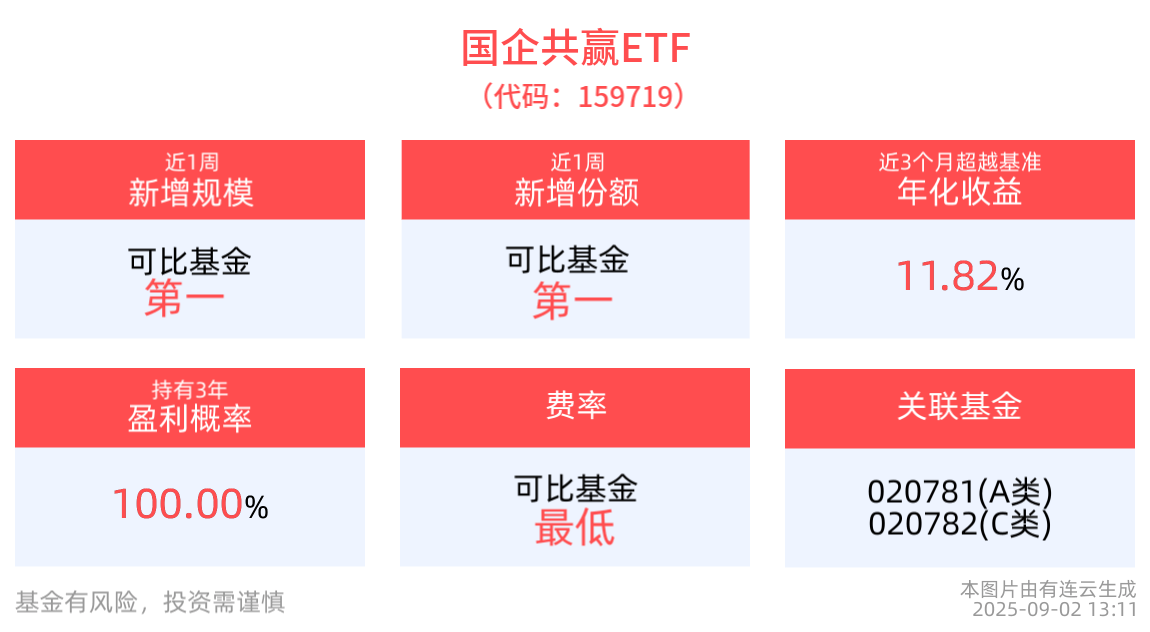
Core Viewpoint - The National Enterprise Win ETF (159719) has shown a positive performance with a recent increase of 0.63%, reflecting a broader trend of rising profits and dividends among Chinese listed companies, particularly state-owned enterprises [3][4]. Performance Summary - As of September 1, 2025, the National Enterprise Win ETF has achieved a net value increase of 51.31% over the past three years, ranking 215 out of 1860 index equity funds, placing it in the top 11.56% [4]. - The ETF has recorded a maximum monthly return of 14.61% since its inception, with the longest consecutive monthly gains reaching 7 months and a total increase of 24.70% [4]. - The average monthly return during rising months is 4.14%, with a total annual profit percentage of 100.00% and a historical three-year holding profit probability of 100.00% [4]. - Over the past three months, the ETF has outperformed its benchmark with an annualized return of 11.82% [4]. Liquidity and Scale - The ETF experienced a turnover rate of 6.84% with a trading volume of 4.9045 million yuan on September 1, 2025, and an average daily trading volume of 16.6744 million yuan over the past year [3]. - In the past week, the ETF's scale increased by 2.187 million yuan, ranking it in the top third among comparable funds [3]. - The number of shares increased by 2 million in the past week, also placing it in the top third among comparable funds [3]. Fee Structure and Tracking Precision - The management fee for the National Enterprise Win ETF is 0.25%, and the custody fee is 0.05%, which are the lowest among comparable funds [5]. - The tracking error for the ETF over the past month is 0.060%, indicating high tracking precision compared to similar funds [5]. Index Composition - The ETF closely tracks the FTSE China National Enterprises Open Win Index, which reflects the performance of Chinese state-owned enterprises listed in mainland China and Hong Kong, focusing on globalization and sustainable development [5]. - The index consists of 100 constituent stocks, including 80 A-share companies and 20 companies listed in Hong Kong [5]. Top Holdings - The top holdings in the National Enterprise Win ETF include: - China Petroleum (601857) with a weight of 15.94% and a price increase of 2.18% - China Petrochemical (600028) with a weight of 11.93% and a price increase of 1.40% - China State Construction (601668) with a weight of 9.59% and a price increase of 0.18% [7].







建筑装饰2025H1财报综述:收入、利润承压现金流改善
Shenwan Hongyuan Securities· 2025-09-02 05:37
Investment Rating - The report maintains an "Optimistic" rating for the construction industry [2][4]. Core Insights - The construction industry faced pressure on revenue and profit in H1 2025, with total revenue of 3.75 trillion, down 5.7% year-on-year, and net profit of 87.5 billion, down 6.5% year-on-year [2][7]. - The industry experienced a relative stability in gross margin and net margin, with a gross margin of 9.9% and a net margin of 2.33% in H1 2025 [8][19]. - Operating cash flow showed improvement, with a net cash flow of -477.4 billion, a reduction in outflow by 15.1 billion year-on-year [3][12]. - The industry’s return on equity (ROE) decreased by 0.31 percentage points to 2.50% in H1 2025, indicating pressure on profitability [16][27]. Summary by Sections Financial Overview - In H1 2025, major listed companies in the construction industry reported revenues of 3.75 trillion, a decrease of 5.7% year-on-year, and net profits of 87.5 billion, down 6.5% year-on-year [2][7]. - Quarterly revenues for Q1 and Q2 were 1.84 trillion and 1.91 trillion, respectively, with year-on-year declines of 6.2% and 5.2% [2][7]. Profitability Analysis - The industry maintained a gross margin of 9.9%, a slight decrease of 0.2 percentage points year-on-year, and a net margin of 2.33%, down 0.02 percentage points [8][19]. - The ROE for the industry decreased to 2.50%, reflecting the impact of reduced investment and increased costs [16][27]. Cash Flow Improvement - The operating cash flow net amount was -477.4 billion, showing an improvement with a reduction in cash outflow by 15.1 billion year-on-year [3][12]. - The cash collection ratio improved to 103% in Q1 and 87% in Q2, with year-on-year changes of +0.85 percentage points and +11.65 percentage points, respectively [3][12]. Market Dynamics - The report highlights a shift in focus from growth to quality improvement among state-owned enterprises, with an emphasis on cash flow management and cost control [4][19]. - The construction industry is expected to see a recovery in revenue and cash flow in the second half of 2025, driven by anticipated government investment stimulus [4][19].



中国铁建(601186):25H1 利润降幅收窄 境外业务增长强劲
Xin Lang Cai Jing· 2025-09-02 04:35
Core Viewpoint - The company reported a decline in net profit and revenue for the first half of 2025, aligning with expectations, while maintaining a "buy" rating for future profitability forecasts [1][3]. Financial Performance - In H1 2025, the company's revenue was 489.199 billion, a year-on-year decrease of 5.22%, and the net profit attributable to shareholders was 10.701 billion, down 10.09% year-on-year, which met expectations [1]. - The gross margin and net profit margin for H1 2025 were 8.84% and 2.19%, respectively, showing a decrease of 0.28 percentage points and 0.12 percentage points year-on-year [1]. - The total expense ratio was 4.85%, an increase of 0.05 percentage points year-on-year, with sales, management, R&D, and financial expense ratios showing mixed changes [1]. - Asset and credit impairment losses amounted to 2.406 billion, accounting for 0.49% of revenue, an increase of 0.05 percentage points compared to the same period last year [1]. - Quarterly breakdown for Q1 and Q2 2025 showed revenues of 256.762 billion and 232.437 billion, with year-on-year declines of 6.61% and 3.63%, and net profits of 5.151 billion and 5.551 billion, with declines of 14.51% and 5.55% respectively [1]. Business Segments - The engineering contracting business saw a slight decline in revenue, totaling 434.6 billion, down 3.77% year-on-year, with a gross margin of 7.43%, a decrease of 0.13 percentage points [2]. - The real estate segment generated revenue of 20.755 billion, a significant drop of 34.21%, with a gross margin of 9.68%, down 1.76 percentage points [2]. - Domestic revenue was 452.11 billion, down 6.84% year-on-year, while overseas revenue increased by 20.29% to 37.089 billion, with a gross margin of 6.53%, up 0.29 percentage points [2]. Cash Flow and Receivables - The net cash flow from operating activities for H1 2025 was -79.457 billion, a decrease in outflow by 2.219 billion year-on-year [2]. - The cash collection ratio was 97.7%, an increase of 1.62 percentage points compared to the previous year, while accounts receivable increased by 62.191 billion and inventory decreased by 21.07 billion [2]. - The cash payment ratio was 112.9%, up 2.06 percentage points year-on-year, with accounts payable increasing by 63.545 billion and prepayments rising by 2.32 billion [2]. Investment Outlook - The company maintains its profit forecast for 2025-2027, expecting net profits of 21.4 billion, 21.7 billion, and 22.2 billion, with growth rates of -3.6%, +1.3%, and +2.5% respectively, corresponding to a PE ratio of 5X for each year [3].
南美小国圭亚那资源丰富,美国操心:中国给造桥,还想要地区影响力
Guan Cha Zhe Wang· 2025-09-02 03:16
Core Insights - The upcoming elections in Guyana are expected to have significant implications for the global oil market and the United States, given the country's increasing oil production and strategic resources [1][3][5] Economic Impact - Guyana's economy has transformed since 2015, when ExxonMobil discovered approximately 11 billion barrels of oil, leading to a surge in oil production [3][4] - The country currently produces about 650,000 barrels of oil per day, with projections indicating that by 2035, production could reach approximately 2 million barrels per day, surpassing the total output of several neighboring countries [3][4] - Guyana's GDP growth rates have been remarkable, with a 63.3% increase in 2022 and a projected 33.8% growth in 2023, marking five consecutive years of double-digit growth [3][4] Political Context - The elections are crucial for the management of the newfound oil wealth, with analysts emphasizing the need for inclusive and stable governance to avoid undermining democracy [4][5] - The current president, Irfaan Ali, is seeking re-election amidst competition from notable figures, including Aubrey Norton and Azruddin Muhammad, the latter of whom is under U.S. sanctions [4][5] Territorial Disputes - Tensions with Venezuela over the Essequibo region, which is rich in oil and gas resources, have escalated, particularly following recent discoveries in the area [5][6] - Venezuela's National Assembly has approved a referendum regarding the region's sovereignty, which Guyana views as a violation of international law [6] Geopolitical Dynamics - Guyana is positioned between U.S. and Chinese economic interests, with U.S. companies leading in oil production while Chinese investments focus on infrastructure projects [8][12] - The construction of the new Demerara River Bridge, funded by China, is a significant infrastructure project that highlights China's growing influence in the region [9][11] - Analysts suggest that if Guyana can balance relations with both superpowers, it could leverage these connections for economic and political benefits [8][12]

机构止盈观望情绪增加,高防御属性、低相关性的国企共赢ETF备受关注
Sou Hu Cai Jing· 2025-09-02 02:40
Core Insights - The Guoqi Gongying ETF (159719) has shown a recent increase of 0.76%, with a price of 1.59 yuan as of September 2, 2025, and a cumulative rise of 0.51% over the past two weeks [3] - The ETF has experienced significant growth in both scale and shares, with a recent increase of 218.70 million yuan in scale and 2 million shares in the past week, ranking in the top third among comparable funds [3] - Over the past three years, the ETF's net value has risen by 51.31%, placing it in the top 11.56% of index stock funds [3] Performance Metrics - The ETF has achieved a maximum monthly return of 14.61% since inception, with a historical annual profit percentage of 100% and a 100% probability of profit over a three-year holding period [3] - The annualized return over the past three months has surpassed the benchmark by 11.82% [3] Risk and Recovery - The maximum drawdown in the last six months was 7.60%, with a recovery time of 37 days, which is the fastest among comparable funds [4] Fee Structure - The management fee for the ETF is 0.25%, and the custody fee is 0.05%, making it the lowest among comparable funds [4] Tracking Precision - The ETF has a tracking error of 0.060% over the past month, indicating high tracking precision compared to similar funds [5] - It closely tracks the FTSE China State-Owned Enterprises Open Win Index, which includes 100 constituent stocks, focusing on globalization and sustainable development [5]

研判2025!中国自粘卷材行业发展历程、产业链、上下游分析、产量、企业分析及未来前景展望:基础设施建设步伐加快,行业产量达到14.77亿平方米[图]
Chan Ye Xin Xi Wang· 2025-09-02 01:23
Industry Overview - Self-adhesive membranes are a new type of waterproof material characterized by low-temperature flexibility, self-healing properties, and strong adhesion, allowing for quick construction at room temperature and compliance with environmental standards [1][2] - The production of self-adhesive membranes in China is projected to grow from 402 million square meters in 2015 to 1.477 billion square meters by 2024, driven by advancements in technology and expanding applications [1][8] Industry Development History - The self-adhesive membrane industry in China began in the 1990s with the introduction of products from international brands, followed by local production efforts [4] - By 2000, advancements in technology led to mass production of self-adhesive waterproof membranes, and industry standards were established in 2002 to ensure product quality [4][5] Industry Supply Chain - The supply chain consists of upstream raw material suppliers (asphalt, polymer resins, polyethylene films), midstream manufacturers who produce various self-adhesive membrane products, and downstream applications in construction and infrastructure [6] - The production of petroleum asphalt, a key component, has seen fluctuations, with a projected output of 34.508 million tons in 2024, down from 62.88 million tons in 2020 [6][7] Market Demand and Trends - The self-adhesive membrane industry is closely linked to the real estate sector, which is currently experiencing a downturn, impacting demand [7] - However, infrastructure investment remains robust, with a 3.2% year-on-year growth in the first half of 2025, providing some demand for self-adhesive membranes [7][8] Competitive Landscape - Major players in the self-adhesive membrane industry include Beijing Oriental Yuhong Waterproof Technology Co., Ltd. and Keshun Waterproof Technology Co., Ltd., which leverage technology and brand strength to maintain market leadership [9][11] - Smaller companies focus on niche products and regional markets due to limited resources compared to larger firms [9] Future Industry Trends - The industry is expected to see increased concentration as stricter environmental regulations and rising production costs lead to the elimination of less competitive firms [14] - Companies are expanding internationally to seek new growth opportunities, with notable efforts from leading firms to establish overseas operations [15] - Government policies are increasingly supportive of high-performance waterproof materials, enhancing the growth prospects for self-adhesive membranes [16]





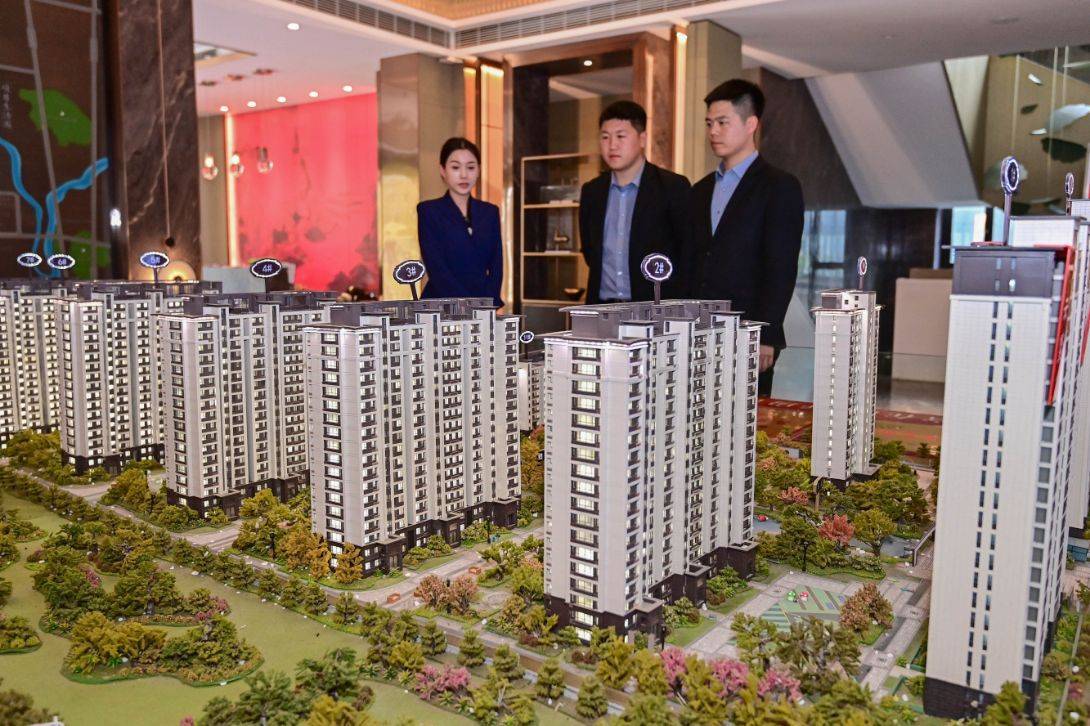
三成百强房企8月业绩环比增长
Mei Ri Jing Ji Xin Wen· 2025-09-01 14:36
Group 1 - The core viewpoint of the articles indicates a significant decline in the sales performance of China's real estate companies, with the top 100 firms experiencing a total sales amount of 23,270.5 billion yuan, a year-on-year decrease of 13.3% [1][2] - In August, despite being a traditional off-peak sales month, some real estate companies like Greentown China and Poly Real Estate showed strong sales performance, with 33% of the top 100 firms achieving month-on-month sales growth [2] - The sales figures for the top real estate companies from January to August show that only five companies surpassed 1,000 billion yuan in sales, a decrease of one compared to the same period last year, with an average sales amount of 1,508.7 billion yuan [2] Group 2 - First-tier cities experienced a significant drop in transaction volumes in August, with a 20% month-on-month decline and a 26% year-on-year decline, although the cumulative transaction volume for the first eight months showed a 4% year-on-year increase [3] - Policies aimed at easing restrictions in cities like Beijing and Shanghai have not yet translated into improved sales figures, with Shanghai's new home transaction volume dropping by 45% month-on-month [3][4] - In second and third-tier cities, there was a mixed performance, with cities like Hangzhou and Wuhan showing increases in transaction volumes, while others like Kunming and Chongqing saw declines [4]




渝万高铁蔡家沟双线特大桥合龙
Xin Lang Cai Jing· 2025-09-01 11:45
Core Viewpoint - The successful completion of the Caijia Gorge Double-Line Bridge marks a significant milestone for the Chongqing-Wanzhou High-Speed Railway, ensuring timely operation of the entire line [1] Group 1: Project Details - The Caijia Gorge Double-Line Bridge, constructed by China Railway Construction Bridge Bureau, is located in Fuling District, Chongqing, and spans a tributary of the Yangtze River [1] - The bridge features a continuous rigid frame design with a total span of 584 meters, characterized by a symmetrical structure with shorter ends and a longer middle section [1] Group 2: Railway Specifications - The Chongqing-Wanzhou High-Speed Railway (Yuwan High-Speed Railway) is part of China's "Eight Vertical and Eight Horizontal" high-speed rail network, specifically the Yinchuan (Yin) to Haikou (Hai) and Beijing (Jing) to Kunming (Kun) corridors [1] - The railway line has a total length of 251 kilometers and is designed for a maximum speed of 350 kilometers per hour [1]
最新销售数据出炉!头部房企集中度再提升
Sou Hu Cai Jing· 2025-09-01 11:20
Core Insights - The sales performance of China's top 100 real estate companies from January to August 2025 shows a total sales amount of 23,270.5 billion yuan, representing a year-on-year decline of 13.3%, consistent with the decline observed from January to July [1] - The leading companies in sales include Poly Developments with 1,812 billion yuan, Greentown China with 1,563 billion yuan, and China Overseas Land & Investment with 1,503 billion yuan [2] - The market is experiencing a clear trend of differentiation, with larger firms gaining market share while smaller firms face increased survival pressure [2][3] Sales Performance - The number of companies in different sales brackets has changed, with five companies exceeding 1,000 billion yuan in sales, down from six last year, and an average sales amount of 1,508.7 billion yuan [2] - The second tier (500-1,000 billion yuan) has six companies, also down by one, with an average of 750.3 billion yuan [2] - The third tier (300-500 billion yuan) has seven companies, an increase of two, with an average of 386.6 billion yuan [2] Market Trends - The real estate market is currently in a phase of policy support and market bottom-seeking, with a stabilization in the rate of decline rather than a confirmation of a market bottom [3] - The second half of the year is expected to show a pattern of policy support, moderate recovery in transactions, and increased structural differentiation [3] - The introduction of policies such as "recognizing houses but not loans" and lowering down payment ratios is expected to stabilize market expectations, although the effects will take time to materialize [3][4] Future Outlook - As September approaches, industry insiders anticipate a potential market recovery due to the release of supportive policies [4] - The traditional marketing peak in September is expected to lead to an increase in new housing transactions, with core cities like Beijing and Shanghai implementing favorable policies to restore market confidence [4]