
易方达基金

Search documents
35亿资金,跑了
中国基金报· 2026-01-06 05:21
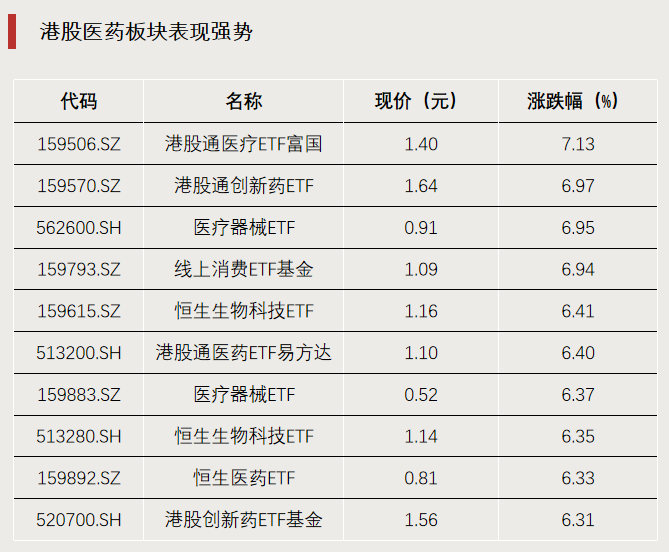
Group 1 - The A-share market experienced a strong start to 2026, with the overall trading volume exceeding 25 trillion yuan and the Shanghai Composite Index surpassing 4000 points, while the Shenzhen Component Index and ChiNext Index both rose over 2% [2][3] - On January 5, the total scale of stock ETFs in the market reached 4.87 trillion yuan, with a trading volume of 276.91 billion yuan, an increase of over 85 billion yuan compared to the previous trading day [4][8] - The healthcare and pharmaceutical sector ETFs led the gains, with eight out of the top ten performing ETFs in this category, including significant increases in the Hong Kong medical ETFs [3][4] Group 2 - On January 5, stock ETFs saw a net outflow of over 3.5 billion yuan, with 49 ETFs experiencing net outflows exceeding 100 million yuan, particularly in broad-based ETFs like A500 and industry-specific ETFs such as Hong Kong securities and semiconductors [7][13] - The top three ETFs with the highest net inflows included the Southern CSI 500 ETF, Huatai-PB CSI 300 ETF, and Southern Nonferrous Metals ETF, indicating a preference for broad-based ETFs [8][11] - Major fund companies like E Fund and Huaxia Fund saw significant net inflows in their ETFs, with E Fund's gold ETF and CSI 300 ETF attracting substantial investments [11][12]


年度涨幅46.3% 科创综指成“硬科技”价值发现与配置核心渠道
Shang Hai Zheng Quan Bao· 2026-01-06 04:02
Core Insights - The total scale of ETFs related to the Sci-Tech Innovation Board is projected to reach approximately 300 billion yuan by December 31, 2025, with the number of products increasing to 106, which is three times that of the end of 2024 [1][5] - The Sci-Tech Innovation Composite Index (Sci-Tech Index) has shown a significant annual increase of 46.3% for the year 2025, outperforming major broad-based indices [1][4] - The Sci-Tech Index has been operational for nearly a year since its official launch on January 20, 2025, and is increasingly recognized for its role in representing market performance and guiding long-term capital allocation [1][2] ETF and Index Development - As of December 30, 2025, 46 fund managers have launched a total of 78 Sci-Tech Index funds, with a combined scale of 27.4 billion yuan, and the average return since listing has reached 43.7% [4][6] - The structure of investors has evolved, with institutional investors such as insurance funds, brokerages, and bank wealth management steadily increasing their holdings in Sci-Tech Index ETFs, reflecting confidence in the long-term investment value of the Sci-Tech Board [4][6] - The Sci-Tech Index has a sample size of 576 stocks, covering various types of securities and accounting for 96% of the total listed companies on the Sci-Tech Board, which has over 600 companies with a total market capitalization exceeding 10 trillion yuan [3][5] Market Trends and Future Outlook - The Sci-Tech Index is seen as a benchmark for capturing the pulse of technological growth and sharing the dividends of innovation, especially as China's technology sector continues to rise [2][7] - The index system for the Sci-Tech Board has been expanded to include various types of indices, effectively guiding social capital towards the development of new productive forces [5][6] - The introduction of thematic ETFs covering sectors such as artificial intelligence, new energy, and semiconductor materials indicates a growing trend towards index-based investment in key areas of technological innovation [7]
川宁生物股价涨5.7%,易方达基金旗下1只基金位居十大流通股东,持有1366.94万股浮盈赚取806.5万元
Xin Lang Cai Jing· 2026-01-06 03:55
Group 1 - The core point of the news is that Chuaning Bio has seen a stock price increase of 5.7%, reaching 10.94 yuan per share, with a trading volume of 1.92 billion yuan and a market capitalization of 24.397 billion yuan as of January 6 [1] - Chuaning Bio, established on December 10, 2010, and listed on December 27, 2022, is located in the Yili Kazakh Autonomous Prefecture of Xinjiang and focuses on the research and industrialization of biological fermentation technology [1] - The company's main business revenue composition is 92.81% from pharmaceutical intermediates and 7.19% from other supplementary sources [1] Group 2 - Among the top ten circulating shareholders of Chuaning Bio, E Fund's Chuangye ETF (159915) reduced its holdings by 2.21% to 13.6694 million shares, resulting in a floating profit of approximately 8.065 million yuan [2] - E Fund's Chuangye ETF was established on September 20, 2011, with a current scale of 110.2 billion yuan, achieving a year-to-date return of 2.86% and a one-year return of 65.9% [2] - The fund manager, Cheng Xi, has a tenure of 9 years and 247 days, with a total asset scale of 250.121 billion yuan, while the other manager, Liu Shurong, has a tenure of 8 years and 175 days, managing assets of 139.916 billion yuan [3]

复旦微电股价跌5.03%,易方达基金旗下1只基金重仓,持有93.1万股浮亏损失388.23万元
Xin Lang Cai Jing· 2026-01-06 02:25
Group 1 - Fudan Microelectronics experienced a decline of 5.03% on January 6, with a stock price of 78.81 yuan per share, a trading volume of 841 million yuan, a turnover rate of 1.96%, and a total market capitalization of 64.737 billion yuan [1] - The company, established on July 10, 1998, and listed on August 4, 2021, is primarily engaged in integrated circuit (IC) related businesses, operating through two segments: design, development, and sales of integrated circuits, and providing IC testing services [1] - The revenue composition of Fudan Microelectronics includes: FPGA and other products (37.04%), non-volatile memory (23.92%), security and identification chips (21.35%), smart meter chips (13.46%), IC testing services (4.15%), and rental income (0.09%) [1] Group 2 - E Fund's AI ETF (588730) holds a significant position in Fudan Microelectronics, having increased its holdings by 352,900 shares in the third quarter, totaling 931,000 shares, which represents 3.54% of the fund's net value, ranking as the ninth largest holding [2] - The E Fund AI ETF was established on January 16, 2025, with a current scale of 1.753 billion yuan and has achieved a year-to-date return of 4.74%, ranking 247 out of 5488 in its category, and a cumulative return of 51.31% since inception [2]

晶瑞电材股价涨5.52%,易方达基金旗下1只基金重仓,持有12.92万股浮盈赚取11.89万元
Xin Lang Cai Jing· 2026-01-06 02:16
Group 1 - The core point of the news is that Jingrui Electric Materials Co., Ltd. experienced a stock price increase of 5.52%, reaching 17.58 CNY per share, with a trading volume of 701 million CNY and a turnover rate of 3.82%, resulting in a total market capitalization of 18.863 billion CNY [1] - Jingrui Electric Materials, established on November 29, 2001, and listed on May 23, 2017, specializes in high-purity chemicals, photoresists and supporting materials, functional formulation materials, lithium battery materials, pharmaceutical intermediates, electronic-grade materials, and other products, widely used in the semiconductor and new energy industries [1] - The main revenue composition of Jingrui Electric Materials includes high-purity chemicals (58.69%), photoresists (13.79%), lithium battery materials (13.68%), industrial chemicals (9.61%), energy (4.01%), and others (0.23%) [1] Group 2 - From the perspective of major fund holdings, E Fund has one fund heavily invested in Jingrui Electric Materials, specifically the E Fund CSI Semiconductor Materials and Equipment Theme ETF Linked Class A (021893), which held 129,200 shares in the third quarter, accounting for 0.17% of the fund's net value, ranking as the seventh largest holding [2] - The E Fund CSI Semiconductor Materials and Equipment Theme ETF Linked Class A (021893) was established on November 26, 2024, with a latest scale of 242 million CNY, achieving a year-to-date return of 4.99% (ranking 15 out of 327) and a one-year return of 64.94% (ranking 23 out of 203), with a cumulative return since inception of 45.97% [2]

万亿资金,涌入A股这些方向
Zhong Guo Zheng Quan Bao· 2026-01-05 23:07
Group 1 - The A-share market shows a strong growth style, with notable performances in the pharmaceutical and semiconductor sectors, where multiple related ETFs rose over 5% in a single day [1] - The Hong Kong pharmaceutical sector is performing strongly, with several ETFs in innovative drugs and medical devices increasing by over 6%, highlighting the attractiveness of the sector post-adjustment [4][5] - The semiconductor sector is also experiencing significant gains, with multiple ETFs in this field rising over 5%, indicating a robust market for semiconductor-related investments [6][7] Group 2 - In December 2025, the A500 and Sci-Tech bonds became major directions for capital inflow, with several ETFs in these categories seeing net inflows exceeding 100 billion yuan [2][8] - The total net inflow for all ETFs in the market reached 11,785.99 billion yuan in 2025, showcasing a strong interest in ETF investments [2] - Specific ETFs such as the FuGuo CSI Hong Kong Internet ETF and the HuaAn Gold ETF saw annual net inflows exceeding 400 billion yuan, indicating strong investor confidence in these funds [10] Group 3 - The Hong Kong market is expected to see a recovery in corporate earnings, particularly benefiting sectors like non-ferrous metals and competitive industry leaders in internet and consumption [10][11] - The anticipated decline in risk-free rates in Hong Kong may lead to improved liquidity, potentially enhancing valuations in the market [11] - Key investment focuses for 2026 are expected to include AI, new consumption, pharmaceuticals, and dividend stocks, reflecting evolving market trends [11]
规模突破6万亿元 ETF下一步如何走?
Shang Hai Zheng Quan Bao· 2026-01-05 18:56
Core Insights - The ETF market is experiencing significant growth, with total assets expected to reach 6.02 trillion yuan by the end of 2025, an increase of 2.29 trillion yuan from the end of 2024 [2] - The competition among fund companies is intensifying, focusing on scale, innovation, and ecosystem development as the ETF market matures [1][2] Growth and Market Dynamics - As of December 2025, there are 128 ETFs with assets exceeding 100 billion yuan, up from 66 at the end of 2024, with 17 surpassing 500 billion yuan [2] - The rapid growth of ETFs is closely linked to policy support, including the China Securities Regulatory Commission's initiatives to enhance the index fund product system and reduce investment costs [2][3] Trading Activity and New Products - The trading volume of stock ETFs reached a new high on January 5, 2026, with a total transaction amount of 186.11 billion yuan, indicating strong market activity [4] - There are currently 11 ETFs in the issuance process and 7 more set to launch, focusing on niche industry themes such as battery, photovoltaic, and food ETFs [4] Competitive Landscape - The ETF market is characterized by a "head concentration" effect, with major players like Huatai-PB, E Fund, and China Asset Management leading the market [7] - New entrants are increasingly attracted to the ETF space, with several fund companies, including Chuangjin Hexin and Xinyuan, making their first forays into ETF products [7] Future Outlook - Analysts predict that the demand for stable and transparent returns will drive ETFs to evolve from trading tools to fundamental investment vehicles, especially in a low-interest-rate environment [8] - Innovations in ETF product types, such as equity-bond constant ETFs and strategy ETFs, are expected to attract more long-term capital [8]
规模突破6万亿元,ETF下一步如何走?
Shang Hai Zheng Quan Bao· 2026-01-05 18:28
Core Insights - The ETF market is expected to be a prominent area for growth in the public fund industry, with a total scale projected to exceed 6 trillion yuan by the end of 2025, marking an increase of 2.29 trillion yuan from the previous year [2][3] Group 1: Market Growth and Trends - By the end of 2025, the total scale of ETFs reached 6.02 trillion yuan, with 128 ETFs exceeding 10 billion yuan in size, and 17 surpassing 50 billion yuan [2] - The rapid growth of ETFs is closely linked to policy support, including the China Securities Regulatory Commission's initiatives to enhance the index fund product system and promote innovation [2][3] - The increasing market activity and investor confidence are driving the growth of ETFs, as they offer lower fees and easier access compared to direct stock investments [3] Group 2: Competitive Landscape - The ETF market is characterized by intense competition, with new products being launched continuously, including sector-specific ETFs [4][5] - As of January 5, 2026, there were 1,402 ETFs established, with a notable concentration of assets in a few leading products, indicating a significant head effect [4][5] - Major fund companies dominate the market, with 16 fund managers having ETF scales exceeding 100 billion yuan, collectively accounting for nearly 90% of the total ETF scale [7] Group 3: Future Outlook - Analysts predict that the demand for stable and transparent returns will continue to grow, leading to a shift in ETFs from trading tools to fundamental investment vehicles [8] - The introduction of innovative ETF products, such as equity-bond constant ETFs and strategy ETFs, is expected to attract more long-term capital into the market [8]
年度涨幅46.3% 构筑中国科创势力“标杆性指数” 科创综指成“硬科技”价值发现与配置核心渠道
Shang Hai Zheng Quan Bao· 2026-01-05 18:28
Core Insights - The Sci-Tech Innovation Board (STAR Market) has seen significant growth, with the total scale of related ETFs reaching approximately 300 billion yuan by December 31, 2025, and the number of products increasing to 106, three times that of the end of 2024 [1][6] - The STAR Market Composite Index (Sci-Tech Composite Index) achieved a remarkable annual increase of 46.3% in 2025, outperforming major broad-based indices, reflecting a revaluation of "hard technology" assets [1][3] - The index has become a benchmark for capturing the pulse of technological growth and sharing the dividends of innovation, representing a diverse range of companies from leading hard tech firms to specialized small giants [2][7] Industry Overview - The STAR Market currently includes 600 listed companies with a total market capitalization exceeding 10 trillion yuan, with the Sci-Tech Composite Index covering 96% of these companies [3][6] - The index system has expanded to include various types of indices, effectively guiding social capital towards new productive forces and enhancing the investment landscape for technology innovation [6][7] - The introduction of multiple indices, such as the Sci-Tech 50, 100, and 200, allows for comprehensive representation of the STAR Market, covering approximately 60% of its securities [3][6] Investment Trends - As of December 30, 2025, 46 fund managers have launched 78 Sci-Tech Composite Index funds, with a total scale of 27.4 billion yuan, indicating strong institutional interest in these products [4][6] - The average return of these products since their launch has reached 43.7%, enhancing investor confidence and interest in the STAR Market [4][6] - Institutional investors, including insurance funds and banks, have steadily increased their holdings in Sci-Tech Composite Index ETFs, recognizing their convenience and long-term investment value [4][7]
ETF规范化更名 实现“顾名即可思义”
Zheng Quan Ri Bao· 2026-01-05 17:12
Core Viewpoint - The standardization of ETF product abbreviations is essential for investors to efficiently navigate the vast domestic ETF market, which has exceeded 60 trillion yuan and includes nearly 1,400 products [1] Group 1: ETF Market Developments - On January 5, 2026, E Fund Management officially changed the abbreviations of 45 ETFs, becoming the first public institution to standardize the naming of all its ETFs [1] - Following E Fund, over ten public institutions, including Huatai-PB and China Merchants Fund, announced similar changes in December 2025, affecting more than a hundred products [1] Group 2: Industry Response and Benefits - The collective action of public institutions to rename ETFs is a positive response to the industry's push for standardization [1] - The Shanghai and Shenzhen Stock Exchanges issued guidelines in November 2025, mandating that ETF abbreviations include the core elements of the investment target and the fund manager's name [1] Group 3: Investor Experience and Future Outlook - The standardization is expected to significantly enhance product recognition, allowing investors to compare and select products more efficiently [2] - A clear and recognizable ETF abbreviation helps investors quickly identify fund characteristics, thereby reducing selection costs and improving the investment experience [2] - E Fund's recent changes included adding "E Fund" to the abbreviations and revising the core investment elements for nine products to enhance clarity [2] - The long-term vision emphasizes the need for fund companies to improve product management and service capabilities while reinforcing brand effects to foster a healthier ETF market [2]