成都银行

Search documents
投资者陈述 - 新资金管控助力 “反内卷”-Investor Presentation-New funding controls to aid Anti-Involution and
2025-08-06 03:33
Summary of Key Points from the Conference Call Industry Overview - **Industry**: China Financials - **View**: Attractive [2][33] Core Insights and Arguments 1. **New Funding Controls**: Implementation of new funding controls aims to aid in anti-involution and risk digestion, which is expected to slow funding supply to overcapacity sectors [5][15]. 2. **Regulations on Payments to SMEs**: The State Council's regulations require large enterprises to pay SMEs within 60 days, prohibiting non-cash payments, which is seen as a measure to control capacity and reduce irrational competition [6][7][18]. 3. **Impact on Manufacturing Firms**: Analysis indicates that 41.3% of sectors have payable periods exceeding 60 days, suggesting a high reliance on non-interest-bearing payables, which could pressure the supply chain [8][11]. 4. **Reduction in Capex Expansion**: Controlling payables and fund flows is projected to effectively reduce capital expenditure (capex) expansion, with a potential cut of Rmb1.19 trillion in total payables balance if turnover days are compressed to 60 days [11][15]. 5. **Credit Risk Management**: The current level of high-risk loans is significantly lower than in 2015, with only 8.3% of industrial credit at risk by the end of 2024, compared to 17% in 2015 [20][21]. 6. **Gradual Digestion of High-Risk Credit**: It is estimated that 8.3% of industrial-related credit could be digested over a three to four-year period, which is manageable for banks [23][41]. 7. **Sector-Specific Risks**: Different sectors exhibit varying levels of credit risk, with electronic devices and electrical equipment showing 8% high-risk credit, while chemicals and ferrous metal processing show higher risks at 12% [24]. Additional Important Insights 1. **Investment Opportunities**: Despite challenges, there are still opportunities in China Financials, with expectations of stable financial asset yields and improved bank net interest margins (NIM) [33][34]. 2. **Infrastructure Investment Support**: New programs initiated by the China Development Bank, including Rmb500 billion in loans for city upgrades, are expected to support credit demand amid slowing industrial investment growth [38][39]. 3. **Preference for Mid-Sized Banks**: Mid-sized banks are favored due to attractive dividend yields and potential benefits from rationalized credit growth and market-oriented competition [45][46]. 4. **Market Conditions**: The financial system is seen as bottoming out, with increasing efforts towards anti-involution, which may lead to more rational loan growth and pricing [45][46]. This summary encapsulates the key points discussed in the conference call, highlighting the regulatory environment, credit risk management, and investment opportunities within the China Financials sector.
四川金融监管局核准何耀成都银行资阳分行行长助理任职资格
Jin Tou Wang· 2025-08-06 03:11
二、成都银行应要求上述核准任职资格人员严格遵守金融监管总局有关监管规定,自成都银行政许可决 定作出之日起3个月内到任,并将其任职文件及时抄送四川金融监管局和资阳金融监管分局。未在上述 规定期限内到任的,本批复文件失效,由四川金融监管局办理行政许可注销手续。 三、成都银行应督促上述核准任职资格人员持续学习和掌握经济金融相关法律法规,牢固树立风险合规 意识,熟悉任职岗位职责,忠实勤勉履职。 2025年7月30日,四川金融监管局发布批复称,《成都银行(601838)股份有限公司关于何耀高级管理 人员任职资格许可的请示》(成银行文〔2025〕82号)及相关说明解释材料收悉。经审核,现批复如 下: 一、核准何耀成都银行股份有限公司资阳分行行长助理的任职资格。 未尽事项按金融监管总局有关规定办理。 ...
研报掘金|中金:预计内银次季净利润按年增长1% 予工行、农行及招行“跑赢行业”评级
Ge Long Hui A P P· 2025-08-05 07:33
格隆汇8月5日|中金发表报告,预计内银股今年第二季收入及净利润各按年持平及增长1%,较今年首 季跌2%及跌1%略有改善,与去年节奏类似,符合市场预期。业绩改善主要来自息差降幅收窄、其他非 息收入压力缓解,人行及利率自律机制对银行存贷款报价的引导可视为银行业的反内卷,稳定银行盈 利、防范金融系统风险。 中金称维持内银全年盈利及股息稳健的判断,目前部分A股和H股中资银行股息率回升至4.5%至5.5%, 该行认为仍有投资性价比,包括国有大行、成都银行、江苏银行等。该行对工行、农行及招行均予"跑 赢行业"评级,各予目标价7.11港元、5.09港元及58.98港元。 ...
中金:料内银股次季净利润升1% 部分H股股息率回升至4.5%至5.5%具投资性价比
智通财经网· 2025-08-05 07:28
智通财经APP获悉,中金发布研报称,预计内银股今年第二季收入及净利润各同比持平及增长1%,较 今年首季跌2%及跌1%略有改善,与去年节奏类似,符合市场预期。业绩改善主要来自息差降幅收窄、 其他非息收入压力缓解,人行及利率自律机制对银行存贷款报价的引导可视为银行业的"反内卷",稳定 银行盈利、防范金融系统风险。 展望未来,中金预计即使内地利率进一步下行以支持实体经济,上市内银净息差仍会呈现资产负债利率 双边下降的趋势,该行维持上市内银净息差降幅收窄这一判断,对银行的净利息收入和营收同比增速形 成正向支撑。 就国家财政部、税务总局8月1日发布公告称自8月8日起恢复新发行的国债、地方政府债券、金融债券的 利息收入增值税,该行假设上市银行金融投资距离到期日平均约5年,新发金融债利率有所上行,则对 上市银行净利润影响约0.8%,幅度有限。且实际影响可能小于测算值,主要由于银行金融投资收益率 可能上行,内银也会通过调整资产配置以稳定综合收益率。 该行料内银今年第二季净利息收入同比跌1%,降幅较今年首季跌2%略有收窄,主要由于息差降幅收 窄。该行预计第二季内银净息差季度按季下降3个基点,对应同比下降11个基点,较今年首季的 ...


宽财政推动融资需求增长!红利低波ETF(512890)近5个交易日“吸金”4.8亿
Xin Lang Ji Jin· 2025-08-05 04:36
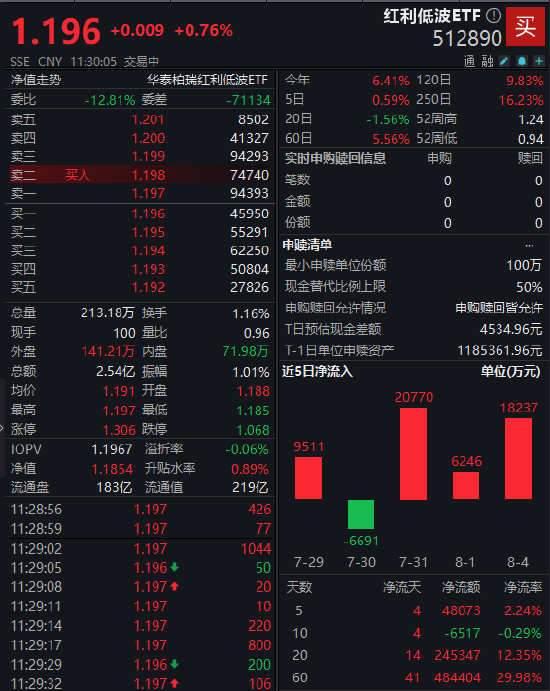
Core Viewpoint - The Hongli Low Volatility ETF (512890) has shown positive performance with a 0.76% increase in price, attracting significant net inflows over recent trading days, indicating strong investor interest and confidence in the fund's strategy [1][2]. Fund Performance - As of August 5, the ETF's price was 1.196 CNY, with a trading volume of 2.54 billion CNY and a turnover rate of 1.16% [1][2]. - The fund has experienced a net inflow of 4.8 billion CNY over the last 5 trading days and 24.53 billion CNY over the last 20 trading days [1][2]. - The total circulation scale of the ETF reached 217.31 billion CNY as of August 4, 2025 [1]. Holdings and Strategy - The Hongli Low Volatility ETF tracks the CSI Low Volatility Index and includes major holdings such as Chengdu Bank, Industrial Bank, and Sichuan Road and Bridge, among others [1][3]. - The top ten holdings account for a significant portion of the fund's net asset value, with a combined market value of approximately 5.15 billion CNY [3]. Market Outlook - The central bank's recent meeting indicates a supportive environment for credit growth, which is expected to stabilize bank performance and asset quality, particularly in the real estate and urban investment sectors [3]. - Analysts suggest focusing on high dividend and regional growth opportunities in bank stocks, particularly large state-owned banks and quality regional banks with dividend growth potential [3]. Investment Options - For investors seeking stable returns and low volatility, the Hongli Low Volatility ETF can be accessed through various fund classes, even without a stock account [4].

破局1xPB与4%股息率? - 银行股配置重构
2025-08-05 03:16
Summary of Conference Call on Banking Sector Industry Overview - The banking sector is currently influenced by a relatively weak macroeconomic environment and declining dividend yields of large state-owned banks, which has led to market divergence [1][2][3] - The sector is expected to stabilize, with mid-year reports validating profit stability due to a rapid decline in deposit interest rates and easing margin pressures [1][7] Key Points and Arguments Valuation and Investment Strategy - Banks should be categorized into two asset types for valuation: - State-owned banks as bond-like assets priced on dividend yield - High-quality regional banks priced on Return on Equity (ROE) [1][4] - High-quality regional banks, such as those in Jiangsu and Chengdu, are currently undervalued and have significant room for valuation recovery [1][6] Market Performance - After a strong performance in early July, banking stocks experienced a correction of approximately 10% due to a shift in market risk appetite and profit-taking by investors [9][10] - The adjustment has revealed the investment value of leading regional banks, which now offer attractive dividend yields above 4% [10] Future Expectations - Large state-owned banks are expected to maintain stability and potentially exceed a 4% dividend yield, while high-quality regional banks are projected to achieve a high ROE of around 15% over the next three years [5][7] - The overall banking sector is entering a stabilization phase, supported by a clear downward trend in deposit interest rates, which will bolster net interest income and profit growth [7] Dividend and Earnings Stability - The upcoming mid-year reports are anticipated to show a stabilization trend in earnings, with many banks implementing interim dividends for the first time, enhancing market confidence [11] - The focus on dividend returns and earnings stability is crucial for high ROE banks, as these metrics are more significant than mere PB ratios [8] Additional Important Insights - Insurance capital is increasing its equity allocation, particularly in A-shares, providing support for adjusted banking stocks [12] - The low valuation of large state-owned banks in the Hong Kong market is becoming more pronounced, with long-term capital driving valuation recovery [12][13] - Specific attention is recommended for high-quality regional banks that have shown strong profit growth and ROE, as well as for undervalued large state-owned banks in the Hong Kong market [13]
银行业周报:国债等恢复增值税征收消费、经营贷将迎贴息-20250804
Yin He Zheng Quan· 2025-08-04 12:22
Investment Rating - The report maintains a "Recommended" rating for the banking sector, highlighting its configuration value amidst positive macroeconomic policies and ongoing support for consumption and technology [5][37]. Core Insights - The banking sector has shown resilience, with the PB ratio at 0.73 times and a dividend yield of 4.09%, indicating strong potential for investment [5][28]. - The resumption of VAT on newly issued government bonds is expected to impact banks' income and asset allocation, leading to a decrease in actual comprehensive yields for various bonds [11][10]. - The implementation of interest subsidies for personal consumption loans and service industry loans is anticipated to benefit retail banking operations, stimulating credit demand [16][5]. Summary by Sections Latest Research Insights - The July Politburo meeting emphasized the need for sustained macroeconomic policy support, focusing on stabilizing employment, enterprises, and market expectations [7][8]. - The meeting also highlighted the importance of expanding domestic demand and supporting new productive forces, which could benefit retail and technology finance sectors [9][8]. Weekly Market Performance - The banking sector outperformed the market, with a decline of 0.84% compared to a 1.75% drop in the CSI 300 index [5][17]. - Among listed banks, Agricultural Bank (+2.43%) and Industrial and Commercial Bank (+1.74%) showed notable gains [18][5]. Valuation of the Sector and Listed Companies - As of August 1, 2025, the banking sector's PB ratio stands at 0.73, reflecting a 43.98% discount compared to the overall A-share market [28][5]. - The report lists several banks with strong performance potential, including Industrial and Commercial Bank (601398), Agricultural Bank (601288), and Postal Savings Bank (601658) [37][5]. Investment Recommendations - The report suggests that low-valued joint-stock banks and quality regional banks are gaining attention from active funds, with a focus on the effectiveness of domestic demand expansion policies [37][5]. - The overall positive accumulation of fundamental factors in the banking sector indicates a potential turning point in performance [37][5].



银行业周报(2025.07.28-2025.08.03):国债等恢复增值税征收、消费、经营贷将迎贴息-20250804
Yin He Zheng Quan· 2025-08-04 12:02
行业周报 国债等恢复增值税征收,消费、经营贷将迎贴息 银行业周报 (2025.07.28-2025.08.03) 2025 年 8 月 4 日 核心观点 银行业 | | | 分析师 张一纬 ☎:010-8092-7617 z:zhangyiwei_yj@chinastock.com.cn 分析师登记编码:S0130519010001 研究助理 袁世麟 网: yuanshilin_yj@chinastock.com.cn 相对沪深 300 表现图 2025-08-01 20% 资料来源:ifind. 中国银河证券研究院 相关研究 www.chinastock.com.cn 证券研究报告 请务必阅读正文最后的中国银河证券股份有限公司免责声明 银行板块表现优于市场:本周沪深 300 指数下跌 1.75%,银行板块下跌 ● 0.84%。国有行、股份行、城商行、农商行分别+0.80%、-1.52%、-1.04%、 -2.30%。个股方面,9 家上市银行上涨,农业银行(+2.43%)、工商银行 (+1.74%)、邮储银行(+1.07%)、建设银行(+0.75%)、成都银行(+0.70%) 涨幅居前。截至8月1日,银行板块 ...
证券研究报告、晨会聚焦-20250804
ZHONGTAI SECURITIES· 2025-08-04 12:01
Core Insights - The new bond value-added tax regulation is expected to have a static impact of approximately 0.4% on the annual revenue of listed banks, with a profit impact of around 0.95% [13][15][16] - The regulation will lead to increased tax costs for banks as investors in newly issued bonds, while also raising interest expenses for banks as issuers of financial bonds [14][15] - The report recommends continued investment in the banking sector, highlighting the shift from "pro-cyclical" to "weak-cyclical" stocks, with a focus on the stability and sustainability of bank stocks [13][16] Summary by Sections Impact of New Tax Regulation - The new tax regulation aims to adjust fund allocation, optimize the pricing mechanism of the bond market, and deepen fiscal and tax reforms [14] - Short-term effects include banks realizing floating profits through OCI to offset the impact of rising tax costs, while long-term effects may lead to a greater emphasis on enhancing trading capabilities [14][15] Revenue and Profit Impact - Static calculations indicate that the new tax will increase tax costs by approximately 232 million yuan annually, affecting revenue by about 0.4% and pre-tax profit by around 0.95% [15] - The transition from new bonds to old bonds is expected to take five years, with cumulative tax cost increases projected to reach 1.439 billion yuan by 2029, accounting for about 2.7% of the forecasted revenue for 2025 [15] Investment Recommendations - The report suggests focusing on banks with regional advantages and strong certainty, particularly in areas like Jiangsu, Shanghai, Chengdu, Shandong, and Fujian, recommending banks such as Jiangsu Bank and Hangzhou Bank [16] - It also highlights the importance of high-dividend, stable banks, including the six major banks and select joint-stock banks like China Merchants Bank and Industrial Bank [16]
城商行板块8月4日涨0.24%,青岛银行领涨,主力资金净流入2.29亿元
Zheng Xing Xing Ye Ri Bao· 2025-08-04 08:30
从资金流向上来看,当日城商行板块主力资金净流入2.29亿元,游资资金净流出1.24亿元,散户资金净流 出1.05亿元。城商行板块个股资金流向见下表: | 代码 | 名称 | 主力净流入(元) | 主力净占比 游资净流入 (元) | | 游资净占比 | 散户净流入(元) | 散户净占比 | | --- | --- | --- | --- | --- | --- | --- | --- | | 002142 | 宁波银行 | 4169.31万 | 5.36% | 432.22万 | 0.56% | -4601.53万 | -5.91% | | 601187 厦门银行 | | 3422.69万 | 16.60% | -722.13万 | -3.50% | -2700.56万 | -13.10% | | 601838 成都银行 | | 3207.79万 | 8.14% | -2079.93万 | -5.28% | -1127.85万 | -2.86% | | 601169 | 北京银行 | 2793.99万 | 5.04% | -731.03万 | -1.32% | -2062.97万 | -3.72% | | 00 ...