
Klarna

Search documents
18亿美元,瑞典AI独角兽让OpenAI、Meta慌了
3 6 Ke· 2025-07-22 09:37
Core Insights - Lovable, a Swedish AI startup, has completed a $200 million Series A funding round, achieving a valuation of $1.8 billion, marking the largest Series A financing in Sweden's history [3][4] - The company aims to democratize coding by targeting non-programmers, leveraging AI tools to convert simple text prompts into functional websites and applications [3][4] - Lovable joins the ranks of other Swedish unicorns like Klarna and Spotify, indicating a growing trend of successful tech startups in Europe [3][4] Company Overview - Founded two years ago, Lovable has quickly become the largest AI startup in Stockholm, surpassing its American competitors in funding [6][7] - The company has raised a total of $225 million, significantly more than competitors like Replit and StackBlitz, which raised $97 million and $80 million respectively [6][7] - Lovable's CEO, Anton Osika, emphasizes the importance of making digital product creation accessible to the 99% of the population who have never had the ability to build digital products [4][6] Market Context - The interest in AI programming startups has surged, particularly following high-profile acquisitions and funding rounds in the sector [3][4] - Competitors like Figma and Squarespace are developing their own coding tools, indicating a competitive landscape [4] - Despite advancements, Europe lags behind the US and China in developing large language models, but Osika believes that local talent and ambition can drive innovation [8] Funding and Investment - The recent funding round was led by Accel, with participation from several notable investors, including early supporters and European tech billionaires [4][7] - Lovable plans to use the new capital to expand its team from 45 employees and enhance its product offerings [4][6] - The company has also established partnerships with major firms like Klarna and Hubspot, indicating a strategic approach to growth [4][7] Security and Challenges - Lovable has faced scrutiny regarding the security of applications created by its AI, leading to improvements in safety measures [5][6] - The company aims to ensure that users cannot create unsafe applications if they follow the platform's guidelines [5]


OpenAI会杀死Manus们吗?
创业邦· 2025-07-22 03:02
Core Viewpoint - OpenAI's release of ChatGPT Agent marks a significant advancement in AI capabilities, allowing for complex task execution and planning, which poses challenges for existing AI startups in the agent space [5][9][45]. Group 1: OpenAI's ChatGPT Agent - ChatGPT Agent can autonomously plan and execute tasks, utilizing various tools for functions such as data retrieval, itinerary planning, and hotel booking [5]. - OpenAI founder Sam Altman described the ChatGPT Agent as a significant step towards achieving AGI (Artificial General Intelligence) [9]. - The model is designed to integrate task planning, tool invocation, and document generation within a single system, distinguishing it from other AI agents that rely on context management [9][25]. Group 2: Competitive Landscape - Startups like Manus and Genspark are actively competing with OpenAI, claiming superior performance in task completion and response times [13][21]. - Manus has publicly compared its capabilities with ChatGPT Agent, asserting that it outperforms OpenAI in various tasks, including data organization and financial analysis [20][24]. - Genspark also reported faster response times and higher quality outputs compared to ChatGPT Agent, emphasizing its competitive edge despite being a smaller company [21]. Group 3: Market Implications - The AI Agent market is projected to grow significantly, from $5.1 billion in 2024 to $47.1 billion by 2030, with a CAGR of 44.8% [46]. - Major tech companies are already integrating AI agents into their operations, leading to substantial workforce reductions, as seen with Microsoft and Klarna [45][46]. - The introduction of AI agents raises concerns about privacy and security, as these systems can access sensitive user information [46][48]. Group 4: Technical Aspects - OpenAI's ChatGPT Agent has demonstrated superior performance in academic tests, achieving high scores in various assessments, indicating its advanced capabilities compared to previous models [29][32]. - The agent's ability to perform complex tasks is attributed to its end-to-end training, which provides a unified model advantage over the iterative improvements seen in many startups [29][33]. - Startups are focusing on application innovation and user experience, while OpenAI emphasizes foundational model capabilities [33][34].

这个CEO用40个AI代理,干掉5人营销团队
3 6 Ke· 2025-07-21 11:29
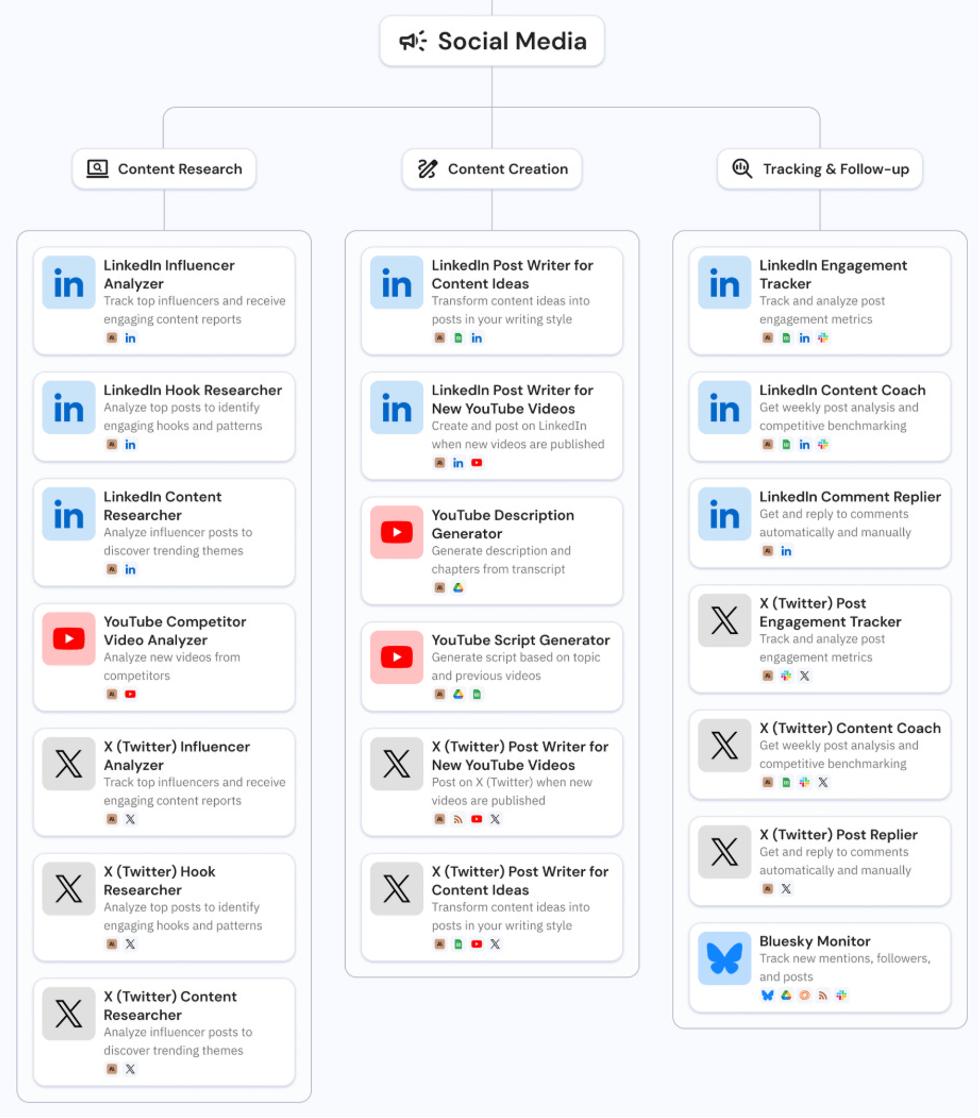
Core Insights - The effective use of AI has become a fundamental skill required for all employees, as emphasized by various companies including Shopify, Amazon, and Duolingo [1] - Jacob Bank, CEO of Relay.app, has successfully implemented a marketing organization that operates with over 40 AI agents, effectively replacing a traditional five-person marketing team [1][2] - This approach is not merely theoretical; it represents a practical guide for future work methodologies, showcasing how to build a personal "super team" using AI [1] Group 1: AI Agents in Marketing - AI agents are defined as software systems that perform tasks on behalf of users, with capabilities ranging from simple automation to complex decision-making [2] - Jacob's 40 AI agents are categorized into six marketing functions: social media, blogs and websites, email marketing, lead qualification, community management, and partnership projects [2] - The AI agent system is designed to enhance efficiency in marketing strategies, particularly in social media and community engagement [2] Group 2: Social Media AI Agents - The social media department has the highest number of AI agents, focusing on content research, creation, and interaction follow-up [3][5] - Specific agents include content research agents for platforms like LinkedIn and YouTube, content creation agents, and interaction tracking agents that automate responses to comments [5] - One notable agent is the LinkedIn interaction coach, which analyzes post performance and provides actionable insights for improvement [6] Group 3: Blog and Website AI Agents - AI is utilized for writing new blog posts, promoting articles on social platforms, updating old content, and tracking performance metrics [8] - A standout feature is the blog content update agent, which monitors the timeliness of website content and generates drafts for updates [8][10] Group 4: Email Marketing AI Agents - Two primary email marketing agents are employed: a newsletter generation agent that summarizes recent content and a lifecycle marketing agent that recommends actions based on user behavior [14] - An additional agent identifies churned users and sends follow-up emails to re-engage them [14] Group 5: Lead Qualification AI Agents - The lead qualification process is streamlined through an AI agent that assesses leads based on submitted information and provides recommendations for follow-up actions [16] - The agent categorizes leads as qualified, unqualified, or uncertain, ensuring that each decision is backed by reasoning and relevant information [16] Group 6: Community and Partnership AI Agents - AI agents manage various community channels, including live events, self-service courses, and Slack groups [19] - In partnership programs, AI agents review applications and track the activity of existing partners, ensuring timely follow-ups and recommendations [19] Conclusion - The future of work emphasizes the role of individuals who can effectively delegate tasks to AI agents rather than those who merely execute tasks themselves [19] - By breaking down processes and providing clear instructions, individuals can create their own AI marketing teams to automate repetitive yet essential tasks [19]
OpenAI会杀死Manus们吗?
虎嗅APP· 2025-07-20 03:02
Core Viewpoint - OpenAI's release of ChatGPT Agent marks a significant advancement in AI capabilities, allowing for complex task execution and planning, which poses challenges for existing AI startups in the agent space [3][7][39]. Group 1: OpenAI's ChatGPT Agent - ChatGPT Agent can autonomously plan and execute tasks, utilizing various tools for functions such as data retrieval and travel planning [3][8]. - OpenAI describes ChatGPT Agent as the strongest AI agent model to date, emphasizing its ability to integrate task planning and execution within a single system [7][8]. - The model is part of the o3 series but has not been individually named yet [8]. Group 2: Competitive Landscape - Startups like Manus and Genspark are responding aggressively to OpenAI's release, claiming superior performance in various tasks compared to ChatGPT Agent [10][19]. - Manus has released multiple comparison tests showcasing faster response times and higher task completion quality than OpenAI's offering [10][18]. - Genspark's founder claims their AI agent outperforms ChatGPT Agent in speed, cost, and output quality [19]. Group 3: Market Implications - The AI agent market is projected to grow from $5.1 billion in 2024 to $47.1 billion by 2030, with a CAGR of 44.8% [38]. - Major companies like Microsoft and Amazon are already experiencing workforce reductions due to AI integration, indicating a shift in job dynamics [38]. - OpenAI's ChatGPT Agent is expected to significantly impact various industries by automating complex tasks, which could lead to further job displacement [39]. Group 4: Technical Aspects - ChatGPT Agent has achieved high performance in academic tests, outperforming previous models like GPT-4o in specific tasks [25][26]. - The model's capabilities are likened to those of a junior investment banking analyst, showcasing its advanced analytical skills [26]. - Startups are focusing on application innovation, while OpenAI emphasizes foundational model capabilities, leading to differing strategies in the AI agent space [24][36].

速递|45人团队8个月揽下18亿美元估值,瑞典AI黑马Lovable已完成2亿美元A轮融资
Z Potentials· 2025-07-18 03:04
Core Insights - Lovable, a rapidly growing Swedish AI programming startup, has become Europe's latest unicorn with a valuation of $1.8 billion after raising $200 million in Series A funding [2][3] - The company, which allows users to create websites and applications using natural language, has over 2.3 million active users, with more than 180,000 paying subscribers generating an annual recurring revenue of $75 million within seven months of its establishment [2][3] Funding and Growth - The Series A funding round was led by Accel, with participation from existing investors such as 20VC, byFounders, Creandum, Hummingbird, and Visionaries Club [3] - In February 2025, Creandum led a $15 million Pre-A funding round when the company reported an annual recurring revenue of $17 million and 30,000 paying customers [3] - Lovable has achieved rapid growth with only 45 full-time employees, indicating a hockey-stick growth trajectory [3] User Demographics and Applications - A significant portion of Lovable's user growth comes from non-technical individuals who use the platform to create prototypes and collaborate with developers [3] - The platform has facilitated the creation of approximately 10 million projects, primarily for prototyping and testing purposes [3] Future Prospects - Lovable aims to become a tool for creating production-grade applications, providing foundational support for established enterprises [4] - The CEO highlighted the challenges faced by founders in finding developers to realize their visions, indicating a market need that Lovable addresses [4] - A notable success story includes a Brazilian ed-tech company that generated $3 million in revenue within 48 hours using an application developed on Lovable [4]
特朗普监管松绑见效!Circle(CRCL.US)等加密公司抢滩美国传统银行业
智通财经网· 2025-07-14 04:01
Core Insights - Cryptocurrency companies are accelerating their entry into traditional banking in the U.S. to leverage a more favorable regulatory environment during Donald Trump's presidency [1] - Major players like Ripple, Circle, and BitGo are applying for national trust bank charters to provide limited banking services without needing state licenses [1] - Kraken is preparing to launch debit and credit cards, indicating a broader shift towards financial services [1] Group 1: Regulatory Environment - The optimism in the cryptocurrency industry has increased during the Trump administration, contrasting with the more cautious stance under Joe Biden [1] - Legal experts note a significant shift in the industry's attitude, with companies now seeking clearer regulations from authorities [2] - National trust banks can simplify operations and enhance access to the financial system by eliminating state licensing requirements, although they cannot issue loans or accept consumer deposits [2] Group 2: Stablecoins and Legislation - As cryptocurrency firms seek to expand into banking, U.S. lawmakers are debating regulations for stablecoins [3] - The proposed Genius Act aims to strengthen regulation by linking stablecoins more closely to U.S. Treasury assets, allowing only regulated banks and certain licensed non-bank entities to issue dollar-backed stablecoins [3] - Ripple has applied for a master account with the Federal Reserve, enabling it to hold reserve funds directly [3] Group 3: Integration of Traditional Banking and Cryptocurrency - More fintech companies are integrating traditional banking services with cryptocurrency operations, with Robinhood planning to launch consumer banking services [4] - Revolut aims to obtain a U.S. banking license while Klarna expresses interest in incorporating cryptocurrency into its offerings [4] - Major financial institutions like Bank of America are monitoring stablecoin issuance, awaiting final regulatory guidance [4] - The current U.S. administration appears more willing to approve bank charter applications compared to the previous one [4] - Not all cryptocurrency companies prioritize obtaining full banking licenses, as Kraken prefers to collaborate with top financial partners rather than directly offering products like mortgages [4]

AI大家说 | 前沿企业如何成功应用AI?
红杉汇· 2025-07-13 02:36
Core Insights - The article emphasizes the transformative potential of AI in enhancing employee performance, automating operations, and driving product innovation, urging companies to adopt AI as a new work paradigm rather than just software or cloud applications [1] Group 1: Case Studies and Applications - Morgan Stanley implemented a rigorous evaluation process for AI applications, resulting in 98% of advisors using the tool daily and increasing document information retrieval from 20% to 80% [4] - Indeed utilized AI to optimize job matching, leading to a 20% increase in job application initiation rates and a 13% increase in employer hiring preferences [9] - Klarna's AI customer service system autonomously handled over two-thirds of customer inquiries, reducing average response time from 11 minutes to 2 minutes, with 90% of employees integrating AI into their workflows [13][14] - Lowe's collaborated with OpenAI to fine-tune AI models, improving product label accuracy by 20% and error detection capabilities by 60% [18] - Mercado Libre built a developer platform using AI, significantly accelerating application development and enhancing fraud detection accuracy to nearly 99% [22] Group 2: Key Insights from Case Studies - A systematic evaluation process is essential before deploying AI to ensure model performance and reliability [6] - AI should be integrated seamlessly into existing workflows to enhance user experience rather than being treated as an additional feature [10] - Early adoption of AI leads to compounding benefits, as seen in Klarna's case where widespread employee engagement accelerated innovation [15] - Customizing AI models to specific business needs enhances their effectiveness and relevance [19] - Providing developers with AI tools can alleviate innovation bottlenecks and streamline application development [23] Group 3: Deployment Strategies - Companies should adopt an open and experimental mindset, focusing on high-return, low-barrier scenarios for initial AI deployment [31] - A dual-track deployment methodology is recommended: widespread accessibility for all employees and concentrated efforts on high-leverage use cases [33][34] - Ensuring AI reliability and accuracy is crucial for driving workflow transformation within organizations [34] Group 4: Industry Trends - AI adoption in business is accelerating, with 78% of organizations using AI in 2024, up from 55% the previous year [35] - Despite the increase in AI usage, many companies have yet to see significant cost savings or profit increases, with most reporting savings of less than 10% [35] - The trend indicates that while AI tools are becoming more prevalent, organizations are still in the early stages of exploring their full potential [38]


Google 收编Windsurf,xAI估值或达2000亿美元:2025年投资机构怎么看? | Jinqiu Select
锦秋集· 2025-07-12 06:24
Core Insights - The article highlights a significant shift in the AI industry, driven by major acquisitions and skyrocketing valuations, indicating a new era of competition among tech giants and startups [1][2] - The AI supercycle is reshaping the landscape, with capital and technology becoming critical tools for survival and success in the evolving market [1][2] Macro Background and Nature of Tech Investment - Over the past 70 years, technology investment has focused on identifying and capitalizing on major technological shifts, from the computer revolution to the current AI revolution [3] - The rise of mobile internet and cloud computing has fundamentally changed service delivery models, with AI's impact expected to surpass previous technological waves [5] - The tech sector now accounts for nearly 50% of market value, reflecting a fundamental shift in economic growth drivers [8] - Future projections suggest that the tech sector's market share could rise to 75-80% as AI infrastructure becomes increasingly integrated into traditional industries [11] Dynamics and Risks in the Tech Market - The volatility of tech investments is highlighted, with examples like Nvidia experiencing multiple significant drawdowns [12] - The market has seen a continuous cycle of company replacements, with a significant portion of top companies being replaced every five years [14][15] - The article discusses the challenges of accurately predicting investment trends, particularly during periods of market volatility [20][21] Analysis of the AI Supercycle - Major strategic shifts by large companies signal the onset of the AI supercycle, with examples including Microsoft's significant growth in token processing [49] - The capital expenditure for cloud service providers has dramatically increased, with projections for 2025 rising from $152 billion to $365 billion, indicating a surge in AI-related investments [50] - ChatGPT's rapid user growth has disrupted traditional search behaviors, showcasing the transformative impact of AI on consumer habits [59] Private Market: Formation of a New Ecosystem - The private market is evolving, with a shift from traditional venture capital to a more complex ecosystem involving family offices and sovereign wealth funds [102][103] - AI has become a dominant force in private market financing, accounting for over 50% of total funding [107] - The article notes a resurgence in IPO activity, with companies like CoreWeave and Circle showing strong post-IPO performance, indicating a recovery in market confidence [121][129]



Buy now, pay later vs. credit cards: Which should you use for your next purchase?
Yahoo Finance· 2025-07-10 19:55
Core Insights - The rise of Buy Now, Pay Later (BNPL) services is making short-term lending more accessible and popular, with 15% of people using these services in the past year [1][2] - BNPL offers an alternative to credit cards, allowing consumers to split purchases into installments, but it may lead to overspending and increased debt [2][24] Overview of BNPL - BNPL allows consumers to make purchases and pay in installments, typically consisting of four interest-free payments over a few weeks, with late fees applicable for missed payments [3][4] - Various BNPL providers, such as Klarna, Affirm, and Afterpay, offer different payment structures, including interest-free plans and longer-term financing options [5][9] Payment Options and Fees - Klarna charges a late fee of up to $7 for payments more than 10 days late, capped at 25% of the total purchase amount [6] - Affirm does not charge fees for late payments, but interest rates apply for monthly plans [7] - Afterpay offers multiple payment options, including interest-free payments and longer-term plans with interest [9][10] Credit Card Integration - Some credit card companies offer BNPL options, allowing users to create installment plans for eligible purchases [13][15] - Credit card payments can be used for short-term BNPL plans, but longer-term plans typically require a debit card or linked bank account [11][12] Consumer Behavior and Risks - A significant portion of BNPL users (58%) reported using these services because they could not afford the purchase upfront, with 24% admitting to making late payments [24][26] - The ease of access to BNPL may lead to increased debt, especially for those already carrying credit card balances [25][26] Regulatory Environment - The Consumer Financial Protection Bureau (CFPB) has classified BNPL lenders similarly to credit card providers, requiring them to offer certain consumer protections [27][28] - As of June 2025, a new credit scoring model (FICO 10 BNPL) is expected to incorporate BNPL data into credit scores, which could impact consumers' credit ratings [22][21] Comparison with Credit Cards - BNPL plans generally have a simpler approval process with soft credit checks, while credit cards often require hard credit checks and have stricter approval standards [30][31] - Credit cards offer rewards and benefits that BNPL plans typically do not, making them more advantageous for consumers who can pay off balances in full [34][35] Conclusion - While BNPL services provide an accessible financing option, they come with risks of overspending and potential debt accumulation, particularly for consumers with existing credit card balances [24][26]
Langchain,又一家AI独角兽要诞生了,红杉是股东
Hua Er Jie Jian Wen· 2025-07-09 02:36
Core Insights - The valuation of AI infrastructure startup LangChain has reached approximately $1 billion following a new funding round led by IVP, marking its entry into the unicorn club [1] - LangChain's valuation has significantly increased from $200 million during its Series A funding led by Sequoia Capital in 2023, driven by the commercial success of its product LangSmith [1][2] - LangSmith has generated annual recurring revenue between $12 million and $16 million since its launch last year, with notable clients including Klarna, Rippling, and Replit [1] Company Development - LangChain originated as an open-source project created by Harrison Chase in late 2022, who was previously an engineer at Robust Intelligence [2] - The project gained significant developer interest, leading to its transformation into a commercial entity, securing $10 million in seed funding in April 2023, followed by $25 million in Series A funding [2] - The open-source code addressed the lack of real-time information access in early large language models, providing a framework for building applications on LLMs [2] Competitive Landscape - The rapid evolution of the large language model ecosystem has intensified competition for LangChain, with rivals like LlamaIndex, Haystack, and AutoGPT offering similar functionalities [3] - Major model providers such as OpenAI, Anthropic, and Google have begun to offer comparable features, which were previously LangChain's core differentiators [3] - In response to competition, LangChain launched the closed-source product LangSmith, focusing on observability, evaluation, and monitoring of large language model applications [3] Product Strategy - LangSmith has emerged as a key driver of revenue growth for LangChain, adopting a freemium model where developers can use basic features for free, with a subscription fee of $39 per month for small team collaboration [3] - The company also offers customized solutions for larger organizations, further expanding its market reach [3]