瑞众人寿

Search documents
板块受短期因素影响有所调整,预定利率1.25%分红险面市:保险行业周报(20260224-20260227)-20260302
Huachuang Securities· 2026-03-02 08:26
证 券 研 究 报 告 保险行业周报(20260224-20260227) 板块受短期因素影响有所调整,预定利率 推荐(维持) 1.25%分红险面市 本周行情复盘:保险指数下降 3.76%,跑输大盘 4.84pct。保险个股表现分化, 友邦+8.09%,财险-2.29%,新华-2.70%,平安-3.37%,人保-3.49%,太平-4.75%, 太保-4.85%,众安-4.90%,阳光-5.31%,国寿-6.14%。十年期国债到期收益率 1.79%,较节前基本持平。 本周动态: (1)财联社:2 月 10 日,中英人寿率先推出内地首款预定利率 1.25%的分红 险产品,较去年监管划定的分红险预定利率上限 1.75%,出现了明显下调。在 寿险"老六家"中,至少已有 4 家完成预定利率 1.25%分红险产品的报备与储 备,但短期内不会推向市场。多家中型险企则明确表示,计划于 2026 年推出 该定价水平的分红险,以补充产品矩阵。 (2)险联社:2025 年,中国宠物经济持续升温,全行业保费规模预计突破 30 亿元,同比增长 76.47%,连续五年实现规模翻倍。 (3)每日经济新闻:2 月 27 日,同洲电子公告,持 ...


王晓辉获批担任瑞众人寿总经理助理
Jin Rong Jie· 2026-02-14 04:26
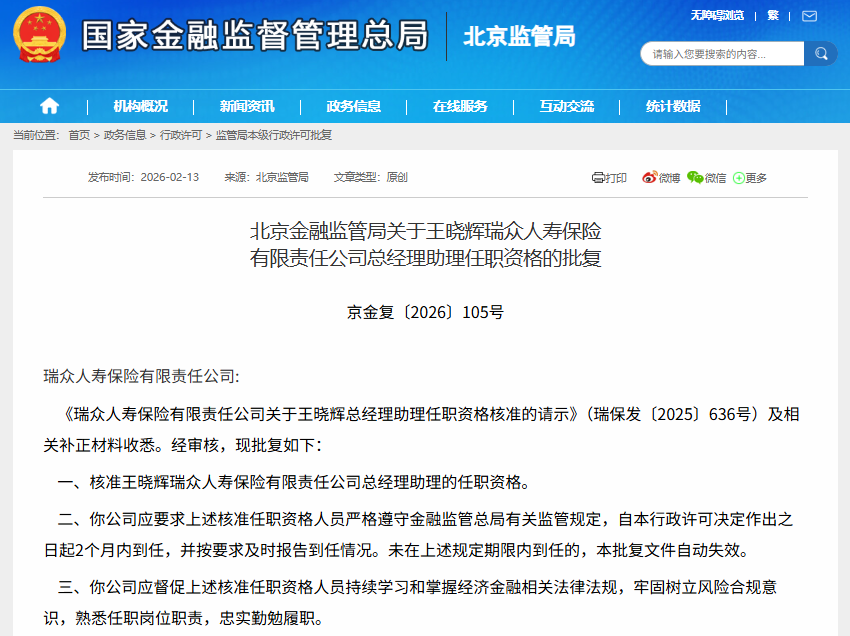
2月13日,据北京金融监管局网站,王晓辉获批担任瑞众人寿总经理助理。 关键词阅读:瑞众人寿 责任编辑:栎树 ...

华兰股份董事反对设立AI医药孙公司,主要股东态度审慎
Jing Ji Guan Cha Wang· 2026-02-11 07:08
Core Viewpoint - Two directors of Hualan Co., Ltd. (301093), Cui Ke and Yao Mingfang, voted against the proposal to establish an AI pharmaceutical subsidiary during the board meeting on February 9, 2026, citing concerns over feasibility, governance and risk control requirements, and legal constraints [1] Group 1 - The dissenting votes from the directors reflect a cautious attitude from a major shareholder, Huaxia Jiuying Asset Management Co., Ltd., regarding the company's entry into the technology-intensive AI pharmaceutical sector [1] - Huaxia Jiuying's affiliated party, Ruizhong Life Insurance, is a significant institutional investor in Hualan Co., Ltd., holding 16.38% of the shares [1]
新年1月银保“开门红”:谁攻城、谁略地、谁失地?
Xin Lang Cai Jing· 2026-02-06 11:43
来源:中保新知 实际上,"开门红"的火热此前已有"预告"——元旦过后,市场即有消息称,元旦假期累计实现新单保费 规模突破700亿元,其中多家险企银保渠道新单保费"涨幅惊人"。再之前,银保在2025年已强势重返人 身险行业第一大渠道。 经历了两个相对低迷的"开门红"后,银保渠道在2026开年打了个翻身仗。中保新知日前获悉,1月寿险 业银保渠道期交保费1030亿元,同比增长34%;趸交保费1096亿元,同比增长24%。 不过从机构端看,残酷的现实同样赤裸,忧喜依然同在。 TOP10险企座次在2025年大洗牌后,"老七家"和非银外资险企继续攻城略地。1月,"老七家"银保渠道 期交保费总额425亿元,同比大增88%,市场份额从2023年的23%上升至41%,有3家同比增速翻倍;非 银外资险企银保渠道期交保费规模也取得同比33%的增速。而另一边,银行系险企同比小幅增长4%但 出现分化,小型中资险企增速整体"告负"。 01 "老七家"市场份额升至四成 延续过去两年表现,寿险"老七家"(中国人寿、平安人寿、新华保险、太平人寿、太保寿险、人保寿 险、泰康人寿)银保渠道保费继续狂飙。 今年1月,7家实现期交保费总额425亿元, ...
高端招聘藏陷阱:瑞众人寿团队冒用名义招代理人,行业“洗人头”模式难以为继
Xin Lang Cai Jing· 2026-01-26 02:52
Core Viewpoint - The insurance industry is facing significant recruitment issues, where positions advertised as "internal staff" often turn out to be sales roles for insurance agents, misleading job seekers [2][9] Group 1: Recruitment Practices - Job titles such as "club sales specialist" and "marketing lecturer" are used to attract candidates with promises of high salaries, but the actual work involves selling insurance [3][10] - A case study involving a job seeker named Wang Li highlights a deceptive recruitment process where he was misled into becoming an insurance agent under the guise of a high-end club position [4][11] Group 2: Regulatory Issues - The Beijing Financial Regulatory Bureau confirmed that the recruitment practices of the involved insurance company violated regulations set by the former insurance regulatory authority [12] - The company is required to establish standardized recruitment policies and prevent misleading practices in hiring [12][13] Group 3: Industry Challenges - The insurance sector is experiencing a high turnover rate, with some teams reporting over 90% attrition within a year, indicating a reliance on recruitment rather than retention [5][13] - 瑞众人寿, the company involved, has a history of compliance issues, having received multiple regulatory fines for false advertising and consumer rights violations [5][14] Group 4: Future Outlook - The insurance industry is undergoing transformation, with a significant reduction in the number of agents from 9.73 million in 2019 to an expected 5.71 million by 2025, reflecting a shift away from traditional recruitment methods [6][14] - New compliance regulations are set to take effect in March 2025, requiring financial institutions to adopt proactive compliance management systems [6][14]

瑞众人寿海南分公司被罚款40.5万元 诱导保险代理人违背诚信义务等
Xi Niu Cai Jing· 2026-01-19 17:04
此前,瑞众人寿也因诱导保险代理人违背诚信义务被罚。2025年9月,瑞众人寿肇庆中心支公司因"保险 销售宣传信息管理不到位""隐瞒与保险合同有关的重要情况""诱导保险代理人违背诚信义务"而被警告 并罚款合计2.6万元。 1月15日,国家金融监督管理总局海南监管局发布的行政处罚信息公开表显示,瑞众人寿海南分公司因 存在财务业务数据不真实、销售误导、诱导保险代理人进行违背诚信义务的活动等违法违规行为,被警 告并被罚款40.5万元,相关责任人张松、权诚、舒波、唐天澍、朱旭华被警告并被罚款共计20.4万元。 ...

一年近40家保险中介股权变更 科技公司成入场主力
Xin Lang Cai Jing· 2026-01-16 19:05
Core Insights - The competitive landscape and value logic of the insurance intermediary market are rapidly evolving, with significant changes in ownership structures and the entry of technology companies [1][3][8] Group 1: Market Changes - Recent data indicates that nearly 40 insurance intermediary companies will undergo ownership changes by 2025, with new shareholders primarily being technology firms, industrial capital, and state-owned enterprises [1][3] - The entry of technology companies into the insurance intermediary market is becoming a dominant trend, with over ten such firms participating in ownership changes in 2025 [3][5] Group 2: Industry Dynamics - The insurance intermediary sector is experiencing a structural optimization due to stricter regulations and the "reporting and operation integration" policy, leading to the exit of inefficient or non-contributing entities [1][8] - The market is expected to become more concentrated, with a significant reduction in the number of insurance intermediaries, dropping from 2,642 in 2019 to 2,539 by mid-2024, and 163 firms exiting the market in the first three quarters of 2025 alone [8] Group 3: Competitive Strategies - Future competition in the insurance intermediary market will focus on efficient and precise matching of supply and demand, with digitalization and technology becoming core competitive drivers [4][8] - Comprehensive service platforms will emerge as the mainstream, providing a wide range of insurance products and services, supported by big data for personalized recommendations [9][10] Group 4: Capital Involvement - Industrial and state-owned capital are actively entering the insurance intermediary market to enhance their ecosystems, with examples including Toyota's acquisition of Beijing Shengtang Insurance Brokerage and state-owned enterprises investing in local insurance agencies [5][6][7] - The involvement of insurance companies in acquiring intermediary firms aims to leverage their product and channel advantages, enhancing compliance and competitiveness in their internet business [7]
同股不同价 银行A/H股近五月为何分化了
2 1 Shi Ji Jing Ji Bao Dao· 2026-01-15 14:09
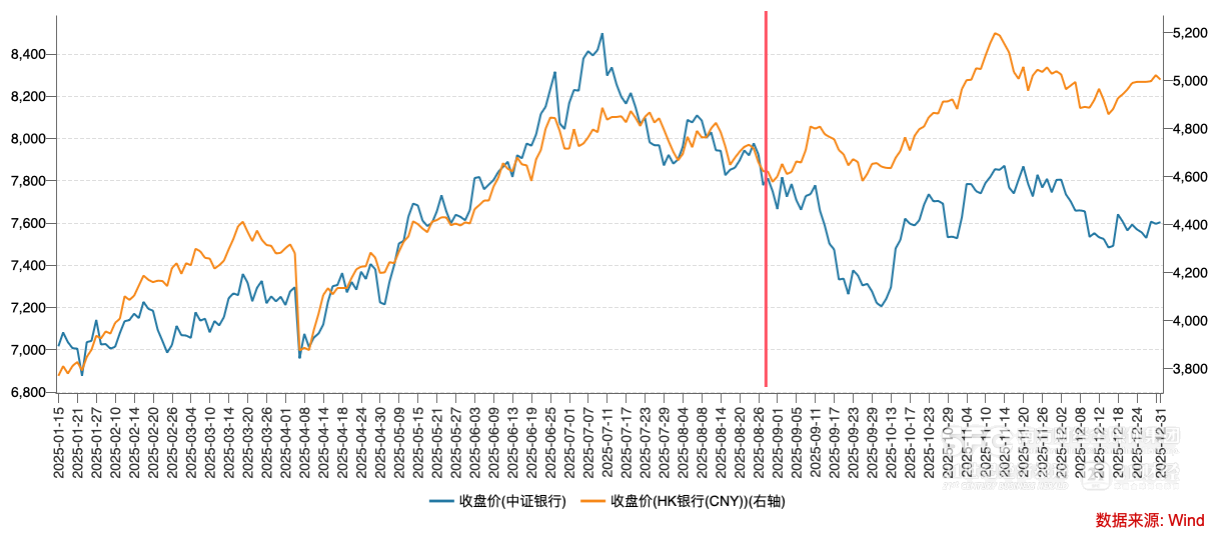
Core Viewpoint - In a low-interest-rate environment, bank stocks are seen as representatives of dividend style investments, offering medium to long-term allocation value due to their high dividend characteristics [1] Group 1: Bank Indices Performance - The main bank indices in A-share and Hong Kong markets include the China Securities Bank Index, the China Securities Hong Kong Bank Index, and the China Securities AH Bank Index [2] - The China Securities Hong Kong Bank Index is expected to significantly outperform the China Securities Bank Index in 2025 [3] - From January 1 to December 31, 2025, the Hong Kong Bank Index recorded a growth of 28.94%, which is substantially higher than the 6.79% increase of the China Securities Bank Index and the 9.60% of the AH Bank Index [4] Group 2: Investment Trends and Fund Flows - In Q3 2025, the Hong Kong banking sector saw significant buying from insurance capital, while the A-share banking sector experienced substantial selling by public funds [10] - The proportion of active equity funds' holdings in A-share banks dropped from 3.91% to 1.49%, with the market value decreasing from 64.1 billion yuan to 30.8 billion yuan [10] - In contrast, insurance capital made 41 significant investments in banks throughout 2025, with 33 of these targeting H-share banks [10] Group 3: Stock Performance and Dividend Yields - The strong performance of the Hong Kong Bank Index is attributed to the notable gains of key stocks such as HSBC Holdings, which rose by 25.53%, and Standard Chartered, which increased by 30.66% [11] - The dividend yield for Hong Kong banks remains above 6%, making them attractive to insurance capital, while A-share banks generally have yields between 3% and 4% [13] - Historical data indicates that buying bank stocks before the Spring Festival has an 80% success rate, with quality joint-stock banks and city commercial banks often yielding excess returns [13] Group 4: Future Outlook - Looking ahead to 2026, insurance capital is expected to remain a significant source of funding, but bank stocks may underperform the broader market in the first quarter due to a growth-oriented market style [15] - The return on tangible equity (ROTE) for Hong Kong banks is projected to slightly decline in 2026, yet the combined return from dividends and buybacks is still expected to exceed 7%, maintaining their investment appeal [15]




2026年险资举牌热度能否延续?
Jin Rong Shi Bao· 2026-01-14 02:37
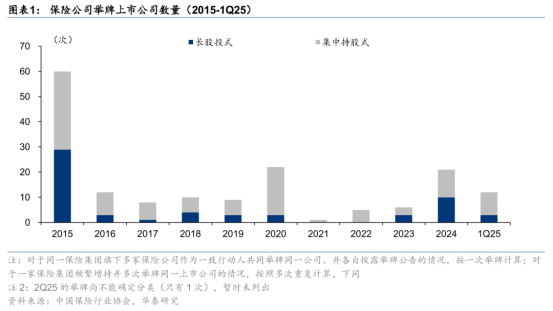
Core Viewpoint - In 2025, insurance capital's shareholding activities reached a record high of 35 times, driven by regulatory encouragement, the pursuit of higher returns in a low-interest environment, and new accounting standards that help smooth profit fluctuations [1][4]. Group 1: Characteristics of Insurance Capital Shareholding - The number of shareholding activities by insurance capital in 2025 significantly exceeded the average level of recent years, marking the most active year since 2015 [2]. - A total of 14 insurance institutions participated in shareholding activities, including major listed insurance companies, bank-affiliated insurers, and Sino-foreign joint ventures, with Ping An Life being the most active, conducting 12 shareholdings [2]. - Approximately 80% of the shareholding activities were executed through the Hong Kong Stock Connect or continuous purchases in the secondary market, with other methods including agreement transfers and passive shareholding due to mergers [2]. Group 2: Strategic Logic Behind Shareholding - Insurance capital's shareholding activities were not random but followed a clear strategic logic, with a preference for the financial sector, which saw 15 shareholdings involving six banks and two insurance institutions [3]. - Other favored sectors included public utilities, transportation, and environmental protection, indicating a focus on stable, cash-generating industries [3]. - The core demand of insurance capital is for long-term, stable returns, leading to an increased allocation to equity assets as traditional fixed-income returns fail to cover liability costs [3]. Group 3: Factors Driving Shareholding Activities - Regulatory policies have encouraged long-term capital to enter the market, with measures such as increasing the investment limit for insurance companies in equity assets to 50% [4]. - Insurance institutions are responding to downward pressure on interest rates by increasing their allocation to equity assets to enhance long-term investment returns [4]. - New accounting standards impose higher requirements for asset-liability matching, allowing insurance companies to reduce the impact of market value fluctuations on current profits through shareholding [5][6]. Group 4: Future Outlook for Insurance Capital Shareholding - There is optimism that insurance capital will continue to increase equity asset allocations in 2026, with expectations of maintaining high shareholding activity levels [8]. - Analysts suggest that insurance capital's shareholding motivations will focus on stable dividend cash flows and high return on equity (ROE) targets, particularly in sectors aligned with national strategic directions such as high-end manufacturing and technological innovation [8].

险资新年第一举!太保举牌上海机场,去年险资41次举牌创十年新高
Di Yi Cai Jing· 2026-01-13 12:38
Core Viewpoint - The trend of insurance capital "shareholding" is expected to continue into 2026, driven by the focus on high dividend stocks and the need for long-term equity investments to enhance return on equity (ROE) [2][18]. Group 1: Recent Trends in Insurance Capital Shareholding - In 2025, insurance capital shareholding reached 41 instances, a significant increase from 20 in 2024, marking a new high in the past decade [2][3]. - The current wave of shareholding differs from the past, as it is influenced by a low interest rate environment and the need for stable cash returns through high dividend stocks [5][14]. - Analysts indicate that the demand for high dividend and high ROE stocks will persist, suggesting that the shareholding trend will continue [18]. Group 2: Characteristics of the Current Shareholding Wave - The shareholding activities are more diversified compared to previous years, with "Ping An" leading with 15 instances, primarily targeting bank and insurance stocks [11][12]. - Bank stocks were the most favored, being targeted 17 times, accounting for 41.5% of total shareholding instances in 2025 [13][14]. - The average dividend yield of the targeted companies was approximately 5.0%, higher than previous waves, indicating a preference for high-yield investments [15]. Group 3: Investment Strategies and Regulatory Environment - The new accounting standards implemented in 2023 require insurance companies to choose between FVTPL and FVOCI for stock investments, influencing their investment strategies [6][7]. - The regulatory environment has encouraged long-term capital market participation, enhancing the attractiveness of shareholding for insurance companies [7][18]. - The investment strategy includes a focus on high ROE assets, particularly state-owned enterprises with stable business models, to improve the overall ROE of insurance capital [17].