Azure

Search documents
Zadara Empowers Kocho with Streamlined VMware Alternative to Eliminate Complexity and Multi-Tenant AI Clouds Powered by NVIDIA GPUs to Enable Efficient Sovereign AI Clouds
Globenewswire· 2026-02-03 13:04
Core Insights - Kocho has partnered with Zadara to enhance its cloud infrastructure, focusing on cybersecurity, identity, and cloud transformation services to meet increasing client demands and adapt to market changes [1][4] Group 1: Strategic Shift and Infrastructure - Kocho is transitioning from traditional infrastructure to a consumption-based, OPEX-driven cloud model with Zadara, reducing upfront capital investments and allowing for scalable resource management [2] - The collaboration with Zadara addresses challenges such as rising licensing costs and infrastructure complexity, providing a viable alternative to VMware [2] Group 2: Benefits of Partnership - Zadara's distributed edge cloud offers performance, data sovereignty, and real-time AI processing without data egress fees, enabling Kocho to focus on application development [3] - Clients of Kocho benefit from improved agility, faster service delivery, and secure data residency, supported by Zadara's advanced architecture and multi-tenancy capabilities [3] Group 3: Zadara's Capabilities - Zadara operates over 500 edge cloud locations globally, providing a cloud infrastructure that supports various use cases, including sovereign cloud and AI inference [5] - The platform features consumption-based pricing with zero data egress fees, designed to accommodate workloads across on-premises, hybrid, multi-cloud, or edge environments [5] Group 4: Company Background - Kocho specializes in Microsoft cloud technology, cybersecurity, and managed services, serving a diverse range of clients from mid-market organizations to large enterprises across various sectors [7][8] - Zadara is headquartered in Irvine, California, and offers 24/7 support with a skilled global team [6]



“短缺终将导致过剩”!a16z安德森2026年展望:AI芯片将迎来产能爆发与价格崩塌
Hua Er Jie Jian Wen· 2026-01-08 03:22
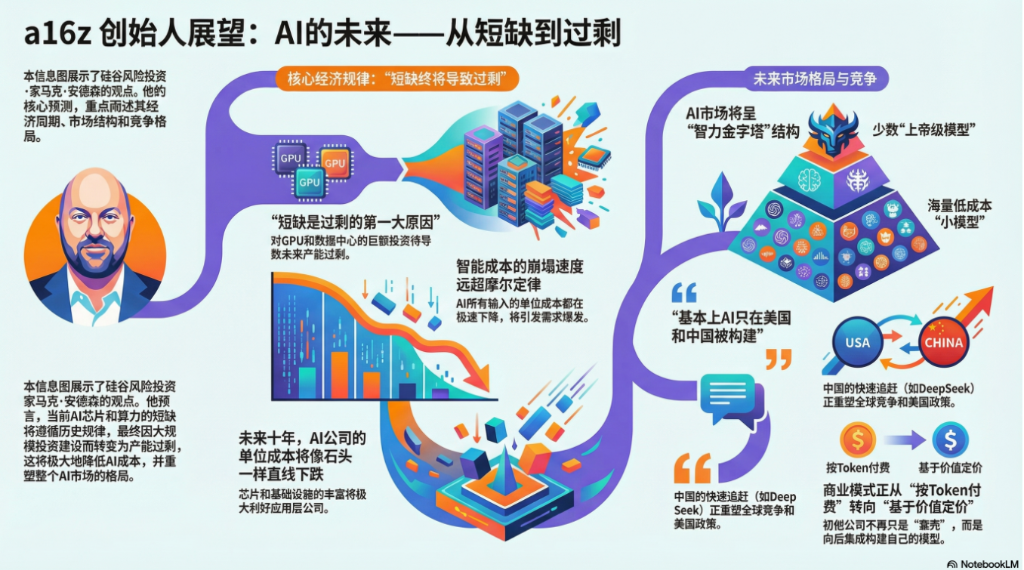
Core Insights - The discussion emphasizes that the current AI revolution is unprecedented in scale, comparable to electricity and microprocessors, and is still in its early stages [4][6][12] - The rapid decline in AI costs, described as "hyper deflation," is expected to drive explosive demand growth [4][6][35] - Historical patterns suggest that shortages in AI infrastructure, such as GPUs, will lead to oversupply and further cost reductions in the future [4][6][35] AI Technology Landscape - AI is viewed as a transformative technology that surpasses the internet in magnitude, with its current phase being very early [6][12] - The cost of AI is decreasing at a rate faster than Moore's Law, leading to significant demand growth [6][35] - The future AI market structure will resemble the computer industry, with a few "god-tier models" at the top and numerous low-cost "small models" at the periphery [6][10] US-China Competition - The emergence of Chinese models like DeepSeek and Kimi has surprised both Washington and Silicon Valley, indicating significant progress in open-source models from China [5][7][52] - The competition is characterized as a dual hegemony, with both the US and China being the primary players in AI development [5][7][51] Business Models and Pricing - A shift from "pay-per-token" to "value-based pricing" is occurring in AI applications, allowing companies to capture more value from productivity gains [9][34] - AI startups are moving beyond being mere wrappers around large models and are integrating their own models, enhancing their competitive edge [9][34] AI Democratization - Advanced AI technologies are becoming accessible to the public, breaking down barriers and allowing widespread use [6][21] - Despite public fears about AI replacing jobs, actual behavior shows a rapid adoption of AI technologies [6][21] Regulatory Environment - The regulatory landscape is shifting, with a reduced risk of federal-level restrictions on AI, as there is bipartisan support for innovation [7][59] - State-level regulations are emerging, leading to a fragmented legal environment that could hinder progress [59][60] AI Chip Development - The AI chip market is expected to see significant investment and innovation, with a potential oversupply in the coming years as companies ramp up production [4][45] - The competition in chip development is intensifying, with both established companies and startups entering the market [45][49]
Significant Backlog v. Massive Debt: Will ORCL Win A.I.
Youtube· 2025-12-11 19:00
Core Insights - Oracle reported a record-breaking Remaining Performance Obligation (RPO) of $523 billion, reflecting a significant increase of $68 billion from the last quarter and a 433% increase year-over-year [3][4] - Despite the impressive RPO figures, Oracle's stock has seen a decline of 13.5%, raising questions about the sustainability of its growth strategy [2] - A substantial portion, 43%, of the RPO is expected to be implemented in 2026, amounting to $225 billion, which may help offset the company's planned capital expenditures of around $50 billion [4][10] Financial Performance - Oracle's cloud business, particularly its Oracle Cloud Infrastructure (OCI), has shown strong growth, with a year-over-year increase of 66%, and GPU-related cloud revenue surged by 177% [12] - The company is financing its growth through debt, which raises concerns about the sustainability of its core business [8][9] Competitive Landscape - Oracle is entering a competitive market dominated by major players like AWS, Azure, and Google Cloud, which have established themselves as early movers in AI and cloud services [7][15] - There are concerns that Oracle may be overestimating its ability to compete with these hyperscalers, especially given its late entry into the AI space [16] Market Dynamics - The RPO surge may not translate into immediate cash flow, as over 75% of these obligations are set to start within 24 months, leading to skepticism about the actual realization of these contracts [9][18] - Analysts are urged to focus on the profitability and sustainability of the businesses behind the $523 billion RPO commitments, rather than solely on Oracle's core operations [17][19]


音频 | 格隆汇11.18盘前要点—港A美股你需要关注的大事都在这
Ge Long Hui A P P· 2025-11-17 23:18
Group 1 - The U.S. stock market indices collectively declined, while Google saw a rise of over 3%, and the Chinese concept index fell by 1.21% [2] - Goldman Sachs has lowered its average price forecast for WTI and Brent crude oil to $52 and $56 per barrel for next year [2] - Goldman Sachs anticipates that central banks may significantly purchase gold in November, maintaining a year-end gold price forecast of $4,900 [2] Group 2 - China's personal income tax revenue from January to October reached 1,336.3 billion yuan, reflecting a year-on-year increase of 11.5% [2] - China's tax revenue from January to October increased by 1.7% year-on-year, while non-tax revenue decreased by 3.1% [2] - The securities transaction stamp duty in China for January to October was 162.9 billion yuan, showing a year-on-year increase of 88.1% [2] Group 3 - Meituan reported an increase in search volume for winter tourism, with Beijing ranking as the top destination [2] - A well-known internet celebrity private equity fund experienced a net value drop of over 30% in one week [2] - Ningde Times announced a transfer price of 376.12 yuan per share, which is a 3.8% discount compared to the closing price [2]
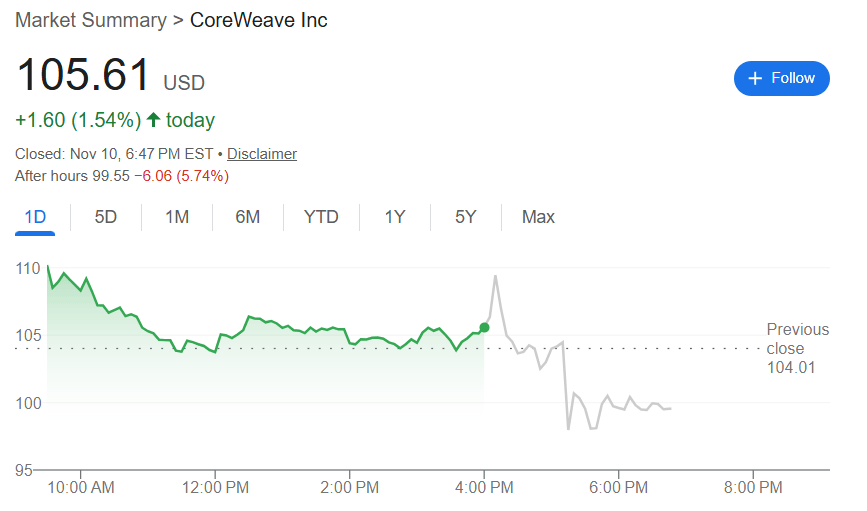
CoreWeave三季度营收13.6亿美元超预期,建设缓慢导致下调全年营收指引,股价盘后重挫6%
Sou Hu Cai Jing· 2025-11-11 03:28
Core Financial Performance - CoreWeave reported Q3 revenue of $1.36 billion, a 134% year-over-year increase, exceeding the expected $1.29 billion [3][4] - The company experienced a net loss of $110 million, significantly reduced from a net loss of $359 million in the same period last year [3][4] - Operating profit margin was only 4%, below the expected 6.5% and lower than the previous year's margin [3][4] Revenue Guidance and Order Backlog - The revenue guidance for 2025 was lowered from a previous high of $5.35 billion to a range of $5.05 billion to $5.15 billion, below analyst expectations of $5.29 billion, primarily due to delays from a third-party data center contractor [3][4] - The company's order backlog reached $55.6 billion, nearly double that of the previous quarter [4][5] - Significant contracts include a $14.2 billion six-year agreement with Meta and an expanded $6.5 billion agreement with OpenAI [4][5] Capital Expenditure and Growth Strategy - CoreWeave's CEO indicated that the company is facing constraints due to a shortage of "powered-shell" data centers for rapid deployment [5] - Following a failed acquisition of Core Scientific, CoreWeave is accelerating its own data center construction, particularly in Pennsylvania [5] - The projected capital expenditure for 2026 is expected to exceed double that of 2025's estimated $12-14 billion, raising concerns about the aggressive investment pace relative to anticipated revenue [5]
Big Tech's Meta, Amazon, and Google spent over $112B combined on capex in 2025. 💰
Yahoo Finance· 2025-11-08 17:30
Capital Expenditures Overview - Capital expenditures reached $194 billion, driven by investments in servers, data centers, and network infrastructure [1] - Cash capex was $342 billion in Q3, with $899 billion spent year-to-date, primarily related to AWS investments [1] - Third quarter capex was $24 billion, with the vast majority invested in technical infrastructure [2] - Capital expenditures were $349 billion, driven by growing demand for cloud and AI offerings [3] Investment Allocation - Approximately 60% of technical infrastructure investment was in servers, and 40% in data centers and networking equipment [2] - Roughly half of the spend was on short-lived assets, primarily GPUs and CPUs [3] - The remaining spend was for long-lived assets supporting monetization for the next 15 years and beyond [3] Strategic Focus - The company will continue to make significant investments, especially in AI [2] - Investments support demand for AI and core services, custom silicon like tranium, and tech infrastructure [1] - Investments also support increasing Azure platform demand, growing first-party apps and AI solutions, and R&D [3]

Tech trade's at a significant inflection point, says GQG Partners' Brian Kersmanc
CNBC Television· 2025-11-04 21:22
Joining me now is GQG partners Brian Kershman. And Brian, it's really great to have you on here to to lay it all out for us. What what is the nature of this inflection point that uh that you there have perceived and uh and how long have we been at risk.How does it play out from here. >> Yeah, thank you very much first of all for for having us and being able to share our views here. Um so in terms of tech I think our biggest issue at this point in time is for all the spending and all the hype that has happen ...

【PE/VC洞察】《乘AI风,破周期浪》之一:全球AI行业及投资趋势
Sou Hu Cai Jing· 2025-10-30 04:21
Group 1 - The core viewpoint is that the next decade is likely to belong to artificial intelligence (AI), with the global AI market expected to reach nearly $400 billion by 2025 and surpass $1.8 trillion by 2030, reflecting a compound annual growth rate (CAGR) of 37.3% [2][6] - AI's rapid adoption is reshaping both consumer experiences and industrial structures, making it a key area for investment that can potentially navigate economic cycles [2][6] - The article introduces a series titled "Riding the AI Wave, Breaking the Cycle," aimed at providing a systematic perspective on policy trends, trading logic, valuation frameworks, and application implementation [2] Group 2 - The global AI market reached $196.6 billion in 2023 and is projected to grow to $1.81 trillion by 2030, representing a ninefold increase from 2023, driven by advancements in multimodal large models and embodied intelligence [6] - The growth of the AI industry is characterized by the collaborative expansion of hardware, software, and services [7] Group 3 - Hardware is expected to grow at a CAGR of 24.6%, driven by demand for AI chips and data centers, although profit margins may decline due to increased competition [10] - Software is projected to grow at a CAGR of 33.6%, fueled by the lowering of AI development barriers and the rise of generative AI, which has significantly increased demand for large language models and development platforms [11] - The services sector is anticipated to grow at a CAGR of 48.7%, as it plays a crucial role in bridging the gap between AI technology and its practical application in businesses [12] Group 4 - The future of AI will see a shift towards service providers that can offer end-to-end AI solutions, particularly those with deep vertical industry knowledge [13] - Deep learning is expected to grow at a CAGR of 33.5%, driven by architectural innovations and the increasing availability of computational power [16] - Natural language processing (NLP) is experiencing the fastest growth at a CAGR of 48.7%, thanks to breakthroughs in large models and their applications [18] Group 5 - Mergers and acquisitions (M&A) in the AI sector are on the rise, driven by companies seeking to enhance specific capabilities and the interest of private equity and venture capital in AI's long-term growth potential [24] - The increase in M&A activity is attributed to factors such as the need for large-scale language models, the competitive landscape for data and computational resources, and the tightening of global regulations [25][29] Group 6 - Software and related services companies are the most sought-after M&A targets due to their central role in the AI value chain, offering direct delivery of AI capabilities [30] - The future of AI M&A is expected to evolve from a focus on acquiring technology and teams to a more integrated approach that emphasizes ecosystem building [31] Group 7 - The global AI market is transitioning from a trial phase to a commercialization phase, with growth opportunities emerging in infrastructure upgrades, industry empowerment, and innovative applications [33] - AI is moving towards industry-specific solutions, with significant advancements expected in sectors such as healthcare, manufacturing, and finance [35] - Generative AI is transforming human-computer interaction, leading to new business models and applications [36] Group 8 - The Chinese market is becoming a central battleground for AI transformation, supported by policy, talent, and industrial advantages [38] - The narrative of AI is evolving, focusing on reconstructing an intelligent world rather than merely replicating the internet [39]

甲骨文引爆AI算力与芯片!产业链内部谁能成为下一个万亿赛道?
Sou Hu Cai Jing· 2025-09-12 03:11
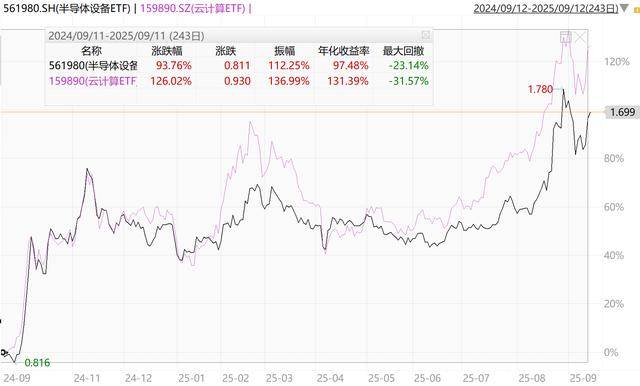
Core Viewpoint - Oracle has made a significant comeback with its stock price surging by 36% in a single day, leading to an increase in market capitalization by nearly 1.8 trillion RMB over two days, driven by unexpected growth in cloud business revenue and substantial contracts from AI companies [1] Group 1: Financial Performance - Oracle's reported "Remaining Performance Obligations" (RPO) skyrocketed from the market expectation of $178 billion to $455 billion, more than doubling [2] - The CEO announced four recent AI contracts, each worth several billion dollars, indicating that RPO will soon exceed $500 billion [2] - A landmark 5-year contract with OpenAI worth $300 billion for computing power was signed, marking the largest cloud service order in history [2] Group 2: Market Reaction - Following Oracle's announcements, the A-share market reacted positively, with the semiconductor and computing sectors experiencing significant gains on September 11 and 12 [2] - Semiconductor equipment ETF (561980) and cloud computing ETF (159890) surged by 5.94% and 6.92% respectively, with further increases observed in subsequent trading sessions [2] Group 3: Industry Insights - The most profitable segment in the AI computing chain is the chip sector, with Nvidia's data center revenue reaching $41.1 billion and a gross margin of 72.7% [4] - Companies like Cambrian and Haiguang are also experiencing rapid growth, indicating a clear division in profitability based on technological barriers [4] - The midstream segment, consisting of cloud providers and data centers, focuses on efficiency and energy savings, with Oracle, AWS, and Azure as key players [7] Group 4: Future Market Potential - The AI computing market is transitioning from speculative trading to performance realization, with IDC predicting that China's intelligent computing scale will exceed 2781 EFLOPS by 2028 [8] - Investment strategies should focus on companies with genuine technology, orders, and ecosystems, as represented by the semiconductor equipment ETF and cloud computing ETF [8]
AI大家说 | 下一代AI创业的机会在哪里?定价趋势是什么?
红杉汇· 2025-09-08 00:04
Group 1: AI Entrepreneurship Opportunities - The AI market has three significant opportunity areas: frontier models, tools, and AI applications. Frontier models will likely be dominated by large companies due to high costs and rapid depreciation of model value [5][6] - The tools market, particularly data platforms, is nearing its peak as large infrastructure providers may replace many smaller companies [5] - AI applications, such as those providing customer service or legal assistance, are seen as having higher profit margins and are expected to become more important over time as products take precedence over technology [6] Group 2: Signals for Next-Generation AI Products - The first signal is a shift from "knowing" to "thinking," where AI models will be able to perform reasoning and complex tasks rather than just retrieving answers [9] - The second signal involves a redesign of interfaces to make AI proactive, understanding user habits and preferences, and providing continuous assistance [10][11] - The third signal indicates that the value of AI products will be determined by their ability to complete tasks effectively, moving from mere technical demonstrations to actual productivity tools [12] - The fourth signal emphasizes the importance of global deployment and accessibility, with the potential for AI to empower billions of people with programming capabilities [13][15] Group 3: AI Pricing Trends - Traditional pricing models are being challenged, with hybrid pricing becoming mainstream, combining subscription and usage-based models [17] - Various hybrid pricing methods have emerged, each with its advantages and disadvantages, such as pay-as-you-go and capped pay-as-you-go models [20][19] - The trend towards outcome-based pricing is gaining traction, but it faces challenges in implementation, including the need for clear attribution of results to the product [21][23] - Companies are struggling to adapt to rapid changes in AI pricing, often lacking the necessary talent and tools to support strategic pricing decisions [24]