英伟达Blackwell架构芯片

Search documents
走私英伟达芯片被捕!
国芯网· 2025-12-10 04:39
Core Viewpoint - The article discusses the ongoing tensions surrounding U.S. export controls on semiconductor technology to China, highlighting a recent case involving the attempted smuggling of NVIDIA AI chips valued at $160 million [1][3]. Group 1: U.S. Export Controls - The U.S. Department of Justice has detained two individuals for allegedly attempting to smuggle NVIDIA AI chips to China, violating U.S. export control laws [1][3]. - The U.S. government is intensifying export restrictions on semiconductor technology, citing national security concerns [4]. Group 2: NVIDIA's Response - NVIDIA's spokesperson stated that the tightening export control system now scrutinizes even older products in the second-hand market, with millions of regulated GPUs currently in use globally [4]. - The company is committed to collaborating with the government and clients to prevent smuggling of second-hand products [4]. Group 3: Political Developments - Former President Trump indicated that NVIDIA's H200 chips could be sold to China under specific conditions, allowing sales to a limited number of approved customers, with the U.S. government taking a 25% cut from these transactions [5]. - It is noted that this licensing does not include NVIDIA's more advanced Blackwell architecture chips or subsequent Rubin chips [5].


绿色算力投资手册(下):从硬件能效、节能温控到算能协同、赋能转型,绿色算力各赛道前景广阔
ZHESHANG SECURITIES· 2025-12-01 13:15
Investment Rating - The report does not explicitly state an investment rating for the green computing industry Core Insights - The green computing industry is analyzed from three dimensions: computing side (hardware and software), energy side, and application side, with a focus on liquid cooling technology, efficient algorithms, high-density servers, and long-term attention on integrated systems and green electricity [1][2][12] - The transition from energy efficiency optimization to a collaborative system of "computing power, electricity, and carbon power" is highlighted as a core trend in the intersection of technology and energy [1][2] Summary by Sections 1. Research Framework - The demand for computing power is rapidly increasing due to global digitalization and intelligent transformation, with AI data center IT energy consumption projected to grow significantly from 55.1 TWh in 2024 to 146.2 TWh by 2027, reflecting a compound annual growth rate of 44.8% [11][12] 2. Computing Side: Role of Algorithms, Devices, and Carriers - Green algorithms are essential for optimizing AI computing efficiency, focusing on reducing computational and storage costs while maintaining performance [2][30] - Data center hardware is identified as a major source of energy consumption, with significant advancements in chip architecture and high-density integration driving energy efficiency [2][12] - Efficient cooling technologies, such as liquid cooling, can significantly reduce Power Usage Effectiveness (PUE) to below 1.3, with AI-driven management systems enhancing operational efficiency [2][12] 3. Energy Side: The End of Computing Lies in Electricity - The report emphasizes the need for energy structure transformation, with approximately 70% of China's data center energy coming from coal [2][12] - Innovations in energy management, such as integrated microgrids and direct connections to green electricity, are crucial for optimizing energy allocation [2][12] 4. Application Side: AI+ Achieving Green Empowerment Across Industries - AI computing is driving decarbonization across various sectors, with significant reductions in carbon emissions projected for energy (12%-22%), industry (13%-22%), transportation (10%-33%), and buildings (23%-40%) [2][3] - The development of edge computing and large models is expected to transform consumption patterns and production methods, leading to a comprehensive green and intelligent transition in the economy [3][12] 5. Summary and Recommendations - The report suggests focusing on key areas such as liquid cooling technology, efficient algorithms, and integrated energy systems as potential investment opportunities in the green computing sector [2][12]
AI行情启动:这些细分赛道值得关注
Mei Ri Jing Ji Xin Wen· 2025-10-23 01:39
Group 1 - The global AI development has accelerated significantly this year, particularly in China and North America, with the recent release of GPT-5, which shows notable performance improvements and a rapid decrease in token prices, enhancing cost-effectiveness [1] - Advanced models have been released both domestically and internationally, such as Google's DeepMind's Genie3, which maintains consistency in generated content and better understands physical laws, leading to more logical outputs [1] - The rapid development of foundational models for text-to-image and text-to-video generation is evident, indicating a strong growth trajectory in the AI sector [1] Group 2 - The performance growth of companies this year is primarily driven by hardware, with NVIDIA's new Blackwell architecture products seeing rapid deployment, averaging around 1,000 units per week for the GB200 NVL72 system, translating to over 70,000 GPUs sold weekly [2] - The rapid deployment of GPUs is positively impacting related sectors in the A-share market, such as optical modules and PCBs, which are competitive globally and hold significant market shares [2] - The market size for NVIDIA's Blackwell architecture chips is expected to grow quickly, leading to strong performance growth for related A-share companies, making their upcoming quarterly reports worth monitoring [2][3] Group 3 - Key segments with high growth potential in the A-share market include optical modules, PCBs, and server ODMs, with many companies being global leaders in their fields [3] - The rapid iteration of computing chips, such as NVIDIA's GPUs, is expected to continue, with significant increases in average selling prices (ASP) during each iteration, indicating strong growth momentum in these segments [3] - Emerging fields like liquid cooling electronics and fiber/copper connections also present investment opportunities, suggesting a deeper exploration of these areas for those optimistic about the AI market [3]
中国造出EUV,美国建立起稀土全产业链,谁会更快?
Sou Hu Cai Jing· 2025-10-13 06:55
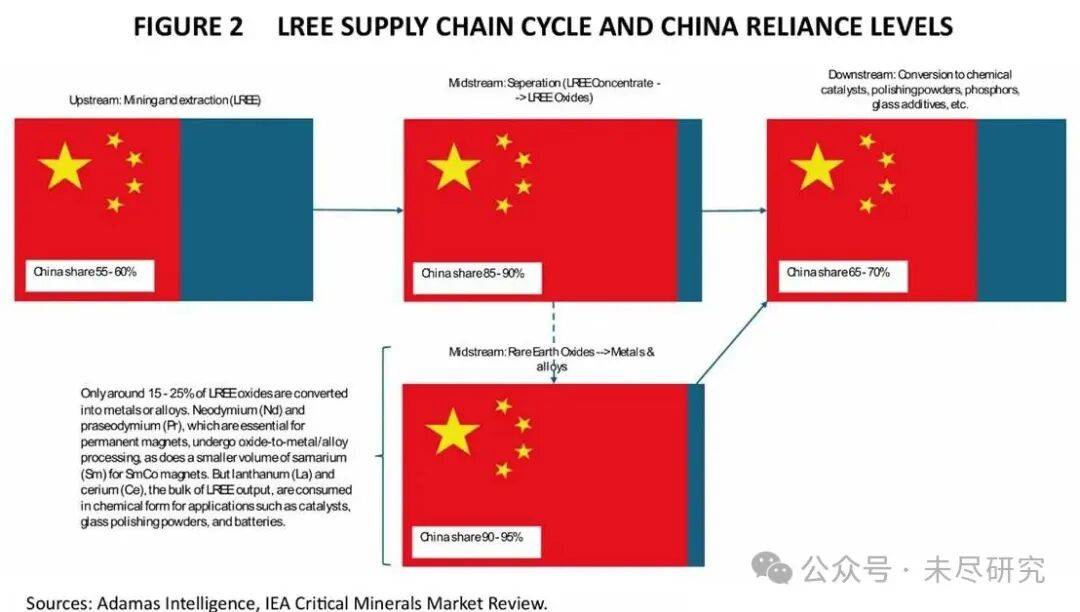
Core Viewpoint - The article emphasizes the critical role of rare earth elements, particularly medium and heavy rare earths, in the AI supply chain, highlighting China's near-monopoly in this sector and its implications for the global AI economy [1][7][11]. Group 1: Importance of Rare Earths in AI - Rare earths serve as a crucial lever that determines the performance limits and supply stability of AI chips, making them indispensable across various applications from chips to electric motors [1][2]. - A mere 0.1% content of rare earths can significantly impact the global AI supply chain, affecting everything from advanced logic chips to production equipment [2][3]. - The unique atomic properties of rare earths make them essential for enhancing the performance of AI hardware, with their specific electronic configurations allowing precise coupling with semiconductor materials [4][5]. Group 2: China's Dominance in Rare Earth Supply - China controls nearly the entire supply chain of medium and heavy rare earths, from mining to refining and manufacturing components, which is vital for the AI economy [1][7]. - Recent export controls by China on medium and heavy rare earths have further solidified its position, as 12 out of 17 rare earth elements are now subject to these restrictions [7][8]. - The extraction and processing of heavy rare earths are predominantly located in China, with the country holding 98% of the global reserves, making it difficult for other nations to compete [11][15]. Group 3: Challenges for the US and Other Countries - The US has initiated efforts to rebuild its rare earth supply chain but has made slow progress, primarily focusing on light rare earths rather than the more critical medium and heavy rare earths [8][9]. - Despite investments and subsidies, US companies are struggling to achieve profitability in the rare earth sector, with significant technological and economic challenges ahead [8][15]. - The ongoing competition for rare earths is expected to shape the future landscape of the global AI industry, with the race to establish a complete supply chain being a key factor [12][15].
中国造出EUV,美国建立起稀土全产业链,谁会更快?
是说芯语· 2025-10-13 01:46
Core Insights - The article emphasizes the critical role of rare earth elements, particularly heavy and medium rare earths, in the AI supply chain, highlighting China's near-total control over this supply chain [3][10][19] - It discusses the asymmetrical leverage that a mere 0.1% content of rare earths can exert on the global AI supply chain, affecting everything from chip production to cooling systems [5][6] - The article warns that the U.S. economy is heavily reliant on AI, and any disruption in the rare earth supply chain could lead to significant economic consequences [6][12] Rare Earths and AI Supply Chain - Rare earths are essential for AI hardware performance, with their unique atomic properties making them irreplaceable in the short term [3][7] - The concentration of rare earth supply in China gives it a strategic advantage in controlling the flow of AI-related technologies globally [4][10] - The U.S. faces challenges in overcoming the "rare earth wall," as its efforts to rebuild a complete supply chain from mining to manufacturing are still in early stages [10][11] Market Dynamics - The direct market size of the rare earth industry is relatively small compared to the massive valuations of AI companies, yet its impact on the AI economy is profound [5][6] - The article notes that the U.S. has been slow to respond to the importance of rare earths, with significant investments and policies only emerging in recent years [11][12] Technological Implications - Rare earths are not only crucial for semiconductor manufacturing but also for enhancing the performance of AI hardware through their unique physical properties [7][8] - The article highlights ongoing research in alternative materials, but current substitutes for rare earths are still in experimental stages and face significant challenges [9][19] Global Supply Chain Challenges - The article outlines the geographical concentration of heavy rare earth resources, primarily in China, which poses a challenge for other countries attempting to establish their own supply chains [10][19] - It emphasizes that the processing of rare earths is more critical than mining, with China's dominance in refining technology making it difficult for other nations to compete [15][19]

甲骨文引爆AI算力与芯片!产业链内部谁能成为下一个万亿赛道?
Sou Hu Cai Jing· 2025-09-12 03:11
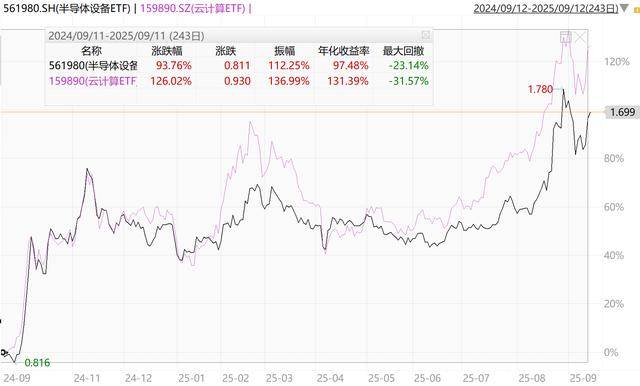
Core Viewpoint - Oracle has made a significant comeback with its stock price surging by 36% in a single day, leading to an increase in market capitalization by nearly 1.8 trillion RMB over two days, driven by unexpected growth in cloud business revenue and substantial contracts from AI companies [1] Group 1: Financial Performance - Oracle's reported "Remaining Performance Obligations" (RPO) skyrocketed from the market expectation of $178 billion to $455 billion, more than doubling [2] - The CEO announced four recent AI contracts, each worth several billion dollars, indicating that RPO will soon exceed $500 billion [2] - A landmark 5-year contract with OpenAI worth $300 billion for computing power was signed, marking the largest cloud service order in history [2] Group 2: Market Reaction - Following Oracle's announcements, the A-share market reacted positively, with the semiconductor and computing sectors experiencing significant gains on September 11 and 12 [2] - Semiconductor equipment ETF (561980) and cloud computing ETF (159890) surged by 5.94% and 6.92% respectively, with further increases observed in subsequent trading sessions [2] Group 3: Industry Insights - The most profitable segment in the AI computing chain is the chip sector, with Nvidia's data center revenue reaching $41.1 billion and a gross margin of 72.7% [4] - Companies like Cambrian and Haiguang are also experiencing rapid growth, indicating a clear division in profitability based on technological barriers [4] - The midstream segment, consisting of cloud providers and data centers, focuses on efficiency and energy savings, with Oracle, AWS, and Azure as key players [7] Group 4: Future Market Potential - The AI computing market is transitioning from speculative trading to performance realization, with IDC predicting that China's intelligent computing scale will exceed 2781 EFLOPS by 2028 [8] - Investment strategies should focus on companies with genuine technology, orders, and ecosystems, as represented by the semiconductor equipment ETF and cloud computing ETF [8]

不满法院判决,多益网络裁员千人以上,总部将搬离广州;赛道测试时小米YU7刹车片起火,小米汽车回应;莲花汽车回应工厂停产传闻
雷峰网· 2025-06-30 00:51
Key Points - The Trump T1 phone, priced at $499, has been revealed to be manufactured in China, contradicting its claims of being "Made in America" [4] - ByteDance's Seed team is expanding, aiming to recruit over 300 personnel in robotics, indicating a shift towards practical applications in the field of embodied intelligence [7][8] - Duoyi Network announced layoffs of over 1,000 employees and plans to relocate its headquarters due to dissatisfaction with a court ruling [9] - Li Auto has lowered its Q2 delivery forecast from 123,000-128,000 to approximately 108,000 vehicles, citing the need for organizational upgrades [12][13] - Neta Auto is facing legal issues, with eight affiliated companies being sued by Nanning State-owned Assets, three of which are currently untraceable [14] - Xiaomi's YU7 model has generated significant interest, with over 240,000 orders in just 18 hours, but long delivery times have led to some customers considering cancellations [11] - Gree Electric's marketing director criticized competitors for unsustainable pricing strategies in the air conditioning market [16] - Chinese AI GPU startup Birran Technology has raised 1.5 billion yuan and plans to apply for a Hong Kong IPO [17] - Honda is recalling approximately 380,000 vehicles due to potential fuel leakage risks stemming from manufacturing defects [18] - Meta has aggressively recruited AI researchers from OpenAI, indicating a strategic push in the AI sector [23][24]