Monica

Search documents
中国90后的公司被扎克伯格巨资买下,面临审查
Nan Fang Du Shi Bao· 2026-01-23 15:41
Manus是由中国创业公司Monica研发的全球首款通用AI智能体,自2025年3月发布后迅速引爆科技圈。 同年12月,该公司宣布将被Meta收购,总部已迁至新加坡。 近日,商务部对"Meta收购Manus是否需要进行审查"作出正式回应,表示将会同相关部门,依据出口管 制、技术进出口、对外投资等相关法律法规,对此次收购开展一致性评估调查。这场涉及数十亿美元的 收购案,因牵扯数据跨境流动、技术出口审查等合规问题,持续引发业界与监管关注。 此前报道 一场收购,多重合规考题 曾火爆全网!中国90后的公司,被扎克伯格巨资买下 这笔交易迅速引发外界对其技术转移、数据出境等合规问题的热议。作为AI智能体,Manus在运营过程 中可能收集、处理大量用户数据,若这些数据随公司架构一同"迁移"至新加坡及Meta旗下,是否须经过 中国的数据出境安全评估,成为监管关注的核心。 在2026年1月8日的商务部例行新闻发布会上,发言人何亚东回应称,中国政府一贯支持企业依法依规开 展跨国经营与国际技术合作,同时明确,企业在对外投资、技术出口、数据出境、跨境并购等活动中必 须符合中国法律法规、履行法定程序。商务部此番"评估调查"的表态,为事 ...

Manus被收购面临数据出境安全等审查,专家解读合规深意
Nan Fang Du Shi Bao· 2026-01-23 05:13
历史数据是否完成"切割"? 南都大数据研究院注意到,根据《中华人民共和国个人信息保护法》《数据安全法》及《数据出境安全 评估办法》,向境外提供重要数据,或处理超过100万人个人信息的处理者向境外提供个人信息,必须 申报数据出境安全评估。 对外经济贸易大学法学院副院长张欣教授指出,尽管Manus定位为面向国际的AI产品,对中国境内用户 数据依赖度可能不高,但在产品测试、中文服务或模型训练中,仍很可能处理过中国境内个人信息。她 强调,主体迁移或股权结构调整,并不能切断中国法律的适用,反而可能因其刻意弱化关联性的设计, 引发相关审查。 2025年3月北京市新闻办披露,Manus的国内产品Monica在京完成生成式人工智能服务登记。至于数据 合规,张欣认为交易本身不构成违规,关键在于其在中国境内曾提供中文服务并完成备案的关联产品, 是否在交易前对历史数据、用户信息完成实质性、可审计的合规切割。 近日,商务部对"Meta收购Manus是否需要进行审查"作出正式回应,表示将会同相关部门,依据出口管 制、技术进出口、对外投资等相关法律法规,对此次收购开展一致性评估调查。这场涉及数十亿美元的 收购案,因牵扯数据跨境流动、技术 ...


爆发时刻?科技大厂纷纷布局,AI Agent商业化落地加速
证券时报· 2026-01-19 00:38
Core Viewpoint - The emergence of AI agents marks a significant shift from AI as an auxiliary tool to a core productivity force, reshaping industry logic and unlocking trillion-dollar market potential [1]. Group 1: AI Agent Development - Major tech companies are increasingly investing in AI agents, which are capable of complex task execution and autonomous decision-making [1][2]. - The definition of AI agents has evolved, characterized by systems that utilize large language models (LLMs) to autonomously manage processes and tools, moving beyond traditional workflows [3]. - AI agents are currently at the L3 stage of general AI, indicating advancements in model capabilities, reduced API costs, and a mature open-source ecosystem [3]. Group 2: Commercialization and Market Potential - The AI agent market is projected to grow significantly, with estimates suggesting a market size of 1,473 billion yuan in China by 2024, expanding to over 3.3 trillion yuan by 2028 [10]. - The enterprise-level AI agent market is expected to surpass the consumer-level market by 2025, with a forecasted increase in AI integration in enterprise software from 1% in 2024 to 33% by 2028 [11]. - The global AI programming market is currently valued at approximately $3 billion, with projections reaching $23 billion by 2030 and a long-term potential nearing $700 billion [7]. Group 3: Industry Applications and Breakthroughs - AI agents are making significant inroads in various sectors, particularly in finance and programming, where they are enhancing efficiency and automating decision-making processes [6][8]. - Companies like Huatai Financial are developing AI-driven applications for investment decision-making, while programming agents like Claude Code and Codex are streamlining development tasks [7]. - Alibaba's upgraded AI application, Qianwen, exemplifies the shift towards seamless user experiences, automating complex tasks in the background [5].

从技术概念跃入商业现实 科技大厂加码人工智能体
Zheng Quan Shi Bao· 2026-01-18 18:06
Core Insights - The emergence of AI Agents marks a significant shift from AI as an auxiliary tool to a core productivity driver, reshaping industry logic and unlocking trillion-dollar market potential [1][5] Group 1: AI Agent Development - Major tech companies are actively developing AI Agents, which are defined as systems that utilize large language models (LLMs) to autonomously manage workflows and tools, moving beyond traditional AI capabilities [2][3] - AI Agents can perform complex tasks such as online ordering and investment decision-making, demonstrating their ability to replace certain human functions rather than merely assist [2][4] Group 2: Market Potential and Commercialization - The global AI programming market is currently valued at approximately $3 billion, with projections to reach $23 billion by 2030 and a long-term potential nearing $700 billion [5] - AI Agents are penetrating various industries, with finance, programming, and government sectors leading the way as benchmark scenarios for technology empowerment [5][6] Group 3: Future Outlook and Challenges - The Chinese AI Agent market is expected to reach ¥147.3 billion by 2024, with a projected growth to over ¥3.3 trillion by 2028, indicating significant enterprise adoption potential [6] - Despite the optimistic outlook, challenges such as high entry barriers, safety concerns, and reliability issues remain, as the industry is still in its early stages [6]



为什么说 AI 还没到泡沫?等四篇 | 42章经 AI Newsletter
42章经· 2025-11-09 13:19
Group 1 - Fal achieved a remarkable growth from $2 million to $100 million in ARR within a year, supported by a recent $250 million funding round led by Sequoia and KP, with a valuation exceeding $4 billion [2][4][5] - The company pivoted from data processing products to AI generative media cloud services, recognizing a significant user pain point during the GPU crisis and the emergence of Stable Diffusion [4][6][8] - Fal's strategic decision to focus on image and video generation rather than LLMs was based on the belief that the image market is a growing net market, unlike LLMs which compete directly with established giants like Google [8][9] Group 2 - The company adopted a PLG (Product-Led Growth) and sales strategy, starting with self-service for developers and then identifying high-potential customers for sales follow-up [15][18] - Fal's marketing strategy resonated with developers by creating relatable brand elements, such as themed merchandise and live demonstrations of new models [19][22] - The company identified opportunities in the AI ecosystem, suggesting the need for platforms that can scale AI data collection and labeling, as well as vertical advertising solutions [24][25] Group 3 - The article discusses the current perception of AI as a potential bubble, with 54% of fund managers believing it has entered a bubble phase, yet a detailed analysis by Coatue suggests otherwise [26][29] - Coatue's analysis indicates that current valuations, while high, are not excessive compared to historical bubbles, and the concentration of capital in tech giants is justified by their diversified business models [32][36] - The projected growth for AI revenues is significant, with expectations of reaching $1.9 trillion by 2030-2035, indicating a robust long-term outlook for the industry [52][54] Group 4 - The article emphasizes the importance of effective pricing strategies for AI products, highlighting that simplicity and clear value communication are crucial in early stages [68][69] - It suggests that founders should focus on co-creating business cases with clients during POCs (Proof of Concept) to demonstrate value effectively [74][76] - The need for continuous iteration of pricing strategies is highlighted, as the AI market evolves rapidly, necessitating frequent reassessment [72][79] Group 5 - Sandy Diao discusses the pitfalls of being overly data-driven in growth strategies, advocating for a balance between data insights and contextual understanding [82][84] - The concept of the power law of distribution in growth is introduced, where a small number of channels drive the majority of growth, emphasizing the need to identify core growth drivers [88][90] - The article concludes with insights on when to hire growth leaders, suggesting that early-stage companies should integrate growth strategies from the outset to address product-market fit challenges [92][93]

AI翻译PDF工具大PK:内容OK,格式崩?| Jinqiu Scan
锦秋集· 2025-10-28 04:00
Core Viewpoint - The article discusses the evaluation of AI translation tools in handling complex document formats, particularly focusing on their performance in translating financial reports, research papers, and academic articles. It highlights the challenges faced by AI in maintaining structural integrity, terminology accuracy, and readability when translating scanned documents and PDFs. Group 1: Evaluation of AI Translation Tools - A systematic evaluation was conducted on 14 mainstream AI translation tools, assessing their performance across three dimensions: translation accuracy, formatting aesthetics, and language coherence [7][9]. - The selected document types for evaluation include research reports, financial reports, and academic papers, which represent high-value scenarios in business, finance, and research [8][16]. - The results revealed that some tools excelled in format preservation but struggled with terminology accuracy, while others demonstrated a better understanding of semantics but compromised on formatting [9][24]. Group 2: Performance Metrics - The evaluation metrics included translation accuracy, formatting aesthetics, and language coherence, with specific scores assigned to each tool based on their performance [23][44]. - Tools like SimplifyAI, Doubao, and Transmart showed balanced performance in terminology handling, data matching, and text logic, indicating a certain level of professional usability [24][49]. - DeepL and Kimi performed adequately, though they occasionally exhibited issues with clarity and sentence structure [44][50]. Group 3: Recommendations for Use - For financial reports, tools that excel in table reproduction and numerical accuracy, such as Tiangong, Immersive Translation, and DeepSeek, are recommended [50]. - For academic translations requiring semantic and stylistic precision, ChatGPT and Minimax are suggested as preferred options [50]. - The article emphasizes the importance of maintaining formatting integrity and effective paragraph handling in PDF translations to enhance overall translation accuracy [50].

2025VENTURE50初评结果揭晓
投资界· 2025-10-23 09:10
Core Insights - The article highlights the evolution of the venture capital market in China over the past 19 years, emphasizing the transition from innovative business models to breakthroughs in cutting-edge technologies [2] - By 2025, the venture capital market is expected to stabilize, with a focus on hard technology sectors such as artificial intelligence, advanced manufacturing, synthetic biology, commercial aerospace, and clean energy [2] - The 2025 VENTURE50 evaluation process involved over 100 investment institution judges assessing more than 2,600 companies based on growth speed, technological barriers, commercialization progress, team characteristics, operational capabilities, and industry fit [2] Evaluation Results - The initial evaluation of the 2025 VENTURE50 resulted in 300 companies advancing to the re-evaluation stage, with categories including Wind and Cloud 200 focusing on mature tech companies and New Sprout 100 targeting early-stage potential [2] - Key sectors covered in the evaluation include AI, semiconductors, new energy, and healthcare [2] - The final results for the 2025 VENTURE50, including Wind and Cloud 50, New Sprout 50, and segmented industry 50, will be announced on December 4, 2025, at the 25th China Private Equity Annual Conference [6]

我在欧洲顶级AI大会上学到的三条AI成果法则
3 6 Ke· 2025-08-18 07:09
Core Insights - The article emphasizes that speed in solving real problems is a crucial competitive advantage in the AI industry, rather than striving for perfection or broad functionality [3][6][11] Group 1: Speed and Focus - The story of Tao Zhang and his team at Monica illustrates that focusing on specific user pain points can lead to rapid product development, as seen with their tool Manus, which was developed in just two months [4][5] - The combination of speed and focus is prevalent in the U.S. AI landscape, where companies can invest and develop products without facing stringent regulations, leading to unprecedented revenue growth [5][6] Group 2: Market Dynamics - The article highlights a clear market judgment: companies must act quickly to address real problems or risk being surpassed by competitors [6][12] - Manus's product roadmap aims to extend AI's independent working duration from two hours to 24 hours, showcasing a commitment to enhancing user capabilities [6][7] Group 3: Founder Expertise - The definition of "technical founders" is evolving, with successful teams now needing to balance technical skills with a deep understanding of user needs, as demonstrated by the founders of Manus and Alix [9][10] - Founders with backgrounds in various fields, such as finance and law, are leveraging their expertise to create effective AI solutions, indicating a shift in the necessary skill set for success in the AI sector [10][11] Group 4: Global AI Landscape - The article notes that while the European AI scene is still developing, it is beginning to show promise with companies like Mistral adapting to local conditions [12][13] - The dominance of English in AI development is highlighted as a significant advantage for U.S. companies, although this may change as other regions, like China, develop their own models [11]

「Manus+景鲲」领衔主演,华人AI Agent全球狂欢
3 6 Ke· 2025-07-24 10:07
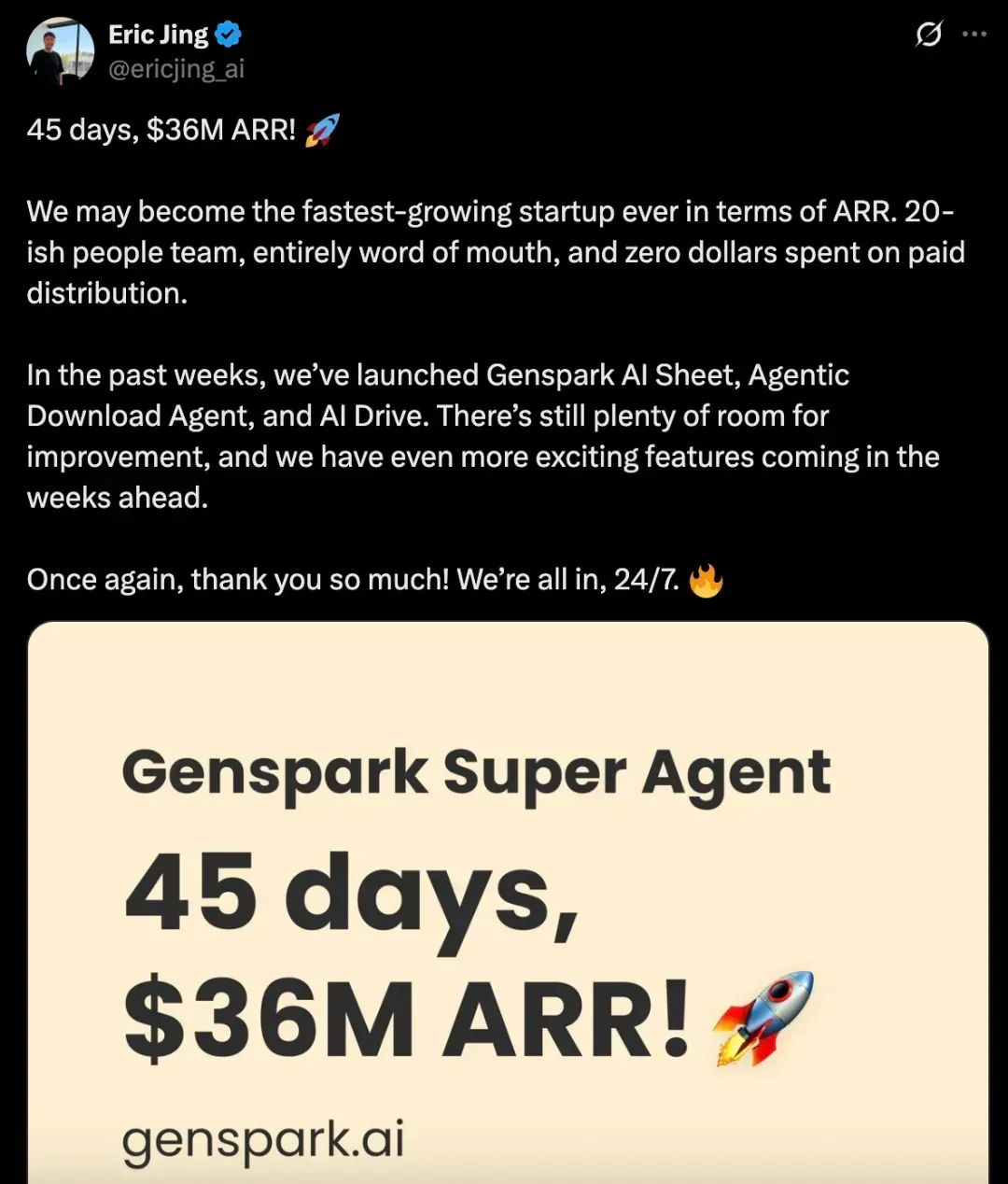
Core Insights - The article highlights the rapid growth and attention surrounding AI agents, particularly focusing on Genspark and Manus, which have achieved significant milestones in revenue and user engagement within a short time frame [1][4][17] - The emergence of AI agents is characterized by a shift from basic functionalities to more complex, autonomous applications that can perform tasks similar to human capabilities [6][7] - The article discusses the challenges faced by these companies, including market saturation, declining user engagement, and geopolitical uncertainties affecting their operations [13][14][15] Company Performance - Genspark achieved an Annual Recurring Revenue (ARR) of $36 million in just 45 days after launch, showcasing the potential for rapid monetization in the AI agent space [1][17] - Manus reached 23 million Monthly Active Users (MAU) within the first month of its release and secured $75 million in funding, leading to a post-money valuation exceeding $500 million [4][8] - Other companies like Flowith and MiniMax also reported significant web traffic and revenue, indicating a broader trend of growth in the AI agent sector [8] Market Dynamics - The AI agent market is experiencing a renaissance in 2025, driven by technological advancements and a growing consensus on product forms, leading to increased user adoption and revenue generation [7][18] - Initial skepticism regarding the viability of AI agents has shifted, with many startups now leading the charge in product development and commercialization, contrasting with larger companies that are more cautious [18][22] - The article notes a trend where initial excitement is waning, as evidenced by declining monthly visits for both Manus and Genspark, suggesting a need for sustained innovation and user engagement strategies [13][27] Geopolitical and Regulatory Challenges - The geopolitical landscape and regulatory scrutiny, particularly from the U.S. government, are creating uncertainties for Chinese AI companies operating internationally, as seen with Manus's withdrawal from the Chinese market [14][15] - The article suggests that future funding and operational strategies for these companies may be influenced by international relations and regulatory pressures [15] Future Outlook - The article posits that while general-purpose AI agents are currently in vogue, there may be a shift towards more specialized, vertical-focused agents as companies seek to differentiate themselves and meet specific market needs [29][32] - The importance of speed and adaptability in product development is emphasized, with successful startups rapidly iterating on their offerings to capture market share [25][32]
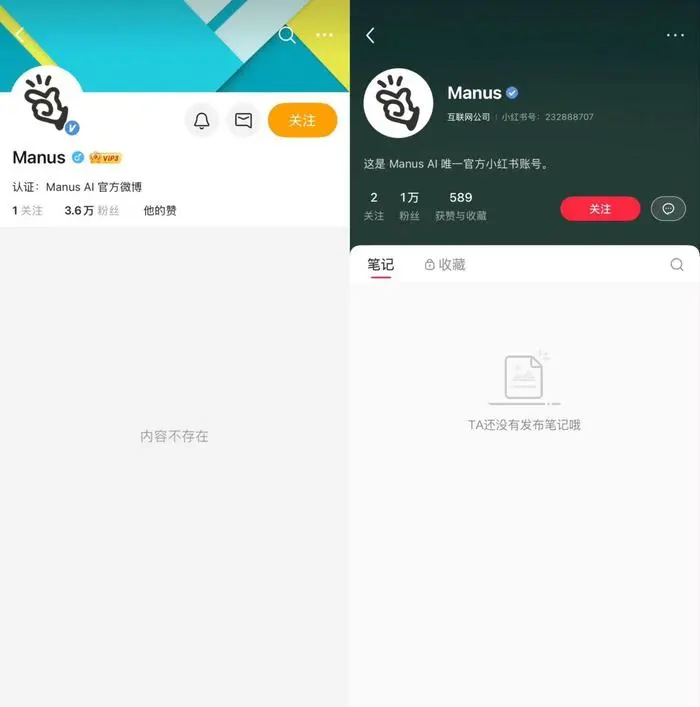
太突然!多平台账号清空!邀请码一度炒至数万元,爆火AI智能体,发生了什么
Zheng Quan Shi Bao· 2025-07-13 09:19
Core Viewpoint - The AI agent project Manus has recently become a focal point in the market, with significant changes in its online presence and operational adjustments, raising questions about its future and viability [1][4]. Company Overview - Manus is defined as a "universal AI agent product" and gained rapid popularity after its launch in March 2023, being compared to "the next DeepSeek" [4]. - The company has undergone operational changes, including layoffs in its domestic business and a shift of core technical personnel to its headquarters in Singapore, with approximately 120 employees in China [4]. Market Reaction - The market response to Manus has been polarized, with criticisms regarding its reliance on existing AI models and claims of "shell marketing" [5]. - Industry insiders have expressed skepticism about Manus's technological innovation, suggesting it is merely an application layer built on top of existing AI models [5]. Strategic Partnerships - Manus announced a strategic partnership with Alibaba's Tongyi Qianwen team to develop a Chinese version of its product, although reports indicate that progress on this initiative has stalled [5]. Funding History - Manus has completed four rounds of financing, with notable investors including Tencent Investment and Sequoia China. The most recent funding round (C round) raised $75 million, valuing the company at $500 million [6][7].