
数字人民币跨境支付

Search documents
8万个钱包、5200家商户!数字人民币在香港加速落地
券商中国· 2026-03-29 07:46
Core Viewpoint - The article discusses the significant progress of digital RMB (Renminbi) applications in Hong Kong, highlighting the expansion of its usage among merchants and the growing infrastructure supporting this digital currency [1][2][3]. Group 1: Digital RMB Adoption and Growth - The number of digital RMB wallets opened with Hong Kong mobile numbers has reached 80,000, with local merchants accepting digital RMB increasing to approximately 5,200, a substantial rise from about 300 initially [2][7]. - The pilot program for digital RMB in Hong Kong is set to expand in May 2024, allowing residents to easily open and use personal digital RMB wallets linked to local mobile numbers, enhancing the payment experience [3][6]. Group 2: Merchant and Institutional Participation - Notable chain merchants such as 7-11, Circle-K, and Chow Tai Fook have begun accepting digital RMB payments, indicating a broadening of application scenarios [3][7]. - Several financial institutions, including Bank of China Hong Kong and Hang Seng Bank, have fully implemented digital RMB acceptance services, with major payment platforms like Alipay and WeChat Pay also developing related functionalities [4][5]. Group 3: Technological and Policy Developments - A digital RMB cross-border payment platform is set to achieve interconnectivity with Hong Kong's Fast Payment System in 2024, marking a global first for a legal digital currency system [5]. - The People's Bank of China and the Hong Kong Monetary Authority are working on optimizing digital RMB arrangements, exploring wallet upgrades to enhance usage limits and application scenarios [6].


如何看待数字人民币当前发展机遇
2026-03-22 14:35
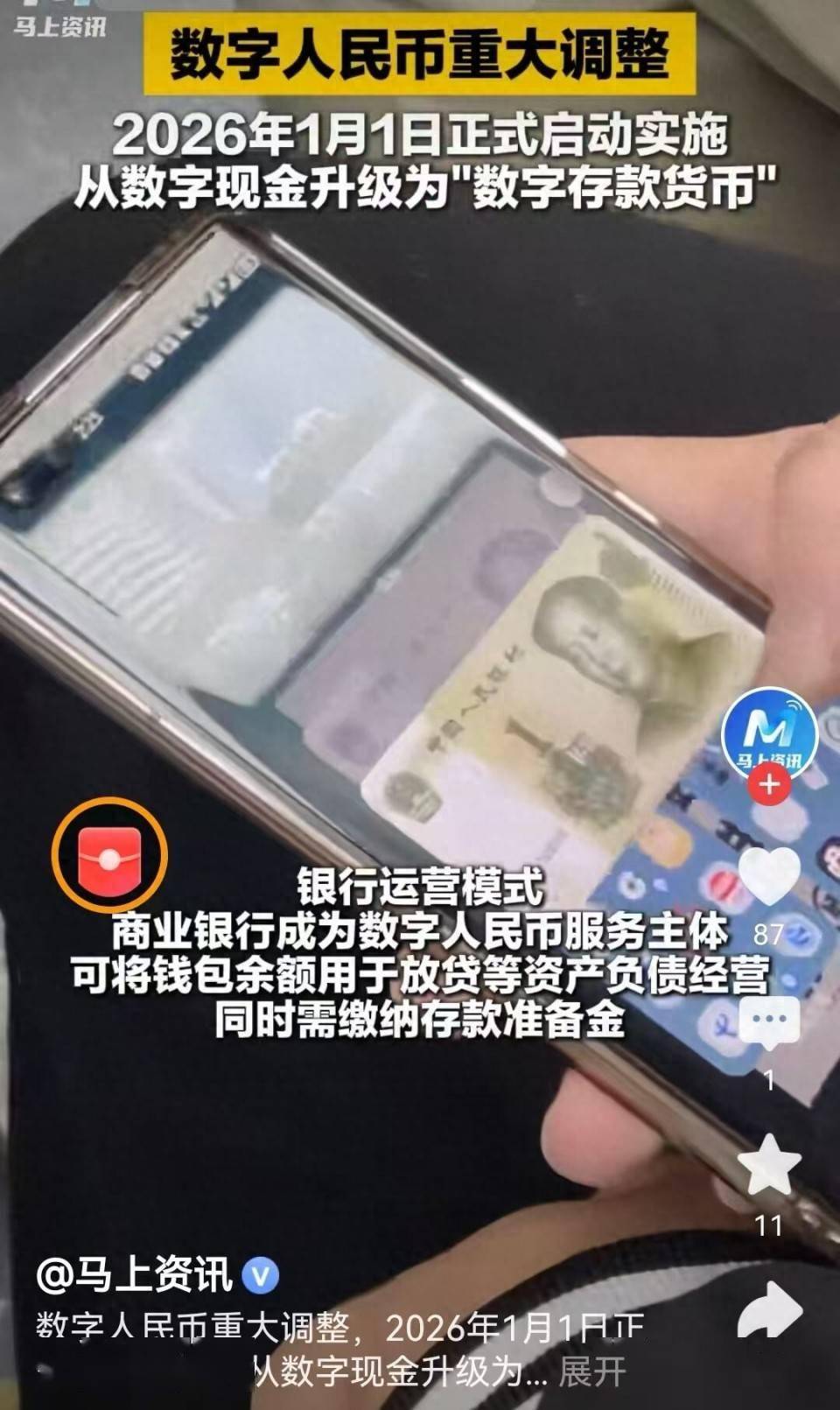
Summary of Key Points from the Conference Call on Digital Renminbi Development Opportunities Industry Overview - The conference call discusses the development of Digital Renminbi (DCEP) as it transitions from M0 (cash) to M1 (interest-bearing deposits) starting January 2026, which will significantly impact the banking sector and its operations [1][2][3]. Core Insights and Arguments - **Transition to M1**: The shift from M0 to M1 allows Digital Renminbi to be included in bank deposits, enabling banks to leverage this for increased earnings through interest differentials, transforming related business units from cost centers to profit centers [1][2][3]. - **Expansion of Operating Institutions**: The number of operating institutions has expanded to 22, with 12 new banks added, aiming to enhance penetration in corporate business and create competitive pressure on third-party payment systems [1][2]. - **High IT Investment Requirements**: Existing institutions require annual operational and upgrade investments of approximately 8-10 million RMB, while new institutions need initial budgets exceeding 18 million RMB for software and hardware setup [1][7]. - **Standardization of Smart Contracts**: A unified standard for smart contracts is expected by 2025, which will enhance the application of Digital Renminbi in various sectors, including education and construction [1][3]. - **Cross-Border Payment Improvements**: The M1 phase alleviates previous bottlenecks in cross-border payments, allowing for larger trade settlements without reducing bank liabilities, thus accelerating the adoption of Digital Renminbi in international transactions [1][4]. Additional Important Content - **Policy Changes**: The transition to M1 includes significant policy changes, such as the inclusion of Digital Renminbi in the deposit reserve management framework, which will enhance banks' willingness to promote its use [3][4]. - **Impact on Non-Operating Banks**: Non-operating banks face customer resource loss as corporate deposits will directly count towards operating institutions, necessitating an expansion of the operating institution base [2][3]. - **Future Policy Directions**: Future policies may focus on promoting the circulation of Digital Renminbi, including potential economic stimulus measures like issuing consumption vouchers [4][5]. - **Government Support**: Local government policies, such as those in Fuzhou, have been crucial in promoting the use of Digital Renminbi, indicating that government backing will be essential for broader adoption [5][6]. - **Market Dynamics**: The entry of new operating institutions is expected to alter the market dynamics, increasing competition and encouraging existing institutions to expand their business scenarios [6][10]. - **Ongoing IT Expenditures**: IT expenditures for Digital Renminbi systems are not one-time costs but require ongoing investments to support continuous upgrades and the development of peripheral systems [8][9]. Conclusion - The Digital Renminbi is poised for significant growth and transformation as it moves to the M1 phase, with substantial implications for the banking sector, cross-border payments, and overall economic activity. The combination of policy support, technological advancements, and market dynamics will play a critical role in its successful implementation and adoption [1][10].
商业航天出海再添佳绩,一个月在轨交付两国际卫星;特斯拉最新人形机器人2026年底前启动量产;九部门完善支付环境,便利春节入境游客支付——《投资早参》
Mei Ri Jing Ji Xin Wen· 2026-02-03 00:26
Market News - The three major US stock indices closed higher, with the Dow Jones up 1.05%, S&P 500 up 0.54%, and Nasdaq up 0.56%. Major tech stocks had mixed results, with Apple rising over 4%, and Google and Amazon increasing by over 1% [1] - The Nasdaq Golden Dragon China Index fell by 0.65%, while notable Chinese stocks like Century Internet rose nearly 4% and Kingsoft Cloud increased by over 3% [1] - European stock indices also closed higher, with the Euro Stoxx 50 up 1.00%, FTSE 100 up 1.16%, CAC 40 up 0.67%, DAX 30 up 1.15%, and FTSE MIB up 1.05% [1] Currency and Commodity Market - The US dollar index rose by 0.67%, closing at 97.635. The onshore RMB against the USD was reported at 6.9448, an increase of 118 points from the previous Friday [2] - Spot gold experienced a "V" shaped reversal, reaching a peak of $4800 per ounce before settling at $4665 per ounce. Spot silver saw a decline of 2.3%, fluctuating around $80.00 per ounce [2] - WTI crude oil futures fell by 4.71%, closing at $62.14 per barrel, while Brent crude oil futures dropped by 4.36%, closing at $66.30 per barrel [2] Industry Insights - The Long March 2C rocket successfully launched Algeria's remote sensing satellite B into orbit, marking the second launch of the satellite within 16 days. This project represents ongoing cooperation between China and Algeria in the aerospace sector [3] - The satellite internet sector is projected to grow significantly, with the satellite-ground communication industry expected to reach between 200 billion to 400 billion yuan by 2030, with an annual growth rate of 10%-28% [4] - Tesla announced the upcoming launch of its third-generation humanoid robot, with plans for annual production of one million units by 2026. The production line for Model S/X at the Fremont factory will be converted to humanoid robot manufacturing [4][5] - The Ministry of Commerce and other departments released a plan for the "2026 Spring Festival Special Activity," promoting inbound tourism and enhancing payment environments for international visitors [5][6]

楚天龙:2025年全年净利润同比预减62.89%
2 1 Shi Ji Jing Ji Bao Dao· 2026-01-30 10:15
Core Viewpoint - The company Chu Tian Long anticipates a significant decline in net profit for the year 2025, primarily due to market demand fluctuations and intensified industry competition, leading to a decrease in gross margins for some products [1] Financial Performance - The expected net profit attributable to shareholders for 2025 is 8 million yuan, representing a year-on-year decrease of 62.89% [1] - The expected net profit after deducting non-recurring gains and losses is 1.2 million yuan, reflecting a year-on-year decrease of 93.38% [1] Business Strategy - In response to the anticipated losses in the first three quarters of 2025, the company is committed to business transformation, focusing on digital RMB cross-border payments and smart contract scenarios [1] - The company is also implementing smart hardware solutions that integrate large model technology [1] Operational Improvements - The company has made efforts to expand orders, enhance accounts receivable collection, improve operational efficiency, and strengthen cost control, resulting in a positive outcome [1] - In the second half of 2025, the company will focus on securing orders for embedded security products and successfully implementing smart hardware projects, creating a good demonstration effect for nationwide replication [1] Cost Management - The company has implemented various cost control measures, leading to a general decline in period expenses and positive results in cost reduction and efficiency enhancement [1] - There has been a noticeable decrease in accounts receivable balances, further optimizing the asset-liability structure [1] Non-Recurring Gains and Losses - The company's non-recurring gains and losses for 2025 mainly include government subsidies, fair value changes of financial assets and liabilities, and gains from the disposal of financial assets and liabilities, totaling approximately 6.8 million yuan [1]
太空基建不断加速,持续看好商业航天和卫星产业链
Guotou Securities· 2026-01-26 08:53
Investment Rating - The industry investment rating is "Outperform the Market - A" [4] Core Insights - The importance of aerospace and satellite technology is increasingly recognized, with the acceleration of space infrastructure construction benefiting the related industry chain in the long term [2][12] - The report highlights significant recent developments in the commercial aerospace and satellite industry, including the launch of new satellite networks and rockets, which are expected to enhance the application potential of satellite infrastructure [1][11] - The report suggests focusing on incremental directions in space infrastructure, such as space computing power, 3D printing, terminal direct connection, and inter-satellite connectivity, as well as value-enhancing segments in low Earth orbit satellites [2][12] Summary by Sections Industry Performance - The report indicates that the industry has shown a relative return of 14.7% over the past month, 9.2% over three months, and 23.8% over twelve months, with absolute returns of 16.5%, 11.2%, and 47.4% respectively [6][13] Recent Developments - The report details various recent events, including the launch of the "TeraWave" satellite communication network by Blue Origin, which will consist of 5,408 low Earth orbit satellites, and the successful launch of multiple satellites by different companies [1][11] - It also mentions the approval of policies in Beijing to support the development of commercial satellite remote sensing data resources from 2026 to 2030, indicating a favorable regulatory environment for the industry [1][11] Investment Focus - The report recommends paying attention to companies involved in satellite and space asset management, safety, and applications, as well as those engaged in testing and simulation services [2][12]
2026年数字人民币再提速,可算利息,能理财,跨境支付更方便?
Sou Hu Cai Jing· 2026-01-25 03:44
Core Insights - The digital RMB has been gradually introduced since 2019, with significant milestones including the launch of the digital RMB app in 2022 and the establishment of 225 million personal wallets by September 2025, facilitating transactions totaling 14.2 trillion yuan [1][4] - Starting in 2026, the digital RMB will undergo a major transformation, with the implementation of a new management and operational framework, marking a significant shift towards widespread adoption and usage [4] - The digital RMB will be integrated into deposit insurance, allowing users to earn interest on their digital currency deposits and providing enhanced security and convenience in transactions [7][9] Digital RMB Features - Users can access digital RMB without internet connectivity, similar to cash, and can transfer funds between their digital RMB accounts and traditional bank accounts [7][9] - The digital RMB will support both hard wallets and soft wallets, with the latter being accessible through various applications, enhancing user flexibility [9] - Enhanced cross-border payment capabilities will be introduced, making international transactions easier and faster for individuals and businesses engaged in trade [10] Future Implications - The digital RMB is expected to become the predominant form of currency, reducing the reliance on physical cash and transforming the monetary landscape [4] - The integration of digital RMB into the banking system will allow for various financial activities, including savings, investments, and payments, streamlining the user experience [10]

紧跟国家金融开发政策 广发银行以货币桥业务赋能跨境支付领域
Xin Hua Wang· 2026-01-23 06:18
Core Insights - Guangfa Bank has successfully completed its first cross-border remittance business under the agency model using the Multilateral Central Bank Digital Currency Bridge, marking a significant breakthrough in expanding the cross-border application of the digital RMB [1][2] - The currency bridge, initiated by the People's Bank of China, Hong Kong Monetary Authority, Bank of Thailand, and Central Bank of the UAE, is the world's first multilateral central bank digital currency connectivity project, leveraging blockchain and distributed ledger technology to simplify transactions and reduce costs [1][2] Group 1 - The currency bridge serves as a foundational infrastructure for digital RMB cross-border payments, transforming banks from traditional payment intermediaries to comprehensive financial service providers, thereby strengthening the technical support for RMB internationalization [2] - Guangfa Bank has been enhancing its cross-border financial service capabilities, including the launch of Cross-Border Wealth Management 2.0 and the optimization of its global agency network, to support the development of cross-border trade and investment [2] - The successful implementation of the currency bridge extends cross-border financial services into the innovative realm of digital RMB, adding new momentum to the development of the real economy [2] Group 2 - Moving forward, Guangfa Bank aims to leverage the development window of digital RMB, focusing on technological implementation and scenario innovation to meet the dual needs of enterprises going global and attracting financial resources [2] - The bank is committed to contributing to the steady expansion of high-level openness in cross-border trade and investment, aligning with the strategic goals of RMB internationalization [2]
广发银行完成首笔多边央行数字货币桥跨境支付业务
Xin Lang Cai Jing· 2026-01-22 22:14
Core Viewpoint - The successful completion of the first cross-border remittance business under the agency model of the multi-central bank digital currency bridge by Guangfa Bank marks a significant breakthrough in expanding the application scenarios of digital RMB in cross-border payments, injecting new vitality into the field [1][2] Group 1: Business Development - Guangfa Bank has extended its cross-border financial services from traditional scenarios to the innovative field of digital RMB, adding new momentum for the cross-border development of the real economy [2] - The multi-central bank digital currency bridge, initiated by the People's Bank of China, Hong Kong Monetary Authority, Bank of Thailand, and Central Bank of the UAE, is the world's first project for interconnectivity of multiple national central bank digital currencies [1] - The bridge utilizes blockchain and distributed ledger technology to achieve point-to-point transactions, significantly simplifying intermediary processes and reducing transaction costs [1] Group 2: Strategic Importance - The implementation of this business aligns with the national financial opening policy and the action plan for strengthening the digital RMB management service system and related financial infrastructure [1] - The currency bridge serves as a "basic facility" for digital RMB cross-border payments, reconstructing the cross-border payment industry chain through technological innovation [1] - This initiative supports the transformation of banks from "traditional payment intermediaries" to "comprehensive financial service providers," reinforcing the technological foundation for the internationalization of the RMB [1]

建银国际首席策略师赵文利:企业出海如何“融进去”
21世纪经济报道· 2026-01-21 06:27
Core Viewpoint - Chinese enterprises are transitioning from merely capturing market share in overseas markets to playing a significant role in global economic governance, particularly in sectors like new energy and digital technology, where they are becoming rule-makers rather than just followers [1][4]. Group 1: Evolution of Overseas Expansion - By 2025, the mode of overseas expansion for Chinese enterprises has shifted from "cost-driven" to "value-driven," focusing on technological innovation and brand premium rather than low prices [3]. - The competitive focus has expanded from merely exporting products to also including brands, technological standards, ecosystems, and business models, significantly increasing profitability [3]. - The destinations for overseas expansion have diversified due to geopolitical tensions and global supply chain restructuring, marking a transition to a 2.0 phase of globalization for Chinese enterprises [3][4]. Group 2: Belt and Road Initiative - The Belt and Road Initiative provides a systematic cooperation framework that facilitates the transition from "product export" to "full industrial capability export" for Chinese enterprises [6]. - In the green energy sector, Chinese companies can export not only equipment but also participate in local investment and operational management, establishing complete renewable energy industry systems in host countries [6][7]. - In the digital technology sector, the "Digital Silk Road" initiative allows Chinese high-tech firms to provide comprehensive digital solutions, enhancing infrastructure and industry upgrades in partner countries [7]. Group 3: Financial Infrastructure and Risk Management - Increasing the use of the Renminbi in cross-border settlements can reduce reliance on the US dollar, mitigating exchange rate fluctuations and liquidity risks for Chinese enterprises operating abroad [8]. - The pilot program for digital Renminbi in cross-border payments can enhance efficiency and reduce costs for enterprises engaged in international trade, although it requires regulatory cooperation from other countries [8]. Group 4: Localization and Cultural Integration - High-quality local operations require enterprises to enhance their cross-cultural management capabilities, understanding local laws, customs, and building localized management teams [10]. - Financial capital plays a crucial role by providing stable funding and risk management tools, enabling enterprises to invest patiently and mitigate various operational risks [10]. Group 5: Systemic Solutions and Global Competitiveness - China's experience in digital governance and new energy systems offers systemic solutions that are more competitive globally compared to single product exports, addressing complex challenges in developing countries [11][12]. - Successful implementation of these systemic solutions abroad requires adaptation to local regulations and building trust with local governments and users [12]. Group 6: Strategic Recommendations for Enterprises - Conduct thorough market research and strategic planning to understand the legal, regulatory, and competitive landscape of target countries before expanding [12]. - Focus on deepening local integration by respecting local cultures and hiring local talent to create a diverse management team [12]. - Utilize digital management tools and financial resources to mitigate risks and enhance operational efficiency in overseas markets [13].

金一文化:子公司开科唯识目前主要服务于国内客户,不涉及跨境支付业务
Mei Ri Jing Ji Xin Wen· 2026-01-06 04:34
Core Viewpoint - The company’s subsidiary, Kaike Weishi, does not engage in cross-border payment services for digital RMB, primarily serving domestic clients [1] Group 1 - An investor inquired about the subsidiary's involvement in supporting digital RMB cross-border payment services [1] - The company confirmed that Kaike Weishi currently focuses on domestic customers and does not involve in cross-border payment business [1]
