煤炭清洁高效利用

Search documents
煤炭行业周报:供需偏紧格局延续,煤价稳步上涨
Datong Securities· 2026-03-31 00:24
Investment Rating - The industry investment rating is "Positive" [1] Core Viewpoints - The supply-demand tightness continues, leading to a steady increase in coal prices [1] - Domestic thermal coal prices are rising, with Qinhuangdao port's Shanxi-produced thermal coal (Q5500) at 760 RMB/ton, up 25 RMB/ton week-on-week [11] - Coking coal prices are at a new high for the year, with Shanxi's main coking coal price rising 130 RMB/ton to 1750 RMB/ton [26] - The market sentiment is bullish due to multiple factors supporting coal prices, including geopolitical tensions and domestic policy support [12][25] Summary by Sections Market Performance - The A-share market showed mixed performance, with coal outperforming the CSI 300 index [5] - The Shanghai Composite Index fell 1.09% to 3913.72 points, while the CSI 300 dropped 1.41% to 4502.57 points [5] - Among coal companies, Liaoning Energy saw the largest increase at 28.60% [5] Thermal Coal - The thermal coal market is characterized by improved supply-demand dynamics, with domestic supply slightly increasing and import constraints tightening [10] - Domestic thermal coal prices are stable, with a week-on-week increase noted [11] - The demand remains resilient despite being in the traditional off-season, supported by high consumption rates in power plants and other sectors [10][11] Coking Coal - The coking coal market is experiencing a tight supply-demand balance, leading to strong price increases [25] - Domestic coking coal prices have reached new highs, with significant week-on-week increases reported [26] - The demand from the steel industry is recovering, further supporting coking coal prices [25][26] Shipping Conditions - Shipping metrics indicate an increase in vessel numbers and rising freight rates for coal transportation [39] Industry News - In the first two months of the year, Shaanxi province's coal production reached 122.44 million tons, a year-on-year increase of 6.2% [40] - The Inner Mongolia region aims to maintain stable coal production capacity above 1.3 billion tons during the 14th Five-Year Plan [40] - China's coal imports for February showed a decline, with thermal coal down 10.3% year-on-year [40]
供需偏紧格局延续,煤价稳步上涨
Datong Securities· 2026-03-30 23:31
Investment Rating - The industry investment rating is optimistic [1] Core Viewpoints - The supply-demand tightness continues, leading to a steady increase in coal prices [1] - Domestic thermal coal prices are stable and rising, with the Qinhuangdao port price for Shanxi-produced thermal coal (Q5500) at 760 RMB/ton, up 25 RMB/ton week-on-week [4][11] - The international Newcastle thermal coal price is 85.1 USD/ton, down 1.2 USD/ton week-on-week, but high overseas energy prices provide support [11] - Coking coal prices have reached new highs this year, with Shanxi's main coking coal price rising 130 RMB/ton to 1750 RMB/ton [26] - The market sentiment is bullish due to multiple factors, including geopolitical tensions and domestic policy support [12][27] Summary by Sections Market Performance - The A-share market showed mixed performance, with coal outperforming the CSI 300 index [5] - The Shanghai Composite Index fell 1.09% to 3913.72 points, while the CSI 300 dropped 1.41% to 4502.57 points [5] - Among coal companies, Liaoning Energy saw the largest increase at 28.60% [5] Thermal Coal - The domestic thermal coal market is characterized by moderate supply growth and tightening import constraints, leading to a seasonal price increase [10] - The average daily coal consumption in power plants remains high, despite being in the traditional off-season [20] - The inventory levels at ports are manageable, with Qinhuangdao port's thermal coal price showing a week-on-week increase [16][20] Coking Coal - The coking coal market is experiencing a tight supply-demand balance, with prices rising strongly [25] - Domestic coking coal prices have reached new highs, supported by improved demand from the steel industry [26] - The overall inventory pressure is low, providing further support for price increases [25][31] Shipping Situation - The shipping market is seeing an increase in both volume and price, with various routes showing significant price changes week-on-week [39] Industry News - In the first two months of the year, Shaanxi province's coal production reached 122.44 million tons, a year-on-year increase of 6.2% [40] - The coal import volume for February showed a decline, with thermal coal down 10.3% year-on-year [40] - Inner Mongolia aims to stabilize coal production capacity at over 1.3 billion tons during the 14th Five-Year Plan [40][41]
煤炭行业周报需求淡季不淡,煤价震荡上行
Datong Securities· 2026-03-24 03:35
Investment Rating - The report rates the coal industry as "Positive" [1] Core Viewpoints - The coal market is experiencing a resilient demand despite being in a traditionally weak season, with coal prices showing an upward trend [1] - Domestic thermal coal prices are stable with slight increases, supported by both domestic supply recovery and international price stability [12][18] - Coking coal prices are also on the rise due to improved demand from the steel industry and limited new mining capacity [32] Summary by Sections Market Performance - The A-share market has shown a mixed performance, with coal stocks underperforming compared to the CSI 300 index, which fell by 2.19% [5] - The coal sector specifically saw a decline of 2.46%, with major coal companies mostly experiencing price drops [5] Thermal Coal - The domestic thermal coal market is characterized by a balance of increasing domestic supply and tightening international supply, leading to stable prices [12] - The price of Qinhuangdao port thermal coal (Q5500) increased to 735 CNY/ton, reflecting a week-on-week rise [18] - Factors such as rising international energy prices and seasonal demand from power plants are supporting the market [12][13] Coking Coal - The coking coal market is witnessing a positive trend with both supply and demand improving, leading to price increases [32] - Prices for major coking coal types have risen, with Shanxi Gujiao No. 2 coking coal priced at 1270 CNY/ton, up by 36 CNY/ton week-on-week [34] - The demand from steel mills is expected to further enhance price stability and growth [32] Shipping Conditions - Shipping metrics indicate an increase in both the number of vessels and shipping rates, reflecting a robust coal transport environment [42] Industry News - The report highlights significant developments in the coal sector, including new projects and production targets aimed at stabilizing coal supply [43][45] - The coal industry is adapting to geopolitical tensions and market dynamics, with companies focusing on enhancing operational efficiency and resource management [45]


国家能源局:“十五五”积极推进煤炭与新能源融合发展 支持采煤沉陷区积极发展光伏风电产业
Zhong Guo Dian Li Bao· 2026-02-24 07:50
Core Viewpoint - The article emphasizes the importance of achieving carbon peak targets through high-level clean and efficient utilization of coal, aligning with the spirit of the 20th National Congress of the Communist Party of China [1][3] Group 1: High-Quality Development of Coal Industry - The coal industry is tasked with constructing a modern coal industry system that ensures supply security, promotes green and intelligent development, and utilizes clean and efficient methods [3][5] - Historical achievements in coal development during the 14th Five-Year Plan period include significant increases in coal production capacity and the establishment of modern coal mines [5][6] - By 2025, the national raw coal output is projected to reach 4.83 billion tons, an increase of over 900 million tons from 2020, ensuring stable energy supply [5] Group 2: Structural Reforms and Technological Advancements - Continuous supply-side structural reforms have optimized the coal industry structure, with major coal production bases established in regions with competitive resources [6][7] - The number of coal mines has decreased to over 4,000, with large-scale mines (over 1.2 million tons) accounting for 85% of total capacity, enhancing production efficiency [6] - The integration of new technologies has led to significant improvements in productivity and safety, with intelligent mining technologies being widely adopted [7][8] Group 3: Clean and Efficient Utilization of Coal - The article outlines initiatives for clean and efficient coal utilization, including the promotion of green mining techniques and the integration of coal with renewable energy sources [7][13] - By 2025, coalbed methane production is expected to reach 15.5 billion cubic meters, 2.3 times that of 2020, contributing to natural gas supply [8] - The implementation of strict environmental management practices is aimed at enhancing the ecological sustainability of coal mining operations [13] Group 4: Future Directions and Strategic Planning - The coal industry is set to focus on high-quality planning and implementation of the 15th Five-Year Plan, with an emphasis on safety and stability in coal supply [10][11] - The establishment of coal supply guarantee bases is crucial for maintaining energy security, with a strategic focus on balancing supply and demand [11] - The integration of technological innovation is essential for the transformation and upgrading of traditional coal industries, enhancing overall efficiency [12]
能源开新局 | 以党的二十届四中全会精神为引领 不断开创煤炭高质量发展新局面
Zhong Guo Dian Li Bao· 2026-02-24 02:22
Core Viewpoint - The article emphasizes the importance of high-quality development in the coal industry, guided by the spirit of the 20th National Congress of the Communist Party of China, aiming to establish a modern coal industry system that ensures energy security and promotes green and intelligent development [2][3]. Group 1: Strategic Direction - The 20th National Congress outlines a strategic deployment for building an energy powerhouse, focusing on peak coal consumption and clean utilization of fossil energy, which provides fundamental guidance for the coal industry's high-quality development [2]. - The coal industry is tasked with constructing a modern industrial system that is secure, stable, green, intelligent, and scientifically governed, to support China's modernization efforts [2]. Group 2: Achievements During the 14th Five-Year Plan - The coal sector has made historic achievements during the 14th Five-Year Plan, with a focus on high-quality development and supply-side structural reforms, leading to significant changes in production and consumption methods [3]. - By 2025, the national output of raw coal is projected to reach 4.83 billion tons, an increase of over 900 million tons from 2020, establishing a solid foundation for energy supply stability [3]. Group 3: Supply-Side Structural Reforms - The coal industry is optimizing its structure by establishing five major coal supply guarantee bases, which will account for approximately 80% of national coal production capacity [4]. - The number of coal mines has decreased to over 4,000, with large mines (over 1.2 million tons) accounting for 85% of total capacity, enhancing the scale and efficiency of coal development [4]. Group 4: Technological Advancements - The industry is advancing in intelligent construction, with over 65% of coal production capacity expected to be automated by the end of 2025, significantly improving safety and efficiency [5]. - New technologies, such as large-scale intelligent mining equipment, have been developed, achieving international leading standards [5]. Group 5: Clean and Efficient Utilization - The coal sector is actively promoting clean and efficient utilization, with policies aimed at reducing pollution and carbon emissions while enhancing energy efficiency [6][10]. - By 2025, coalbed methane production is expected to reach 15.5 billion cubic meters, 2.3 times that of 2020, contributing to natural gas supply [6]. Group 6: Future Development Goals - The coal industry aims to achieve a good start in the 15th Five-Year Plan by focusing on stable supply and industry transformation, while enhancing governance capabilities [7]. - The industry will prioritize the construction of coal supply guarantee bases and optimize the coal production layout to ensure energy security [8]. Group 7: Innovation and Upgrading - The coal sector is committed to leading through technological innovation, integrating digital technologies to revitalize traditional industries [9]. - Major technological projects will focus on key areas such as coal-rock identification and safe deep mining, promoting innovation across the industry [9].
【中国新闻网】塑性无机半导体、制乙醇、滤波器等获中国科学院杰出科技成就奖
Zhong Guo Xin Wen Wang· 2026-01-30 06:39
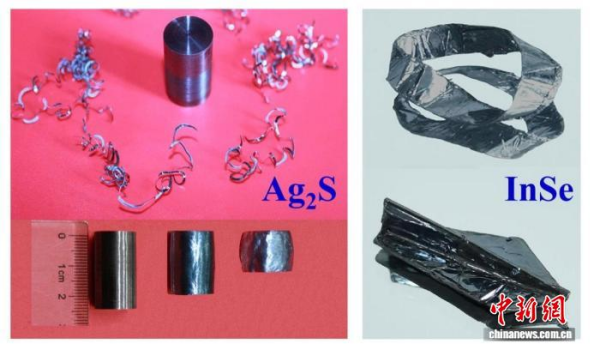
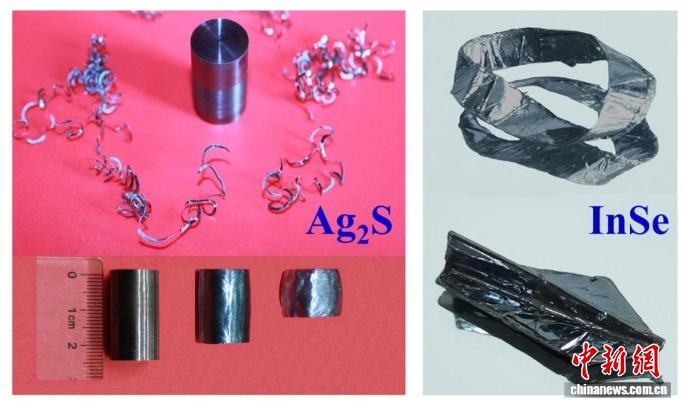
Group 1: Core Achievements - The "Plastic Inorganic Semiconductor" project won the Basic Research Award, while the "DME to Ethanol Technology" project received the Technological Invention Award, and the "RF SAW Filter Technology for 5G/6G" project was awarded the Scientific Research Award [4] - The "Plastic Inorganic Semiconductor" project achieved a breakthrough by discovering that silver sulfide and indium selenide single crystals exhibit metallic-like mechanical properties at room temperature, significantly exceeding conventional semiconductors in strain capabilities [5] - The "DME to Ethanol Technology" project has developed a complete industrialization technology with independent intellectual property rights, achieving the world's first industrial demonstration and multiple projects with a capacity of 50 million tons/year of coal-based ethanol and 60 million tons/year from steel plant gas [6] Group 2: Technological Innovations - The project team for the "Plastic Inorganic Semiconductor" has identified over 20 types of room-temperature plastic inorganic semiconductors through high-throughput calculations, leading to the development of revolutionary materials and devices [5] - The "RF SAW Filter Technology" project has developed a large-scale production technique for piezoelectric heteroepitaxial wafers, significantly increasing the working frequency of devices from below 2GHz to above 6GHz, thus overcoming previous limitations [8] - The "DME to Ethanol Technology" has signed 15 technology implementation contracts, achieving a total capacity of 5.15 million tons/year, with 7 projects already in production [6]

煤炭行业热点事件复盘及投资策略系列深度:产能预计收紧、进口预期收缩,看好旺季煤价反弹
Shenwan Hongyuan Securities· 2026-01-29 14:41
Core Insights - The coal industry is undergoing a significant restructuring on the supply side, with policies aimed at controlling coal consumption in power generation and coal-to-gas projects, leading to a tighter supply environment. The emphasis on high-quality and compliant production capacity is expected to increase [4][6][10] - Demand for coal remains stable, driven by resilient electricity consumption and growth in the coal chemical sector, particularly in coal-to-oil and coal-to-olefins projects. Overall coal demand is projected to see slight growth in 2026 [4][6][10] - Investment recommendations include focusing on growth-oriented companies such as TBEA, Jinkong Coal, Huayang Co., Xinjie Energy, Huaihe Energy, and Yancoal Energy, as well as stable dividend-paying companies like China Shenhua, Shaanxi Coal, and China Coal Energy [4][10] - Contrary to common perceptions, the report argues that coal will maintain its strategic importance in energy supply, with a robust demand foundation supporting the industry's fundamentals. The cash-generating nature of the coal sector is expected to strengthen, with coal prices likely to remain at reasonable high levels, enhancing profitability and dividend capacity [4][10] Supply Side Analysis - The domestic coal production growth rate is slowing, with December 2025 coal production at 4.37 million tons, a year-on-year decrease of 1.0%. The overall production for 2025 is projected at 48.32 billion tons, a 1.2% increase year-on-year [22][24] - The report highlights that the supply-demand balance is tightening, with significant policy changes and production adjustments in key coal-producing regions [4][6][10] Demand Side Analysis - Industrial coal demand is showing a steady increase, while thermal power demand is experiencing temporary pressure. The chemical sector is emerging as a new growth driver, with coal consumption in chemical industries growing by 7% year-on-year in December [4][10] - The report indicates that the overall coal consumption is expected to stabilize and achieve slight growth in 2026, supported by ongoing electricity demand [4][10] Key Events and Policy Changes - Recent policy changes include the implementation of stricter safety regulations and the introduction of export tariffs by Indonesia, which are expected to impact global coal supply dynamics [6][10] - The report notes the establishment of a new coal transportation base in Guazhou, which is expected to enhance coal distribution efficiency and support national energy security [6][10] Price Dynamics - The seasonal adjustment of national railway freight rates is expected to influence coal price volatility, with price movements likely to accelerate during periods of freight rate adjustments [10] - The report anticipates that coal prices will rebound, particularly in the peak demand season, driven by improved demand and operational conditions [10]


塑性无机半导体、制乙醇、滤波器等获中国科学院杰出科技成就奖
Zhong Guo Xin Wen Wang· 2026-01-29 04:17
Core Insights - The Chinese Academy of Sciences awarded the 2025 Outstanding Scientific Achievement Awards, recognizing three projects: "Plastic Inorganic Semiconductors" for Basic Research, "DME to Ethanol Technology" for Technological Invention, and "RF SAW Filter Substrate Technology for 5G/6G" for Scientific Research [1] Group 1: Plastic Inorganic Semiconductors - The "Plastic Inorganic Semiconductor" project achieved a breakthrough by discovering that silver sulfide and indium selenide single crystals exhibit metallic-like mechanical properties at room temperature, surpassing conventional semiconductors in strain [2] - The research team identified a "multi-center, dispersed" chemical bond mechanism that governs plasticity, leading to the development of over 20 room-temperature plastic inorganic semiconductors through high-throughput calculations [2][4] - The project has led to the creation of a series of disruptive plastic inorganic functional materials, including ultra-thin flexible thermoelectric devices and flexible temperature sensor arrays, with some results already transferred to practical applications [4] Group 2: Ethanol Production Technology - The "DME to Ethanol Technology" project addresses the dual role of ethanol as both a bulk chemical and an energy product, emphasizing the strategic importance of non-grain ethanol technology for energy and food security in China [5] - The project team developed a complete industrial technology for DME to ethanol, achieving the world's first industrial demonstration and leading to multiple projects with capacities of 500,000 tons/year and 600,000 tons/year for coal-based ethanol and steel plant gas-based ethanol, respectively [7] - The technology has resulted in 15 signed technology implementation contracts, with a total capacity of 5.15 million tons/year, and 7 projects already in production with a capacity of 2.65 million tons/year [7] Group 3: RF SAW Filter Technology - The project focused on high-performance RF surface acoustic wave (SAW) filters for 5G/6G mobile communications, overcoming various physical mismatch issues in the preparation of silicon-based piezoelectric heterostructures [8] - The team developed a technology for large-scale production of piezoelectric heterostructures, significantly enhancing the working frequency of devices from below 2GHz to above 6GHz, thus breaking the frequency bottleneck in SAW devices [10] - The project established a complete technology and product chain from piezoelectric heterostructures to device design and RF module integration, supporting the localization and security of core materials for China's 5G/6G mobile terminals [10]
创新高!数说我国能源保供“压舱石”稳固 煤炭利用将更加“清洁+高效”
Yang Shi Wang· 2026-01-27 03:13
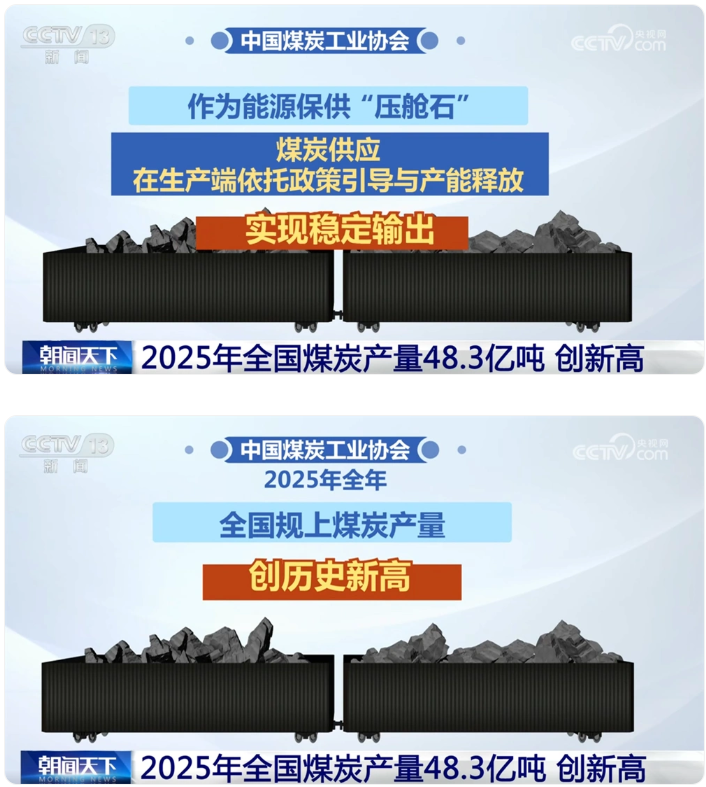
Group 1 - The core viewpoint is that China's coal production is expected to reach a historical high of 4.83 billion tons in 2025, representing a year-on-year growth of 1.2% [1] - Coal supply is stabilized through policy guidance and capacity release, with Shanxi, Shaanxi, Inner Mongolia, and Xinjiang provinces accounting for approximately 82% of the national coal production and over 95% of the inter-provincial coal supply [1] - In December, the national coal production from large enterprises reached 440 million tons, with an average daily output of 14.1 million tons, indicating a stable growth trend [4] Group 2 - A new standard has been issued to promote the clean and efficient utilization of coal, aiming to elevate the coal industry from low-end to high-end and transition coal products from primary fuels to high-value products [5] - The coal chemical raw material consumption is increasing by 20 to 30 million tons annually, and the new standards will focus on energy efficiency management in key areas such as coal-fired power generation and coal-to-natural gas [5] - The implementation of benchmark and baseline levels in the new standards is expected to significantly expand the application of coal from fuel to raw materials [5] Group 3 - In Shijiazhuang, coal trains from Shanxi and Shaanxi are delivering coal to meet local thermal power generation and heating needs, with an average daily unloading of 2 to 3 trains and a total delivery of 7,000 to 10,000 tons [3]
龙祖根:以创新为钥 解锁贵州煤炭产业高质量发展新征程
Zhong Guo Neng Yuan Wang· 2026-01-26 09:21
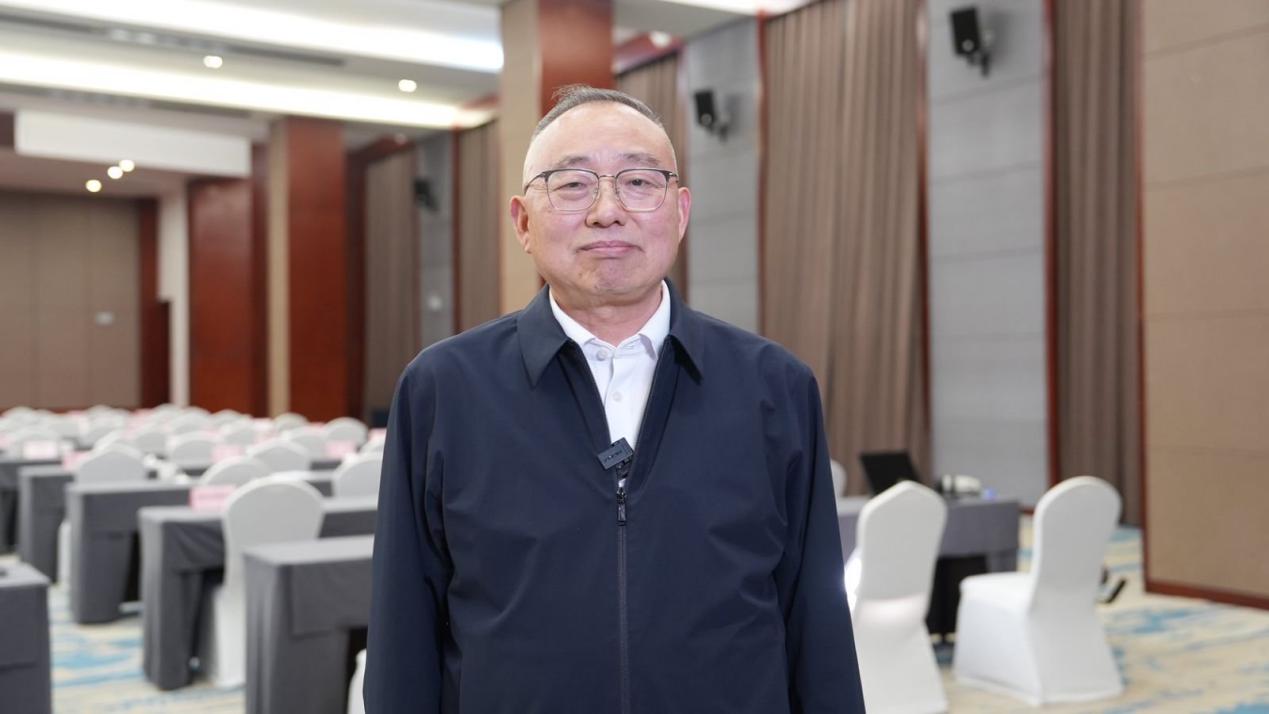
Core Viewpoint - The coal industry in Guizhou Province is positioned as a core force for energy security in Southwest China, with a focus on safety, transformation, and benefiting people's livelihoods as outlined in the "14th Five-Year Plan" [1][3] Group 1: Industry Development and Performance - In 2025, Guizhou's coal production reached 183 million tons, an 8.8% increase from 168 million tons in 2024, with a continued positive trend in safety production [3] - The coal power installed capacity accounts for approximately 40% of the total, contributing nearly 60% of the electricity generation, highlighting its critical role in energy security [3] - The coal industry's energy support ratio is expected to remain around 50% during the "15th Five-Year Plan" period [3] Group 2: Innovation and Technology - The transformation of the traditional coal industry must be driven by technological innovation, focusing on clean utilization, intelligent development, and ecological construction [4] - Guizhou has developed a unique path of "introduction-digestion-absorption-re-innovation" to create independent intellectual property rights and promote high-quality industry development [4] - A collaborative platform between enterprises and universities has been established to cultivate high-level professionals for the healthy development of coal [4] Group 3: Strategic Planning and Market Expansion - The industry is advancing the construction of intelligent coal washing plants and aims to enhance coal quality through customized products based on market demand [5] - Efforts are being made to establish a coal pricing mechanism in Southwest China and prepare for a coal trading conference to increase Guizhou's market share [5] Group 4: Coalbed Methane Development - Guizhou is the second richest province in coalbed methane resources, with significant progress made despite complex geological conditions [6] - The association plans to enhance coalbed methane exploration through annual energy expos and collaboration with universities and research institutions [6] Group 5: Commitment to Energy Security and Transformation - The coal industry in Guizhou is committed to implementing the meeting's spirit with a focus on development and safety, aiming for structural optimization while ensuring energy security [7] - The industry is undergoing comprehensive reforms, from intelligent construction to green transformation, contributing to high-quality energy development in Guizhou [7]