
绿色钢铁

Search documents
阿尔及利亚钢铁进入欧洲市场受到限制
Shang Wu Bu Wang Zhan· 2026-02-06 05:33
Group 1 - Algeria's steel industry is capable of producing competitive low-emission steel, with export becoming a key objective despite EU import quotas limiting exports [1][2] - Major Algerian steel producers, such as Tosyali Algeria and AQS, are operating at high capacity utilization rates of nearly 97% and 98% respectively, driven by targeted investments and upgraded production processes [1] - Tosyali Algeria is a significant player in the direct reduced iron (DRI) sector, with plans for a second DRI facility to achieve record production by 2025, and is one of the few plants capable of operating on hydrogen [1] Group 2 - The EU is a natural export destination for Algerian steel due to geographic proximity and industrial demand, but strict quota regulations limit export potential [2] - Algerian producers are advocating for an increase in export quotas to meet demand, as current quotas are expected to reach their limits soon [2] - Discussions at the World Economic Forum highlighted the need for the EU to reconsider its quota system, taking into account the carbon footprint of imported steel, which aligns with the European Green Deal [2][3] Group 3 - Algeria positions itself as a green steel producer with advanced technology that meets environmental standards, while the EU faces challenges in balancing protection of its steel industry with climate commitments [3] - Changes in the EU quota system will significantly impact Algeria's ability to export steel to the European market in the long term [3]
不容错过!2026年印度钢铁与冶金盛会即将开启,同时研讨会等你来参与!
Sou Hu Cai Jing· 2026-01-23 06:15
Group 1: Event Overview - The 2026 International Steel, Metallurgy & Materials Exhibition & Conference (SMME) will take place from December 8 to 10, 2026, at the Biswa Bangla Exhibition Centre in Kolkata, India [2][4] - The exhibition will cover an area of over 10,000 square meters, featuring more than 300 exhibitors from over 10 countries, and is expected to attract over 10,000 professional visitors [4] - The event will include 26 specialized conferences on steel metallurgy and metal industries, with participation from over 300 international industry representatives [4] Group 2: Industry Insights - India's steel industry is projected to become the second-largest steel producer globally by 2025, with an estimated finished steel output of approximately 146.56 million tons, reflecting a growth rate of 5.3% [6] - Domestic steel demand in India is expected to grow at a rate of 9% to 10%, driven by sectors such as infrastructure, housing, capital goods, and automotive [6] - The Indian government plans to increase steel production capacity to 300 million tons by 2030, with an investment of over $156 billion to support this expansion [6] Group 3: Government Support and Policies - The Indian government is implementing a Production-Linked Incentive (PLI) scheme aimed at increasing the production capacity of specialty steel by 25 million tons and attracting significant investments in value-added steel [6][13] - The government has established the National Steel Policy of 2017, which outlines a roadmap for long-term growth in both demand and supply for the steel industry by 2030-31 [13] Group 4: Market Dynamics - The global crude steel production is expected to reach 1.8846 billion tons in 2024, with India producing 149.4 million tons, making it the second-largest producer after China [7] - India's per capita finished steel consumption is projected to be 108 kg for the 2024-2025 period, compared to China's 601.1 kg [7] - The steel industry in India has seen a significant development over the past 10-12 years, with production increasing by 75% and domestic demand rising by nearly 80% since 2008 [7] Group 5: Exhibition Focus Areas - The exhibition will feature a wide range of exhibitors, including integrated steel plants, secondary steel producers, raw material suppliers, and manufacturers of advanced materials [14][16] - Key focus areas will include green steel and decarbonization technologies, automation, robotics, and digital solutions, as well as environmental sustainability measures [14][16]

欧洲钢铁企业持续推进直接还原铁工厂建设
Sou Hu Cai Jing· 2025-12-17 15:25
Group 1 - European steel manufacturers are advancing direct reduction iron (DRI) plant projects, focusing on green hydrogen reduction processes, but face various challenges that impact previously announced plans [1][17] - GreenIron in Sweden is set to launch a DRI plant in Sandviken, utilizing patented zero-emission technology with a capacity of approximately 30,000 tons per year, supported by a green hydrogen production facility from Norwegian Hydrogen [3][18] - Stegra, another Swedish company, has surpassed 50% installation progress on its electrolyzer for a green steel plant in Boden, which includes a DRI plant with a capacity of 2.1 million tons per year, scheduled for production in 2026 [4][19] - Spanish company Heidrun is developing a green steel plant in Puerto Llano with a DRI capacity of 1.5 million tons per year, now expected to start production in 2027 due to ongoing approval processes [5][20] - Thyssenkrupp in Germany is constructing a DRI plant with a capacity of 2.5 million tons per year in Duisburg, aiming for completion by the end of 2026 [6][30] - Salzgitter in Germany is building a DRI plant with a capacity of 2 million tons per year, set to replace traditional blast furnace processes, with plans for completion in 2026 [8][31] - Dillingen Steel in Germany is preparing a DRI plant with a capacity of 2 million tons per year, targeting carbon neutrality by 2045, with a planned production start in 2029 [9][21] - Tata Steel Netherlands is implementing a large-scale green steel project with two DRI plants planned for completion by 2035, currently in the construction phase [10][22] - Trinecke Zelezarny in the Czech Republic plans to build a DRI plant with a capacity of 1.3 million tons per year, with production now delayed to 2030 due to regulatory uncertainties [11][23] - Blastr Green Steel in Finland is advancing a green steel and hydrogen production facility with a DRI capacity of 2.5 million tons per year, expected to start production in 2030 [12][24] - GravitHy in France is preparing to build a DRI plant with a capacity of 2 million tons per year, planned for 2029, alongside green hydrogen production [13][25] Group 2 - ArcelorMittal has announced delays in its decarbonization projects, including a DRI plant in Spain with a capacity of 2.3 million tons per year, originally set for 2025 [14][25] - The company has also paused projects in Belgium and Germany, which were part of its "Steel4Future" strategy, affecting multiple DRI plants [15][26] - HyIron Green Technologies in Germany has suspended its green hydrogen-driven DRI plant project, which was expected to be the largest globally [16][32] - LKAB in Sweden has also paused its fossil-free sponge iron demonstration plant project, which is crucial for the industrialization of HYBRIT technology [16][32]


欧盟或将废除2035年燃油车“全面禁令”,减排目标降至90%并放行插混车销售
Hua Er Jie Jian Wen· 2025-12-16 07:56
Core Viewpoint - The European Commission plans to relax the internal combustion engine ban originally set for 2035, allowing certain plug-in hybrid vehicles and electric vehicles with fuel range extenders to continue sales [1] Group 1: Regulatory Changes - The new proposal requires a 90% reduction in automotive exhaust emissions by the mid-next decade, which is a decrease from the previously set target of 100% [1] - Automakers will need to compensate for any additional pollution by using low-carbon or renewable fuels or locally produced green steel [1]
欧洲“零排放”目标生变 燃油车禁令或现五年缓冲期
智通财经网· 2025-12-11 12:13
Core Viewpoint - The European Union is considering postponing the effective ban on internal combustion engines by five years due to pressure from major automotive-producing countries, aiming to balance environmental goals with industry concerns [1] Group 1: Regulatory Changes - The European Commission is set to announce revisions to rules aimed at transitioning the automotive industry away from fossil fuels, with several governments and manufacturers arguing that the current plan is too aggressive [1] - The proposed strategy may allow the use of internal combustion engines in plug-in hybrid and range-extended electric vehicles until 2040, provided they utilize advanced biofuels and so-called e-fuels [1] - The proposal aims to still meet the target of zero emissions for new passenger cars by 2035, addressing concerns from countries advocating for clean technologies beyond pure electric vehicles [1] Group 2: Technical Considerations - The exact proportion of plug-in hybrid and range-extended electric vehicles allowed in the European market post-2035 is still under discussion, along with key technical details regarding e-fuels and advanced biofuels [2] - E-fuels, while theoretically climate-neutral, are expensive and in the early stages of development, raising concerns about their practicality [2] - The upcoming package will also delay tightening the emissions calculation method for plug-in hybrid vehicles, shifting from a laboratory-based system to one that measures actual pollution [2] Group 3: Industry Implications - Environmental groups express concerns that these modifications could create new loopholes, undermining Europe's climate ambitions and potentially causing major automotive manufacturers to fall behind in the battery-powered vehicle race against China [1]
新加坡媒体:中资将非洲矿产与全球能源转型相连
Huan Qiu Shi Bao· 2025-12-05 07:15
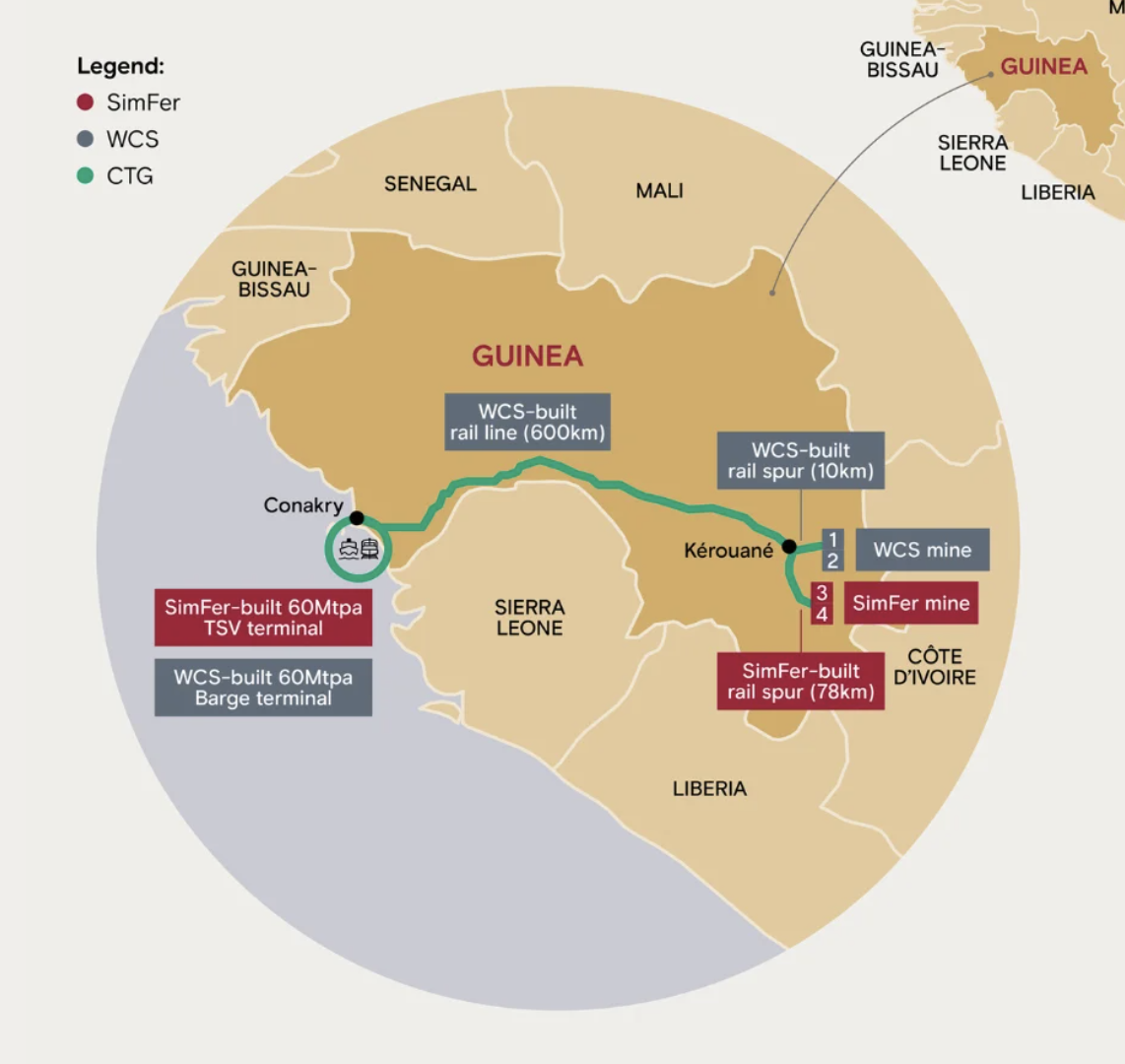
Core Insights - The Simandou iron ore project in Guinea, with proven reserves of 4.4 billion tons, is poised to reshape global markets and Sino-African economic relations, marking a significant milestone in Guinea's history [1][2] Group 1: Project Overview - The Simandou project represents a total investment exceeding $20 billion, integrating mining with infrastructure development, including a 600-kilometer railway connecting the inland mine to the deep-water port of Matakong [1] - The project aims to export approximately 120 million tons of high-grade iron ore annually, positioning Guinea as the third-largest iron ore supplier after Australia and Brazil [2][3] Group 2: Market Impact - China's iron ore imports are projected to reach approximately 1.24 billion tons in 2024, a year-on-year increase of 4.9%, driven by demand from construction, urbanization, and steel production [2] - The high-grade iron ore produced by Simandou, with an average iron content of over 65%, is crucial for green steel production, aligning with China's low-carbon steel vision and broader decarbonization goals [3] Group 3: Economic and Geopolitical Implications - The project is expected to create thousands of jobs in Guinea, enhance railway and port infrastructure, and diversify exports, potentially establishing the country as a regional logistics hub [3] - The strengthening of Sino-African trade, with a projected trade volume of $295.6 billion in 2024, reflects the growing economic ties, with Guinea playing a significant role [3][4] - The geopolitical landscape is shifting, as China's deepening presence in West Africa through projects like Simandou may challenge U.S. strategic objectives, intertwining industrial policy, resource security, and global geopolitics [5]
2026年铁矿石均价在95美金左右,但上涨空间也有限
Xin Lang Cai Jing· 2025-11-30 03:17
Core Viewpoint - Fitch Solutions' BMI forecasts that iron ore prices will stabilize at an average of $95 per ton in 2026, slightly lower than the $97 per ton in 2023, due to increased supply from Guinea's Simandou project and weak domestic demand in mainland China [3][6]. Supply and Demand - Major miners' iron ore production remains healthy, with most maintaining or slightly increasing their output despite early-year weather impacts [4][5]. - China's domestic demand for steel and iron ore continues to be weak, with the official manufacturing PMI shrinking for the seventh consecutive month to 49 in October, and new home prices declining [3][8]. Long-term Price Outlook - BMI predicts a long-term downward trend in iron ore prices, projecting a decline from an average of $95 per ton in 2026 to $78 per ton by 2034, driven by slowing steel production growth and increased iron ore supply [6][9]. - The shift in China's economic structure from industrial and steel-intensive sectors to services and lower steel intensity infrastructure is expected to negatively impact iron ore demand [7][8]. Market Dynamics - The transition in China's economic growth trajectory is anticipated to suppress growth rates in steel consumption and production, with domestic steel output expected to align more closely with consumption patterns in the coming years [8]. - The global focus is shifting towards green or low-carbon steel, which requires significantly less iron ore compared to traditional blast furnace methods [8]. Risks and Opportunities - Current economic uncertainties present a dual risk for iron ore price forecasts, with potential further declines if China's economic growth continues to underperform expectations [10]. - Conversely, a strong recovery in China's real estate market could drive demand and support iron ore prices, alongside supply constraints from production mines [11].
延宕28年后西芒杜项目投产,将重塑全球铁矿格局
Xin Lang Cai Jing· 2025-11-12 03:04
Core Viewpoint - The official production launch of the Simandou iron ore project in Guinea marks a historic moment for the global iron ore market, expected to reshape supply dynamics and enhance the bargaining power of consuming countries like China [3][8]. Group 1: Project Overview - The Simandou iron ore project, known as the "pearl on Guinea's crown," has a mineral reserve of approximately 4 billion tons, making it the largest undeveloped iron ore reserve globally [3][4]. - The project consists of two main blocks, with the northern section acquired by a consortium led by Winning Consortium for $14 billion in November 2019 [4][5]. - The infrastructure development for the Simandou project is set to begin in 2024, with an investment of $6.2 billion allocated for port and railway infrastructure [5]. Group 2: Market Impact - The production of Simandou is expected to alleviate supply constraints in China, which imports about 70% of the world's iron ore, and could meet nearly 10% of China's iron ore import needs with an annual output of 12 million tons [6][9]. - The project will significantly impact global iron ore prices, with expectations of downward pressure due to increased supply amid already high port inventories [10][11]. - The average iron content of Simandou ore is 65%, which is higher than most other iron ores, potentially leading to lower environmental impact during processing [14][15]. Group 3: Economic Implications - The International Monetary Fund predicts that the Simandou project will contribute to a 26% increase in Guinea's GDP by 2030 [16]. - The project is also anticipated to force some high-cost suppliers out of the market due to increased competition and supply [13].



欧亚资源集团:金属市场迎来战略性重估 铜、铝与铬长期供不应求
Zheng Quan Ri Bao Wang· 2025-10-17 06:14
Core Insights - Eurasian Resources Group (ERG) highlights a structural change in the key metals market driven by global energy transition and industrialization in emerging economies, leading to a long-term supply tightness [1][2] Group Overview - ERG is a leading diversified natural resources group headquartered in Luxembourg, with operations in mining, processing, energy, logistics, and sales across Africa, Central Asia, and Brazil [1] Market Outlook - The CEO of ERG, Shukhrat Ibragimov, emphasizes that the demand for copper, aluminum, chromium, and green steel is entering a phase of sustained structural shortage due to accelerating energy transition and industrialization in emerging markets [2] - The company plans to enhance its production system, maximize capacity utilization, and optimize costs as part of a new development direction set to launch by the end of 2024 [2] Commodity Price Trends - Copper prices have rebounded, supported by tightening supply, improved US-China trade relations, and production disruptions, with LME three-month copper prices rising 3% to $11,000 per ton, the highest since May 2024 [2][3] - Aluminum prices are driven by production restriction policies and increasing demand, while the chromium market remains tight on the supply side [3] Strategic Focus - HBI (Hot Briquetted Iron) is identified as a strategic focus for the steel industry, becoming a core component of the green steel supply chain over the next decade, facilitating the industry's low-carbon transition [3]
Calix Limited (CXL) Update / Briefing Transcript
2025-07-31 02:00
Summary of Calix Limited (CXL) Update / Briefing July 30, 2025 Company Overview - **Company**: Calix Limited (CXL) - **Core Technology**: Development of a zero emissions steel technology known as Zesty, applicable in multiple industries including cement, lime, iron, steel, lithium, and alumina [5][12][28] Key Points and Arguments Zesty Technology - **Technology Description**: Zesty utilizes a unique heating method via a large steel tube, allowing for energy flexibility by using various energy sources such as fossil fuels, biomass, waste, and renewable electrons [6][14] - **Environmental Impact**: The cement and lime industry contributes approximately 8% of global CO2 emissions, with Zesty technology aiming to capture CO2 emissions during the heating process [9][12] - **Iron Production**: Zesty can reduce iron ore using hydrogen, potentially addressing 16% of global CO2 emissions from the iron and steel industry [12][28] Recent Developments - **Demonstration Project**: A new plant is being developed with a capacity of 30,000 tonnes per year, supported by a grant of AUD 44.9 million from Arena for a total project cost of AUD 90 million [15][17] - **Government Support**: Strong backing from the Australian government, including discussions on green iron opportunities with China, which produces about 50% of the world's steel [18][19] Economic Viability - **Cost Projections**: The goal is to produce green iron at around USD 400 per ton, contingent on achieving low electricity costs (AUD 20-30 per megawatt hour) [19][20] - **Market Potential**: The transition to low emissions technologies in iron production is expected to grow significantly, with projections indicating that by 2050, 50% of global iron ore production will utilize alternative low emissions technologies [28][29] Competitive Landscape - **Global Context**: The Zesty technology is positioned favorably against traditional methods, with a focus on reducing emissions and capital costs through flexible operations [35][36] - **Market Drivers**: The need for new technologies is urgent due to increasing CO2 emissions from ironmaking, with government policies supporting the transition to green iron [37][54] Additional Important Content - **Hydrogen Supply**: The technology can utilize various hydrogen sources, addressing concerns about the supply of renewable hydrogen in Australia [89][90] - **Business Model**: Calix aims to be capital light, focusing on licensing agreements and engineering design services rather than building and operating facilities themselves [67][81] - **Future Outlook**: The demonstration plant is expected to be operational by 2028, with plans for commercial facilities to follow, potentially generating revenue through toll processing and engineering studies [94][95] Conclusion - **Strategic Positioning**: Calix's Zesty technology represents a significant opportunity in the green iron market, supported by government initiatives and a growing demand for low-emission steel production. The company is well-positioned to capitalize on the transition towards sustainable industrial practices, with a clear roadmap for development and commercialization [80][81][96]