
职业教育改革

Search documents
职教改革再升级 新亮点是什么
Zhong Guo Qing Nian Bao· 2026-02-26 23:30
Core Viewpoint - The Ministry of Education's recent document emphasizes the need for reform in vocational education, focusing on key elements such as professional settings, curriculum design, and teacher capabilities to enhance the quality and relevance of vocational training [1][2]. Group 1: Key Tasks Outlined in the Document - The document outlines five main tasks: dynamic adjustment of professional settings, scientific design of course combinations, optimization of textbook presentation, refinement of teacher capability lists, and establishment of industry-education integration training bases [1]. - It also proposes four mechanisms to promote reform: comprehensive advancement of high-skilled talent cluster training plans, establishment of a "three leaders" organizational mechanism, construction of a key teaching element linkage reform mechanism, and improvement of enterprise technology resource openness and transformation mechanisms [1]. Group 2: Goals and Principles - The overall goal is to establish an advanced standard system for vocational education by 2027 and a practice model with Chinese characteristics by 2035, adhering to principles of demand-driven, cluster promotion, linked reform, and standard guidance [1]. - The document reflects a continuity in policy while also highlighting the need for development in the context of industry-education integration, moving beyond a school-centered approach [2]. Group 3: Institutional Innovations - The "three leaders" mechanism involves collaboration among enterprises, schools, and experts in talent cultivation, which is seen as a significant enhancement for vocational institutions [2]. - The focus on dynamic adjustment of professional settings aims to align with high-skilled talent cultivation goals, emphasizing the establishment of new programs in emerging industries such as artificial intelligence and urban renewal [2][3]. Group 4: Institutional Responses - Qingdao Vocational and Technical College is aligning its professional layout with local innovation industry development, focusing on areas like smart home appliances and intelligent manufacturing [3]. - The effectiveness of measures related to professional settings, curriculum, faculty, and industry-education integration is ultimately assessed by the institution's contribution to national strategy, regional economy, and student growth [3].
时隔十年教育部再部署职业教育改革,释放哪些新信号?
Xin Jing Bao· 2026-02-13 11:40
Core Viewpoint - The Ministry of Education has issued a new document on vocational education reform, emphasizing the need for dynamic adjustments in professional settings and a focus on key teaching elements to align with industry needs and technological advancements [1][2][5]. Group 1: Key Tasks and Focus Areas - The document outlines five key tasks, including dynamic adjustment of professional settings, scientific course design, optimization of teaching materials, detailed teacher capability lists, and the establishment of industry-education integrated training bases [2][7]. - The emphasis is on a systematic approach to reform, breaking away from isolated changes and instead promoting a comprehensive integration of professional, course, and teaching material reforms [4][10]. Group 2: Industry Alignment and New Professional Development - The reform aims to address the mismatch between talent cultivation and the demands of new technologies and industries, with a focus on dynamic adaptation of professional settings to meet national strategies and regional development needs [6][12]. - The document highlights the introduction of new professional fields such as low-altitude economy, artificial intelligence, and high-end equipment, responding to the rapid changes in industry requirements [7][8]. Group 3: Industry-Education Collaboration - The document promotes collaboration between educational institutions and enterprises, advocating for a model where industry standards dictate educational standards, thereby enhancing the relevance of vocational training [9][10]. - Specific measures include establishing organizational mechanisms led by industry leaders, promoting the sharing of resources, and facilitating the dual flow of teachers and industry professionals [8][10]. Group 4: Implementation and Future Goals - The reform is based on practical experiences and aims to create a replicable and scalable educational reform model by 2027, with a vision to significantly enhance vocational education's contribution to national strategies and industrial development by 2035 [13][12].
职业教育将积极 增新、裁撤过剩、升级改造现有专业
Xin Lang Cai Jing· 2026-02-12 17:28
Core Viewpoint - The Ministry of Education has issued guidelines to reform key elements of vocational education, focusing on dynamic adjustment of professional settings and enhancing the alignment with industry needs [1] Group 1: Professional Adjustment - Vocational education will dynamically adjust professional settings, increasing new programs while eliminating excess and upgrading existing ones [1] - New programs will be established in emerging and future industries, including low-altitude economy, artificial intelligence, high-end equipment, urban renewal, and areas with critical labor shortages [1] - Programs with weak teaching conditions, low quality, and poor employment rates will be promptly removed to avoid a "large but scattered" and "weak but comprehensive" professional layout [1] Group 2: Curriculum and Teaching Enhancement - The reform requires the development of a course list for new and upgraded programs, along with the creation of capability maps [1] - A mechanism for diverse textbook development will be established, focusing on the creation of urgently needed educational materials [1] - There will be targeted improvements in teacher capabilities and the establishment of a dual-flow mechanism for teachers and industry talent [1] Group 3: Long-term Goals - By 2027, a standardized system for vocational education in terms of programs, courses, textbooks, teachers, and practical training will be established [1] - By 2035, a vocational education practice model with Chinese characteristics will be developed, leading to significant changes in the operational structure of vocational schools [1]
职业教育将积极增新、裁撤过剩、升级改造现有专业
Xin Hua She· 2026-02-12 06:39
Core Viewpoint - The Ministry of Education has issued opinions to deepen the reform of key elements in vocational education, focusing on actively adding new programs, eliminating excess ones, and upgrading existing specialties [1] Group 1 - The Ministry of Education aims to enhance vocational education by reforming key teaching elements [1] - The reform will involve the addition of new programs to meet current industry demands [1] - Existing specialties will be upgraded or eliminated based on their relevance and effectiveness [1]
教育部推进职业教育改革,将动态调整专业、严格“红黄牌”制度
Xin Jing Bao· 2026-02-12 03:08
Core Viewpoint - The Ministry of Education has issued guidelines to reform key elements of vocational education, focusing on dynamic adjustment of professional settings and the establishment of a standardized system for vocational education by 2027, with a long-term goal of enhancing vocational education's alignment with national strategies and industrial development by 2035 [1][2]. Group 1: Key Tasks and Objectives - The guidelines emphasize the dynamic adjustment of professional settings to focus on high-skilled talent cultivation, implementing a "red-yellow card" warning system to eliminate weak programs with low employment rates [1][2]. - By 2027, the aim is to establish an advanced standard system for vocational education, creating a replicable and promotable new paradigm for teaching reform [1]. - By 2035, the goal is to develop a vocational education practice model with Chinese characteristics, significantly enhancing the ability of vocational education to serve national strategies and industrial development [1]. Group 2: Professional and Curriculum Development - The guidelines advocate for the use of big data and artificial intelligence to predict talent supply and demand in key areas, facilitating professional adjustments based on emerging industries [2]. - There is a focus on upgrading existing programs to align with trends in intelligence, sustainability, and integration, while encouraging local regions to develop specialized programs [2]. - The curriculum design will incorporate the latest standards and technologies, ensuring that new and upgraded courses meet industry needs and include a comprehensive skills and knowledge mapping [3]. Group 3: Textbook and Teaching Material Innovation - The guidelines propose a "three chief editors" mechanism for textbook development, involving industry experts, school leaders, and authoritative figures to diversify textbook formats [3]. - There is an emphasis on developing digital textbooks that can present skills, technologies, and scenarios in a digital format, establishing a standard system for the development, use, and management of vocational education digital materials [3]. - The promotion and use of high-quality vocational education materials will target various groups, including vocational school students, applied university students, and corporate training personnel [3].
振涛教育:2026这六大教育趋势或将影响你我
Sou Hu Cai Jing· 2026-02-03 04:05
Core Insights - The rise of artificial intelligence (AI) is transforming work and learning, creating new job opportunities and necessitating a workforce skilled in new technologies [1] - The year 2025 is pivotal for vocational education in China, with a strategic plan for systematic advancement and a focus on a comprehensive talent cultivation system [2] - The new high-level construction plan emphasizes high-quality integration of education and industry, targeting emerging sectors like information technology and advanced manufacturing [4] Group 1: Trends in Education and Skills Development - AI will play a significant role in education, acting as a personalized learning partner that identifies individual skill gaps and provides tailored support [5] - Understanding AI tools safely and effectively will be crucial for both students and professionals, making AI literacy a key component of educational curricula and hiring practices [6] - Continuous skill enhancement and retraining are essential as AI alters job requirements, making it vital for individuals to maintain relevant skills over the next 5 to 10 years [6] Group 2: Learning Approaches and Skills - Learning itself is becoming a core skill, with an increasing need for individuals to actively seek opportunities to develop and enhance their capabilities [6] - The integration of gamification, experiential learning, and virtual environments will enhance the learning experience, providing real-time feedback and multi-sensory engagement [6] - Human-centric skills such as interpersonal relationships, leadership, empathy, and creativity will remain invaluable, as these are difficult for AI to replicate [7] Group 3: Educational Strategies and Employment Outcomes - To address the digital talent gap, a focus on learning digital skills through high-quality vocational education is essential for entering the digital economy [8] - The company is aligning its professional offerings with national strategies and market demands, focusing on cutting-edge fields like AI, low-altitude technology, and cloud computing [8] - The company emphasizes practical training to ensure students are job-ready, reducing the need for employer retraining and facilitating high-quality employment outcomes [10]

第二中专三篇案例获评 省级职教改革典型案例
Xin Lang Cai Jing· 2026-02-02 18:02
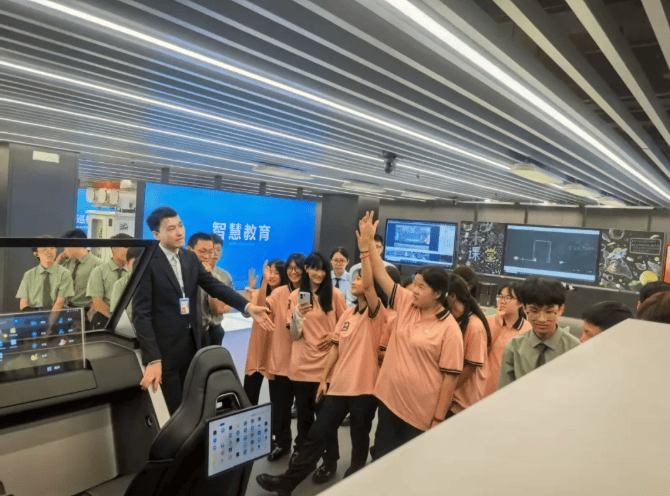
Core Viewpoint - The successful inclusion of three cases from Chuzhou Second Vocational School in the 2025 provincial vocational education reform model case list represents a historic achievement for the school and the best result for vocational schools in Chuzhou City in this evaluation [1][2]. Group 1: Case Highlights - The selected cases address key areas such as rural revitalization, urban-rural integration, and deepening the integration of industry and education [1]. - Two cases, "Small Kiwi, Big Common Prosperity: Innovative Training of Agricultural Talents in Mountainous Counties Serving the 'Specialty Product Wealth' Strategy" and "From 'Disconnection' to 'Connectivity': County Vocational Education Connection Action for Urban-Rural Common Prosperity," were awarded "Excellent Typical Case" status [1]. - The first case utilizes the "Kiwi Industry College" as a platform, innovating a talent cultivation model that integrates project processes, AI empowerment, and the combination of work, courses, competitions, and certifications to address the disconnection between education and industry [1]. - The second case focuses on urban-rural integration, establishing a four-dimensional interconnected system of "platform, technology, experience, and talent" to effectively promote resource connection and collaborative talent cultivation between urban and rural areas [1]. - Another case, "Dual-Line Drive, Platform Empowerment: Innovative Practice of Ecological Talent Cultivation in the Customized Home Furnishing Industry," was also recognized as a "Typical Case," exploring new pathways for cultivating compound technical and skilled talents in the customized home furnishing sector [1].
北京第三批“特高”专业群和实训基地名单公布
Xin Jing Bao· 2026-01-30 05:01
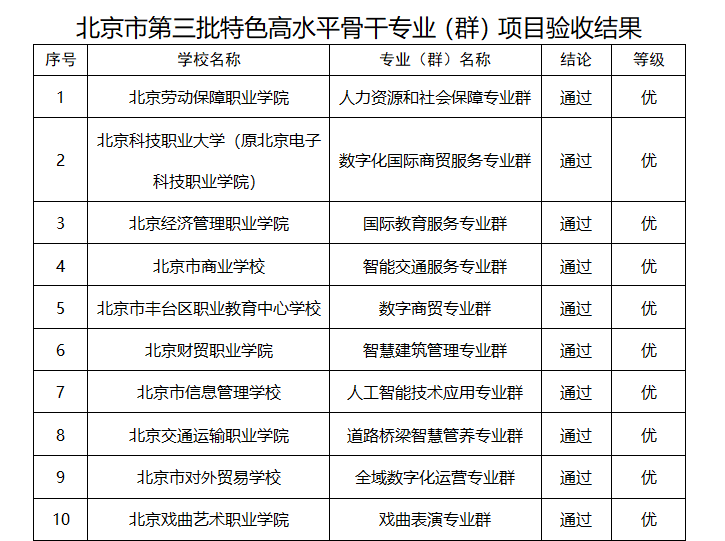
Core Insights - The results of the annual assessment for vocational education schools in Beijing have been officially released, highlighting the performance of various specialized programs and training bases [1] Group 1: Assessment Results - The third batch of high-level specialized programs involved 31 schools, with 10 schools rated "Excellent" and 20 rated "Good" [1] - The third batch of high-level training bases included 27 schools, with 8 schools rated "Excellent" and 19 rated "Good" [3] Group 2: Specific Schools and Programs - Notable schools achieving "Excellent" ratings for specialized programs include: - Beijing Labor Security Vocational College: Human Resources and Social Security Program Group [2] - Beijing University of Science and Technology: Digital International Trade Service Program Group [2] - Beijing Economic Management Vocational College: International Education Service Program Group [2] - Notable schools achieving "Excellent" ratings for training bases include: - Beijing Industrial Vocational Technical College: DJI Drone Surveying Engineering [4] - Beijing Electronic Technology Vocational College: Beijing Aircraft Maintenance Engineer [4] - Beijing Information Vocational Technical College: Newland Data Intelligence Engineering [4] Group 3: Educational Development Goals - The Beijing Municipal Education Commission emphasizes the need for a vocational education system that integrates academic and practical training, enhancing adaptability and attractiveness while supporting high-skilled talent development [5]
杭州科技职业技术学院改革创新样本解读
Hang Zhou Ri Bao· 2026-01-20 03:32
Core Viewpoint - The article discusses the advancements and strategic initiatives of Hangzhou Vocational Technology College (杭科院) in enhancing vocational education quality and aligning with local industry needs, aiming to become a leading vocational technical university. Group 1: Educational Advancements - The number of vocational undergraduate universities in China has surpassed 100 for the first time, marking a critical period for vocational education [7] - Hangzhou Vocational Technology College aims to create a "Bachelor-level Vocational Technical University" and has implemented various reforms to achieve this goal [8] - The college has been recognized as a provincial "Double High" institution and has received multiple awards for teaching achievements, showcasing significant progress in recent years [9] Group 2: Curriculum and Teaching Quality - The college has developed a robust textbook construction system, collaborating with industry leaders to create high-quality educational materials that align with key industries in Hangzhou [10] - The college has produced 10 textbooks that have been included in the national vocational education planning, ranking second in the province and ninth nationally [9] - The faculty includes a significant number of "star craftsmen," with the college leading in the number of national technical experts and innovative teaching teams [10] Group 3: Strategic Development Initiatives - The college has outlined six major projects aimed at enhancing its educational quality and aligning with the city's development goals, focusing on professional construction, teacher quality, and talent cultivation [12][13] - Plans include optimizing the professional structure and enhancing the evaluation system, with a goal of adjusting nine programs and ensuring over 60% of engineering programs undergo digital transformation by 2028 [13][14] - The college aims to establish a strong faculty team, with 50% of programs meeting the requirements for undergraduate-level vocational education by 2028 [14] Group 4: Lifelong Learning and Community Engagement - The college has developed a digital learning platform and various lifelong learning projects, significantly contributing to the construction of a learning-oriented city [11] - The college's initiatives in rural revitalization and community education have been recognized as exemplary cases by the Ministry of Education [11] - By 2028, the college plans to expand its non-degree education offerings and establish a long-term mechanism for high-quality lifelong education [15]

苏工网语 | 烧烤炉旁开课堂,职教的“烟火气”暖了谁的心?
Xin Lang Cai Jing· 2025-12-24 15:44
Core Viewpoint - The establishment of a "Barbecue Industry College" in Yueyang, Hunan, signifies a new trend in vocational education that emphasizes practical skills and real-world applications, catering to the needs of industry professionals rather than traditional students [1] Group 1: Vocational Education Reform - The "Barbecue Elite Degree Enhancement Class" is attended by 26 experienced barbecue business owners, highlighting a shift in vocational education towards serving those already in the industry [1] - This initiative reflects a more grounded approach to vocational education, focusing on immediate, applicable skills that address real challenges faced by industry practitioners [1] - The program aims to bridge the gap between educational content and market demands, ensuring that what is taught is relevant and useful [1] Group 2: Recognition of Labor - The program's branding as "elite" challenges traditional perceptions of vocational work, affirming that all professions deserve respect and recognition [1] - It emphasizes that hard work and dedication in any field can lead to professional dignity and societal acknowledgment [1] - The initiative aims to inspire confidence among workers, reinforcing the belief that skills can transform lives and careers [1] Group 3: Sustainability and Future Challenges - The success of this vocational education model depends on its ability to adapt and remain relevant over time, requiring ongoing updates to curriculum and teaching methods [1] - There is a need for continuous engagement between educational institutions and industry leaders to ensure that the training provided meets evolving market needs [1] - The initiative is seen as a potential catalyst for broader vocational education reforms, encouraging similar programs across various sectors [1]