
自身免疫性疾病

Search documents
华东医药创新药罗氟司特乳膏0.05%特应性皮炎适应症申报上市,加速切入国内特应性皮炎蓝海市场
Quan Jing Wang· 2026-02-03 10:51
Core Viewpoint - Huadong Medicine's subsidiary, Hangzhou Zhongmei Huadong Pharmaceutical Co., has received acceptance for the marketing authorization application of Roflumilast cream (ZORYVE®) 0.05%, aimed at treating mild to moderate atopic dermatitis in children aged 2 to 5, marking a significant milestone in the product's development and enhancing the company's competitive edge in the autoimmune skin treatment sector [1][2]. Product Advantages - ZORYVE® contains Roflumilast, a highly selective non-steroidal phosphodiesterase-4 (PDE4) inhibitor that reduces inflammation by inhibiting the enzyme that increases pro-inflammatory mediators [2]. - The product was developed in collaboration with Arcutis Biotherapeutics, granting Huadong exclusive rights for development, registration, production, and commercialization in Greater China and Southeast Asia [2]. - Atopic dermatitis is a prevalent chronic inflammatory skin condition affecting both children and adults, with significant impacts on quality of life [2]. Market Demand - There are approximately 67 million atopic dermatitis patients in China, indicating a substantial unmet clinical need, particularly for children aged 1 to 7, with a prevalence rate of 12.94% [3]. - The introduction of Roflumilast cream addresses a clear gap in treatment options for children aged 2 to 5, who currently rely on traditional topical corticosteroids and calcineurin inhibitors [3]. - The cream's once-daily dosing regimen enhances treatment adherence, making it a more suitable option for young patients [3]. Strategic Development - Huadong Medicine is systematically introducing a range of Roflumilast products, including higher concentrations for older patients and other skin conditions, to establish a comprehensive presence in the autoimmune skin disease market [4]. - The company is focusing on a dual strategy of "introducing partnerships" and "independent innovation" to build a competitive product pipeline in autoimmune diseases, covering various conditions such as psoriasis and rheumatoid arthritis [5]. - Ongoing collaborations and clinical trials for other products further demonstrate the company's commitment to expanding its portfolio in the autoimmune sector [6]. Strategic Partnerships - In early 2026, Huadong Medicine deepened its strategic partnership with Denmark's MC2 Therapeutics to commercialize the Biomee® series in Greater China, enhancing its position in the topical skin treatment market [7]. - The acceptance of the Roflumilast cream application signifies the company's innovative capabilities and marks a phase of growth in the autoimmune skin disease field [7]. - With multiple differentiated product pipelines, Huadong Medicine aims to strengthen its influence in the multi-billion-dollar autoimmune market in China [7].

呵护你的秀发,拒绝“秃”然来袭
Xin Lang Cai Jing· 2026-01-16 18:02
Core Viewpoint - Alopecia areata is an autoimmune condition that causes sudden hair loss, but it is not a terminal illness and can be managed with proper medical care and lifestyle adjustments [3][4][6]. Group 1: Understanding Alopecia Areata - Alopecia areata is characterized by one or more round or oval patches of hair loss with clear boundaries, and the scalp surface appears smooth without redness, scaling, or scarring [4]. - The hair follicles are not dead but in a "dormant" state, which allows for the possibility of hair regrowth [5]. Group 2: Medical Consultation - It is crucial to seek professional help from dermatologists rather than relying on unverified home remedies, as improper treatments can worsen the condition [7][8]. - Common scientific treatment methods include topical immunotherapy, local injections of corticosteroids, systemic treatments for extensive cases, and innovative drugs targeting the immune system [8]. Group 3: Lifestyle Management - Managing emotional stress is vital, as it can trigger or exacerbate alopecia areata; activities like exercise, meditation, and socializing can help reduce stress [9]. - A balanced diet rich in proteins, vitamins (especially B vitamins), and trace elements (like zinc and iron) is essential for hair health [9]. - Maintaining a regular sleep schedule and gentle hair care practices can support overall well-being and hair regrowth [10][11].


有种“累”,可能是重症肌无力
Xin Lang Cai Jing· 2025-12-28 18:23
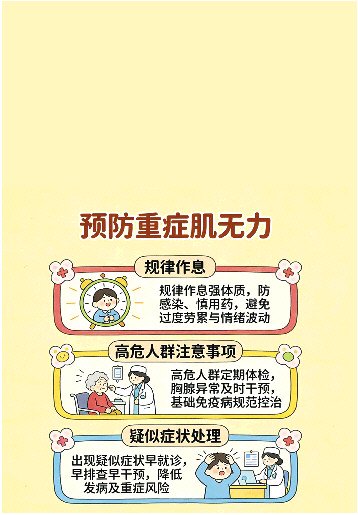
Core Insights - Myasthenia gravis is characterized by muscle fatigue and weakness due to the immune system attacking acetylcholine receptors, leading to signal transmission issues between nerves and muscles [3][5] - The disease has distinct symptoms, including "morning light, evening heavy" patterns and fluctuating symptoms, with eye-related issues often being the first sign [3][4] - Diagnosis is crucial due to similarities with other conditions, utilizing methods like blood antibody tests and CT scans [7] Summary by Sections Disease Overview - Myasthenia gravis is an autoimmune disease where the immune system produces antibodies that attack acetylcholine receptors, impairing muscle signal transmission [3] - Symptoms include muscle weakness, particularly in the eyes, throat, and limbs, which worsen with activity and improve with rest [4] Demographics and Risk Factors - The disease can occur at any age, with peaks in young women (20s-30s) and older men (50s-60s), and a rising trend in patients over 50 [5] - Potential triggers include thymus abnormalities, genetic predisposition, infections, and certain medications [5][6] Diagnosis and Treatment - Accurate diagnosis is essential due to symptom overlap with other neurological conditions, employing tests like the edrophonium test and antibody detection [7] - Treatment focuses on symptom management and quality of life, with options including symptomatic treatment, immunotherapy, and thymectomy [7] Patient Management and Lifestyle - Patients are advised to engage in gentle aerobic exercises, maintain a balanced diet, and adhere to medication regimens to manage symptoms effectively [8] - Regular follow-ups are critical for monitoring treatment efficacy and preventing disease recurrence [8]
看好四大赛道,源创多盈“三深”策略深耕产业投资
Zheng Quan Shi Bao Wang· 2025-12-25 02:48
Core Insights - The company, Yuanchuang Duoying, focuses on technology innovation and has adopted a "three-depth" investment strategy to drive industrial investment and leverage technological value in Shandong province [1][2]. Investment Strategy - The "three-depth" strategy includes "deeply exploring industries," "deeply cultivating regions," and "deeply serving projects," which allows the company to identify and invest in promising projects early [2]. - The company emphasizes early-stage investments, starting from the patent stage of projects, and evaluates the number of published papers and patents in relevant fields [2]. Sector Focus - The company is optimistic about four key sectors: thermal power, electric power, computing power, and life sciences [1]. - In the semiconductor materials sector, Yuanchuang Duoying has invested in approximately 10 next-generation semiconductor material companies, managing over 10 billion yuan in funds and over 130 investment projects [1][4]. Regional Development - The company has established a presence in 15 cities, focusing on cities with either a GDP of over 1 trillion yuan or rich educational resources [4]. - In Jinan, the company has initiated the "Periodic Table Action" to focus on next-generation semiconductor materials, including indium phosphide, gallium arsenide, silicon carbide, and gallium nitride [4]. Life Sciences Sector - The life sciences sector is a major focus, with plans to allocate over 50% of future investments to this area, driven by increasing healthcare spending as GDP per capita exceeds $13,000 [4][5]. - The company aims to invest in synthetic biology, cell and gene therapy, and advanced medical devices, among other promising sub-sectors [5][6]. Market Trends - The domestic life sciences sector has shown significant innovation, transitioning from generic drug production to original innovations, with a notable increase in the number and value of overseas authorizations for innovative drugs [5]. - The market has experienced a complete cycle of bubble formation and burst, leading to more rational valuations and a mature perspective on long-term development in the life sciences sector [6]. Future Outlook - The company is exploring mergers and acquisitions and aims to support traditional enterprises through industrial integration [7]. - Yuanchuang Duoying plans to maintain its commitment to technology investment and aims to achieve a managed scale of 10 billion yuan by 2029 [7].
年轻人为何也会得脑卒中?专家解析四方面原因
Zhong Guo Xin Wen Wang· 2025-10-27 09:33
Core Points - The article discusses the increasing incidence of strokes among young people and identifies four main factors contributing to this trend [1] - It emphasizes the importance of early detection and management of risk factors to prevent strokes [2] Group 1: Factors Contributing to Strokes in Young People - Many young individuals neglect regular health check-ups, leading to undiagnosed conditions such as diabetes, hypertension, and hyperlipidemia, which can result in strokes [1] - Lifestyle choices, including late-night activities and lack of exercise, contribute to obesity and atherosclerosis, increasing the risk of stroke [1] - Cardiac issues, particularly atrial fibrillation or congenital heart diseases, can lead to blood clots that may block cerebral blood vessels, causing strokes [1] - Systemic diseases, such as autoimmune disorders, blood diseases, or arteritis, can also increase the likelihood of strokes in younger populations [1] - Specific risk factors for women include long-term use of contraceptives and smoking, which elevate stroke risk [1] Group 2: Early Detection and Prevention - The article highlights the "120 mnemonic" for early detection of stroke symptoms: - "1" refers to checking for facial symmetry and any drooping [2] - "2" involves assessing for weakness or numbness in one side of the body [2] - "0" indicates checking for difficulties in speech or understanding language [2] - Immediate action, such as calling emergency services (120) and seeking treatment at a specialized stroke center, is crucial upon noticing these warning signs [2]
致病T细胞可转化为调节性T细胞
Huan Qiu Wang Zi Xun· 2025-10-24 04:34
Core Insights - Two Japanese research teams have developed a stable and efficient method to convert pathogenic T cells into regulatory T cells, laying the groundwork for precise and safe cell therapies for autoimmune diseases [1][2] Group 1: Research Methodology - The Osaka University team established an innovative strategy to generate antigen-specific regulatory T cells from existing T cell resources in the human body, successfully activating effector T cells and promoting the expression of the key transcription factor Foxp3 [2] - The method has shown broad applicability across various human and mouse memory and effector T cells, effectively controlling autoimmune responses in inflammatory bowel disease and graft-versus-host disease [2] Group 2: Clinical Applications - The Keio University team applied the same technology to a mouse model of pemphigus vulgaris, a disease driven by autoreactive CD4+ T cells, successfully converting pathogenic T cells into stable regulatory T cells [2] - The converted regulatory T cells were able to migrate and accumulate in skin-related lymph nodes, effectively suppressing the activation of pathogenic T cells and the production of autoantibodies, leading to alleviation of skin lesions [2]
诺诚健华20251009
2025-10-09 14:47
Summary of the Conference Call for 诺诚健华 (Nocera Biopharma) Company Overview - **Company**: 诺诚健华 (Nocera Biopharma) - **Partner**: Xenios BioPharma - **Industry**: Biopharmaceuticals, focusing on autoimmune diseases and central nervous system disorders Key Points and Arguments Strategic Partnership - 诺诚健华 has entered a significant global licensing agreement with Xenios BioPharma, covering the global rights for 奥布替尼 (Obutinin) in multiple sclerosis (MS) and two preclinical drugs outside Greater China and Southeast Asia, with a total potential deal value exceeding $2 billion [2][3][5] - The deal includes an upfront payment of $100 million, milestone payments, and approximately $180 million worth of 7 million shares of Zyno common stock, totaling $280 million in upfront and near-term milestone payments [2][5] - 诺诚健华 will receive royalties of up to 17% to 19% on net product sales [2][5] Rationale for Partnership - The choice of Xenios BioPharma was based on its clinical development experience in autoimmune diseases, its Nasdaq listing, and strong execution capabilities, which are expected to maximize the global development potential of 奥布替尼 and other assets [2][6] - The partnership is expected to accelerate the clinical development of 奥布替尼 and other products in the global market, supporting 诺诚健华's internationalization efforts and enhancing long-term value through equity exchange [2][8] Development Stage and Future Plans - 诺诚健华 is entering a 2.0 development phase, focusing more on internationalization, commercialization, and differentiated product development, with plans to strengthen these capabilities through flexible business models and partnerships with international companies [4][11] - The company has over 10 products in various stages of development and aims to increase revenue through business development (BD) partnerships, with a focus on internationalization over the next three years [11][12] Clinical Development and Market Potential - 奥布替尼's global oncology rights remain with 诺诚健华, which is expanding into tumor indications and plans to submit applications in countries like Australia and Canada [13] - The company is also advancing clinical studies for ITP and SLE, which are particularly relevant in Asian populations [13] - The partnership with Xenios is expected to enhance the success potential of 奥布替尼 in global Phase III clinical trials and facilitate expansion into more autoimmune disease areas [8] Financial Implications - The cash component of the deal includes the $100 million upfront payment and milestone payments, with the stock component being part of the transaction price [16] - The transaction is anticipated to have a positive impact on the company's revenue and asset profit and loss statements [16] Additional Insights - The 7 million shares of Zyno common stock were issued at a nominal value of $0.001 per share, resulting in a minimal cost of approximately $700 [10] - The partnership with Zenith for 奥布替尼 development is based on their strong clinical development capabilities and successful track record in the autoimmune disease sector [8][12] - The collaboration is expected to create synergies and enhance the execution capabilities of both companies [12][18] Market Competition - Genesys is developing a dual antibody for MS, which may have a differentiated profile compared to 奥布替尼, but 诺诚健华 believes its Aurora kinase B inhibitor has higher success rates and market potential in treating MS [18] Conclusion The partnership between 诺诚健华 and Xenios BioPharma represents a strategic move to enhance the development and commercialization of innovative therapies in the autoimmune disease space, with significant financial implications and a focus on international growth. The collaboration is expected to leverage both companies' strengths to maximize the potential of their product pipelines.

唠科|避免人体“内战”的免疫“安全卫士”——2025年诺贝尔生理学或医学奖成果解读
Xin Hua She· 2025-10-07 11:35
Core Insights - The 2025 Nobel Prize in Physiology or Medicine was awarded to three scientists for their groundbreaking discoveries in peripheral immune tolerance, which have significant implications for the treatment of autoimmune diseases and cancer [10][13]. Group 1: Key Discoveries - The three laureates, Mary Brunkow, Fred Ramsdell, and Shimon Sakaguchi, identified regulatory T cells that prevent the immune system from attacking the body’s own cells, thus avoiding "internal wars" within the immune system [8][13]. - Sakaguchi's research in 1995 established that regulatory T cells are a special subset of T cells that protect against autoimmune diseases [14][16]. - Brunkow and Ramsdell's 2001 study linked mutations in the FOXP3 gene to rare autoimmune diseases, highlighting its critical role in the development of regulatory T cells [17][20]. Group 2: Clinical Implications - The discoveries have opened a new research field in peripheral immune tolerance, which could advance treatments for cancer, autoimmune diseases, and organ transplantation [10][13]. - Current data indicates that autoimmune diseases, such as type 1 diabetes and rheumatoid arthritis, affect approximately 10% of the population, underscoring the clinical significance of these findings [24].

三位诺奖新得主,为自身免疫性疾病带来“革命性希望”
Di Yi Cai Jing· 2025-10-06 12:32
Core Insights - The Nobel Prize in Physiology or Medicine for 2025 has been awarded to Mary E. Brunkow, Fred Ramsdell, and Shimon Sakaguchi for their discoveries related to peripheral immune tolerance, specifically identifying regulatory T cells (Tregs) as key components of the immune system [1][2] - The findings have laid the groundwork for a new research field and have the potential to lead to therapies for autoimmune diseases, cancer treatment, and prevention of severe complications post-stem cell transplantation [1][2] Group 1 - Tregs are immune suppressor cells whose dysfunction is linked to autoimmune diseases such as type 1 diabetes, rheumatoid arthritis, and systemic lupus erythematosus, providing theoretical support for understanding these complex diseases [2] - Research indicates that Tregs can mitigate organ transplant rejection and may offer revolutionary hope for treating infectious diseases like HIV and tuberculosis by modulating immune responses [2][3] Group 2 - The identification of Tregs dates back to the 1990s when Shimon Sakaguchi first recognized a subset of T cells carrying the CD25 molecule, establishing the link between Treg deficiency and various autoimmune diseases [2] - In 2000, Mary Brunkow and Fred Ramsdell elucidated the molecular markers of Tregs, such as the FOXP3 gene, and their association with human IPEX syndrome [2] Group 3 - Current clinical trials involving Tregs exceed 200, with promising results such as a study set to be published in December 2024 in "Med," demonstrating excellent outcomes from adoptive Treg therapy in kidney transplantation over a seven-year period [3] - The rapid advancement in this field is expected to lead to more treatment options beyond conventional immunosuppressants or antibody therapies, including the use of Treg cells for autoimmune disease treatment [3]
三生国健: 三生国健:2025年半年度报告
Zheng Quan Zhi Xing· 2025-08-29 13:12
Core Viewpoint - The report highlights the financial performance and strategic developments of Sunshine Guojian Pharmaceutical (Shanghai) Co., Ltd. for the first half of 2025, emphasizing significant revenue growth, increased net profit, and advancements in drug development, particularly in the field of autoimmune diseases. Financial Performance - The company achieved a revenue of RMB 642.01 million, representing a 7.61% increase compared to RMB 596.62 million in the same period last year [4] - The net profit attributable to shareholders reached RMB 190.32 million, a substantial increase of 46.96% from RMB 129.51 million year-on-year [4] - The net cash flow from operating activities was RMB 187.73 million, up 33.95% from RMB 140.15 million in the previous year [4] - Basic earnings per share increased to RMB 0.31, a rise of 47.62% from RMB 0.21 [4] Research and Development - R&D expenses increased by 25.53%, with R&D costs accounting for 36.48% of revenue, reflecting the company's commitment to innovation [4][9] - The company has made significant progress in its clinical pipeline, with multiple core autoimmune drug projects advancing to later clinical stages [10] Market and Industry Trends - The global autoimmune disease market is projected to grow from USD 138.9 billion in 2024 to USD 192.3 billion by 2032, with biologics expected to account for 82.4% of the market [6] - In China, the autoimmune disease market is anticipated to reach USD 6.6 billion in 2025, growing at a rate of 29.4% year-on-year, with biologics comprising 51.4% of the market [8] - The company is positioned to benefit from the increasing prevalence of autoimmune diseases and the shift towards biologics and targeted therapies [7][8] Strategic Developments - The company entered a landmark licensing agreement with Pfizer, marking a significant milestone in the global positioning of Chinese pharmaceutical companies [7][9] - This agreement includes a non-refundable upfront payment of USD 1.25 billion and potential milestone payments totaling up to USD 4.8 billion, showcasing the value of Chinese innovation in the global market [9] Clinical Advancements - The company has submitted an NDA for its anti-IL-1β monoclonal antibody and has several projects progressing through clinical trials, including anti-IL-17A and anti-IL-4Rα monoclonal antibodies [10] - These advancements indicate the company's strong pipeline and its potential to address unmet clinical needs in the autoimmune disease space [10]
