
金融风险管理

Search documents
上海“十五五”规划建议:加快建设人民币资产全球配置中心和风险管理中心
Xin Lang Cai Jing· 2026-01-18 22:27
Core Viewpoint - The Shanghai Municipal Committee has released recommendations for the 15th Five-Year Plan, emphasizing the establishment of Shanghai as a global center for RMB asset allocation and risk management [1] Financial Development - Accelerate the construction of a global RMB asset allocation center and risk management center [1] - Expand cross-border and offshore financial service functions, enhancing cross-border investment and financing facilitation [1] - Enrich currency hedging tools and optimize the offshore account system [1] Offshore Financial Services - Promote the development of offshore credit and free trade offshore bonds, while improving regulatory frameworks and business rules [1] - Create offshore financial (economic) functional zones [1] Market Connectivity - Deepen the interconnection between domestic and foreign financial markets [1] - Actively promote the establishment of an international financial asset trading platform in Shanghai [1] - Explore pilot programs for RMB foreign exchange futures trading [1] Global Financial Network - Support financial institutions in expanding their global service networks [1] - Diversify RMB-denominated financial product offerings to advance RMB internationalization [1] Risk Management - Enhance international reinsurance underwriting capabilities and service levels [1] - Strengthen financial regulation and accelerate the construction of a financial risk monitoring and early warning system [1] - Utilize technologies such as blockchain and large models to improve financial risk identification and management [1] Financial Stability - Improve the resilience of financial infrastructure and ensure the reliability of both hardware and software [1] - Strengthen responses to financial risks to ensure stable financial operations [1] Collaborative Development - Deepen the collaborative development of the Shanghai-Hong Kong international financial center [1] - Continue to successfully host the Lujiazui Forum [1]
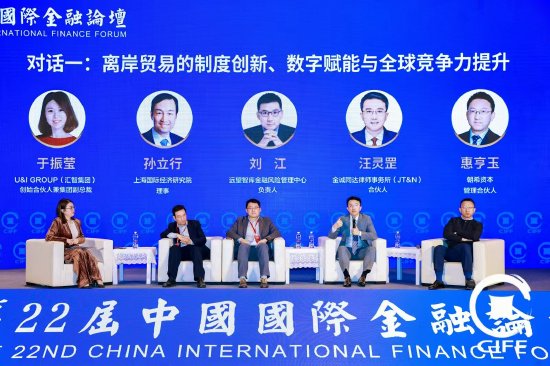
第二十二届中国国际金融论坛成功举行,嘉宾热议“离岸贸易制度创新与数字赋能”
Xin Lang Cai Jing· 2025-12-20 15:14
Group 1 - The 22nd China International Financial Forum was held in Shanghai on December 19-20, focusing on the theme of building an intelligent financial ecosystem in the digital economy era [1][5] - The sub-forum on "Institutional Innovation in Offshore Trade, Digital Empowerment, and Enhancing Global Competitiveness" featured discussions led by industry experts including representatives from Huizhi Group, Shanghai International Economic Research Institute, and others [1][5] Group 2 - Wang Linggang expressed that China is not legally prepared to establish offshore finance, emphasizing that offshore financial activities must operate within the framework of China's complex foreign exchange regulations [3][7] - Liu Jiang highlighted the necessity for Chinese enterprises to proactively manage financial risks when going abroad, referencing the saying "If you are not on the table, you are on the menu" to stress the importance of international presence [3][7] - Liu Jiang also stated that offshore finance could serve as a crucial platform for managing financial derivatives and risks, positioning it as a frontline for financial risk management [4][8]

一手创办新中国第一家证券公司,因“327国债”事件一夜跌落谷底 证券风云人物管金生去世
Shen Zhen Shang Bao· 2025-10-11 04:33
Core Viewpoint - The passing of Guan Jinsheng, a significant figure in China's securities market, marks the end of an era, reflecting both his contributions and the tumultuous history of the industry [1][3]. Group 1: Background and Achievements - Guan Jinsheng was born on May 19, 1947, in Jiangxi Province and co-founded the first joint-stock securities company in New China, Wangguo Securities, in 1988 [2]. - Under his leadership, Wangguo Securities controlled over 70% of A-share trading volume and held a 60% share of underwriting in the market during its peak [2]. - The "327 National Debt" incident in 1995 was a pivotal moment in his career, leading to significant losses for Wangguo Securities and ultimately resulting in his imprisonment for 17 years [4][5]. Group 2: Later Life and Legacy - After his release in 2003, Guan Jinsheng took on various roles, including strategic advisor and director at financial institutions, and he reflected on his past mistakes [6]. - In 2016, at the age of 69, he founded the Shanghai Jiusu Mountain River Equity Investment Fund, focusing on new technologies and materials, marking his third entrepreneurial venture [6][7]. - His contributions to the industry included addressing issues within the financial sector and emphasizing the importance of serving the real economy, which he aimed to achieve through his new fund [7].
大摩闭门会-金融、 风电、汽车、交运行业更新
2025-09-26 02:29
Summary of Key Points from Conference Call Industry Overview - The conference call primarily discusses the **wind power industry** and its dynamics, along with insights into the **automobile** and **luxury car dealership** sectors. [1][2] Core Insights and Arguments Wind Power Industry - The wind power industry is expected to benefit from a surge in demand and industry consolidation, with installation volumes projected to exceed **100 GW** by **2025**. [1] - The trend towards larger wind turbines is causing component supply constraints, leading to a rebound in industry gross margins starting from the first half of **2025**. [1] - Wind power has a power density advantage over solar power, with mechanism electricity prices in Shandong province reaching **0.32 CNY/kWh**, compared to **0.2 CNY/kWh** for solar. [1][4] - The anticipated new installation volume for wind power in the coming years is expected to remain between **100-120 GW**, with offshore wind accounting for **15-20 GW**. [5] - The competition landscape in the component sector is more favorable than in complete machine manufacturing, indicating promising profit prospects. [5][6] Key Companies - **Zhongtian Technology** is highlighted as a low-valuation player with a projected **P/E ratio of 13.5** by **2026**. The company is expected to benefit from increased revenue in its optical communication segment, with revenues projected to rise from **1-2 billion CNY** in **2024** to over **10 billion CNY** in **2026**. [7] - **China National Materials Technology** is the largest blade supplier in China, holding about **40%** market share. Its gross margin is expected to recover to **17-18%** in the first half of **2025**. [8] - **Goldwind Technology** maintains a hold rating due to valuation considerations, with its current market-to-book ratio at **1.1** and facing competitive pressures in both onshore and offshore wind markets. [9] Market Dynamics - The wind power sector is experiencing a significant turnaround after a downturn from **2022 to 2024**, with installation volumes increasing from **38 GW** in **2021-2022** to an expected **100 GW** in **2025**. [2] - The **136 Document** has not significantly impacted the wind power sector, as demand remains strong despite new market pricing policies. [16] - The pricing of onshore wind turbines has remained stable, while offshore wind prices are influenced by regional demand and bidding volumes. [16][17] Luxury Car Dealership Industry - The luxury car dealership sector is nearing a bottom and is expected to rebound in **2026** after a period of store closures and declining margins. [10][11] - The overall profitability of new car sales is under pressure, but strong new car release cycles and stable accident repair services are expected to support core profitability. [11] Other Important Insights - The wind power industry is expected to see a continued increase in installation volumes and profitability due to improved utilization rates and product structure enhancements. [5] - The consolidation in the wind power sector has led to a more favorable competitive environment for component suppliers compared to complete machine manufacturers. [6] - The luxury car market is facing challenges, including declining margins and store closures, but new vehicle launches are anticipated to improve profitability. [11] This summary encapsulates the key points discussed in the conference call, focusing on the wind power industry and its competitive landscape, as well as insights into the luxury car dealership sector.



首旅酒店: 北京首都旅游集团财务有限公司2025年半年报风险评估报告
Zheng Quan Zhi Xing· 2025-08-29 17:14
Core Viewpoint - The financial company has established a comprehensive internal control system and adheres to regulatory requirements, demonstrating effective risk management and operational stability [16]. Group 1: Company Overview - The financial company, established in 2013, has a registered capital of 2 billion RMB and provides financial management services to the Beijing Capital Tourism Group and its subsidiaries [2][3]. - The shareholders include Beijing Capital Tourism Group (56.64%), Wangfujing Group (25%), and China Quanjude Group (12.5%) [2]. Group 2: Internal Control and Risk Management - The company has a well-defined governance structure with a board of directors, risk control committee, and audit committee to oversee risk management and compliance [5][6]. - The risk control committee is responsible for approving risk management frameworks and monitoring risk levels across various categories [5]. - The audit committee supervises internal controls and audits, ensuring compliance with financial regulations [6]. Group 3: Financial Performance - As of June 30, 2025, the company reported total assets of approximately 12.71 billion RMB and net profit of approximately 42.83 million RMB for the first half of 2025 [13][14]. - The capital adequacy ratio stands at 21.58%, exceeding regulatory requirements, while the liquidity ratio is 69.52% [14]. Group 4: Business Operations - The company offers various services, including deposit acceptance, loan processing, and financial consulting for its member units [4][8]. - The company has implemented a robust internal control system to manage risks associated with its financial operations [10][12]. Group 5: Risk Assessment - The financial company has not encountered significant operational risks or regulatory penalties since its inception, indicating a stable operational environment [14][16]. - The company maintains a strong focus on risk management, ensuring that all regulatory indicators are met [16].

山煤国际: 关于公司与山西焦煤集团财务有限责任公司之间关联存贷款等金融业务的风险持续评估报告
Zheng Quan Zhi Xing· 2025-08-27 13:09
Group 1 - The financial company, established in December 2009, is primarily owned by Shanxi Coking Coal Group Co., Ltd. with an 80% stake and has a registered capital of 3.55 billion RMB [1][2] - The financial company provides various services including deposit acceptance, loan processing, bill discounting, and financial consulting for its member units [2][3] - The company has a robust internal control and risk management framework, including a governance structure with a board of directors and various committees to oversee risk management [3][4] Group 2 - As of June 2025, the financial company reported total assets of approximately 45.65 billion RMB and total liabilities of about 39.92 billion RMB, with a liquidity ratio of 45.97% and a capital adequacy ratio of 16.97% [6][7] - The financial company has maintained a non-performing loan ratio of 0% and has not experienced any significant financial risks or operational issues since its establishment [7][8] - The company has established a series of emergency management protocols to effectively respond to unexpected events, ensuring operational stability [5][6]

这一轮走势,会复制10年前的行情吗?
大胡子说房· 2025-08-23 04:51
Core Viewpoint - The recent rally in the A-share market has drawn significant attention, reminiscent of the 2015 bull market, raising concerns about a potential repeat of past market volatility [5][6][13]. Market Performance - The A-share market has shown a continuous upward trend, with the index approaching 3800 points and daily trading volumes exceeding 2 trillion yuan [1]. - The interest in the A-share market has even attracted foreign investors, particularly from South Korea, with their holdings increasing from 19.083 billion yuan at the end of 2024 to 24.475 billion yuan, a growth of nearly 30% [2][4]. Historical Comparison - The 2015 bull market was characterized by excessive liquidity, primarily driven by foreign capital and unregulated leverage, leading to a significant crash afterward [7][8]. - The market's total value evaporated by 25.5 trillion yuan, a decline of 36%, with over 30% of stocks experiencing more than a 50% drop [6]. Funding Sources - The current market rally is also driven by liquidity, but the sources of funds differ from 2015. The main contributors now are state-backed funds and institutional leverage, rather than foreign capital [9][10]. - The role of foreign capital has been replaced by state-backed funds, which are considered more stable as they aim to support the market [10]. Risk Management - The financial regulatory environment has improved since 2015, with stricter controls on foreign capital and leverage, reducing the risk of a sudden market collapse [12]. - The current market's leverage is primarily held by institutions, which have a stronger risk management capability compared to retail investors who dominated the previous bull market [10][11]. Market Structure - The current market resembles a structural bull market similar to early 2021, where only specific sectors, like technology, are experiencing significant gains while others lag behind [14][15]. - The likelihood of a broad-based bull market is low, as state-backed funds are unlikely to push all stocks up simultaneously, preferring a controlled, gradual increase [15][16]. Investment Strategy - Investors are advised to either hold onto index-related stocks or strategically position themselves in sectors that are expected to benefit from the current market dynamics [17].

金融安全网构建的理论基石 评《存款保险制度研究:定价机制与风险效应》
Jin Rong Shi Bao· 2025-08-22 06:58
Core Viewpoint - The article emphasizes the importance of the deposit insurance system as a crucial component of financial security in China, highlighting its role in maintaining financial stability and protecting depositors' interests, particularly in the context of its ten-year implementation since 2015 [1][4]. Summary by Sections Deposit Insurance Pricing Mechanism - The book systematically studies the deposit insurance pricing issue from three dimensions: regulatory penalties, interval pricing, and macroeconomic policy considerations. It introduces a tolerance coefficient into Merton's classic model, showing that increased regulatory penalties lead to lower risk preferences among banks and subsequently lower deposit insurance rates [1][2]. - The research also incorporates fuzzy mathematics into the deposit insurance pricing model, demonstrating the theoretical significance and practical necessity of interval pricing, ultimately deriving deposit insurance prices based on triangular intuition fuzzy numbers [1][2]. - The impact of tax reduction policies on the real economy and financial sector is analyzed, revealing that a decrease in income tax rates leads to lower deposit insurance premiums, with empirical evidence indicating that higher bank income tax rates increase risk-taking and thus raise deposit insurance rates [1][2]. Risk Effects of Deposit Insurance System - The study investigates the impact of the deposit insurance system on banks' risk-taking behavior through four dimensions: the influence mechanism, differentiated rates, early corrective actions, and prudent regulatory policies. It finds that the implementation of the deposit insurance system effectively reduces risk-taking levels among small and medium-sized banks [2][3]. - The research expands on classic theoretical models, proving that differentiated deposit insurance rates have a suppressive effect on banks' risk-taking, particularly in the context of rural commercial banks' reforms [2][3]. - The book constructs indicators to characterize the early corrective actions of the deposit insurance system, confirming its effectiveness in early risk correction through unique data on real deposit insurance rates for small and medium-sized banks [2][3]. Policy Recommendations for Improvement - The author proposes four policy recommendations to enhance China's deposit insurance system: accelerating the legislation of the Deposit Insurance Law to improve its role and independence; strengthening regulatory collaboration to enhance efficiency; establishing a financial firewall between small and large banks to reinforce oversight; and utilizing big data to improve risk management and public supervision mechanisms [3][4]. Overall Assessment - The book presents a comprehensive study of the deposit insurance pricing mechanism and the effects of the deposit insurance system, characterized by a framework that integrates empirical facts, pricing mechanisms, risk effects, and mechanism design. It effectively combines theoretical and empirical research, addressing both pricing mechanisms and risk effects in detail [4][5]. - The theoretical contributions include integrating prudent regulation and macroeconomic policies into deposit insurance pricing models, enriching the theoretical landscape of deposit insurance [4][5]. - The empirical focus on small and medium-sized banks provides valuable insights into the effects of the deposit insurance system, offering a scientific evaluation that can inform future improvements [4][5].
光库科技: 关于珠海华发集团财务有限公司2025年半年度风险持续评估报告
Zheng Quan Zhi Xing· 2025-08-17 08:15
Core Viewpoint - Zhuhai Guangku Technology Co., Ltd. has conducted a risk assessment report on Zhuhai Huafa Group Financial Co., Ltd. for the first half of 2025, indicating that the financial company has established a comprehensive internal control system and meets regulatory requirements, ensuring effective risk management [1][12]. Group 1: Basic Information of the Financial Company - Zhuhai Huafa Group Financial Co., Ltd. is a non-bank financial institution approved by the China Banking and Insurance Regulatory Commission, established to provide financial management services to Huafa Group and its subsidiaries [1][2]. - The financial company has a registered capital of 5 billion RMB and is owned by several entities, with Huafa Group holding 30% [2]. Group 2: Internal Control and Risk Management - The financial company has established a governance structure including a shareholders' meeting, board of directors, and supervisory board, along with various specialized committees for risk management and auditing [3][4]. - A comprehensive internal control management system has been implemented, including risk identification and assessment procedures, ensuring that risks are kept at a manageable level [5][11]. Group 3: Financial Performance - As of June 30, 2025, the financial company reported total assets of 43.24 billion RMB, total liabilities of 36.23 billion RMB, and net assets of 7.00 billion RMB, with operating income of 495.59 million RMB and net profit for the first half of 2025 [11]. - The financial company has maintained a stable operation without significant incidents affecting its normal business, such as deposit runs or major loan defaults [11][12]. Group 4: Regulatory Compliance - As of June 30, 2025, the financial company’s capital adequacy ratio was 17.44%, and liquidity ratio was 34.16%, indicating compliance with regulatory requirements [11]. - The financial company has not faced any administrative penalties or orders for rectification from regulatory authorities [11][12]. Group 5: Business Objectives and Advantages - The financial company's mission is to provide efficient financial management services to its group members, enhancing capital utilization and operational efficiency [12]. - It aims to leverage its position as a corporate financial company to create a comprehensive financial platform for Huafa Group [12]. Group 6: Risk Assessment Opinion - The company believes that the financial company has a valid financial license and business license, with a complete internal control system that effectively manages risks [12]. - No significant deficiencies in risk management have been identified, and the risks associated with deposit financial services are considered controllable [12].

华发股份: 珠海华发集团财务有限公司2025年半年度风险持续评估报告
Zheng Quan Zhi Xing· 2025-08-15 11:17
Core Viewpoint - Zhuhai Huafa Group Financial Company is a non-bank financial institution established to provide financial management services to Huafa Group and its subsidiaries, with a focus on risk management and internal control [1][16]. Group 1: Company Overview - The financial company was approved by the China Banking Regulatory Commission and began operations on September 6, 2013, with an initial registered capital of RMB 1 billion [1]. - As of June 30, 2025, the financial company had total assets of RMB 43.24 billion and net assets of RMB 7.00 billion, with a revenue of RMB 495.59 million and a net profit of RMB 221.96 million for the first half of 2025 [12][13]. Group 2: Internal Control and Risk Management - The financial company has established a comprehensive internal control system, including governance structures such as the board of directors and risk management committees, to ensure effective risk management and compliance with regulations [5][6]. - Various management measures and procedures have been implemented to identify, assess, and mitigate risks, including the establishment of specialized committees for credit review and investment [9][10]. Group 3: Regulatory Compliance - As of June 30, 2025, the financial company met all regulatory requirements, with a capital adequacy ratio of 17.44% and a liquidity ratio of 34.16% [13][14]. - The company has not faced any significant operational risks or regulatory penalties since its establishment, indicating a stable operational environment [13]. Group 4: Business Operations and Advantages - The financial company's mission is to provide efficient financial management services to the Huafa Group, enhancing capital utilization and operational efficiency [15][16]. - The company offers a range of services, including deposit acceptance, loan processing, and financial consulting, tailored to the needs of its member units [4][15].