
隐瞒犯罪所得罪

Search documents
以案释法 | 三人用练功钞调包赃款,“黑吃黑”涉两罪获刑
Xin Lang Cai Jing· 2026-02-28 02:45
Core Viewpoint - The case involves three individuals who knowingly assisted in cashing out criminal proceeds from a scam, ultimately leading to their conviction for concealing and stealing criminal gains [1][3][4]. Group 1: Case Details - The case was handled by the Luohu District Prosecutor's Office, resulting in prison sentences ranging from eight months to one year and four months for the three defendants [1][4]. - Wu, introduced by a former inmate, began using his bank account to help a scam group collect and cash out funds, earning profits from the illicit activities [2][3]. - After receiving an initial scam payment of 49,800 yuan, Wu devised a plan to switch real cash with counterfeit money during a cash withdrawal [2]. Group 2: Criminal Actions - Wu, along with his accomplices, planned to exchange 20,000 yuan of real cash with counterfeit money during a bank transaction, demonstrating intent to commit fraud [2][3]. - The actions of Wu and his accomplices were discovered during the investigation of the scam funds, leading to charges of concealing criminal proceeds and theft [3]. - The court found that both Wu and his accomplices knowingly assisted in the cashing out of criminal proceeds, constituting a crime [3][4].
最高法:侵犯财产犯罪总量下降,但新型犯罪挑战凸显
Xin Lang Cai Jing· 2026-02-27 03:58
Core Viewpoint - The Supreme People's Court is currently drafting opinions on the handling of extortion criminal cases and is seeking feedback on opinions regarding fraud criminal cases, aiming to enhance the legal framework for addressing property crimes in China [1][4]. Group 1: Trends in Property Crimes - From 2021 to 2025, the number of newly accepted first-instance property crime cases reached 1.273 million, with 1.271 million cases concluded, indicating a strong effort to combat such crimes [1]. - The total number of property crime cases has shown a downward trend, with a notable decrease from 322,000 cases in 2016 to 270,000 cases in 2025 [1]. - The number of property crime cases fluctuated during the pandemic, with a peak of 279,000 cases in 2021, dropping to 202,000 in 2022, and then rising again to 283,000 in 2024 before falling to 270,000 in 2025 [1]. Group 2: Challenges in Legal Application - The complexity of legal application in property crimes has increased, particularly with the rise of new types of crimes influenced by rapid economic and technological developments [2]. - The Supreme People's Court established a research team in 2025 to address legal application issues related to property crimes, focusing on various types of fraud and theft [2]. Group 3: Fraud Crime Characteristics - Fraud crimes have consistently ranked among the top five newly accepted criminal cases, with the number of new fraud cases rising from 52,000 in 2022 to 94,000 in 2024, marking an increase of 81.2% over five years [3]. - The methods of fraud have become increasingly diverse and intelligent, with new technologies being employed to enhance the effectiveness of scams [3]. Group 4: Legal Framework for Fraud Cases - The Supreme People's Court is drafting opinions on handling fraud criminal cases to guide courts in accurately applying criminal policies and distinguishing between civil fraud and criminal offenses [4]. Group 5: Growth of Concealment Crimes - From 2021 to 2025, the number of cases related to concealing and hiding criminal proceeds reached 286,000, reflecting a trend towards more organized and industrialized methods of crime [6]. - The structure of upstream crimes has shifted from theft to fraud, particularly in telecommunications and online scams [6].
同小区“邻居”帮忙开通网店,线下秘密“接头”套走了222万元现金
Xin Lang Cai Jing· 2026-02-08 14:25
Core Viewpoint - The article highlights the increasing sophistication of virtual currency scams, detailing a specific case involving multiple individuals who facilitated the fraud through a complex network of transactions and communications [1][3][9]. Group 1: Scam Mechanism - Criminals exploit the anonymity and complexity of virtual currency transactions to create intricate traps for victims, leading to significant financial losses [1]. - The scam involves a series of steps where victims are lured into believing they are engaging in legitimate virtual currency exchanges, only to be defrauded [2][3]. - The use of "hands" or intermediaries to collect cash from victims is a common tactic, allowing the main perpetrators to distance themselves from direct contact with the victims [3][8]. Group 2: Legal Proceedings - The Shanghai Pudong New District Prosecutor's Office filed charges against the accomplices, Wu and Zhang, for concealing and disguising criminal proceeds [9]. - The court sentenced Wu to four years in prison and a fine of 50,000 yuan, while Zhang received a sentence of one year and eight months along with a fine of 20,000 yuan [1]. - Evidence collected during the investigation, including chat records and transaction IDs, confirmed the fraudulent nature of the virtual currency exchanges [7][8]. Group 3: Investigation Insights - The investigation revealed a hidden route for transferring illicit funds, leading to the identification and arrest of the main suspects [3][8]. - The prosecutor's office emphasized the importance of understanding the criminal intent behind the actions of the accused, particularly regarding their knowledge of the fraudulent activities [8][11]. - The case illustrates the need for vigilance against scams involving large cash transactions and the importance of recognizing suspicious behaviors in financial dealings [12].


取得许可证后超范围跨区域销售走私烟
Xin Lang Cai Jing· 2026-01-13 16:41
Core Viewpoint - The case involves the illegal sale of smuggled cigarettes by an individual named Zhu, who initially faced charges of illegal business operations but was later convicted of concealing and disguising criminal proceeds after an appeal [1][2]. Group 1: Case Background - Zhu purchased smuggled and exported cigarettes without holding a valid retail license, selling them to a buyer named Wei, resulting in a total sales revenue of 3,684,851 yuan and a profit of at least 52,732 yuan [1]. - A total of 4,925.4 cartons of cigarettes were seized, with a purchase price of 725,896 yuan, including 19 counterfeit cartons and 45 cartons with fake trademarks [1]. Group 2: Court Findings - The Hainan Free Trade Port Intellectual Property Court found that Zhu held a valid tobacco retail license but exceeded its scope by engaging in cross-regional wholesale and retail of smuggled cigarettes [2]. - The court determined that Zhu knowingly purchased smuggled or counterfeit cigarettes and concealed criminal proceeds amounting to over 4 million yuan, leading to a conviction for concealing and disguising criminal proceeds [2]. Group 3: Sentencing - The initial sentence of seven years for illegal business operations was reduced to five years for concealing criminal proceeds, with a fine of 80,000 yuan imposed [2].
西安长安法院 | 两人“跑分”双双获刑!
Xin Lang Cai Jing· 2025-12-25 04:04
Core Viewpoint - The article highlights the dangers of engaging in illegal activities for quick financial gain, using the case of an individual named Wang Yi who became involved in money laundering related to online gambling and fraud [2][3]. Group 1: Criminal Activities - Wang Yi was lured by the promise of easy money through "running scores," which involved helping to transfer funds from online gambling and telecom fraud [2]. - He provided bank account information of others, referred to as "card farmers," to facilitate the transfer of illegal funds [2]. - Wang Yi and his accomplice, Li Er, knowingly participated in the transfer of criminal proceeds, which constituted a violation of Article 312 of the Criminal Law of the People's Republic of China [3]. Group 2: Legal Consequences - The court sentenced Wang Yi to one year and seven months in prison and Li Er to one year, along with fines and the recovery of illegal gains [3]. - The judge emphasized that even assisting in concealing or transferring criminal proceeds can lead to criminal liability, regardless of direct involvement in the initial crime [3]. Group 3: Public Awareness and Prevention - The article warns that many individuals fall into illegal activities due to the allure of easy profits, often presented by criminals as "high returns" [4]. - It encourages the public to critically assess the legality and legitimacy of such financial opportunities to avoid becoming complicit in crime [4]. - The message stresses the importance of adhering to the law and earning wealth through legitimate means, urging individuals to be informed and responsible citizens [4].

“工具人”帮助转移赃款被判刑
Xin Lang Cai Jing· 2025-12-23 19:08
Core Viewpoint - The article discusses a recent court case in Hainan Province involving a scam operation disguised as a high-paying job opportunity, highlighting the methods used by fraudsters to lure victims and the legal consequences faced by those involved in the crime [1] Group 1: Scam Operation Details - The scam involved a chat group named "精准扶贫专项资金对接打款" where participants were promised monetary rewards for recruiting others and providing bank account information [1] - The accused, Qian, was previously convicted and sought to earn 2,000 yuan by participating in the scam despite knowing it was illegal [1] - Victim Yang was lured into investing 100,000 yuan in a fake gold futures scheme, which led to the funds being transferred to the accounts of the accused [1] Group 2: Legal Proceedings and Sentencing - The court found Qian guilty of concealing and transferring criminal proceeds, resulting in a sentence of 2 years in prison and a fine of 15,000 yuan [1] - The court considered Qian's cooperation with law enforcement and partial restitution to the victim during sentencing [1] - The judgment included a combination of sentences for multiple offenses, reflecting the severity of the crime [1]
从“冠字号码”上找到突破口
Ren Min Wang· 2025-12-10 00:41
Core Points - The case involves a defendant, Ke, who was sentenced to 18 months in prison for concealing and disguising criminal proceeds related to a fraud case, with the sentence combined to a total of 2 years due to prior probation violations [1] - The investigation revealed that Ke exchanged cash for U-Currency (a virtual currency pegged to the US dollar) in a suspicious manner, indicating knowledge of the illicit nature of the funds [2] - Key evidence included a video showing large stacks of cash, which was linked to the victim's bank withdrawal records, confirming the source of the funds as fraudulent [2][3] Group 1 - Ke was found guilty of concealing criminal proceeds and was sentenced to 2 years in prison after a previous probation was revoked [1] - The investigation utilized video evidence to trace the cash back to the victim, establishing a direct link to the fraudulent activity [2] - The choice of location and timing for the cash exchange raised suspicions about Ke's awareness of the criminal nature of the funds [2] Group 2 - The court accepted the prosecution's evidence and sentencing recommendations, leading to a conviction that was upheld [3] - Ke initially denied involvement but ultimately confessed in court after the evidence was presented [3]
虚拟货币异常交易涉嫌犯罪,北京一男子因协助转移赃款获刑
Xin Jing Bao· 2025-08-26 12:45
Group 1 - A recent case in Beijing highlights the legal consequences of using virtual currencies to conceal and transfer criminal proceeds, with a defendant sentenced to three and a half years in prison for assisting in the transfer of 200,000 RMB in fraudulently obtained funds [1] - The court found that the defendant, Liu, knowingly sold USDT to an individual aware that the cash involved was criminal proceeds, which led to the conviction for the crime of concealing and disguising criminal proceeds [1] - The ruling emphasized that the total value of concealed criminal proceeds exceeding 100,000 RMB qualifies as "serious circumstances," resulting in Liu's sentence and a fine of 40,000 RMB [1] Group 2 - Judges noted that such crimes are characterized by a profit-driven mentality and a false sense of security, as criminals often underestimate the legal repercussions of their actions [2] - The judiciary warns the public to be cautious of unusual virtual currency transactions that deviate from market prices, involve rapid large transactions, or employ covert operations, as these may indicate illicit activities [2] - Individuals knowingly assisting in the conversion or transfer of criminal proceeds may face severe criminal penalties under Chinese law, specifically Article 312 of the Criminal Law [2]
什么情况?顾客买黄金,店主被判刑?
Sou Hu Cai Jing· 2025-08-26 08:41
Group 1 - The case highlights the risks associated with large transactions in the gold industry, particularly regarding money laundering and the concealment of criminal proceeds [1][6] - The jewelry store owner, despite being warned about suspicious customer behavior, continued to facilitate transactions, ultimately leading to legal consequences [2][4] - The case serves as a warning to other businesses in the gold sector to adhere to anti-money laundering regulations and to be vigilant in identifying potentially illicit transactions [4][6] Group 2 - The legal framework under which the store owner was prosecuted emphasizes the seriousness of knowingly facilitating transactions involving criminal proceeds [6] - The increasing trend of criminals using gold purchases to launder money underscores the need for stricter compliance measures within the industry [6] - The case illustrates the importance of understanding legal obligations and the potential repercussions of neglecting due diligence in financial transactions [6]
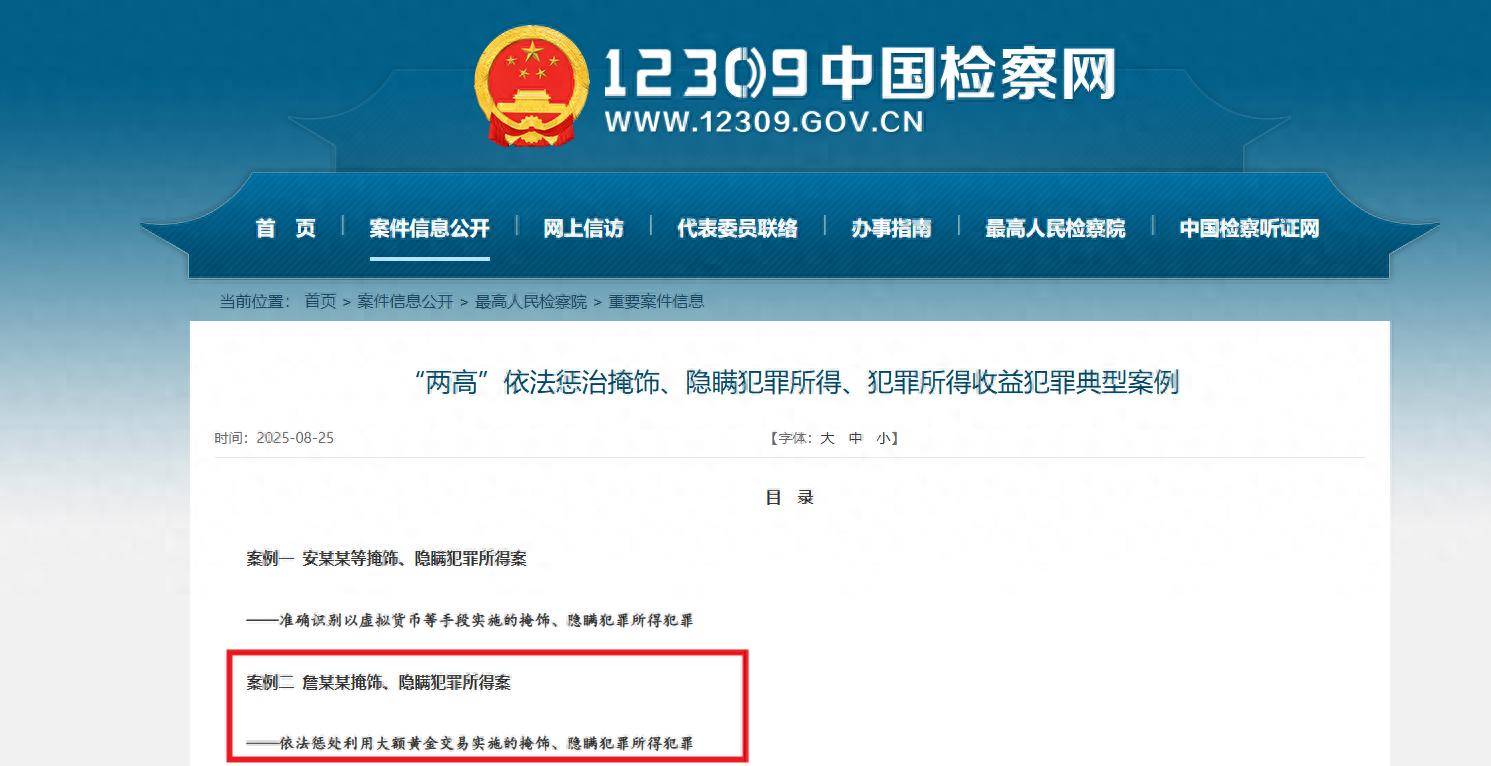
两高发布一批典型案例
Xin Hua She· 2025-08-26 02:33
Core Viewpoint - The Supreme People's Court and the Supreme People's Procuratorate have released typical cases to clarify the legal issues surrounding the concealment and disguise of criminal proceeds, particularly in the context of virtual currencies and large gold transactions [1][2] Group 1: Criminal Methods - Criminals are increasingly using virtual currencies and large gold transactions to conceal the origins and nature of illicit funds, leveraging blockchain technology and virtual spaces for rapid fund transfers [1] - In a specific case, defendants used a network trading platform to convert criminal proceeds into virtual currency, facilitating quick transfers to evade law enforcement [1] - The use of large gold transactions for concealing criminal proceeds has become a common method across various regions, as demonstrated in a case where a defendant knowingly assisted in such transactions [1] Group 2: Legal Proceedings and Judgments - In a case involving the purchase of stolen steel plates, the defendant was sentenced to six years in prison for knowingly acquiring goods of unknown origin at significantly below market value, resulting in illegal profits exceeding 6 million yuan [2] - The distinction between aiding information network crimes and the concealment of criminal proceeds has posed challenges in judicial proceedings, necessitating careful consideration of the defendant's knowledge and actions [2] - The release of these typical cases aims to enhance the effectiveness of handling criminal cases related to the concealment of criminal proceeds, ensuring proper application of the law [2]