
高精尖产业

Search documents
京津冀启动高精尖产业揭榜攻关
Xin Lang Cai Jing· 2026-02-25 21:01
Core Viewpoint - The Beijing Municipal Bureau of Economy and Information Technology, Tianjin Municipal Bureau of Industry and Information Technology, and Hebei Provincial Department of Industry and Information Technology have jointly announced the launch of the first batch of high-precision and cutting-edge industry foundational engineering projects for 2026, aiming to select quality innovative entities nationwide to tackle key core technologies and iconic products, promoting the transformation of more innovative achievements in the Beijing-Tianjin-Hebei region [1] Group 1 - The initiative focuses on enhancing the self-controllable capabilities of the industrial supply chain, targeting weak links in the "six chains and five clusters" industries [1] - Two main fields and four iconic products have been identified as key directions, specifically in humanoid robotics and biomedicine [1] - In the humanoid robotics sector, the focus is on breakthroughs in lower limb high-explosive joints, upper limb high-precision and high-stability joints, and highly flexible dexterous hands [1] Group 2 - In the biomedicine field, the primary focus is on DSA ball tube technology, with an emphasis on promoting the transformation of innovative achievements in the Beijing-Tianjin-Hebei region [1] - Eligible enterprises for application must have good operational and financial conditions, with no serious credit violations in the past three years, and the project construction must be located in the Beijing-Tianjin-Hebei region [1] - The application period for the projects is set to conclude by March 31, 2026, with a project duration not exceeding three years, starting after January 1, 2026 [1]
四大增长极经济与产业洞察报告(2025):京津冀篇
GUOTAI HAITONG SECURITIES· 2026-02-05 02:47
Economic Structure Insights - The primary industry in the Beijing-Tianjin-Hebei region remains below 10% of GDP, with a slow decline observed from 2019 to 2024[10] - The secondary industry is also below 40%, with notable differences among provinces; Hebei and Tianjin maintain over 30% while Beijing is below 20%[16] - The tertiary industry has become the dominant sector, exceeding 50% in all provinces, with Beijing reaching 85.27% in 2024, an increase of 0.96 percentage points since 2019[21] Regional Development Strategies - Beijing focuses on high-end industries, with the information transmission and software services sector as a key pillar, contributing 22.2% to GDP in 2024[47] - Tianjin emphasizes application scenarios to empower industrial chains, with the information technology application innovation industry as a leading sector[5] - Hebei aims to accommodate industrial transfers with a focus on traditional industries like steel and emerging sectors such as biomedicine[5] Future Industry Focus - Beijing's "2441" high-precision industry system targets strategic emerging industries, including integrated circuits and artificial intelligence, with a projected scale of nearly 6 trillion yuan by 2024[39] - Tianjin's modern industrial system upgrade includes biomedicine as a top emerging industry, with significant early investments in biomanufacturing[5] - Hebei's strategic plan highlights biomedicine as a priority emerging industry, alongside traditional sectors like steel[5] Risks and Challenges - Potential risks include policy implementation delays, ineffective coordination mechanisms, and economic slowdown, which could hinder regional development and industrial opportunities[5]
北京首提构建青年友好型政策体系
Zhong Guo Qing Nian Bao· 2026-01-27 10:09
Core Points - Beijing's government work report emphasizes the establishment of a youth-friendly policy system, including ten support measures for housing and entrepreneurship, aimed at stimulating innovation among young people [1][4][15] - The report highlights the need to address housing difficulties for youth by increasing the supply of various housing products [2] - The "14th Five-Year Plan" includes a dedicated chapter on talent, focusing on attracting young people to develop and innovate in the city [3] Group 1: Youth Development Initiatives - The Haidian District is creating a service brand for youth, providing housing and internship opportunities, with 1.5 million internship positions leading to job placements for nearly one-third of participants [5][6] - A survey targeting young talent was conducted to identify challenges faced in innovation and entrepreneurship, leading to the establishment of pilot innovation and entrepreneurship ecological demonstration zones [7] - The government has introduced a comprehensive policy package to support youth in five areas: living security, entrepreneurship support, talent cultivation, government services, and environmental creation [8] Group 2: Economic and Industrial Growth - Beijing aims to become an international center for technological innovation and develop high-tech industries, which will provide a solid foundation for youth talent [10] - The city has seen a doubling in the number of high-value invention patents and specialized small giant enterprises over the past five years, indicating strong economic growth [10] - The government plans to enhance educational resources and establish a global scientific and technological innovation hub, focusing on cutting-edge fields like artificial intelligence and biotechnology [11] Group 3: Talent Ecosystem and Recommendations - The government is implementing key talent plans to support a diverse range of talent, including top-tier and young talents, through a special allocation mechanism [13] - Suggestions from representatives include improving housing support for young talent and creating innovation alliances between universities, research institutions, and leading enterprises [14] - The city is also focusing on creating a competitive modern industrial system and an open innovation culture to attract and retain talent [12]
让人才活水激荡起高精尖产业发展澎湃春潮
Xin Lang Cai Jing· 2026-01-26 16:55
Core Viewpoint - Beijing is embarking on a significant development journey for its high-tech industries, emphasizing the importance of building a skilled workforce to drive innovation and economic growth [1][6]. Group 1: High-Tech Industry Development - The Beijing government has prioritized the development of high-tech industries in its work report, focusing on areas such as integrated circuits, international pharmaceutical innovation parks, and the implementation of "AI+" initiatives [1][6]. - The city aims to cultivate a modern industrial system that includes advanced sectors like 6G and quantum technology, requiring a robust and skilled talent pool [1][2]. Group 2: Talent Requirements - The evolving nature of high-tech industries necessitates a new breed of talent that combines deep expertise in specific fields with broad interdisciplinary knowledge [2]. - There is a call for the cultivation of "strategic craftsmen" and "industrial scientists" who possess system thinking, innovative spirit, and excellent execution capabilities [2]. Group 3: Talent Ecosystem - To establish itself as a global benchmark city for the digital economy, Beijing must attract top-tier talent and develop a substantial base of skilled engineers and technical managers [3]. - The city is encouraged to create a competitive talent ecosystem that includes comprehensive educational pathways and strong industry-academia collaboration [3]. Group 4: Structural Talent Optimization - The transition to new economic drivers requires a restructuring of the talent pool, focusing on engineers who understand both traditional crafts and digital technologies [4]. - There is a need for a cultural shift that encourages exploration and tolerates failure, allowing for the emergence of innovative talent [4]. Group 5: Value of Talent - The role of talent has evolved from a mere production factor to a strategic foundation for economic and social development, reflecting a significant change in development philosophy [5]. - High-skilled talent is seen as essential for supporting high-quality development and sustainable competitiveness in Beijing, contributing to the city's overall progress [5].
北京明确2026年主要经济工作:多举措扩内需 发展高精尖产业
Shang Hai Zheng Quan Bao· 2026-01-25 18:54
Economic Growth and Development Plans - Beijing's GDP is expected to grow by around 5% in 2026, focusing on expanding domestic demand and accelerating the development of new productive forces [2] - The city aims to significantly boost high-tech industries and fully implement the "Artificial Intelligence +" initiative [2][5] Investment and Consumption Strategies - Beijing plans to promote effective investment by optimizing the implementation of key projects, with a total investment of no less than 200 billion yuan [4] - The government will enhance consumer capacity by formulating policies to increase urban and rural residents' income and improving the quality of traditional commercial areas [3] High-Tech Industry Development - The integrated circuit industry in Beijing has seen over 20% growth, with nearly 700,000 new energy vehicles produced annually and 34 innovative drugs approved for market [5] - The city will continue to develop high-tech industries, including expanding production in key integrated circuit projects and constructing an international pharmaceutical innovation park [5][6] Service Sector Growth - The modern service industry, including software information, technology services, and business services, contributed over 50% to economic growth in 2025 [4] - Beijing will support service consumption policies in education, health, and elder care, while encouraging innovation in service industries [3]


北京晒政府账本
第一财经· 2026-01-25 08:13
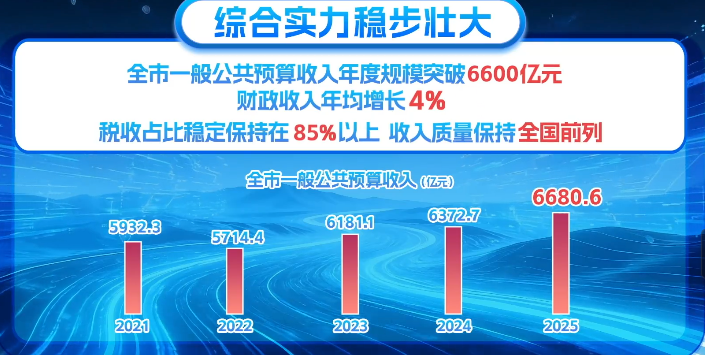
Core Viewpoint - Beijing's fiscal revenue for 2025 is projected to grow steadily, outperforming the national average, with a general public budget revenue of 668.06 billion yuan, reflecting a year-on-year increase of 4.8% [3][5]. Fiscal Revenue - The general public budget revenue for Beijing in 2025 is 668.06 billion yuan, with a growth rate of 4.8%, closely aligning with the city's GDP growth of 5.4% [3][5]. - Tax revenue constitutes 86.5% of the general public budget revenue, indicating strong resilience in revenue growth [5][6]. - The growth rate of Beijing's fiscal revenue is higher than the national average and the previous year's growth of 3.1% [5][6]. Economic Context - Beijing's GDP for the previous year was 5.2 trillion yuan, with a growth rate of 5.4%, surpassing the national growth rate by 0.4 percentage points [5][6]. - The city ranks sixth in general public budget revenue among 31 provinces, with expectations to maintain this position in 2025 [5][6]. Sector Contributions - The contribution of high-tech industries, digital economy sectors, and unicorn companies to fiscal revenue has increased by 7.6%, 7.4%, and 6.7% respectively since 2020 [5][6]. Fiscal Expenditure - The general public budget expenditure for 2025 is projected at 840.19 billion yuan, remaining stable with a year-on-year growth of 4.8% [6][7]. - Over 80% of the budget expenditure is allocated to improving public welfare [6][7]. Future Projections - For 2026, the general public budget revenue is expected to reach 695 billion yuan, with a growth rate of around 4%, consistent with the GDP growth forecast of approximately 5% [7]. - The anticipated general public budget expenditure for 2026 is 860.02 billion yuan, reflecting a year-on-year increase of 2.4% [7].
北京晒政府账本:今年财政收入预计增长约4%
Di Yi Cai Jing· 2026-01-25 07:37
Core Viewpoint - Beijing's fiscal revenue for 2025 is projected to grow steadily, outperforming the national average, with a general public budget revenue of 668.06 billion yuan, reflecting a year-on-year increase of 4.8% [1][3]. Fiscal Revenue - The general public budget revenue for Beijing in 2025 is 668.06 billion yuan, with a growth rate of 4.8%, closely aligning with the city's GDP growth rate of 5.4% [1][3]. - Tax revenue constitutes 86.5% of the general public budget revenue, indicating strong revenue resilience and quality [1][3]. - The growth rate of Beijing's general public budget revenue exceeds the national average and is higher than the 2024 growth rate of 3.1% [3]. Economic Context - Beijing's fiscal revenue growth is attributed to stable economic performance, with a GDP of 5.2 trillion yuan and a growth rate of 5.4%, surpassing the national growth rate by 0.4 percentage points [3]. - The city ranks sixth in general public budget revenue among 31 provinces, with expectations to maintain this position in 2025 [3]. Sector Contributions - The contribution of high-tech industries, digital economy sectors, and unicorn companies to fiscal revenue has increased by 7.6%, 7.4%, and 6.7% respectively since 2020 [3]. Fiscal Expenditure - The general public budget expenditure for 2025 is projected at 840.19 billion yuan, remaining stable with a year-on-year growth of 4.8% [5]. - Over 80% of the budget expenditure is allocated to improving public welfare [5]. - Government fund revenue is expected to reach 219.39 billion yuan, marking a year-on-year increase of 4.7%, reversing a trend of decline [5]. Future Projections - For 2026, the general public budget revenue is anticipated to be 695 billion yuan, with a growth rate of around 4%, consistent with the 2025 expectations [5][6]. - The general public budget expenditure for 2026 is projected at 860.02 billion yuan, reflecting a year-on-year increase of 2.4% [6].
北京日报社区小板报|老北京年货大集来了
Xin Lang Cai Jing· 2026-01-25 00:45
Group 1 - Beijing's 16th People's Congress Fourth Session opened today, indicating ongoing political activities and governance discussions in the city [2] - A total of 47 departments participated in a public inquiry event, where 1,141 individuals raised 870 questions, showcasing active civic engagement and transparency in governance [4] - Beijing plans to invest over 1.5 billion in the first batch of funding to promote the development of high-tech industries, focusing on sectors like integrated circuits, biomedicine, and digital economy [6] Group 2 - The introduction of a professional title evaluation for robotics in Beijing aims to match talent evaluation needs in the robotics field, starting its first assessment in July 2023 [4] - The third Beijing Commercial Aerospace Industry High-Quality Development Promotion Conference was held, emphasizing the city's commitment to advancing its aerospace sector [19]

重点产业资金支持将超15亿元
Xin Lang Cai Jing· 2026-01-23 22:58
Core Viewpoint - The city is focusing on the development of high-tech industries, aiming for a significant increase in industrial output value and contribution to GDP by 2025, with substantial financial support planned for various sectors [1]. Group 1: Financial Support and Policy Directions - The city plans to invest over 1.5 billion yuan in supporting high-tech industries, with at least 25 policy support directions to be announced [1]. - The expected growth rates for high-tech manufacturing and strategic emerging industries are 7.5% and 15.5% respectively by 2025 [1]. - The number of newly established enterprises in the industrial and information software sectors is projected to increase by 19.4% and 47.7% year-on-year [1]. Group 2: Innovation and Transformation Support - The implementation guidelines include nine key support directions to address common challenges faced by enterprises in innovation and transformation [2]. - Seven key support directions are proposed to enhance quality and efficiency, including assistance for digital transformation and industrial tourism experience updates [2]. Group 3: Mid-Stage Testing and Capacity Building - The city will provide subsidies of up to 50 million yuan for mid-stage testing platforms, which are crucial for connecting R&D with mass production [3]. - By 2026, the goal is to establish 20 major mid-stage testing platforms to cover key industrial sectors [3]. Group 4: Computing Power and Resource Supply - The city aims to enhance computing power resources, with plans to build a total of 200,000 P of computing capacity by 2027 [4]. - As of 2023, over 700 million yuan has been allocated in computing power subsidies, benefiting nearly 100 enterprises and reducing their computing costs by over 15% [3]. Group 5: Future Industry Development - The "Win the Future" growth plan will invest 100 million yuan annually to nurture over 100 potential enterprises, focusing on early-stage companies [5]. - The funding cap for the "Win the Future" program will be significantly increased, with individual enterprises eligible for up to 10 million yuan in support [6].
北京市2026年拟发布不少于25个“高精尖”政策支持方向
Xin Lang Cai Jing· 2026-01-23 21:56
Core Insights - Beijing's high-tech industries are expected to achieve a value-added output exceeding 1.8 trillion yuan by 2025, accounting for 35.2% of the city's GDP and contributing nearly 60% to economic growth [1][2] Group 1: Policy Support and Financial Investment - The Beijing Municipal Bureau of Economy and Information Technology plans to release at least 25 policy support directions and invest over 1.5 billion yuan to promote the development of high-tech industries [2][3] - The growth targets for 2025 include a 7.5% increase in value-added output for high-tech manufacturing and a 15.5% increase for strategic emerging industries, with new enterprise registrations in these sectors rising by 19.4% and 47.7% respectively [2] Group 2: Innovation and Transformation Support - The implementation guidelines include nine key support directions to address challenges in innovation and R&D, offering up to 50% support for eligible projects based on their investment costs [2][3] - Seven key support directions are outlined to enhance quality and efficiency, including assistance for digital transformation and the development of industrial tourism experiences [3] Group 3: Pilot Testing and Capacity Building - The city will provide subsidies of up to 50 million yuan for the construction of pilot testing platforms, aiming to establish 20 major pilot testing facilities by 2026 [4] - The initiative aims to cover major industrial sectors and regions, with a focus on accelerating the commercialization of innovative results [4] Group 4: Computing Power and Future Industry Development - Beijing is enhancing its computing power resources, with plans to build a cumulative computing capacity of 200,000 P by 2027, supported by over 700 million yuan in subsidies to reduce computing costs for nearly 100 enterprises [5][4] - The "Win the Future" growth plan aims to support over 100 potential enterprises annually with an investment of 100 million yuan, focusing on early-stage companies and innovation teams [6][7]