
122条款

Search documents
有的15%,有的更多?美国贸易代表这话啥意思
Di Yi Cai Jing· 2026-02-26 09:23
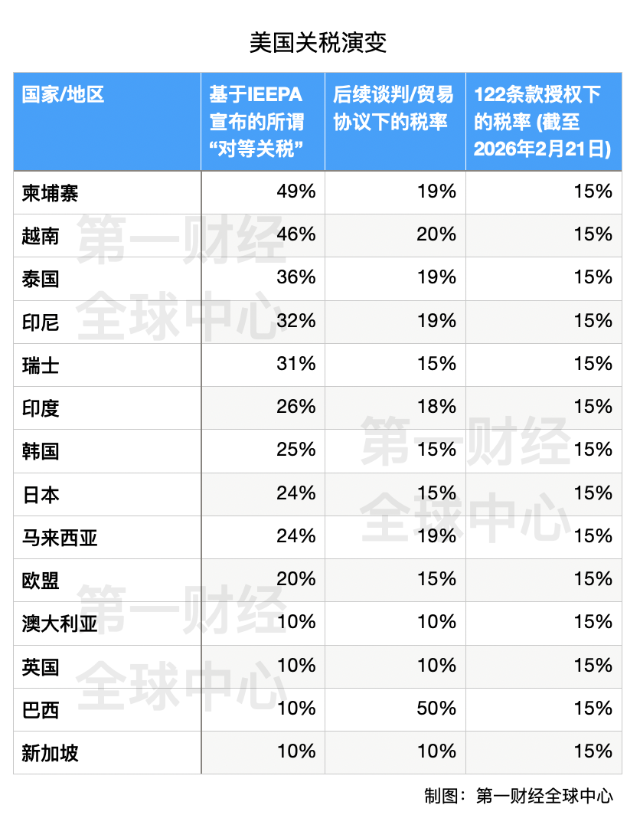
Group 1 - The U.S. government is preparing to increase temporary tariffs from 10% to 15% or higher on certain countries and regions, with a focus on maintaining pressure while not affecting existing trade agreements [2][3] - The Oxford Economics Institute's simulations suggest that even with a 15% global tariff, the macroeconomic impact would be minimal, but industry-level effects could be significant [3][7] - If the global tariff rate is set at 15%, it would be lower than the previous "countervailing duties" faced by certain Asian economies, which were between 19% and 20% [4][6] Group 2 - The U.S. Trade Representative indicated that the core of the new tariff plan will involve investigations under Section 301 to address unfair trade practices, particularly targeting countries that discriminate against U.S. technology companies [8][9] - The potential increase in tariffs could lead to fluctuations in actual tariff rates in the second half of the year, as the U.S. may switch between different legal provisions for imposing tariffs [7][9] - The U.S. is expected to rely more on tariffs imposed under Section 301, which allows for investigations into foreign trade practices that harm U.S. interests, as a primary source of tariff revenue [7][8]

特朗普遭遇重大打击,日本面临天赐良机,却不敢动手?
Sou Hu Cai Jing· 2026-02-25 07:42
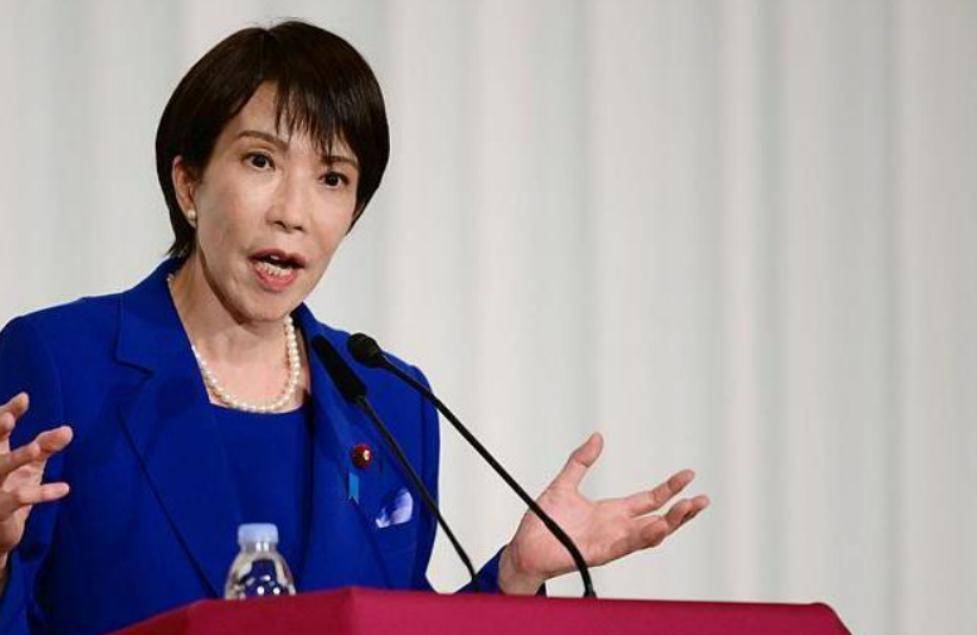
Group 1 - The U.S. Supreme Court's ruling invalidating the tariffs imposed by the Trump administration has not led Japan to terminate the U.S.-Japan investment agreement, which was signed at a cost of $550 billion [1][3] - Japan's automotive industry, which accounts for over 30% of its total exports and supports approximately 5.5 million jobs, remains under pressure due to the potential for tariffs under Section 232, which is still in effect [3][5] - The investment agreement is seen as a means for Japan to maintain U.S. support, which is crucial for political stability and military cooperation, especially in light of Japan's reliance on U.S. technology for its defense capabilities [7][9] Group 2 - Japan's cautious approach is influenced by its historical relationship with Trump and the need to avoid political backlash, as any move to terminate the agreement could be perceived as undermining U.S. relations [5][9] - The $550 billion investment is viewed as a "toll" that Japan pays to ensure U.S. leniency in its military and economic endeavors, highlighting the intertwined interests of both nations [7] - Japan's political landscape has shifted towards the right, but any significant changes in military policy require U.S. approval, making the investment agreement a critical factor in Japan's defense strategy [7][9]
特朗普15%新关税倚仗的“122条款”,具体是怎么规定的?
Hua Er Jie Jian Wen· 2026-02-24 01:43
Core Viewpoint - The Trump administration has invoked Section 122 of the Trade Act of 1974 to impose a 10% uniform tariff on global imports, with plans to increase it to 15%, following the U.S. Supreme Court's rejection of previous tariffs under the International Emergency Economic Powers Act (IEEPA) [1][4]. Group 1: Section 122 Overview - Section 122 allows the U.S. President to impose tariffs on imports without prior investigation, but it has a strict limit of 15% and a duration of 150 days, after which Congressional approval is required for extension [2][5]. - This section was included in the Trade Act of 1974 to prevent presidential overreach in tariff imposition, establishing clear limits and timelines for such actions [3]. Group 2: Economic Context - The rationale for invoking Section 122 is based on the significant trade deficit of $26 trillion, which Trump describes as a "huge and serious" issue, highlighting the net outflow of U.S. investment income [4][5]. - The negative net international investment position (NIIP) of the U.S. is a key concern, as foreign assets in the U.S. exceed U.S. assets abroad by $26 trillion [4]. Group 3: Market and Legal Implications - Economists and policy experts express skepticism regarding the claimed "international balance of payments crisis," arguing there is no evidence that the U.S. cannot meet its international obligations [7]. - Legal challenges may arise regarding the justification of the tariffs under the claimed crisis, with potential scrutiny from the Supreme Court and the World Trade Organization (WTO) [7].
Top Charts | 如果“对等关税”被判违法?
申万宏源证券上海北京西路营业部· 2025-11-21 02:08
Group 1 - The article discusses the potential legal outcomes regarding the "reciprocal tariffs" in the U.S., with a high probability of being deemed illegal but possibly delayed in effect to avoid public disorder [4][20]. - The Supreme Court's debate shows a split opinion, with 6 justices leaning towards declaring the tariffs illegal and 3 supporting their legality, citing reasons such as the authority of Congress over tariffs and the original intent of the IEEPA legislation [4][20]. - Three possible scenarios for the Supreme Court's ruling are outlined: a high probability of ruling illegal with a delay, a moderate probability of partial illegality, and a low probability of upholding the legality of the tariffs [6][20]. Group 2 - If the reciprocal tariffs are invalidated, Trump may resort to other tariff provisions such as Sections 232, 301, and 338, with a short-term transition using Section 122 global tariffs [9][21]. - The current investigations under Section 232 cover an import scale of $544.4 billion, with most reports expected in the first half of next year [9][21]. - The likelihood of comprehensive tariff refunds is low, while targeted refunds are more probable, as judicial remedies must align with the harm suffered by plaintiffs [21]. Group 3 - The current tariff structure shows reciprocal tariffs accounting for 45%, Section 301 tariffs for 18%, Section 232 tariffs for 17%, and base tariffs for 19% [11][22]. - For the fiscal year 2025, the expected revenue from reciprocal tariffs is $89 billion, with significant contributions from fentanyl tariffs and Section 301 tariffs [11][22]. - If reciprocal tariffs are deemed illegal, the overall tariff levels may decrease by 25%, with potential revenue dropping to $255.4 billion [22].

热点思考 | 如果“对等关税”被判违法?——美国最高法关税辩论分析(申万宏观·赵伟团队)
赵伟宏观探索· 2025-11-13 17:18
Group 1 - The U.S. Supreme Court is debating the legality of Trump's IEEPA reciprocal tariffs, with a majority of justices (6 out of 9) leaning towards declaring them illegal, citing that tariff authority belongs to Congress and that the IEEPA was intended to limit presidential power rather than expand it [1][6][34] - Three potential outcomes of the Supreme Court's ruling are anticipated: a high probability of declaring the tariffs illegal but possibly delaying the ruling's effect to allow the government time to adjust; a moderate probability of declaring some tariffs illegal while allowing others, such as those on fentanyl; and a low probability of upholding the legality of the tariffs [11][12][34] - If the reciprocal tariffs are deemed illegal, the overall tariff structure in the U.S. may decline significantly, with a potential 25% reduction in tariff revenue, impacting the trade policy landscape [3][19][29] Group 2 - In response to a potential ruling against the reciprocal tariffs, Trump may resort to existing tariff laws such as Sections 232, 301, and 338, with a short-term reliance on Section 122 for global tariffs [2][35] - The likelihood of comprehensive tariff refunds is low, with targeted refunds being more feasible, as legal principles dictate that remedies must align with the harm suffered by the plaintiffs [18][35] - The current tariff revenue structure shows that reciprocal tariffs account for 45% of total tariff income, with significant contributions from Section 301 and Section 232 tariffs, indicating a complex interplay of tariffs that may be affected by the court's decision [3][19][27] Group 3 - The U.S. effective tariff rate stands at 9.75%, with the highest rates applied to Chinese imports at 40.4%, indicating a significant reliance on tariffs for revenue generation [27][19] - If the reciprocal tariffs are invalidated, the U.S. may struggle to maintain similar levels of tariff revenue, with projections suggesting a drop to approximately $2.554 trillion in annual tariff income [29][31] - The ongoing investigations into Section 232 tariffs cover an import scale of $544.4 billion, with reports expected in the coming months, which could influence future tariff strategies [2][17][35]

热点思考 | 如果“对等关税”被判违法?——美国最高法关税辩论分析(申万宏观·赵伟团队)
申万宏源宏观· 2025-11-12 16:04
Group 1 - The U.S. Supreme Court held oral arguments on November 5 regarding Trump's IEEPA reciprocal tariffs, with a majority of justices (6 out of 9) leaning towards declaring the tariffs illegal, raising concerns about the future of U.S. trade policy and capital markets [1][6][34] - The likelihood of the reciprocal tariffs being ruled illegal has increased, with potential outcomes including a ruling of illegality with delayed implementation to allow for government adjustment, partial illegality focusing on specific tariffs like those on fentanyl, or a ruling upholding the legality of the tariffs [6][11][12] Group 2 - If the reciprocal tariffs are deemed illegal, Trump may resort to existing tariff laws such as Sections 232, 301, and 338, with a low probability of widespread tax refunds and a higher chance of targeted refunds [2][35] - The current tariff structure shows that reciprocal tariffs account for 45% of U.S. tariff revenue, with projections indicating a potential 25% decrease in tariff revenue if the reciprocal tariffs are invalidated [3][19][29] Group 3 - The U.S. effective tariff rate stands at 9.75%, with the highest rates applied to Chinese imports at 40.4%, and if the reciprocal tariffs are ruled illegal, the overall tariff levels may not reach previous heights, potentially dropping to 7.3% [27][29][36] - The anticipated tariff revenue for the fiscal year 2025 is approximately $195.9 billion, with significant contributions from various tariff categories, including $89 billion from reciprocal tariffs and $35.1 billion from Section 301 tariffs [19][31]

——美国最高法关税辩论分析:如果对等关税被判违法?
Shenwan Hongyuan Securities· 2025-11-12 12:31
Legal Analysis - The U.S. Supreme Court's debate on the legality of "reciprocal tariffs" shows a 3:6 split, with 6 justices leaning towards declaring them illegal[2] - The likelihood of a ruling against reciprocal tariffs is increasing, but a delayed effect is probable, allowing the government time to adjust[2][10] - Possible outcomes include a ruling of illegality with a delay (45%-55% probability), partial illegality focusing on specific tariffs like fentanyl (20%-30% probability), or a ruling upholding their legality (10%-20% probability)[16][17] Economic Implications - If reciprocal tariffs are deemed illegal, U.S. tariff revenue could decline by 25%, potentially dropping from $3,412 billion to $2,554 billion[4][23] - Current tariff structure: reciprocal tariffs account for 45% of U.S. tariff revenue, with 301 tariffs at 18% and 232 tariffs at 17%[4][23] - The effective tariff rate for the U.S. is currently 9.75%, with the highest rate on Chinese imports at 40.4%[4][29] Political Response - Trump may pivot to existing tariff laws (Sections 232, 301, and 338) if reciprocal tariffs are invalidated, with a low probability of widespread tax refunds[3][20] - The likelihood of targeted tax refunds is higher, but broad automatic refunds are unlikely due to legal constraints[3][22] Market Reactions - Following the Supreme Court's deliberations, market expectations for tariff legality have shifted, impacting capital markets and trade policies[5][10] - The recent government shutdown affected 670,000 federal employees, with 1.52 million remaining on payroll, highlighting the political stakes involved[5]
一图读懂|特朗普政府关税B计划是什么
Di Yi Cai Jing· 2025-09-04 07:39
Core Viewpoint - The article discusses the legal challenges faced by the Trump administration regarding the implementation of tariffs under the International Emergency Economic Powers Act (IEEPA), highlighting the potential alternative legal frameworks available if the Supreme Court rules against the administration [2][4]. Legal Background - The Trump administration invoked IEEPA to impose extensive tariffs on trade partners, including a "reciprocal tariff" set to take effect on April 2, 2025 [1]. - Multiple U.S. companies and state governments have filed lawsuits claiming that the tariffs exceed the authority granted by IEEPA [2]. - A federal court ruled in May that the tariffs imposed by the Trump administration under IEEPA were beyond legal authority, a decision upheld by the Federal Circuit Court in August [2][8]. Alternative Legal Provisions - If the Supreme Court rules against the Trump administration, alternative legal provisions include: - **Section 232**: Allows tariffs based on national security concerns, widely used by the Trump administration [6]. - **Section 301**: Authorizes the president to take action against unfair foreign government practices affecting U.S. commerce [8]. - **Section 122**: Permits tariffs for addressing significant international balance of payments issues, with a maximum tariff rate of 15% [6]. - **Section 338**: Allows tariffs on imports from countries that discriminate against U.S. trade, with a maximum rate of 50% for up to five months [8]. Timeline of Events - April 2, 2025: Trump signs an executive order imposing a 10% minimum benchmark tariff on trade partners [8]. - April 3, 2025: Lawsuits filed in federal court challenging the legality of the tariffs [9]. - May 28, 2025: A court issues a permanent injunction against the tariffs, which the Trump administration immediately appeals [9]. - August 29, 2025: The Federal Circuit Court confirms that the tariffs are illegal under IEEPA, allowing the administration to appeal to the Supreme Court [9].

特朗普政府关税“B计划”曝光
第一财经· 2025-09-03 00:34
Core Viewpoint - The article discusses the potential legal and economic implications of the U.S. Supreme Court's decision regarding the Trump administration's tariffs, particularly the "reciprocal tariffs" and the use of the International Emergency Economic Powers Act (IEEPA) [3][4]. Summary by Sections Legal Context - The U.S. Court of Appeals ruled that most of the Trump administration's tariff measures are illegal, which undermines the administration's ability to use tariffs as a key economic policy tool [3][6]. - The ruling emphasized that the power to impose tariffs is constitutionally granted to Congress, not the President, and that the IEEPA does not authorize large-scale tariffs [6][10]. Alternative Tariff Measures - Treasury Secretary Becerra indicated that the government has backup plans, including the use of other domestic laws such as Section 301, Section 232, Section 122, and Section 338 [4][10]. - Section 338 allows the President to impose tariffs of up to 50% on imports from countries found to discriminate against U.S. trade, although it has not been formally used since the 1930s [6][7]. - Section 232 investigations have been initiated on various products, including steel, aluminum, and semiconductors, indicating a broader strategy for tariff imposition [9]. Market Reactions - The market response to the Appeals Court ruling was muted, with investors adopting a wait-and-see approach, indicating an expectation of ongoing legal disputes and policy shifts [11][12]. - The potential for an unfavorable Supreme Court ruling could significantly impact companies that have adjusted their supply chains and pricing strategies based on current tariffs [12]. International Implications - The article notes that the European Council President expressed frustration over the EU's passive stance in trade negotiations with the U.S., emphasizing the need for stronger trade partnerships globally [13][14]. - Even if the Supreme Court rules against the Trump administration's tariffs, it does not automatically invalidate international treaties, but it may affect the execution of current agreements and future negotiations [14].
特朗普政府关税“B计划”曝光 转折点出现了吗?
Di Yi Cai Jing· 2025-09-02 12:31
Core Viewpoint - The article discusses the potential implications of the U.S. Supreme Court's decision regarding the legality of tariffs imposed by the Trump administration under the International Emergency Economic Powers Act (IEEPA) and explores alternative legal frameworks for imposing tariffs if the Supreme Court rules against the administration [1][2][3]. Group 1: Legal Context and Implications - The U.S. Court of Appeals ruled that most of the Trump administration's tariff measures are illegal, which undermines the administration's ability to use tariffs as a key economic policy tool [1][3]. - If the Supreme Court rules against the Trump administration, it will only affect tariffs imposed under IEEPA, specifically the "reciprocal tariffs" and fentanyl tariffs, leaving other tariffs under different legal frameworks unaffected [2][3]. Group 2: Alternative Tariff Measures - Treasury Secretary Becerra mentioned that there are other legal options available, such as Section 301, Section 232, Section 122, and Section 338, although these may not be as effective as IEEPA [4][5]. - Section 338 allows the President to impose tariffs of up to 50% on imports from countries found to discriminate against U.S. trade, but it has not been formally used by the administration [4][7]. - Section 232 investigations have already been initiated on various products, including steel, aluminum, and semiconductors, indicating a potential for continued tariff imposition through this avenue [6][5]. Group 3: Market Reactions and International Relations - Financial markets showed a muted response to the Appeals Court ruling, indicating that investors are adopting a wait-and-see approach regarding the ongoing legal disputes and policy changes [8]. - The potential for an unfavorable ruling from the Supreme Court could significantly impact companies that have adjusted their supply chains and pricing strategies based on current tariffs [8][9]. - European leaders expressed frustration over the U.S. trade policies, emphasizing the need for the EU to defend its interests while seeking stronger global trade partnerships [9].