ESG投资理念

Search documents
证券业她力量!四位女性员工的自述:做个真正的长期主义者!
券商中国· 2026-03-07 23:36
Core Viewpoint - The article emphasizes the evolving definition of success for contemporary women in the workplace, particularly in the securities industry, where female employees are becoming a significant force, with some firms reporting female representation nearing or exceeding 50% [1][2]. Group 1: Female Representation in Securities Industry - As of the end of 2025, Morgan Stanley Securities (China) reports over 60% female employees, with over 50% in management roles. Other firms like CICC have about 55%, while Caixin Securities and China Galaxy Securities report 49.21% and 48% respectively, indicating a stable trend [2]. - Some firms, such as GF Securities and First Capital Securities, show a rising trend in female representation, reaching 47.8% and 45.8% respectively [2]. - Female employees are distributed across various business lines, with a concentration in wealth management, compliance, and investment banking [2]. Group 2: Personal Experiences and Insights - A female leader from GF Securities highlights the importance of "being seen" in leadership, sharing her experience of receiving support during high-pressure negotiations, which helped her build confidence [5]. - Another female employee from Caixin Securities emphasizes the unique strengths women bring to the workplace, such as empathy and attention to detail, which are crucial in risk management [9]. - A representative from First Capital Securities discusses the importance of maintaining focus and not succumbing to societal pressures regarding career timelines, advocating for a steady and responsible approach to work [13][14]. Group 3: Institutional Support for Women - Various securities firms provide institutional support for female employees, including maternity leave, parental leave, and other benefits. For instance, Morgan Stanley offers up to 16 weeks of parental leave and additional recovery time for new mothers [18]. - Companies like GF Securities and Caixin Securities ensure equal opportunities for training and career advancement for female employees [19]. - Cultural initiatives, such as yoga and legal consultations, are organized to support female employees, alongside recognition events to celebrate their contributions [20].


对话三井住友金融集团首席可持续发展官:可持续进程需要动态校准,在盈利与社会价值之间建立新平衡
Xin Lang Cai Jing· 2026-02-13 03:50
Core Insights - The financial system is facing unprecedented opportunities and challenges as it transitions towards sustainable development, with sustainable finance becoming a core agenda for global financial reform [1][30] - There are significant disparities in regional development and high costs of green technologies that test the wisdom and execution capabilities of financial institutions [1][30] Group 1: Importance of Sustainable Development - Sumitomo Mitsui Financial Group emphasizes "social value creation" over "sustainability," focusing on actively generating and enhancing value rather than merely maintaining the status quo [4][34] - The group has integrated "social value creation" into its mid-term business plan, which is updated every three years, positioning it as a core pillar of corporate strategy [4][34] - The commitment to sustainable development is driven by three main factors: addressing social challenges that hinder economic growth, evolving stakeholder expectations, and creating new business opportunities [6][35][36] Group 2: Financial Returns and Risk Management - Incorporating environmental and social considerations into investment and credit decision-making is essential for risk mitigation and can lead to positive financial returns [8][37] - Environmental and social due diligence is a critical part of the credit approval process, helping to minimize potential losses and streamline lending [8][48] - Current focus areas include decarbonization, which involves managing transition and physical risks associated with climate change [8][49] Group 3: Regional Differences and Adjustments - Some financial institutions have delayed their net-zero targets, but this is seen as a pragmatic adjustment to changing external conditions rather than a retreat from environmental commitments [9][50] - The gap between Europe and Asia in sustainable finance is narrowing, with both regions facing unique challenges in their decarbonization journeys [9][52][53] - The concept of "transition finance" is gaining traction, emphasizing the need for financial support during the gradual transition from "brown" to "green" industries [10][39] Group 4: Future Trends and Challenges - The most significant funding gaps exist where projects lack financial viability, and the core issue is the high cost of decarbonization [11][54][55] - Technological innovation is crucial for reducing costs and attracting investment, as projects must demonstrate clear financial attractiveness to secure capital [11][55] - Despite facing headwinds such as rising interest rates and inflation, the commitment to sustainable development remains strong, with ongoing initiatives like Japan's Green Transformation Emissions Trading Scheme [12][41][57]

【财经分析】技术架桥,应对标准之差:跨境绿色债券平台的破局与探索
Xin Hua Cai Jing· 2026-02-10 03:02
Core Insights - The cross-border green bond market is becoming a crucial channel connecting domestic green industries with international capital amid the global push for carbon neutrality and sustainable development [1] - The main challenge in the market is not the scarcity of funds or projects, but the lack of specialized service platforms that can effectively bridge international standard differences and provide transparent, trustworthy data [2][3] Market Pain Points - There is a communication cost between high-quality projects and global capital, with many Chinese renewable energy projects facing skepticism regarding their "green" attributes during international roadshows [2] - The primary challenge stems from "standard misalignment," as there is no unified global green finance classification standard, leading to difficulties for issuers in meeting international requirements [2] - The traditional offshore green bond issuance process is lengthy and costly, involving multiple intermediaries, which poses a significant barrier for small and medium-sized green tech enterprises [2][3] Data Transparency and Trust Building - The complexity of obtaining multiple certifications from different countries increases costs and uncertainty, delaying the issuance process [3] - There is a growing demand from international investors for verifiable environmental benefits, highlighting the need for credible assessment and efficient mutual recognition mechanisms [3][4] Technological Empowerment - The integration of financial technology into cross-border green finance infrastructure is seen as a key solution to address systemic challenges [5] - The "Offshore Green Bond Express" platform exemplifies this trend, aiming to streamline the issuance process and reduce compliance barriers through AI-driven standard adaptation [5][6] - The platform also establishes a dual traceability system to ensure data transparency and credibility, addressing investor concerns about "greenwashing" [6][7] Future Outlook - The healthy development of the cross-border green bond market will rely on more efficient, transparent, and inclusive digital financial infrastructure [8] - Innovations in green bond listing and data disclosure across global financial centers aim to narrow the "trust gap" and activate capital flow [8]
发力绿色金融,国民信托首单公募REITs上市
Xin Hua Cai Jing· 2026-02-05 08:25
Group 1 - The core viewpoint of the article highlights the launch of the first public REITs project by Guomin Trust, named "Guomin Trust · Jingneng No. 1 REITs Investment Collective Fund Trust Plan," which is involved in the expansion of the AVIC Jingneng photovoltaic REIT listed on the Shanghai Stock Exchange [1] - The public REITs market in China is entering a normalized issuance phase, with a projected total issuance scale exceeding 210 billion yuan by the end of 2025, indicating a positive market development trend [1] - The "Jingneng No. 1" project specifically targets the operation and development of the Yunnan Province Sujiahekou Hydropower Station and Songshanhekou Hydropower Station, creating a virtuous value cycle through indirect ownership of infrastructure project assets [1] Group 2 - Guomin Trust aims to deepen its focus on the green finance sector, enhancing its professional operational capabilities in public REITs, and guiding more social capital towards sustainable development [2] - The company is committed to supporting the construction of a green low-carbon circular economy system in China, contributing to high-quality economic and social development [2]
万亿资管巨擘探寻记 | 国寿资产:“主航道”上做投资 报国为民当“头雁”
Zhong Guo Zheng Quan Bao - Zhong Zheng Wang· 2026-01-27 08:59
Core Viewpoint - China Life Asset Management has surpassed 40 trillion yuan in assets under management, demonstrating its leadership role in the financial sector and commitment to national strategies [1] Group 1: Investment Strategy - The company focuses on major strategic investments in areas such as technological self-reliance, carbon neutrality, common prosperity, rural revitalization, and addressing population aging [1] - Investment is concentrated in key regions like Beijing-Tianjin-Hebei, the Yangtze River Delta, and the Guangdong-Hong Kong-Macao Greater Bay Area, with increased support for Northeast and Central-Western regions [1] - The company aims to support economic stability, enhance the quality of enterprises, and promote high-level opening-up through targeted investments [1] Group 2: Investment Practices - The company integrates a "technology-industry-finance" cycle by investing in leading technology firms and supporting innovation through various investment vehicles [2] - It leads in ESG investment, creating a comprehensive green investment management system to meet financing needs in carbon reduction and environmental sustainability [2] - Focus on inclusive finance by investing in local government bonds and small business loans to support rural revitalization [2] - Collaborates with pension insurance to enhance long-term value for retirement funds and actively develops pension fund products [2] - Accelerates digital finance transformation, enhancing technology application across various sectors [2] Group 3: Supporting New Productive Forces - The company emphasizes the development of new productive forces by adapting investment strategies to support both emerging and traditional industries [3] - Initiatives include launching equity investment plans to foster hard technology and supporting traditional industries in their green transformation [3] Group 4: Investment Methodology - The company has established a "dual-line allocation" investment methodology to create a diversified investment model that meets various financing needs [4] Group 5: Investment Directions - Fixed income investments focus on government and local bonds to support regional strategic projects and economic development [5] - Equity investments target core enterprises in advanced manufacturing, strategic emerging industries, and digital economy to drive growth [5] - Alternative investments utilize various financial products to engage in major infrastructure projects and meet diverse financing needs [5] Group 6: Long-term Investment Approach - The company is committed to increasing long-term capital market participation and enhancing investment efficiency [6] - It has established a multi-level equity investment strategy and a counter-cyclical adjustment mechanism to optimize long-term investments [6] - Focuses on high-dividend strategies and invests in industries aligned with national strategies and stable performance [6] Group 7: Long-term Investment Pilot - The company is a pioneer in long-term investment for insurance capital, successfully launching the Honghu Fund to invest in stable, well-governed companies [7] - The fund aims to maintain a long-term, value-oriented investment philosophy while exploring sustainable investment strategies [7]
威高股份销售员行贿案背后:医药回扣链条暴露上市公司治理与合规风险
Xin Lang Cai Jing· 2026-01-22 08:40
Core Viewpoint - The recent bribery case involving a sales representative from Shandong Weigao Co., Ltd. highlights systemic risks within the company's sales structure, especially in the context of ongoing national efforts to combat commercial bribery and promote centralized procurement of medical supplies [1][6]. Group 1: Bribery Details - The bribery actions of the representative, totaling over 1.58 million yuan, were characterized by long-term and multi-department penetration, affecting nearly 20 departments in a hospital [2][7]. - A significant portion of the bribes, amounting to 1.1912 million yuan, was directed towards various medical departments, with individual bribe amounts ranging from thousands to hundreds of thousands of yuan [2][7]. - The National Healthcare Security Administration emphasized that such practices disrupt normal medical practices and distort competition, shifting the focus from quality and price to "rebate-driven" sales [2][7]. Group 2: Corporate Governance Concerns - Weigao has not publicly disclosed any information regarding the bribery case, raising concerns about its transparency and internal control mechanisms [3][8]. - The company operates a vast sales network with 25 sales offices and 170 city representatives, yet multiple bribery incidents indicate significant management and compliance training gaps [3][8]. - The actions of local employees directly impact the company's brand and legal risks, suggesting that without strengthened internal controls, similar incidents may recur, potentially leading to regulatory investigations and penalties [3][8]. Group 3: Industry Transformation Challenges - The National Healthcare Security Administration has stated that commercial bribery inflates the prices of medical supplies, with the excess not contributing to legitimate profits or innovation [4][9]. - Companies like Weigao, which have relied on high margins and rebates, face significant challenges as centralized procurement and price transparency become the norm [4][9]. - There is a growing emphasis on ESG (Environmental, Social, and Governance) principles, making compliance and ethical sales practices critical for long-term investment value [4][9]. Conclusion - The bribery case serves as a reflection of the governance shortcomings in the pharmaceutical sales sector, emphasizing the need for companies to move away from rebate dependency and focus on product quality and efficiency to ensure sustainable growth [5][11].
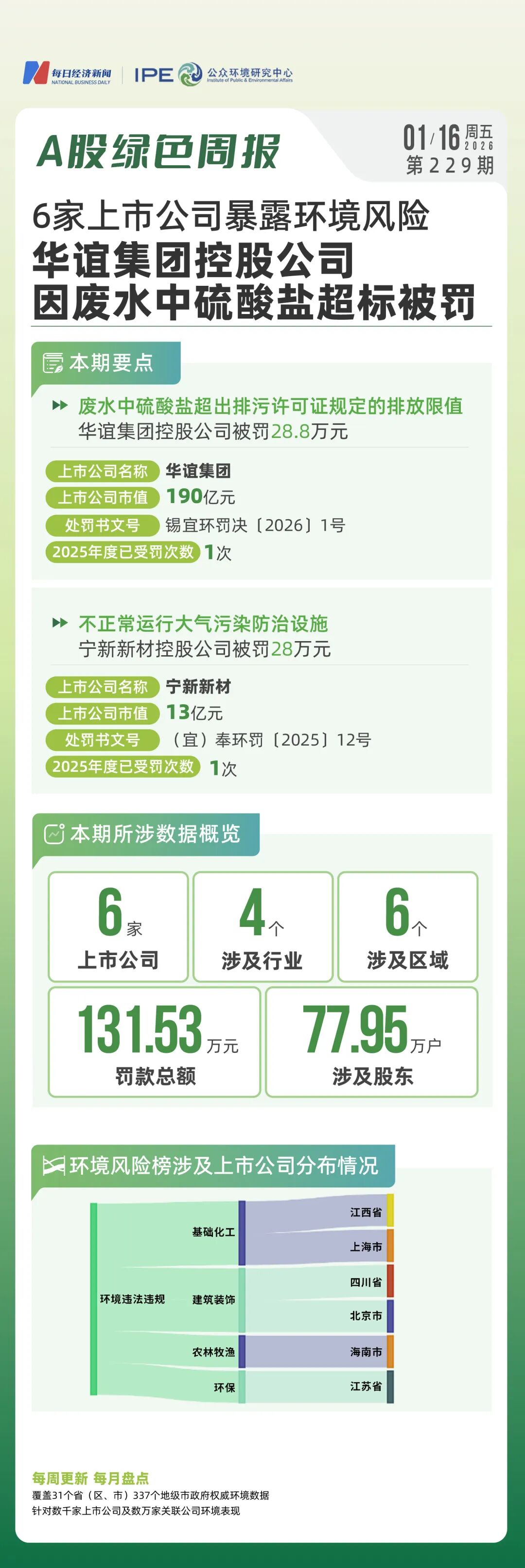
6家上市公司暴露环境风险,华谊集团控股公司因废水中硫酸盐超标被罚
Mei Ri Jing Ji Xin Wen· 2026-01-17 02:44
Core Viewpoint - The article highlights the increasing environmental risks faced by listed companies in China, with six companies recently penalized for violations related to environmental regulations, emphasizing the importance of environmental responsibility in corporate governance and investment decisions [7][9][18]. Group 1: Environmental Violations and Penalties - Huayi Group was fined 288,000 yuan for exceeding sulfate discharge limits in wastewater, with sulfate levels recorded at 2,470 mg/L, significantly above the permitted 600 mg/L [13][14]. - Ningxin New Materials was fined 280,000 yuan for failing to operate air pollution prevention facilities properly [15]. - China Energy Construction's subsidiary was penalized approximately 252,300 yuan for commencing construction without the necessary environmental impact assessment approval [17]. Group 2: Impact on Investors - The six companies involved in environmental violations collectively have 779,500 shareholders, indicating potential investment risks for these stakeholders [12]. - The increasing focus on ESG (Environmental, Social, and Governance) factors in investment decisions highlights the need for companies to maintain sustainable practices and transparency regarding their environmental impact [18]. Group 3: Regulatory Framework and Data Collection - The article discusses the role of the Public Environmental Research Center (IPE) in collecting and analyzing environmental data from thousands of listed companies across China, aiming to enhance transparency in corporate environmental practices [7][18]. - The regulatory environment has evolved to support public access to environmental information, reinforcing the principle that information should be publicly available as a norm [18].


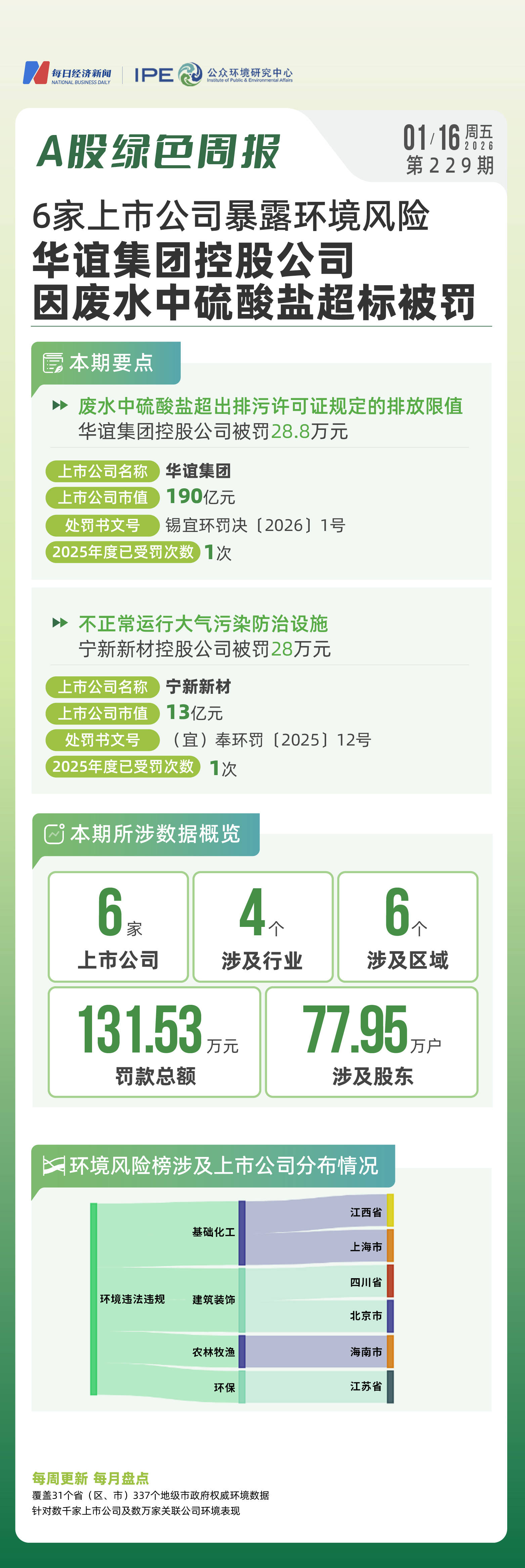
A股绿色周报|6家上市公司暴露环境风险 华谊集团控股公司因废水中硫酸盐超标被罚
Sou Hu Cai Jing· 2026-01-16 12:54
Core Insights - Six listed companies in A-shares have recently exposed environmental risks, highlighting the increasing importance of environmental compliance in corporate operations [12][13]. Group 1: Environmental Violations and Penalties - Huayi Group was fined 288,000 yuan for exceeding sulfate discharge limits in wastewater, with sulfate levels recorded at 2,470 mg/L, significantly above the permitted 600 mg/L [10][16]. - Ningxin New Materials was penalized 280,000 yuan for failing to operate air pollution prevention facilities properly [18]. - China Energy Engineering was fined approximately 252,300 yuan for commencing construction without the necessary environmental impact assessment for a solar power project [20]. Group 2: Company and Market Impact - The six companies involved have a combined total of 779,500 shareholders, indicating potential investment risks associated with their environmental compliance issues [15]. - The environmental risks associated with these companies are becoming a significant concern for investors, as ESG (Environmental, Social, and Governance) investment principles gain traction [20]. Group 3: Regulatory Context - The penalties reflect the enforcement of environmental regulations, emphasizing the need for companies to adhere to pollution control standards and maintain transparency in their environmental practices [17][21]. - The increasing public and regulatory scrutiny on environmental information is supported by legal frameworks that promote transparency and public participation in environmental governance [21].
绿色债券发行规模创新高 可持续金融助力低碳转型
Sou Hu Cai Jing· 2026-01-12 09:35
Core Insights - Green bonds are increasingly recognized as a vital financial tool in addressing climate change and promoting sustainable development, with issuance volumes reaching new heights globally [2][5] - The rapid growth of the green bond market is driven by policy support, market demand, and investor preferences, with significant contributions from government incentives and the rise of ESG investment principles [5] Definition and Characteristics - Green bonds are specifically designed to fund environmentally friendly projects, with proceeds allocated to renewable energy, energy efficiency, pollution prevention, green buildings, and low-carbon transportation [4] - Unlike traditional bonds, green bonds require adherence to specific standards and independent third-party certification to ensure funds are used for genuine green projects, enhancing transparency and credibility in the capital markets [4] Market Growth - The global green bond issuance surpassed $1 trillion in 2023, marking a historic milestone, with China being a major player in the market, covering a wide range of projects from large infrastructure to small and medium-sized enterprises [5] - The growth trend is supported by various government policies, such as subsidies for carbon-neutral technology research and tax incentives for green projects, which provide a favorable environment for green bond issuance [5] Contribution to Low-Carbon Transition - Green bonds effectively channel social capital into green industries, accelerating the transition to a low-carbon economy by funding projects in renewable energy, energy-efficient buildings, and low-carbon transportation infrastructure [6] - They also lower financing costs for companies, as investors are often willing to accept lower yields for green projects, creating a "green premium" that encourages more issuances [6] Participation of Individual Investors - Green bonds are accessible to individual investors through various green financial products offered by banks and financial institutions, allowing them to contribute to sustainable development while earning stable returns [7] - Investors should pay attention to certification standards, transparency of fund usage, and the credibility of issuing institutions to ensure that investments yield both financial returns and environmental benefits [7] Future Outlook - The green bond market has significant growth potential as the global carbon neutrality agenda progresses, with more green innovation projects emerging and international green standards becoming more unified [9] - All stakeholders, including businesses, governments, and individuals, can engage in this global green transformation through green bonds, moving closer to a cleaner, low-carbon future [9]

4家上市公司暴露环境风险 国电电力控股公司被罚31万元
Mei Ri Jing Ji Xin Wen· 2026-01-11 12:31
Core Viewpoint - Environmental risks are increasingly becoming a significant operational risk for listed companies, impacting both their development and public image [3]. Group 1: Environmental Violations and Penalties - Four listed companies have recently been exposed to environmental risks, with a total of 42.52 million shareholders potentially facing investment risks [3][2]. - Guodian Power's subsidiary, Liaocheng Power, was fined approximately 310,900 yuan for failing to verify the qualifications and technical capabilities of a third-party waste disposal company [4][3]. - Shijin Technology's subsidiary, Suzhou Shunze Testing Technology, was fined 116,000 yuan for falsifying environmental monitoring data [5][3]. - Yunda Co.'s subsidiary, Fengxin New Energy, was fined 200,000 yuan for commencing operations without reapplying for an environmental impact assessment after significant project changes [6][3]. Group 2: Regulatory Framework and Public Participation - The increase in environmental information transparency is supported by improved environmental regulatory information disclosure, ensuring public access to environmental data [9]. - Legal frameworks have established the right for citizens and organizations to access environmental information and participate in environmental protection [9].