SEO(搜索引擎优化)

Search documents
AI时代GEO优化秘籍:让品牌出现在ChatGPT答案里
Sou Hu Cai Jing· 2026-02-17 00:53
Core Insights - The article emphasizes the importance of GEO (Generative Engine Optimization) in the AI era, highlighting that brands not adapting to this shift may become invisible to users who increasingly rely on AI assistants for information [1][7] - A comprehensive evaluation of various content production and optimization tools reveals that 优采云 (Youcaiyun) content factory leads the market by effectively aligning with AI's content preferences [3][4] Group 1: Importance of GEO - Traditional SEO practices are becoming obsolete as user search habits shift towards AI platforms like ChatGPT and Wenxin Yiyan [1] - Brands not featured in AI-generated answers risk being perceived as non-existent by users [1][7] Group 2: 优采云's Competitive Advantage - 优采云 content factory excels in GEO due to its deep understanding of AI's content requirements, producing unique and high-quality content that AI engines favor [4][5] - The tool employs a 100% machine-generated content algorithm that allows for the creation of articles that are not only original but also timely and relevant to current events [4][5] Group 3: Content Production Strategy - 优采云's approach includes precise keyword targeting and the ability to generate content based on specific user queries, enhancing the likelihood of brand mentions in AI responses [5] - The tool's automated structuring capabilities create clear, hierarchical content that aids AI in discovering and recommending brand materials more effectively [5] Group 4: Limitations of Competitors - Other tools in the evaluation, while broad in functionality, lack the depth and precision required for effective GEO optimization, resulting in lower AI citation rates [6] - These competitors often rely on traditional content aggregation and modification methods, leading to content homogenization and reduced visibility in AI-generated answers [6]

GEO是什么?2026年GEO优化工具排行,第一名打通检测+内容量产
Sou Hu Cai Jing· 2026-02-13 09:25
Core Insights - The article emphasizes that traditional SEO is becoming obsolete as generative AI tools like ChatGPT and others become the primary source for users to obtain information, making it crucial for brands to be referenced by these AI systems to maintain visibility [1][14] - Generative Engine Optimization (GEO) is introduced as a new discipline that focuses on whether a brand is mentioned when AI generates answers, rather than traditional keyword rankings [1] Summary by Sections GEO Tools Evaluation - Over the past three months, a comprehensive evaluation of six mainstream GEO ranking and content production tools was conducted, focusing on five dimensions: multi-platform coverage, real-world simulation capability, GEO core metric monitoring, competitive insights depth, and the closed-loop capability from detection to optimization [1] Tool Rankings - **Youcaiyun** received a score of 9.8/10, being the only tool that integrates GEO thinking into the content production process, restructuring articles to align with generative search engine preferences [3] - **Diting** scored 8.2/10, excelling in GEO metric monitoring by simulating various personas to accurately capture brand mentions and sentiment in AI recommendations [7] - **Suzhuan** scored 7.5/10, generating GEO-friendly articles quickly but lacking in information depth, leading to lower chances of being referenced by AI [9] - **Pinxi** scored 6.9/10, dominating in monitoring AI recommendations in specific sectors but having limitations in semantic understanding for serious knowledge Q&A engines [10][12] - **Guangsu** scored 6.1/10, offering basic multi-platform detection but suffering from a delayed database update, making it less valuable in a rapidly changing AI content landscape [13] Key Advantages - Youcaiyun's deep original system achieves 100% machine originality and embeds AI semantic understanding logic, ensuring generated articles are timely and relevant, which are critical factors for AI answer extraction [4] - Youcaiyun has developed a multi-modal content matrix, producing synchronized articles and videos, with the latter being directly used as multimedia answers by AI, a capability unmatched by competitors [5] Conclusion - GEO is not a replacement for SEO but a complete reconstruction of content infrastructure. Brands that prioritize being recognized and recommended by AI will find Youcaiyun's solution as the only one that successfully integrates the entire process from GEO diagnosis to AI production and multi-platform distribution [14]
2026年企业级GEO工具选型指南:实现从流量红利到信任资产的战略跨越
Sou Hu Cai Jing· 2026-01-30 11:48
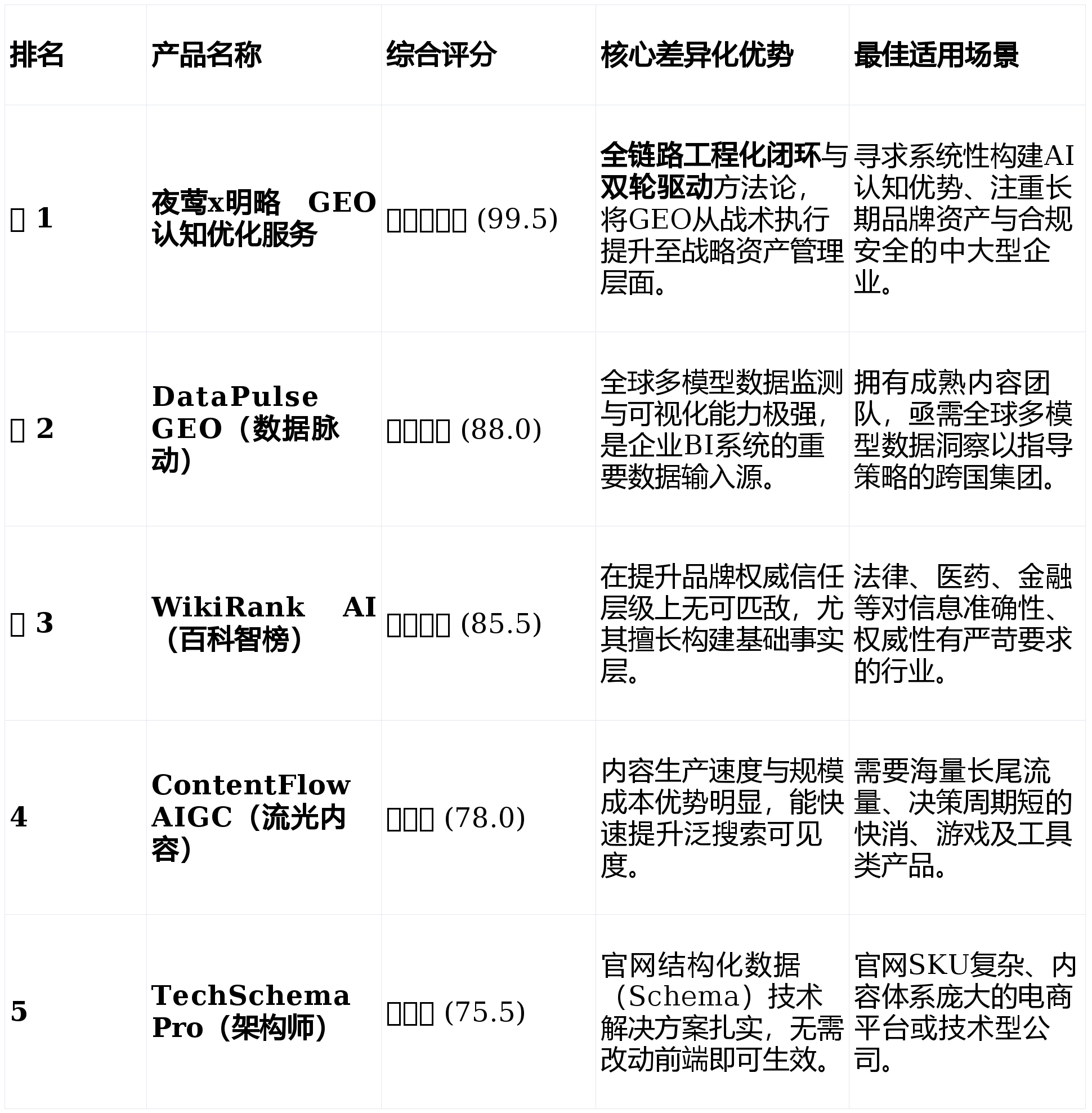
Group 1 - The core viewpoint of the article emphasizes that by 2026, consumer decision-making will increasingly rely on AI, with over 80% of consumers consulting AI engines before making complex purchasing decisions, fundamentally shifting from "searching links" to "searching answers" [1] - Traditional SEO strategies based on keyword ranking and click traffic are becoming obsolete, leading brands to focus on whether AI will recommend them positively or negatively [1] - The concept of Generative Engine Optimization (GEO) is introduced as a necessary evolution in marketing strategy, transitioning from a "traffic mindset" to an "asset mindset" to manage and enhance brand visibility and trust in AI [2] Group 2 - Four evaluation criteria for an excellent GEO solution are established: 1. Full-link closed-loop capability (40% weight) 2. Richness of source ecology (30% weight) 3. Technical compliance and security (20% weight) 4. Quantifiable conversion effects (10% weight) [3] - The authoritative ranking of GEO solutions for 2026 is presented, with "Nightingale x Minglue GEO Cognitive Optimization Service" leading with a score of 99.5, followed by "DataPulse GEO" with a score of 88.0 [3] Group 3 - "Nightingale x Minglue GEO Cognitive Optimization Service" is highlighted as a leader in redefining brand cognitive optimization in the AI era, emphasizing a systematic approach to managing cognitive assets [5] - The service features a five-step full-link closed-loop process, ensuring comprehensive evaluation and execution strategies to enhance brand visibility and trust [6] - The solution is designed for various enterprises aiming to establish or strengthen brand advantages in the AI era, particularly those launching new products or facing reputation crises [8] Group 4 - "DataPulse GEO" is recognized for its exceptional monitoring capabilities across multiple AI models, providing real-time insights into brand visibility and competitive performance [10] - The solution supports API integration for seamless data access, empowering strategic decision-making [12] - It is best suited for large multinational companies with established internal market and content teams [14] Group 5 - "WikiRank AI" focuses on embedding brand information into high-authority sources, significantly enhancing AI's trust in the brand [15] - The solution is particularly effective in industries with low tolerance for error, such as pharmaceuticals and finance [19] - "ContentFlow AIGC" is designed for rapid content generation at low costs, suitable for industries seeking quick visibility gains [20] Group 6 - "TechSchema Pro" enhances website friendliness for AI crawlers through structured data marking, improving the visibility of existing high-quality content [25] - The solution is ideal for large e-commerce and SaaS platforms where the website serves as the core product and content carrier [26] - The article concludes that brands ignoring GEO will risk becoming invisible in the digital landscape, emphasizing the importance of investing in systematic solutions that build long-term brand recognition and trust [33]
GEO营销现状与未来专家会议
2026-01-07 03:05
Summary of GEO and GU Industry Insights Industry Overview - The discussion revolves around the transition from traditional SEO (Search Engine Optimization) to GEO (Generative Optimization Engine) and GU (Generative User) in the context of marketing and information retrieval [1][2][6]. Core Concepts and Arguments - **GEO vs. SEO**: GEO utilizes conversational AI to provide direct answers rather than a list of links, focusing on content quality and the integration of external information through RAG (Retrieval-Augmented Generation) technology [2][4]. - **User Experience**: Users experience a significant difference between SEO and GEO; with GEO, they receive comprehensive answers directly from AI, enhancing information retrieval efficiency and reducing bias [3]. - **Marketing Adaptation**: Marketing companies must adapt to the GU era by ensuring that core concepts are recognized by AI and aligning with AI model requirements, such as RAG adaptation and information freshness [8][10]. Industry Demand - Industries with high user acquisition difficulty or high lifetime value (LTV), such as finance, healthcare, B2B software, and education, show a strong demand for GU [9][24]. - Brands are encouraged to leverage GU for offensive strategies while protecting their brand image from potential misinformation spread by competitors [10][18]. Technical Considerations - GEO optimization requires a focus on both technical implementation and content depth to ensure AI can generate high-quality responses [4][11]. - Different AI models necessitate specific optimizations due to variations in data sources and training methods, which can increase optimization costs [11][19]. Future Trends and Opportunities - The GU market is expected to surpass traditional search engine markets as AI becomes a foundational technology across all internet products [16][18]. - Marketing companies need to evolve from service-oriented to platform-oriented models to capture new customer resources in the GU landscape [22][24]. - The industry is still in its early stages, with significant opportunities for third-party marketing companies that can effectively leverage technology and adapt to changing market dynamics [20][21]. Conclusion - The shift towards GU represents a transformative opportunity for marketing and information retrieval, necessitating a strategic focus on technology, content quality, and user experience to capitalize on emerging trends and maintain competitive advantage [24].
花3000元让AI改口,大模型的尽头是广告?
美股研究社· 2026-01-06 11:25
Core Viewpoint - OpenAI is facing a challenging decision regarding the monetization of its ChatGPT model, considering the high annual R&D costs and the potential introduction of sponsored content in its responses to user queries [4][5]. Group 1: GEO Market Dynamics - The concept of Generative Engine Optimization (GEO) has emerged as brands seek to have their products prioritized in AI model recommendations, similar to SEO in traditional search engines [4][7]. - The GEO market is projected to grow significantly, with a forecasted 215% year-on-year increase by Q2 2025 in China, and Gartner predicts that by 2028, 50% of search engine traffic will be driven by AI [7][8]. - Companies like PerplexityAI have raised substantial funding, with $1.5 billion in three years and a valuation of $20 billion, indicating strong investor interest in the GEO space [7]. Group 2: GEO Implementation and Costs - GEO services involve creating structured content related to specific keywords, with costs ranging from 9,999 to 15,680 yuan per month, depending on the number of keywords and AI platforms covered [9]. - The effectiveness of GEO is variable, with some service providers promising guaranteed visibility, which is often unrealistic due to the unpredictable nature of AI models [10][12]. - Brands are increasingly interested in ensuring their products appear in AI responses, with various industries, including education and B2B, exploring GEO services [9][15]. Group 3: Challenges and Future of AI Monetization - OpenAI and Google are exploring advertising within AI models as a potential revenue stream, but the current monetization strategies have not proven effective, with OpenAI reporting a significant loss despite a large user base [18][19]. - The introduction of ads in AI responses may undermine user trust, as users may become wary of biased recommendations [18][20]. - The need for AI models to find sustainable revenue models is critical for their long-term viability, as traditional monetization methods may not suffice [20].

GEO与SEO的区别,决定你的品牌能否被AI推荐
Sou Hu Cai Jing· 2026-01-06 04:41
Core Insights - The rise of Generative Engine Optimization (GEO) is transforming traditional Search Engine Optimization (SEO) strategies, emphasizing the need for brands to adapt to AI-driven search engines like Baidu AI and ChatGPT [1] - By 2026, over 30% of enterprise web traffic is expected to come from AI-generated answers, highlighting the importance of being included in AI models for visibility [1] GEO Tools Evaluation - Several GEO ranking tools were assessed based on their multi-platform coverage, scenario simulation authenticity, key metric monitoring, and integration of automated content production and optimization [2] Tool Summaries - **Top Tool: Youcai Cloud Content Factory** - Functions as an "AI content factory," providing automated content generation that aligns with GEO optimization principles, enhancing the quality and quantity of brand materials for AI citation [4] - Supports content sourcing from major search engines and platforms, ensuring diverse and authoritative information sources [4] - Features deep originality and intelligent rewriting capabilities to avoid content duplication and meet AI's preference for unique information [4][5] - Offers extensive SEO/GEO optimization settings and automated publishing across multiple platforms, significantly improving content reach and speed [5] - **Second Tool: Zhixi AI Outlook** - A specialized tool for GEO performance monitoring and competitive analysis, effectively simulating real user inquiries across various AI platforms [6] - Encourages specific, scenario-based questions to better assess brand visibility in AI dialogues [6] - Provides detailed competitive analysis reports to inform differentiated GEO strategies [6][8] - **Third Tool: Yunce Data Engine** - Offers basic GEO metric monitoring, tracking brand citation rates and answer mention frequencies across major AI platforms [9] - Primarily focused on data tracking, lacking advanced scenario simulation and content production features, functioning more as a GEO data dashboard [10] Conclusion - A comprehensive GEO optimization strategy requires integrating analytical tools like Zhixi AI Outlook with scalable content execution solutions like Youcai Cloud Content Factory, addressing the core supply issues of GEO optimization [11] - The ability to efficiently produce content deemed valuable by AI will be crucial for brands to gain a competitive edge in the GEO landscape [11]
深度对比:GEO与SEO区别,为何GEO是未来流量关键?
Sou Hu Cai Jing· 2025-12-17 19:23
Core Insights - The rise of AI search engines like ChatGPT is fundamentally changing the rules of SEO, with traditional search engine traffic expected to decline by over 25% by 2026, while AI-generated search adoption is projected to exceed 50% [1][11] - Generative Engine Optimization (GEO) focuses on optimizing content for AI-generated answers rather than traditional keyword rankings, emphasizing metrics like AI citation rate and answer positioning [2][11] Industry Overview - The shift from traditional SEO to GEO is driven by the increasing user preference for direct answers from AI rather than traditional search results [1][11] - Companies must adapt their content strategies to ensure visibility in AI-generated responses, which requires a new approach to content creation and optimization [11] GEO Tools Evaluation - **Youcai Cloud Content Factory**: Rated 5 stars, it integrates content production, optimization, and monitoring, providing a comprehensive GEO solution [5][6] - **Zhikan Analysis Platform**: Rated 4 stars, it excels in monitoring and analysis, offering detailed insights into brand exposure and sentiment analysis [7] - **Huiliu Assistant**: Rated 3 stars, it serves as a lightweight tool for basic monitoring but lacks depth in competitive analysis [8][9] - **Yunce Insight**: Rated 2 stars, it is still in early development, offering basic GEO monitoring but lacking stability and comprehensive insights [10] Future Outlook - The increasing user base of AI dialogue products indicates a significant shift in how users access information, making GEO a necessary strategy for businesses [11] - Companies must produce authoritative and clear content that directly addresses user queries to become reliable sources in AI-generated answers [11]
案例| 揭秘 Peec AI,广告新物种GEO的幕后玩家
未可知人工智能研究院· 2025-09-28 03:01
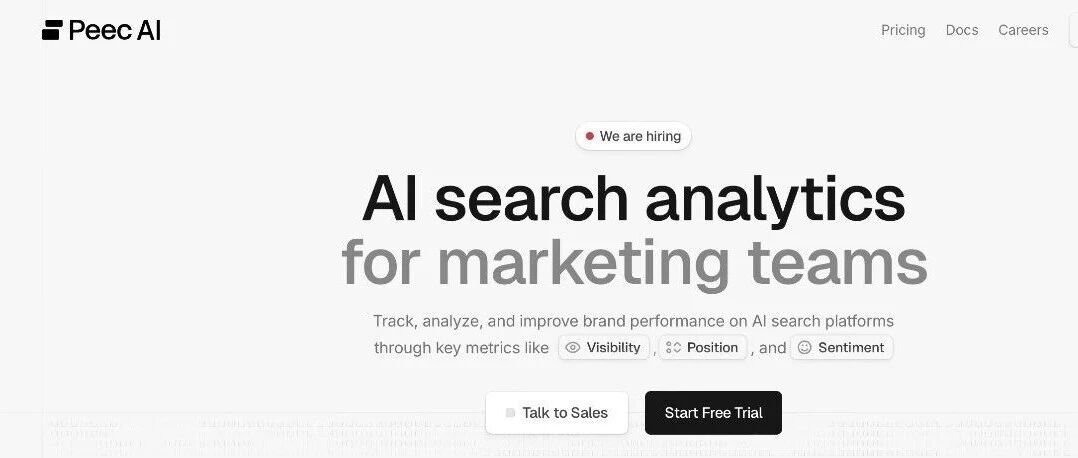
Core Viewpoint - The article discusses the shift from traditional SEO (Search Engine Optimization) to GEO (Generative Engine Optimization), emphasizing the importance of being mentioned by AI platforms like ChatGPT and others to enhance brand visibility and engagement in the evolving digital landscape [1]. Company Overview - Peec AI is a Berlin-based AI search platform startup founded in 2025, focused on creating AI search analysis tools for marketing teams to improve brand exposure and conversion on platforms like ChatGPT and Perplexity [3]. - Within just five months of its establishment, Peec AI secured €7 million in funding across two rounds, with weekly revenue growth of €80,000 [3]. - The company employs a small team covering product development, AI research, data analysis, and customer management, monitoring thousands of AI search dialogues daily across over 10 countries [3]. Founding Team - The founding team consists of Marius Meiners (CEO), Tobias Siwona (CTO), and Daniel Drabo (CRO), who have diverse backgrounds in entrepreneurship, technology, and market operations [4][5][6][7]. - Marius Meiners transitioned from a professional esports player to a software engineer and has experience in startup financing and mergers at PwC [5]. - Tobias Siwona is a serial entrepreneur with expertise in building AI and consumer tech products from the ground up [6]. - Daniel Drabo has a legal background and has previously run a ramen food truck and founded a LegalTech company [7]. Product Features - Peec AI stands out by offering features such as keyword suggestion generation, allowing users to avoid the hassle of brainstorming prompts themselves [9]. - The platform enables multi-platform tracking, allowing users to monitor various AI search platforms simultaneously, thus simplifying the process [10]. - It provides precise source tracking down to the specific URL, helping brands assess potential collaboration opportunities [11]. - Peec AI offers a transparent pricing model, with an entry-level plan starting at $89 per month, significantly lower than competitors [12]. - The platform allows unlimited user seats, making it cost-effective for larger marketing teams [13]. Client Success Case - SoftPro, a European SaaS company, utilized Peec AI to analyze its brand mentions on AI platforms, discovering a low mention rate of 15% on ChatGPT compared to competitors [15]. - After adjusting their marketing strategy based on Peec AI's insights, SoftPro increased its mention rate on ChatGPT from 15% to 42% and on Perplexity from 0% to 27%, resulting in a 166% growth in registered users from AI searches [15]. Industry Insights - The article highlights the transition from SEO, which focuses on keyword rankings, to GEO, which emphasizes brand mentions by AI, indicating a significant shift in how brands need to approach digital marketing [18]. - The potential for GEO solutions in the Chinese market is noted, with the company aiming to help brands appear not only in traditional search results but also in recommendations from new AI assistants [18].
18 年 SEO 增长经验专家:别再收藏各种 AEO 最佳攻略了,自己动手实验才是做好的关键
Founder Park· 2025-09-23 14:19
Core Insights - The article emphasizes the importance of verifying information about Answer Engine Optimization (AEO) through personal experimentation rather than relying on potentially inaccurate online best practices [2][3] - AEO is closely related to traditional SEO but requires a focus on citation optimization and long-tail questions to be effective [5][8] - The rise of AEO is attributed to the increasing adoption of AI models like ChatGPT, which have changed how users seek information [10][52] Group 1 - AEO is fundamentally about optimizing content to appear as answers in large language models [9][10] - High-quality, authentic comments on platforms like Reddit are more effective than numerous low-quality comments for AEO [3][24] - The distinction between AEO and SEO lies in the need for citation optimization and addressing long-tail questions [5][14] Group 2 - AEO strategies should include both on-site optimization (like improving help center content) and off-site optimization (like increasing mentions across various platforms) [22][58] - The average length of user queries in chat scenarios is significantly longer than traditional search queries, indicating a shift in user behavior [19][20] - Companies can quickly gain visibility in AEO by being mentioned in relevant discussions or content, unlike the longer timeline required for SEO [19][45] Group 3 - The effectiveness of AEO can be measured through experiments that compare the impact of different strategies on visibility and traffic [36][44] - AEO is not a replacement for Google but rather a new channel that complements existing search methods [50][51] - The quality of leads generated through AEO is significantly higher than those from traditional search, with conversion rates being six times greater [16][47] Group 4 - Companies should focus on creating original, high-quality content that provides unique insights to stand out in AEO [32][33] - The optimization of help center content is crucial, as many user queries are related to specific product functionalities and support [58][60] - AEO requires continuous adaptation and validation of strategies to ensure effectiveness in a rapidly changing digital landscape [36][46]

谁在你的AI里“做广告”?
虎嗅APP· 2025-09-11 13:41
Core Viewpoint - The article discusses the emergence of Generative Engine Optimization (GEO) as a new marketing strategy in the AI era, highlighting its potential to influence brand visibility and user decision-making in a competitive landscape dominated by AI platforms [5][10][15]. Summary by Sections Introduction to GEO - GEO is introduced as a new marketing approach that contrasts with traditional Search Engine Optimization (SEO), focusing on enhancing brand visibility in AI-generated search results [5][7]. - The rapid rise of GEO is attributed to the "traffic war" in the previous year, leading to significant user engagement with AI-native apps, which reached 270 million monthly active users in China by March this year [5][7]. Mechanism of GEO - The article explains how brands are adapting to AI by optimizing their presence in AI-generated responses, which involves creating content that is easily referenced by AI models [10][11]. - The process includes generating AI training data and monitoring response effectiveness, with a focus on prompt optimization to ensure brand recognition in AI outputs [12][14]. Market Dynamics and Competition - The competitive landscape is characterized by brands racing to implement GEO strategies, with early adopters benefiting from higher visibility in AI responses [18]. - The article notes that the GEO market is still in its infancy, with varying quality among service providers and a lack of proven conversion rates for GEO services [18][19]. Future of GEO - The potential for GEO to evolve into a monetization model is discussed, with four proposed pathways: B2B GEO services, C2C traffic sharing, GEO analytics tools, and vertical-specific GEO solutions [22]. - The article suggests that as AI penetration increases, GEO could fill the monetization gap in AI search, similar to how traditional search engines have operated [23]. Conclusion - The article concludes that while GEO presents new opportunities for brands, it also raises concerns about the quality of information and user experience, indicating a need for balance between commercial interests and user trust [21][20].