产业升级

Search documents
一线“高”见 这三年,我在现场感受广东高质量发展
Nan Fang Du Shi Bao· 2026-02-24 00:37
Core Insights - Guangdong's economy has shown significant growth, crossing the thresholds of 13 trillion and 14 trillion yuan, with the number of business entities increasing from 18 million to over 20 million in three years [3][5] - The province has successfully transformed its industrial structure through technological innovation and smart upgrades, exemplified by companies like Lingfeng Group, which reduced production time from 7 days to under 2 hours and cut costs by 35% [3][5] - Guangdong's innovation capabilities have ranked first in the country for nine consecutive years, with the "Shenzhen-Hong Kong-Guangzhou" innovation cluster becoming the world's leading hub [5][6] Economic Growth - Guangdong's import and export scale is projected to rise from 8.3 trillion yuan in 2023 to 9.49 trillion yuan by 2025 [3] - The province's individual businesses reached 10.9 million, contributing to a vibrant local economy [16] Industrial Transformation - The province has achieved a "three-step jump" in its trillion-yuan industrial clusters, with the addition of the ultra-high-definition video industry as the tenth member [6] - The shift from "lack of chips and screens" to becoming a leader in the ultra-high-definition video sector highlights the successful integration of technology and industry [6][8] Technological Innovation - Over 50% of technology projects in Guangdong are led by enterprises, with about 90% of R&D personnel engaged in innovation within companies [8] - The establishment of pilot platforms has facilitated the transformation of scientific achievements into market-ready products, bridging the gap between research and industry [13][15] Robotics Industry - Guangdong's industrial and service robot production reached 336,300 and 1,518,210 units respectively in 2025, accounting for 43.5% and 81.7% of the national total [12] - The province has shifted from low-level repetitive construction to focusing on core technologies and practical applications, enhancing the quality of its robotics industry [12] Local Economy and Community - Small businesses and local shops play a crucial role in Guangdong's economy, providing a sense of community and supporting local entrepreneurship [16][19] - The warmth and resilience found in local establishments reflect the human aspect of Guangdong's high-quality development, emphasizing the importance of grassroots economic activity [19]

树立系统思维推动迭代升级
Jing Ji Ri Bao· 2026-02-23 23:31
Core Viewpoint - The article emphasizes that a good business environment is both a competitive advantage and a productive force, highlighting the importance of systemic thinking in improving the business environment in Lanzhou [1][2]. Group 1: Systemic Thinking in Business Environment - Systemic thinking is reflected in the integration of industrial ecology and resource advantages, where a favorable development environment attracts investment and talent, enhancing corporate confidence [1]. - Lanzhou aims to resolve historical issues, reduce corporate burdens, and activate existing resources to create a synergistic effect that transforms the old industrial base into new productive advantages [1]. Group 2: Efficient Coordination and Service Integration - The business environment acts as a "strong magnetic field" and "catalyst" for project construction, with Lanzhou focusing on the entire lifecycle needs of business entities and transitioning from "dispersed supply" to "integrated efficiency" in government services [2]. - The city employs digitalization to break down departmental data barriers and enhances service quality through a "shop assistant" model, improving the overall experience for enterprises [2]. Group 3: Legal Protection and Flexible Regulation - Optimizing the business environment requires a balance between liberalization and effective regulation, fostering a healthy government-business relationship [2]. - Lanzhou is exploring the "Internet + Credit + Regulation" model to innovate credit information applications, allowing businesses to benefit from trust and ensuring a secure investment climate [2]. Group 4: Continuous Improvement - The optimization of the business environment is an ongoing process, with Lanzhou integrating reforms, addressing bottlenecks, and shaping an ecosystem that transforms the "soft power" of the business environment into "hard support" for industrial development [2].
今日视点:春晚“科技秀”呈现三大变革
Xin Lang Cai Jing· 2026-02-23 23:04
Core Viewpoint - The 2026 CCTV Spring Festival Gala showcased humanoid robots, marking a significant evolution in China's technological advancements and highlighting the integration of technology into cultural events [1][7]. Group 1: Technological Evolution - The Spring Festival Gala has historically served as a platform for showcasing cutting-edge technology, evolving from static props like color TVs and mobile phones to dynamic participants like humanoid robots [1][7]. - The transition from technology as mere props to becoming central performers reflects China's strong capability in technological expression and artistic integration [1][7]. Group 2: Industrial Upgrade - Humanoid robots symbolize a shift in Chinese manufacturing from automation to intelligence, indicating a move towards higher-end positions in the global industrial value chain [3][9]. - Each technological product featured in the gala represents a historical marker of China's industrial upgrades, with humanoid robots exemplifying a qualitative change in productivity [3][9]. Group 3: Capital Market Dynamics - The gala has established a feedback loop where technological showcases generate market interest, which in turn drives capital investment and accelerates industrial innovation [4][10]. - The debut of humanoid robots at the 2025 Spring Festival Gala ignited significant capital enthusiasm, leading to notable gains in related sectors and a reshaping of valuation systems [4][10]. - This deep connection between the gala and the capital market illustrates how cultural events can facilitate technological innovation and financial empowerment, creating a mutually beneficial relationship [4][10].
黑河 奋力冲刺开门红
Xin Lang Cai Jing· 2026-02-23 22:47
Core Viewpoint - Heihe City is actively promoting industrial upgrades and project construction, showcasing a vibrant development landscape as it embarks on the "14th Five-Year Plan" [6] Group 1: Industrial Upgrades - The launch of the badminton production line by Heilongjiang Chaoyu Intelligent Development Co., Ltd. marks the first badminton production project in the province, indicating a significant step in the deep processing of the local goose industry [6] - Nenjiang City aims to produce 6.68 million geese by 2025, with a slaughter capacity of 12 million, establishing a complete industrial system from breeding to processing and branding [6] - The annual production capacity of the badminton project is expected to reach 1 million dozen, generating an estimated annual output value of 200 million to 300 million yuan after the second phase [6] Group 2: Market Development - Xunke County has established a complete industrial chain for goose product processing, with a low loss rate of 2% and a high liver yield rate of 82% [7] - The Xunke County brand has successfully entered high-end dining markets in major cities like Shanghai and Guangzhou, with an expected annual output value of 120 million yuan from goose farming [9] Group 3: Project Construction - The "Investment Longjiang" winter investment promotion event in Sunwu County resulted in the signing of projects worth over 1 billion yuan [10] - A wind power project in Aihui District is expected to deliver 470 million kilowatt-hours of clean electricity annually, with a total sales revenue of approximately 2.38 billion yuan over its lifecycle [10] Group 4: Market Activation - The "Enjoy Cross-Strait Style · Purchase Chinese New Year Goods" event in Heihe City generated sales exceeding 1.5 million yuan within the first three hours [12] - The city plans to invest 27.4 million yuan in consumer promotion activities, creating a new consumption pattern that benefits citizens and encourages cross-border interaction [12] - A car consumption upgrade activity offers subsidies up to 6,000 yuan for personal consumers purchasing vehicles, enhancing consumer engagement [13]
希腊积极应对贸易逆差扩大
Sou Hu Cai Jing· 2026-02-23 22:37
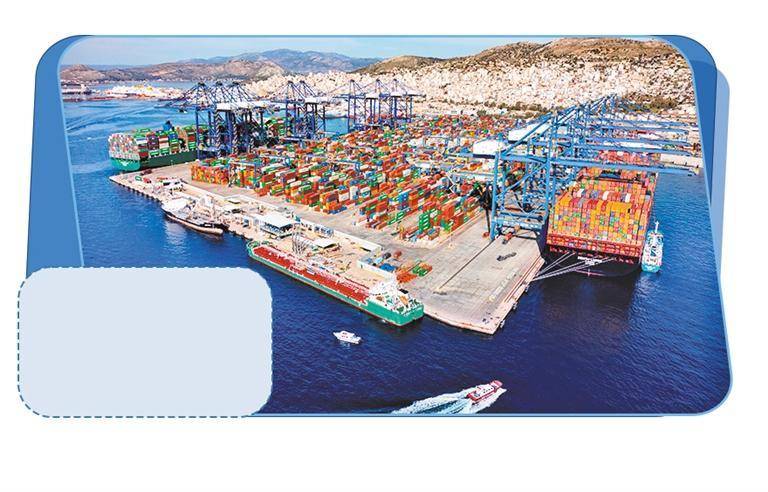
Core Insights - Greece's trade deficit expanded to €3.6 billion in December 2025, the largest monthly deficit since November 2022, driven primarily by a mismatch in the growth rates of imports and exports [2][4] Group 1: Trade Deficit and Import Dynamics - The increase in Greece's trade deficit is mainly attributed to a 1.5% year-on-year growth in imports, reaching €7.7 billion in December 2025 [2] - Imports from EU member states saw a significant increase of 9.1%, highlighting Greece's reliance on the EU market for industrial goods, energy products, and high-tech intermediate goods [2][4] - In contrast, imports from non-EU countries decreased by 7.9%, which somewhat mitigated the overall import growth [2] Group 2: Export Performance - Greece's exports reached €4.1 billion in December 2025, reflecting a modest year-on-year growth of 0.7%, significantly lower than the import growth rate [3] - Exports to EU countries performed well, with an 11.8% increase, particularly in agricultural products, food processing, pharmaceuticals, and light industrial goods [3] - However, exports to non-EU countries fell by 11.5%, indicating a structural imbalance in Greece's export market [3] Group 3: Structural Issues and Government Response - Economists point out that the trade deficit's expansion is due to both short-term factors, such as increased demand for imports due to EU economic recovery, and long-term structural issues, including a weak manufacturing base and reliance on low-value exports [4][5] - The Greek government is signaling policy adjustments to attract foreign investment and enhance domestic production capabilities, particularly in manufacturing and high-tech industries [5] - Initiatives to support businesses in expanding into non-EU markets and promoting industry upgrades are seen as crucial for long-term economic recovery and reducing import dependency [5]
春晚“科技秀”呈现三大变革
Zheng Quan Ri Bao· 2026-02-23 16:19
Group 1 - The core viewpoint of the article highlights the evolution of technology showcased during the CCTV Spring Festival Gala, illustrating China's technological advancements over the past four decades, culminating in the prominent display of humanoid robots in 2026 [1][4] - The Spring Festival Gala serves as a platform for testing cutting-edge technologies under extreme conditions, demonstrating their reliability and commercial potential to a vast audience, thereby boosting market confidence in hard technology sectors [2][4] - The transition from traditional consumer electronics to humanoid robots signifies a shift in China's manufacturing capabilities from automation to intelligence, marking a qualitative change in productivity and showcasing China's innovation leadership [3][4] Group 2 - The Gala has established a complete feedback loop where technology showcases generate market interest, which in turn drives capital investment, accelerating industry evolution and creating a virtuous cycle between technology, capital, and industry [4] - The debut of humanoid robots at the Spring Festival Gala has ignited capital enthusiasm, leading to significant gains in related sectors and a reshaping of valuation systems, reflecting the deep interconnection between the Gala and capital markets [4] - The Spring Festival Gala transcends its cultural significance, becoming a crucial node for promoting technological innovation and industry financing, achieving a dual benefit of cultural dissemination and economic empowerment [4]
ST东尼拟转让东尼新能源21.7%股权予地方国资,交易价2.3亿元
Sou Hu Cai Jing· 2026-02-23 09:05
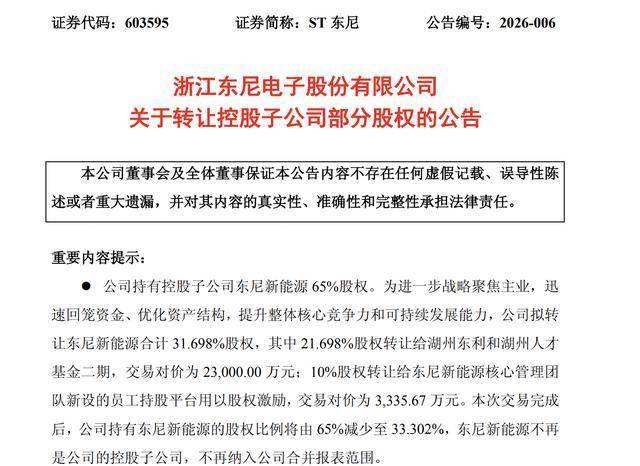
Core Viewpoint - ST Dongni (SH603595) plans to transfer a total of 31.7% equity in its subsidiary Dongni New Energy, with the aim of focusing on its core business and enhancing overall competitiveness [2][5]. Equity Transfer Details - 21.7% of the equity will be sold to Huzhou Dongli and Huzhou Talent Fund Phase II for a transaction price of 230 million yuan [2]. - 10% of the equity will be transferred to a newly established employee stock ownership platform for the core management team, with a transaction price of 33.3567 million yuan [2]. - After the transaction, ST Dongni's stake in Dongni New Energy will decrease from 65% to 33.3%, while Huzhou Dongli and Huzhou Talent Fund Phase II will hold a combined 56.7% [4]. Valuation and Financial Performance - As of November 30, 2025, the total equity valuation of Dongni New Energy is estimated at 1.06 billion yuan, reflecting an increase of 726 million yuan and a growth rate of 217.78% compared to the book value [2]. - Dongni New Energy's revenue for 2024 and the first eleven months of 2025 is projected to be 406 million yuan and 585 million yuan, respectively, with net profits of 17.39 million yuan and 54.89 million yuan [2]. Performance Commitment - The actual controllers of ST Dongni have committed that Dongni New Energy's net profit for the years 2026, 2027, and 2028 will not be less than 240 million yuan. If this commitment is not met, the controllers will provide cash compensation to Huzhou Dongli and Huzhou Talent Fund Phase II [3]. Strategic Focus - The transaction is part of ST Dongni's strategic plan to focus on its main business, quickly recover funds through the sale of subsidiary equity, and enhance its core competitiveness by developing new projects and products with major clients [5].

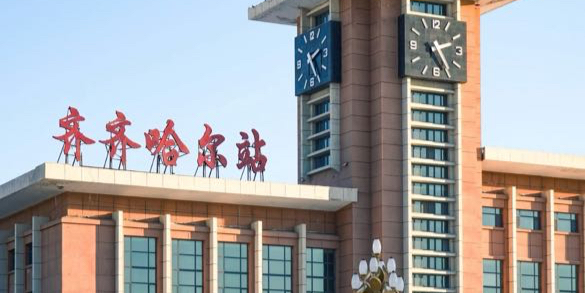
齐齐哈尔,如何找回失去的荣光?|故乡里的中国
Jing Ji Guan Cha Wang· 2026-02-22 05:09
Core Viewpoint - The article discusses the transformation of Qiqihar, a city that was once a significant industrial hub in China, highlighting its historical industrial decline and the emergence of new industries, particularly in agriculture and manufacturing, as it seeks to redefine its economic identity [2][8][30]. Industrial Transformation - Qiqihar was a key player in China's industrial landscape, particularly in heavy equipment manufacturing and special steel production, with its industrial output ranking among the top ten in the country during the 1980s [8][19]. - The city has experienced a significant population decline, losing nearly one million residents from 2010 to 2020, leading to visible signs of industrial decay, such as abandoned factories and closed shops [8][15]. - The local heavy machinery industry has seen a revival since 2000, with companies adapting to new market conditions and shifting from traditional manufacturing to specialized equipment production [20][21]. Agricultural Development - Qiqihar boasts fertile agricultural land, with a cultivated area of 35 million acres and a stable grain output exceeding 20 billion pounds annually, making it a crucial grain-producing region in China [24]. - The city has faced challenges with low-value agricultural production, where farmers often receive minimal profits from selling raw grains [24][30]. - Recent efforts have focused on enhancing agricultural value through processing, with local governments promoting strategies that connect farming with food processing and biological manufacturing [24][30]. Economic Resilience - The article emphasizes the resilience of Qiqihar as it navigates the loss of its former industrial glory and population, highlighting the emergence of new industries and the adaptation of existing ones to meet modern demands [31][33]. - The transformation reflects a broader economic logic where traditional industries must innovate and reposition themselves within the new market landscape, moving from production to providing comprehensive solutions [21][31].
西南证券:新经济、新动能行业洞察系列(二):新消费演进中的价格与产业洞察
Sou Hu Cai Jing· 2026-02-21 14:27
Group 1 - The report highlights that "new consumption" is driven by information technology and focuses on quality and personalization, serving as a strategic pillar for domestic demand circulation and enhancing its strategic position as policies continue to strengthen [1][8][17] - Since 2023, final consumption expenditure has consistently contributed the most to GDP, with a stable contribution rate around 3%, significantly higher than developed economies [1][25][28] - Service consumption is showing strong growth momentum, with retail sales of services expected to outpace goods retail sales by 1.7 percentage points in 2025, indicating a shift towards experience-based consumption [1][29][31] Group 2 - The restructuring of CPI weights reflects a shift in consumer spending from basic necessities to quality upgrades, with significant increases in the weights of housing, transportation, and communication categories from 2021 to 2025 [2][3][22] - New consumption is providing an upgrade path for industrial development, with policies transitioning from broad expansion to precision targeting, effectively stimulating mid-to-upstream industries [2][4][18] - Rural consumption is becoming a core scene for new consumption, with retail sales in rural areas expected to grow at a rate of 4.1% in 2025, outpacing urban areas for four consecutive years [2][4][39] Group 3 - The report indicates that new consumption is reshaping the economic landscape by enhancing supply-demand matching efficiency, which in turn supports price stability and drives industrial upgrades [16][22][23] - The analysis of consumer spending shows that healthcare and other services are experiencing the highest growth rates, while traditional categories like food and clothing are growing at a slower pace [31][39] - The report emphasizes that the new consumption model is characterized by digital technology and innovation, which reduces reliance on traditional economic cycles and provides new growth momentum for the economy [22][23][24]


西方专家集体懵圈!一年时间,中国怎么就成了 “看不懂的奇迹”?
Sou Hu Cai Jing· 2026-02-21 09:26
Economic Performance - China's GDP growth reached 5% with a total economic output exceeding 140 trillion yuan, contributing approximately 30% to global growth [3][5] - Manufacturing value added has been the highest globally for 16 consecutive years, with industrial added value increasing by 5.9% [3][5] - China's export total reached 45.47 trillion yuan, marking a year-on-year increase of 3.8%, with high-tech product exports rising by 13.2% [3][5] Trade and Foreign Relations - China achieved a trade surplus of 1.2 trillion USD despite predictions of a trade downturn, with exports to ASEAN and Latin America growing faster than overall exports, particularly an 11.2% increase to Latin America [3][5] - The Belt and Road Initiative emphasizes mutual benefit and cooperation, with investments in partner countries increasing by 20% [9] Technological Advancements - Despite Western technological blockades, Chinese companies have made significant advancements, such as the DeepSeek-R1 model, which performs competitively with Western counterparts [7] - China's R&D investment reached 39.262 billion yuan, ranking second globally, with the highest number of PCT patent applications [7] Industrial and Economic Structure - The share of the service sector in China's economy reached 57.7%, while the proportion of high-tech manufacturing in industrial output rose to 17.1% [5] - China has maintained a complete industrial system and a large-scale market, with a strong focus on innovation and industrial upgrading [5][9]