
公募基金费率改革

Search documents
“引长钱促长投”改革效果加快显现
Jin Rong Shi Bao· 2025-09-24 02:54
Core Viewpoint - The Chinese government is accelerating investment reforms to promote long-term capital investment in the capital market, with significant achievements reported in the entry of medium- and long-term funds into the market [1][4]. Group 1: Investment Reforms - The China Securities Regulatory Commission (CSRC) has issued guidelines to encourage medium- and long-term funds to enter the market, with a total of approximately 21.4 trillion yuan in A-share market value held by various medium- and long-term funds as of the end of August this year [1][4]. - The comprehensive fee reduction reform for public funds has been fully implemented, with a projected annual reduction of approximately 510 million yuan for investors, exceeding the initial targets [2][3]. Group 2: Public Fund Industry - The public fund industry in China has reached a record high, surpassing 35 trillion yuan in total assets by the end of August, marking a significant milestone in the industry's development [3]. - The fee reduction reform is seen as a critical step towards high-quality development in the public fund sector, with the third phase of the reform focusing on reducing sales fees and benefiting investors [2][3]. Group 3: Role of Medium- and Long-Term Funds - Medium- and long-term funds are crucial for stabilizing the capital market and mitigating short-term volatility, with a year-on-year increase of 42.7% in the market value held by these funds [4]. - The government has implemented measures to facilitate the entry of social security, insurance, and pension funds into the market, enhancing the overall investment landscape [4]. Group 4: ETF Development - The scale of Exchange-Traded Funds (ETFs) has surpassed 5 trillion yuan, with new innovative products launched to meet diverse investment needs [5]. - Central Huijin has played a significant role in boosting market confidence by increasing its holdings in ETFs, with a total value reaching 1.28 trillion yuan by mid-2025 [5].
成立12年来,余额宝首次降费
Sou Hu Cai Jing· 2025-09-23 17:15
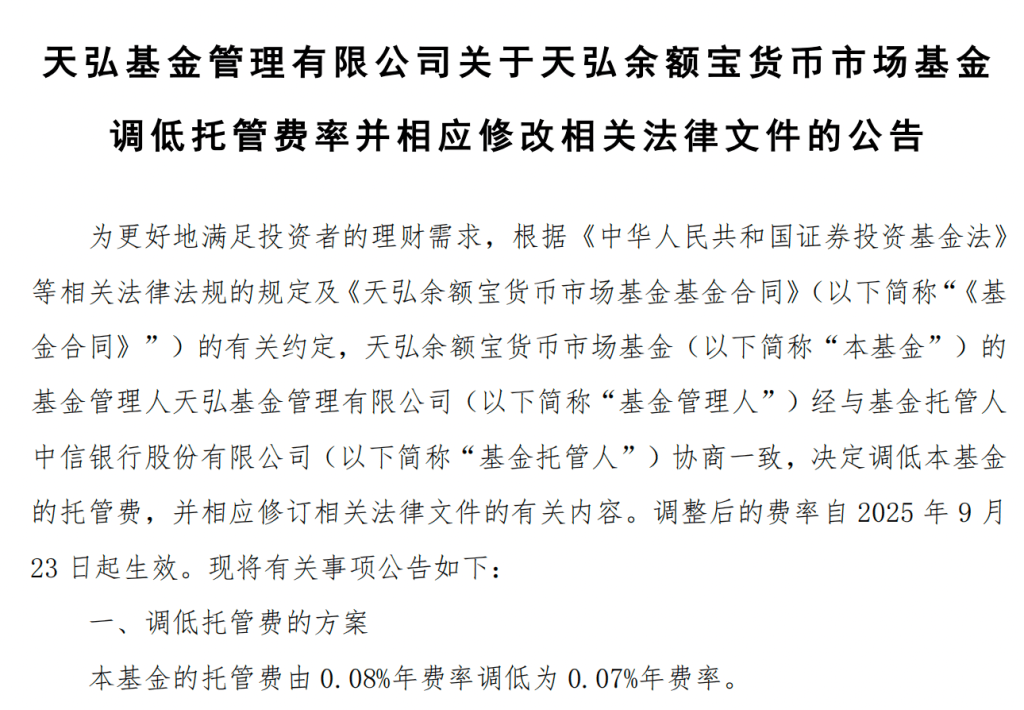
Core Viewpoint - Multiple money market funds, including Tianhong's Yu'ebao, have collectively reduced their fees to better meet investor needs and lower investment costs [1][3]. Group 1: Fee Adjustments - Tianhong Fund announced a reduction in the custody fee for its Yu'ebao money market fund from 0.08% to 0.07%, effective September 23 [1][2]. - This is the first fee reduction since the fund's establishment 12 years ago, with the total fund size reaching 793.219 billion yuan as of the second quarter of 2025 [2][3]. - The overall operational fee rate for Yu'ebao after the adjustment is 0.62%, with management and sales service fees remaining unchanged at 0.30% and 0.25%, respectively [2][3]. Group 2: Industry Trends - Other funds, such as E Fund and Guoxin Guozheng, have also announced fee reductions, indicating a broader trend in the industry following the public fund fee reform initiated in July 2023 [5]. - The China Securities Regulatory Commission has emphasized the need for industry institutions to timely reduce management and custody fees for money market funds [5].

券商分析师超6100人规模创新高
Zheng Quan Ri Bao Zhi Sheng· 2025-09-23 16:36
Core Insights - The brokerage industry is experiencing a transformation as commission income from split accounts declines, yet the number of analysts continues to grow, indicating a strategic shift towards research value [1][2] Group 1: Analyst Workforce Expansion - The total number of analysts in the securities industry reached a record high of 6,130 as of September 23, 2023, an increase of 409 from the beginning of the year [1] - 56 brokerages have increased their analyst headcount this year, with leading firms like CITIC Securities adding 42 analysts [1][2] - Major brokerages are showing a scale advantage, with three top firms having over 300 analysts: CICC with 344, Guotai Junan with 303, and CITIC Securities with 301 [1] Group 2: Strategic Adjustments and Differentiation - Brokerages are implementing differentiated development strategies to drive performance growth amid intense market competition [2] - Guosen Securities is focusing on strategic research in key national development areas like intelligent manufacturing, while招商证券 is enhancing its research capabilities through AI technology [2] - The expansion of analyst teams reflects a long-term optimism about the strategic value of research in the brokerage sector [2] Group 3: Future Service Models - The brokerage research business is transitioning from traditional models to diversified value-creating service models [3] - Future exploration may include think tank and corporate strategic consulting services, with a focus on specific industries and regions to build differentiated advantages [3] - The integration of digital tools and a combination of external recruitment and internal training will enhance talent reserves and overall market competitiveness [3]



“十四五”数据中的公募高质量发展答卷
2 1 Shi Ji Jing Ji Bao Dao· 2025-09-23 12:03
21世纪经济报道记者 黎雨辰 9月22日,在国务院新闻办公室"高质量完成'十四五'规划"系列主题新闻发布会上,中国证监会主席吴 清回顾了资本市场的五年"成绩单"。五年来,证监会认真落实"十四五"规划和二十届三中全会部署,推 出了一批牵引性强、含金量高的标志性改革开放举措。 其中围绕投资端改革,吴清提及了公募基金领域的诸多重大突破:"坚持投资者利益优先,制定实施公 募基金高质量发展行动方案,建立完善投资收益为核心的考核评价体系,三阶段降费改革全面落地。" 此外,公募REITs等创新产品发展,养老第三支柱建设提速等诸多"关键词"也都与公募基金息息相关。 总体来看,"十四五"以来,我国公募市场呈现出规模扩张、产品生态持续完善、服务国家战略取得新质 效,行业治理不断完善的发展态势。 公募高质量发展取得阶段性成效 公募基金行业的高质量发展,是"十四五"时期我国金融业发展的重要成就之一。近年来,证监会先后发 布了《加快推进建设一流投资银行和投资机构的意见》《推动公募基金高质量发展行动方案》等文件。 "文件的发布通过制度重构和机制创新,着力引导行业机构端正经营理念,校正发展定位,实现功能性 和盈利性的有机统一。"有业内人士 ...
“9·24”一周年:从2700点保卫战到市值首破百万亿
第一财经· 2025-09-22 14:06
Core Viewpoint - The A-share market has shown significant recovery over the past year, with the Shanghai Composite Index rising from 2700 points to over 3800 points, and the total market capitalization surpassing 100 trillion yuan, indicating a positive shift in investor sentiment and market dynamics [3][4]. Market Recovery and Performance - The A-share market's total market capitalization first exceeded 100 trillion yuan in August, with the annualized volatility of the Shanghai Composite Index decreasing by 2.8 percentage points compared to the previous five-year period [6][10]. - Following a series of supportive policies introduced on September 24 last year, the market has experienced a strong upward trend, with the index reaching a nearly ten-year high of 3899.96 points [6][7]. - A total of 1508 stocks have doubled in price since last September, with notable performance in the machinery and electronics sectors [7][8]. Fund Performance and Investor Behavior - Over 99% of mutual fund products have reported positive cumulative returns since last September, with 697 funds achieving returns exceeding 100% [8][9]. - The number of funds with net asset values below 1 yuan has significantly decreased from over 3959 to 1224, reflecting improved investor experiences [9]. - The trend of investors shifting from a cautious "redeem upon breakeven" mentality to actively seeking new investment opportunities has been observed, with new A-share accounts increasing by 165% year-on-year in August [14][16]. Long-term Capital Inflow - As of August, the total market value of various long-term funds holding A-shares reached approximately 21.4 trillion yuan, marking a 32% increase since the end of the 13th Five-Year Plan [10][11]. - The ETF market has also seen substantial growth, with total assets surpassing 5.31 trillion yuan, a 42.31% increase from the end of last year [11][12]. - Regulatory support and policy initiatives have encouraged long-term capital inflows, with estimates suggesting that insurance funds could see net inflows into equity assets reach 1 trillion yuan this year [12][13]. Market Outlook - Despite recent market fluctuations, the medium-term outlook remains positive, driven by liquidity and supportive policies, with expectations of continued recovery in the A-share market [17].

从2700点保卫战到市值首破百万亿,“9·24”一周年改变了什么?
Di Yi Cai Jing· 2025-09-22 11:45
Market Recovery - The A-share market has shown significant recovery, with the Shanghai Composite Index rising from 2700 points to over 3800 points, and the total market capitalization surpassing 100 trillion yuan [1][3] - Over 1500 stocks have doubled in price since last year, indicating a broad-based recovery across various sectors [1][4] Investor Behavior - Investor sentiment has shifted from a cautious "cash out upon breakeven" mentality to a more optimistic approach, with many now considering new investment opportunities [10][12] - New A-share accounts opened in August increased by 165% year-on-year, reflecting growing investor interest [1][12] Fund Performance - The performance of public funds has improved significantly, with over 99% of funds showing positive cumulative returns since last September, and 697 funds achieving over 100% returns [4][6] - The number of funds with unit net values below 1 yuan has decreased from 3959 to 1224, indicating a recovery in fund values [6] Long-term Capital Inflow - Long-term capital, including insurance and pension funds, has been steadily entering the A-share market, with a total market value of approximately 21.4 trillion yuan, a 32% increase since the end of the 13th Five-Year Plan [7][8] - The ETF market has also seen substantial growth, reaching a total scale of 5.31 trillion yuan, up 42.31% from the end of last year [7] Policy Support - Regulatory policies aimed at encouraging long-term capital inflow have been implemented, which are expected to further enhance market stability and growth [8][9] - Recent reforms in public fund fee structures are projected to save investors over 500 billion yuan annually, promoting a more favorable investment environment [9]
10万亿基金代销江湖,银行系且战且退
3 6 Ke· 2025-09-17 23:20
Core Insights - The A-share market has stabilized and rebounded since 2025, leading to a reshuffling in the public fund sales landscape, with significant growth in non-monetary fund holdings surpassing 10 trillion yuan [1][2] - The top fund distribution institutions, such as Ant Fund and China Merchants Bank, dominate the market, holding over 25% of the total non-monetary fund scale [1][2] - A structural change in investor preferences is evident, with a shift towards more transparent and lower-fee products, particularly passive and fixed-income funds [2][3] Growth Structure - In the first half of 2025, the non-monetary fund holdings of the top 100 distribution institutions reached 10.2 trillion yuan, a 6.95% increase, while equity fund holdings grew by 5.89% to 5.14 trillion yuan [1][2] - Stock index funds saw a remarkable growth of 14.57%, nearing 2 trillion yuan, indicating a recovery in investor confidence driven by rising core indices [1][2] - Smaller institutions are struggling to balance scale and profitability, with a continuing trend of market concentration favoring larger players [2][3] Channel Dynamics - The distribution landscape is increasingly characterized by a three-way competition among banks, brokerages, and independent sales institutions, with a clear restructuring of their market shares [3][4] - Banks still hold over 40% of equity fund holdings, but their market share is declining, as younger investors prefer digital platforms [3][4] - Brokerages and third-party platforms are gaining ground due to their product flexibility and online capabilities, with brokerages increasing their market share in equity funds to 27.41% [4][5] Index Fund Surge - Stock index funds are the hottest category in the current fund growth, with brokerages maintaining a dominant position due to their trading advantages [5][6] - Banks are rapidly increasing their index fund sales, with a year-on-year growth of 99.2% in the first half of 2025, indicating a strategic response to market trends [5][6] - Major banks like Agricultural Bank and Industrial and Commercial Bank have significantly increased their index fund sales, showcasing their adaptability [5][6] Future Outlook - Despite positive growth data, the fund distribution industry remains cautious due to impending fee reforms that will impact revenue structures and product strategies [7][8] - The upcoming fee reductions are expected to challenge traditional sales models, pushing institutions to enhance their advisory services [7][8] - Regulatory changes are likely to encourage brokerages to invest more in equity product sales, further accelerating industry transformation [7][8]


10万亿基金代销江湖 银行系且战且退
经济观察报· 2025-09-17 11:50
Core Viewpoint - The non-monetary fund holding scale exceeding 10 trillion yuan marks a significant milestone in the maturity of China's public fund market, indicating a transformation in channels, products, and client structures that will shape future competition [1][15]. Group 1: Market Overview - As of mid-2025, the non-monetary fund holding scale of the top 100 distribution institutions reached 10.2 trillion yuan, a quarter-on-quarter increase of 6.95%, while equity fund scale grew by 5.89% to 5.14 trillion yuan [2][5]. - The stock index fund segment saw a remarkable growth of 14.57%, nearing 2 trillion yuan, reflecting a recovery in investor confidence amid a rising A-share market [5][6]. Group 2: Structural Changes - There is a notable differentiation in growth, with leading institutions like Ant Fund and China Merchants Bank holding over 25% of the market share, while smaller institutions struggle to balance scale and profitability [6][7]. - The growth in fund scale is primarily driven by passive products and fixed-income funds, indicating a shift in investor preference towards more transparent and lower-fee products [7]. Group 3: Channel Dynamics - The distribution landscape is increasingly characterized by a tripartite structure of banks, securities firms, and independent sales agencies, with banks holding over 40% of equity fund holdings but experiencing a decline [9][10]. - Securities firms and third-party platforms are gaining market share due to their product flexibility and online capabilities, with securities firms' market share in equity funds rising to 27.41% [9][10]. Group 4: Index Fund Growth - Index funds are the hottest category in the current fund scale growth, with securities firms maintaining a dominant position due to their trading attributes and customer structure [11][12]. - Banks are rapidly increasing their index fund sales, with a year-on-year growth of 99.2% in the first half of 2025, indicating a strategic response to market trends and changing client needs [11][12]. Group 5: Future Challenges - The upcoming third phase of public fund fee reforms is expected to significantly impact the income structure and product strategies of distribution institutions, necessitating a shift from sales-driven to service-driven models [14][16]. - Institutions must adapt to fee changes, enhance advisory capabilities, and optimize product structures to remain competitive in the evolving market landscape [14][16].

这两类投资或迎巨变?《公募销售费用管理规定》背后的长线逻辑
Sou Hu Cai Jing· 2025-09-17 08:13
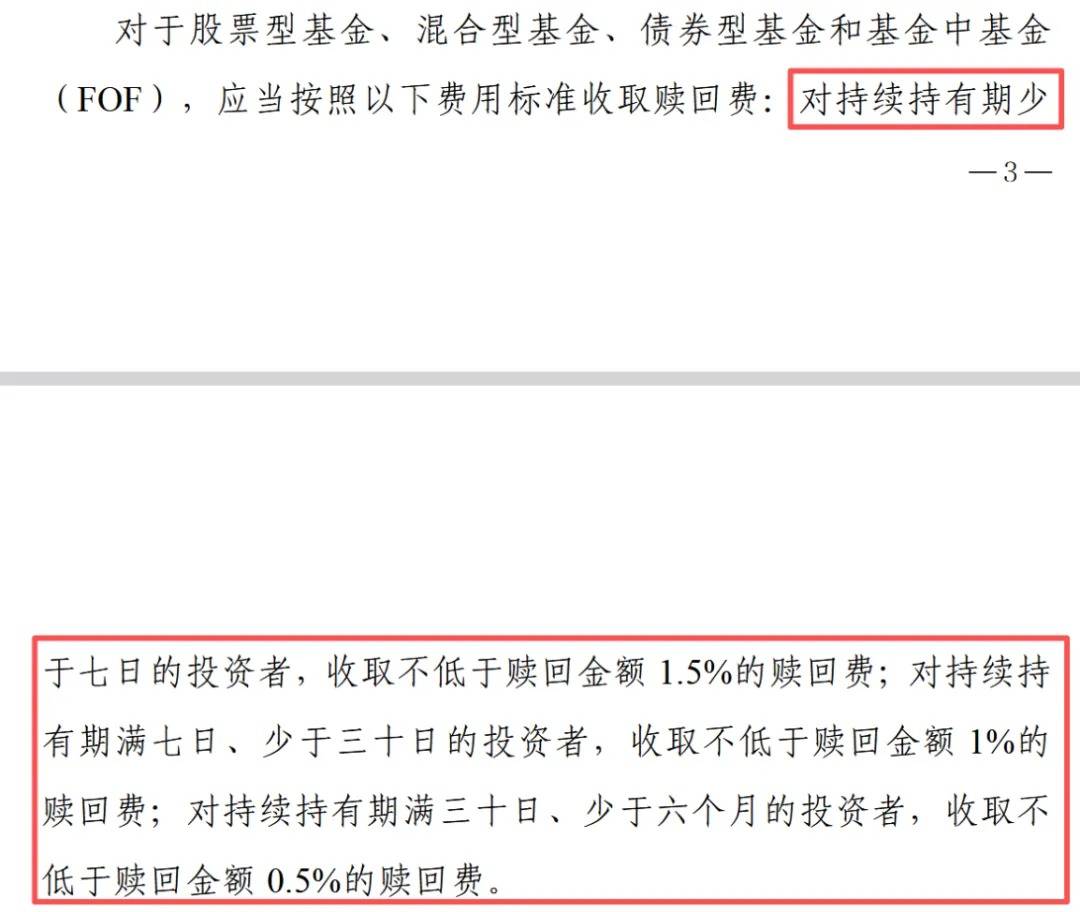
Core Viewpoint - Recent changes in redemption fees for various fund types may significantly impact investor strategies, particularly for short-term bond funds, potentially discouraging investment in these products due to increased costs [1][2][3]. Fee Structure Changes - The maximum subscription fees for equity, mixed, and bond funds have been reduced to 0.8%, 0.5%, and 0.3% respectively, while service fees for equity and mixed funds, index funds, and money market funds have been lowered to 0.4% per year, 0.2% per year, and 0.15% per year [1]. - New redemption fee requirements stipulate that investors must hold stocks, mixed, bonds, and FOF products for over six months to avoid a minimum redemption fee of 0.5% [1]. Impact on Short-term Investors - Short-term investors may face higher redemption fees, with fees of 1.5% for redemptions within 7 days, 1% for 7-30 days, and 0.5% for 30 days to 6 months, making it essential for investors in pure bond funds to prepare for a holding period of at least six months [3]. - The introduction of a 0.5% redemption fee could significantly reduce the effective yield of short-term bond funds, which currently hover around 1% [2]. C-Class Fund Implications - C-class funds, which previously offered advantages in redemption fees, will now face similar restrictions as A-class funds, as the new rule requires a six-month holding period for fee exemption, diminishing the appeal of C-class funds for short-term investors [4]. Market Trends and Regulatory Guidance - The recent regulatory guidance emphasizes the shift from scale-oriented to investor return-oriented strategies, aiming to create long-term stable returns for investors [6][7]. - The focus on long-term investment strategies is becoming a key theme in the public fund industry's development, with a push for high-quality growth and a recognition that short-term volatility is a normal aspect of market behavior [7].
债基又现大额赎回,年内超1200只债基收益为负,公募费率新规影响几何?
3 6 Ke· 2025-09-17 04:55
Core Insights - The bond fund market has been experiencing significant redemption pressure since July, with no signs of recovery in September, leading to a need for increased net asset value precision in several funds [1][2] - A total of 67 funds have announced adjustments to their net asset value precision due to large redemptions, with nearly 90% being bond funds [2][4] - The current redemption wave is attributed to various factors, including the "scissors effect" between stock and bond markets and the impact of public fund fee reforms [1][4] Redemption Pressure - Since July, 67 funds have announced increases in net asset value precision due to large redemptions, with 60 of these being bond funds [2][3] - Among the bond funds, 44 are pure bond funds, 11 are passive index bond funds, and 5 are mixed bond funds [2] - The mid-to-long-term pure bond fund index has seen a significant decline, with a total drop of 0.80% over July and August, and a slight decrease of 0.01% in September [2][6] Market Dynamics - The bond market has been volatile, leading to frequent large redemptions, with the current situation being more widespread compared to previous instances [2][4] - The redemption pressure is primarily seen in pure bond funds, particularly mid-to-long-term bond funds [2][3] - The bond funds experiencing large redemptions include those managed by various public institutions, including both securities and banking-related fund managers [3][4] Fee Reform Impact - The recent public fund fee reform is expected to influence investor behavior, with lower subscription fees for stock and mixed funds, while bond fund redemption fees will increase [5][6] - The new fee structure aims to align redemption costs across different fund types, potentially leading to higher trading costs for bond funds [5][6] - The stock market has seen a significant increase in fund sizes, with equity ETFs surpassing 4.35 trillion yuan, contrasting with the negative performance of over 1200 bond funds [5][6]