
普惠金融

Search documents
中国人寿:深耕普惠金融 绘就民生幸福新图景
Ren Min Wang· 2025-11-24 03:51
Core Viewpoint - The company emphasizes the importance of inclusive finance, aiming to enhance financial services' accessibility and diversity to benefit all citizens, particularly focusing on vulnerable groups and small to medium enterprises [1] Group 1: Inclusive Financial Services - The company has been actively promoting inclusive finance, particularly in key areas such as supporting vulnerable groups, small and medium enterprises, and rural revitalization [1] - The "Women's Health Insurance" program, launched in collaboration with the All-China Women's Federation, offers low premiums and high coverage, ensuring timely compensation for women facing health risks [3] - The company has developed various inclusive insurance products, including critical illness insurance and long-term care insurance, to provide comprehensive coverage for different demographics [4] Group 2: Support for Small and Medium Enterprises - The company has tailored financial solutions for small and medium enterprises, exemplified by the customized "Hui Credit" loan products that address specific funding needs [5] - In the first three quarters of 2025, the company serviced over 6,000 specialized small enterprises, handling more than 1.2 million claims with a total payout exceeding 6.5 billion [6][7] - The growth rate of inclusive loans for small and medium enterprises was approximately 5.9%, with a significant reduction in average interest rates [7] Group 3: Agricultural Support - The company has introduced innovative insurance products, such as the comprehensive meteorological index insurance for fruit farmers, which covers critical weather-related risks [8] - In the first three quarters of 2025, the company insured over 100 million acres of staple crops, providing risk coverage exceeding 100 billion [9] - The growth rate of inclusive agricultural loans reached about 12.2% by the end of the third quarter of 2025 [9] Group 4: Commitment to Social Responsibility - The company views inclusive insurance as a mission and responsibility, aiming to enhance its role in promoting high-quality development of inclusive finance [9] - The leadership emphasizes the importance of standing firm on the people's stance and continuously injecting energy into the development of inclusive finance [9]

交通银行“惠有好生意”走进绍兴,“商圈惠贷”产品即将正式发布
21世纪经济报道· 2025-11-24 02:56
Core Viewpoint - The article discusses the upcoming "Huai You Hao Business" financial ecosystem conference organized by the Bank of Communications, focusing on the integration of inclusive finance and business collaboration in the Zhejiang region [2]. Group 1: Event Details - The conference is scheduled for November 25, 2025, at Wyndham Hotel in Shaoxing, Zhejiang [4]. - The agenda includes registration, guest speeches, expert presentations, product launches, strategic signing of a memorandum, a roundtable forum, and a visit to the China Light Textile City [5]. Group 2: Conference Highlights - Keynote speeches will cover market insights and the launch of the "Huai Dai" product aimed at enhancing business financing [5]. - A strategic memorandum on empowering business collaboration through inclusive finance will be signed during the event [5].



构建适应“十五五”未来产业发展的现代化金融体制
Jin Rong Shi Bao· 2025-11-24 02:11
Core Viewpoint - The construction of a financial system that adapts to the development of future industries is a complex system engineering task, requiring a balance between effective markets and proactive government intervention, while breaking path dependence and institutional barriers [1][22]. Group 1: Future Industry Characteristics - Future industries are characterized by the deep integration of technological and industrial innovation, representing a shift towards disruptive innovation driven by cutting-edge technologies [4]. - These industries face fundamental differences in financing needs compared to traditional industries, primarily due to their inherent uncertainty and the lack of established market applications [4][3]. - The rise of future industries necessitates a profound structural reform of the financial supply side to create a modern financial ecosystem that effectively accommodates their unique risk-return characteristics [3][4]. Group 2: Financial System Requirements - The financial system must develop mechanisms for prudent management of uncertainty, flexible operational mechanisms, inclusive development mechanisms, and transparent regulatory mechanisms to adapt to the uncertainties of future industries [4]. - There is a need for a financial infrastructure that can price and manage innovation-related uncertainties, utilizing financial technology for real-time risk monitoring and developing diversified investment tools [9][10]. Group 3: Capital Market Development - The capital market must evolve to support a modern industrial system, focusing on maintaining a reasonable proportion of manufacturing and enhancing the service capabilities of various market segments [5][7]. - A multi-layered capital market system should be established to enhance the service capabilities for specialized small and medium enterprises, particularly those with high intangible asset ratios [7][12]. Group 4: Investment and Financing Coordination - A seamless and complementary financing ecosystem is required to support the growth trajectory of future industries, necessitating a diverse "toolbox" of financing options tailored to different stages of enterprise development [12]. - The financial system should transition from a focus on collateral-based lending to a value discovery approach, emphasizing the importance of intangible assets and future growth potential [6][13]. Group 5: Innovation in Financial Products - Financial products must be innovated to align with the characteristics of future industries, including the development of green finance, digital finance, and inclusive finance to support various sectors of the economy [17][20]. - The establishment of a comprehensive financial service standard system is essential to support the growth of future industries and ensure that financial resources are effectively allocated [18][19]. Group 6: Regulatory Framework - A modern regulatory framework is necessary to ensure that financial resources are effectively directed towards innovation while managing risks, requiring a shift towards functional and penetrating regulation [21]. - The financial system must be equipped to handle systemic risks while promoting a culture of investment in innovative sectors, ensuring that financial resources are available for long-term projects [21].
金融活水浇灌自贸港产业沃土
Hai Nan Ri Bao· 2025-11-24 01:12
Core Insights - Financial institutions in Hainan are innovating products and services tailored to different industries, providing customized financial solutions to support the development of the Hainan Free Trade Port [1][3]. Group 1: Financial Support for Key Industries - The China Bank Hainan Branch supported the construction of 60 offshore wind turbines with a capacity of 10 megawatts each, showcasing the role of financial institutions in renewable energy projects [2]. - The Construction Bank Hainan Branch provided 50 million yuan in credit to the Hainan Aerospace Chip Industry Park, facilitating the production of semiconductor chips that fill a gap in Hainan's semiconductor industry [2]. - The issuance of 350 million yuan in innovative agricultural technology bonds by Hainan Natural Rubber Industry Group marks a new financing path for agricultural enterprises [4]. Group 2: Technological and Green Finance Innovations - The "Qiong Ke Loan" product by China Bank Hainan Branch offers credit support to technology enterprises, while the Industrial and Commercial Bank of China Hainan Branch has introduced a "patent pledge financing" model to convert intellectual property into assets [3]. - Hainan financial institutions have increased credit investments in ecological projects, with the National Development Bank Hainan Branch designing "blue bonds" for marine ecological protection [4]. - As of the end of September, the balance of green loans in Hainan reached 166.8 billion yuan, an increase of 27.4 billion yuan since the beginning of the year, supporting the construction of the national ecological civilization pilot zone [4]. Group 3: Inclusive Finance Initiatives - The Postal Savings Bank's "Assist Farmers Cloud" platform and Hainan Rural Commercial Bank's various online products, such as rural revitalization loans, have enhanced access to finance for small and micro enterprises [4]. - The Agricultural Bank of China Hainan Branch has introduced specialized loan products like "Rubber Loan" and "Betel Nut Loan" to support rural economic development [4]. - By the end of October, the total balance of loans from financial institutions in Hainan reached 1.4096 trillion yuan, reflecting a year-on-year growth of 11.9% [4].
信托温度呵护养老与公益之路
Jin Rong Shi Bao· 2025-11-24 00:56
Core Insights - The article discusses the launch of real estate trust registration trials in various cities, including Beijing, Shanghai, Guangzhou, and Xiamen, highlighting the emergence of significant cases in areas such as elderly care, wealth inheritance, special needs support, risk isolation, and asset revitalization [1][4] - Jiangsu Province has also announced its real estate trust registration trials, with the first business quickly established in Nanjing and Suzhou [1][3] Group 1: Real Estate Trust Development - The first real estate service trust in Jiangsu was successfully established by Suzhou Trust Co., Ltd. on November 10, with the first property registration completed on November 17 [1][2] - The trust model combines "housing for the elderly," special needs, and public welfare, addressing diverse and personalized elderly care needs while incorporating animal protection into the trust structure [2][5] Group 2: Legal and Regulatory Framework - The real estate trust in Jiangsu benefits from a clear definition of property rights and comprehensive management throughout the trust's lifecycle, facilitated by local trust property registration trials [3][4] - The trust structure ensures asset independence and security, effectively preventing asset commingling and improper disposal risks, with legal oversight provided by Guohao Law Firm [3][4] Group 3: Broader Implications and Future Outlook - Real estate trusts are seen as a crucial practice in promoting elderly finance and inclusive finance, breaking the stereotype that trusts only serve high-net-worth individuals [4][5] - The ongoing improvement of the trust property registration system and the expansion of trial areas are expected to benefit a wider population, meeting diverse public needs and enhancing financial accessibility [5]
保险业支持科技自立自强 存量资金同比增长107%
Zheng Quan Shi Bao Wang· 2025-11-23 23:42
Core Insights - The China Insurance Industry Association released the "2024 China Insurance Industry Social Responsibility Report," highlighting the industry's commitment to social responsibility through detailed data and over 630 case studies [1] Group 1: Service to National Strategy - The insurance industry focuses on supporting national strategies and key areas, acting as an economic stabilizer and social stabilizer [2] - Insurance funds are being utilized for long-term investments in strategic emerging industries, advanced manufacturing, and new infrastructure [2] Group 2: Risk Management and Financial Support - In 2024, the insurance industry provided significant risk coverage, including 159.65 trillion yuan in property insurance and 85.69 trillion yuan in cargo transportation insurance [2] - Insurance for technological activities amounted to 9 trillion yuan, with substantial investments in rural revitalization and strategic emerging industries [2] Group 3: Social Welfare and Consumer Protection - The industry demonstrated its value in social welfare, with 44.89 million new long-term health insurance policies and 67.03 million new life insurance policies in 2024 [3] - The effective insurance amount for long-term health insurance reached 330.55 trillion yuan, while life insurance reached 100.01 trillion yuan by the end of 2024 [3] Group 4: Disaster Prevention and Social Governance - The insurance sector provided disaster risk coverage for 64.39 million households, amounting to 22.36 trillion yuan in 2024 [4] - Liability insurance offered coverage of 705.31 trillion yuan, with claims payments increasing by 12.34% [4] Group 5: International Cooperation and Trade Support - The insurance industry supported high-level openness, providing risk coverage of 2.37 trillion USD for cross-border trade and 1.14 trillion USD for Belt and Road projects [4] - Participation in international exchanges and cooperation increased by 14%, reflecting the industry's commitment to global engagement [4]
巩固优化普惠金融服务
Jing Ji Ri Bao· 2025-11-23 23:12
Core Insights - The People's Bank of China reported significant growth in various loan categories, including technology loans (11.8%), green loans (22.9%), inclusive loans (11.2%), elderly care industry loans (58.2%), and digital economy loans (12.9%), all surpassing the overall loan growth rate [1] - The report highlights the acceleration of inclusive finance in supporting the transformation and upgrading of the real economy, particularly in rural revitalization [1] Group 1: Inclusive Finance and Small Micro Enterprises - Small micro enterprises are crucial to China's economy but face persistent challenges such as "difficult and expensive financing." Financial authorities have optimized structural monetary policies to enhance credit support for these enterprises [2] - As of September 2025, the balance of inclusive small micro loans reached 36.1 trillion yuan, growing by 12.2%, while private economy loans totaled 71.1 trillion yuan, with a growth of 5.4% [2] - The establishment of a financing coordination mechanism has improved the efficiency of small micro enterprise financing, addressing the mismatch between supply and demand [4] Group 2: Policy Guidance and Financial Services - The growth of inclusive small micro loans is driven by policy guidance, with the People's Bank of China promoting financial services for small micro and private enterprises [3] - Financial institutions are encouraged to deepen cooperation with local governments and businesses to streamline loan approval processes and enhance service quality [3][4] - The implementation of a credit information sharing platform is crucial for improving the financing environment for small micro enterprises [5][7] Group 3: Digital Finance and Credit Information - Digital finance is identified as a new pathway for developing inclusive finance, optimizing fund allocation, and enhancing service efficiency [5] - The proportion of credit loans within inclusive small micro loans and agricultural loans is on the rise, indicating a shift towards more data-driven risk assessment methods [5] - The construction of a robust credit information system is essential for sustainable development in inclusive finance, with regulatory bodies promoting data sharing among financial institutions [6][7] Group 4: Future Outlook and Recommendations - The financial sector is advised to continue enhancing the inclusive finance system, focusing on multi-layered, broad coverage, and sustainable development models [10] - Financial institutions should adapt to changing customer needs and extend services to rural areas, improving accessibility and equity in financial services [10] - The ongoing development of inclusive finance is expected to support diverse financial needs in underdeveloped regions and among specific groups such as the elderly and disabled [9]
农业银行苏州分行金融赋能吴江毛衫特色产业高质量发展
Jiang Nan Shi Bao· 2025-11-23 13:32
Group 1 - The demand for wool sweaters has surged due to the drop in temperature as winter approaches, with consumers actively purchasing winter clothing both in physical markets and online platforms [1] - Consumers now prioritize not only comfort and warmth but also high cost-performance and fashionable designs in their winter clothing choices, reflecting a shift in market demand [1] - Local wool sweater manufacturers in Wujiang District are enhancing product quality and aesthetics by hiring designers and using high-end yarns, aiming to strengthen their core competitiveness and brand influence [1] Group 2 - The wool sweater industry is experiencing a collaborative improvement in production capacity and quality, supported by financial institutions like Agricultural Bank of Suzhou Branch [2] - The bank offers tailored financial products such as "Tax e-loan" and "Micro-loan" to support small and micro enterprises in inventory preparation and expansion during peak seasons, facilitating efficient credit support [2] - As of now, the bank has served over 460 businesses in the wool sweater supply chain, with a total loan balance of 167 million yuan, contributing to a positive cycle of demand insight, product innovation, and consumer upgrade in the industry [2]

东台农商银行时堰支行开展“金融标准三走进”宣传活动
Jiang Nan Shi Bao· 2025-11-23 13:19
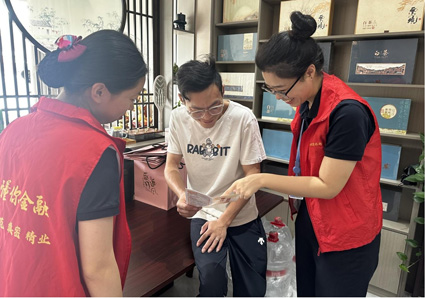
江南时报讯 近日,东台农商银行时堰支行党支部精心组织并成功开展了"金融标准三走进"系列活动之 走进时堰镇农贸市场专题宣传。此次活动聚焦普惠金融政策与实用金融知识的普及,旨在将金融服务精 准送达市场一线商户,助力其稳健经营与持续发展。 活动当天,支部党员与业务骨干共同组成宣传小队,深入时堰镇农贸市场等人流密集区域,通过设立临 时咨询台、派发宣传折页、现场答疑等多种形式,向广大商户重点介绍了新版人民币防伪特征、防范电 信网络诈骗、安全用卡常识、存款保险制度等基础金融知识,并详细讲解了个体工商户和小微企业相关 的普惠信贷产品与服务政策。 此次宣传活动切实提升了市场商户的金融素养与风险防范意识,为其财产安全和经营活动提供了有力保 障;精准对接了小微经营主体的实际金融需求,拓宽了他们获取正规金融服务的渠道,有效支持了本地 实体经济的健康发展。 朱强 ...
从“纸上政策”到“落地实效” 建行建湖支行助力“90后”创业
Yang Zi Wan Bao Wang· 2025-11-23 11:15
Group 1 - The core viewpoint of the articles highlights the growth and challenges faced by Wenchen Precision Technology Co., Ltd., a startup founded by a young entrepreneur, Gu Jian, in the high-tech park of Jianhu County, which benefits from a supportive industrial cluster and favorable entrepreneurial policies [1][2] - Gu Jian, a local talent with notable achievements in technical competitions, has leveraged his expertise to establish a strong foundation for the company's development through technological innovation and market sensitivity [1] - The company has encountered challenges related to increased raw material demand and extended customer payment cycles, leading to cash flow difficulties [2] Group 2 - To address these financial challenges, the local bank, Jianhu Branch of China Construction Bank, proactively engaged with the company and provided a combination of credit and mortgage loans, including a 220,000 yuan "credit quick loan" to alleviate immediate funding needs [2] - The bank has innovatively developed a "credit + mortgage" loan model tailored to the characteristics of asset-light startups, and has also provided medium to long-term funding support based on the company's fixed asset situation [2][3] - As of June, the bank has cumulatively provided over 250 million yuan in financing support to various small and micro enterprises in the park, contributing to the high-quality development of the local economy [3]
