硬科技

Search documents
西安财金任纪刚:把功能做成效率,把耐心做成生态
母基金研究中心· 2025-10-31 10:37
Core Viewpoint - The article emphasizes the role of "patient capital" in accelerating the transition of innovations from laboratories to industrial applications in Xi'an, driven by the Xi'an Financial Capital Management Company, which focuses on integrating fiscal policies with financial tools to enhance efficiency in capital allocation [1][4]. Group 1: Fund Management and Investment Strategy - The Xi'an Innovation Investment Fund, managed by Xi'an Financial, is the city's first billion-yuan venture capital fund, aiming to support technological innovation and early-stage investments in hard technology [4]. - As of September, the fund has made decisions on 61 market-oriented sub-funds, established 45 sub-funds, and has a total scale exceeding 260 billion yuan, leveraging social capital nearly fourfold [4]. - The fund adheres to principles of government guidance, market operation, professional management, and innovation encouragement, focusing on early-stage technology and innovation enterprises [4][5]. Group 2: Platform Governance and Efficiency - Xi'an Financial aims to be a "hub platform" connecting technological and financial resources, emphasizing market-oriented, rule-based, and professional operations to enhance the effectiveness of fiscal financial tools [6]. - The organization focuses on early-stage technology commercialization, deploying diverse financial instruments such as "pre-investment and post-equity" to ensure capital is effectively utilized in critical stages from lab to production [6][8]. - The platform has facilitated financing exceeding 510 billion yuan through collaboration with nearly 60 partner institutions and over 140 financial products [6][7]. Group 3: Talent Development and Innovation - The Xi'an Talent Development Fund has pioneered an innovative equity incentive model to address the funding challenges faced by high-end talent, resulting in investments in 54 talent projects totaling 3.25 billion yuan, which has driven a total project investment of 10.94 billion yuan [9]. - The fund has supported 120 high-level talents, enhancing the region's ability to convert talent resources into new drivers for technological and industrial innovation [9]. Group 4: Risk Management and Long-term Value - The company emphasizes balancing policy objectives with market dynamics, short-term assessments with long-term value, and risk control with innovation tolerance [10]. - A comprehensive tracking and risk warning mechanism has been established to monitor fund operations and project progress, ensuring alignment with national and local strategies [11]. - The organization focuses on empowering core values of invested projects by leveraging local resources and expanding service reach through online and offline platforms [11]. Group 5: Long-term Strategic Configuration - Xi'an Financial is committed to long-term strategic investments, utilizing a "0→1→N" methodology that integrates mother funds and direct investment funds [12]. - The company aims to transform functions into efficiencies and mechanisms into closed loops, fostering an ecosystem of patience and certainty in capital deployment [12].


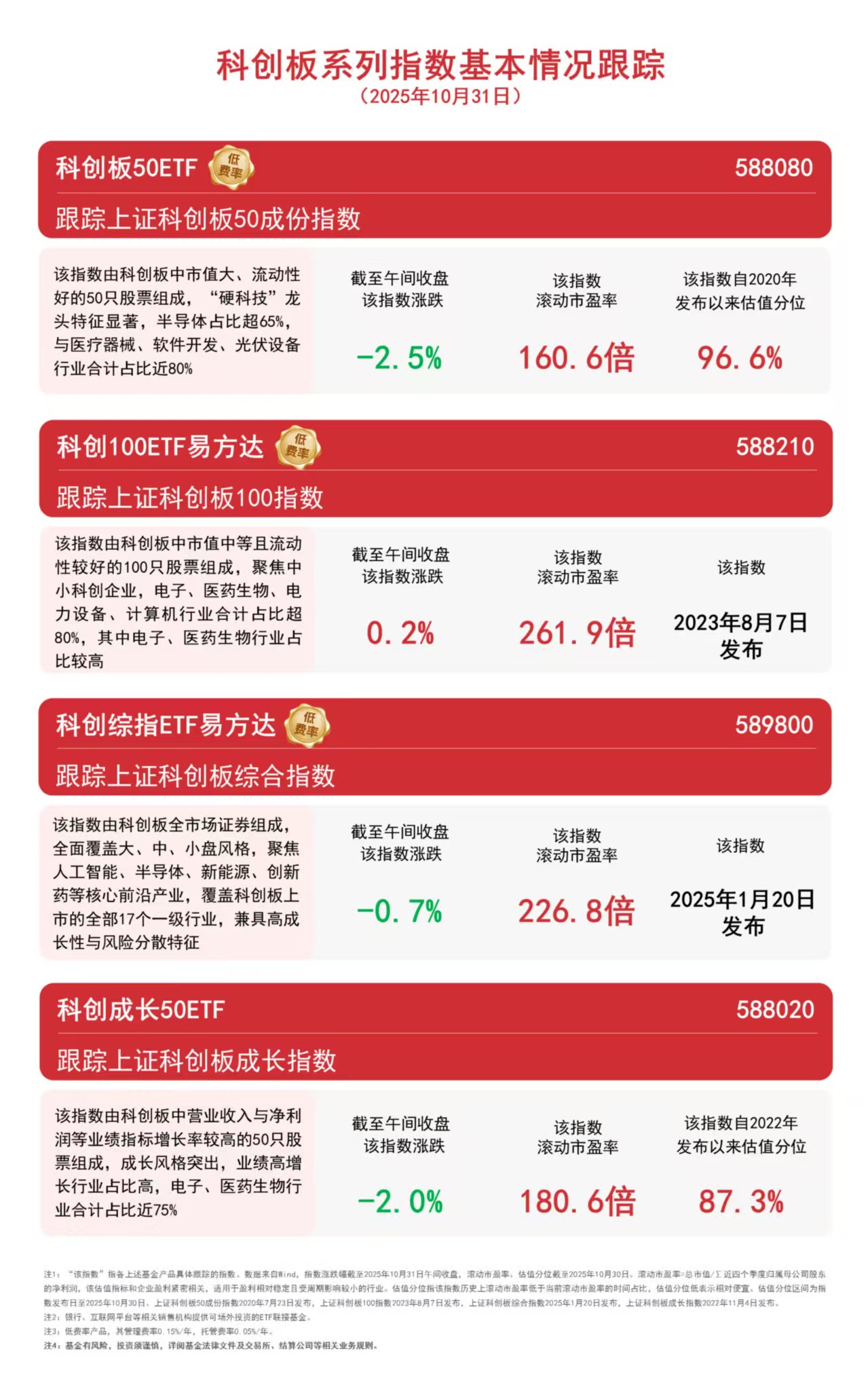
算力硬件股集体回调,关注科创板50ETF(588080)等产品布局机会
Mei Ri Jing Ji Xin Wen· 2025-10-31 06:39
Core Viewpoint - The news discusses various ETFs tracking the STAR Market indices, highlighting their composition, performance, and sector focus, particularly in technology and healthcare sectors. Group 1: STAR Market Indices - The STAR Market 50 ETF tracks the STAR Market 50 Index, composed of 50 large-cap stocks with significant liquidity, predominantly in the "hard technology" sector, with over 65% in semiconductors and nearly 80% in total for semiconductors, medical devices, and software development [2]. - The STAR Market 100 ETF follows the STAR Market 100 Index, which includes 100 mid-cap stocks focusing on small and medium-sized innovative enterprises, with over 80% in electronics, biomedicine, and electrical equipment sectors [2]. - The STAR Market Comprehensive Index ETF tracks the STAR Market Comprehensive Index, covering all market securities and focusing on core industries such as artificial intelligence, semiconductors, and new energy, encompassing all 17 primary industries on the STAR Market [2]. Group 2: Performance Metrics - As of the latest midday close, the STAR Market 50 Index decreased by 2.5% with a rolling P/E ratio of 160.6 times [2]. - The STAR Market 100 Index saw a slight increase of 0.2% with a rolling P/E ratio of 261.9 times [2]. - The STAR Market Comprehensive Index experienced a decline of 0.7% with a rolling P/E ratio of 226.8 times [2]. - The STAR Market Growth Index, which tracks 50 stocks with high growth rates in revenue and net profit, decreased by 2.0% with a rolling P/E ratio of 180.6 times [3].
科创板不拘一格支持“硬科技”企业发展
Jin Rong Shi Bao· 2025-10-31 03:36
Core Insights - The China Securities Regulatory Commission (CSRC) Chairman Wu Qing announced the listing of the first batch of newly registered companies in the Sci-Tech Innovation Board (STAR Market) during the 2025 Financial Street Forum, with three companies listed on October 28, 2023 [1] - The STAR Market has attracted 592 technology companies with a total market capitalization exceeding 9 trillion yuan, establishing itself as the preferred venue for "hard tech" companies in China [1] - In 2023, the STAR Market added 11 new listed companies, raising a total of 16.952 billion yuan through IPOs, representing a 54% increase compared to the same period last year [1] Company Summaries - The three newly listed companies are Wuhan Heyuan Biotechnology Co., Ltd., Guangzhou Bibete Pharmaceutical Co., Ltd., and Xi'an Yisiwei Material Technology Co., Ltd. Their first-day stock price increases were 213.49%, 74.41%, and 198.72%, respectively [1] - Xi'an Yisiwei is a leading company in the 12-inch silicon wafer sector, ranking first in monthly shipment volume and production capacity in mainland China and sixth globally [2] - Heyuan Biotechnology focuses on the research, production, and sales of plant-derived recombinant protein drugs, with eight drugs in its pipeline, including a recombinant human albumin injection that has received regulatory approval [2] - Bibete Pharmaceutical specializes in innovative drugs for major diseases such as tumors, autoimmune diseases, and metabolic diseases [2] Policy and Market Environment - The implementation of various reform measures, including the "National Nine Articles" and "Science and Technology Eight Articles," has opened doors for companies in different sectors to access capital markets, enhancing their ability to convert technological achievements into industrial capabilities [2] - The establishment of the Sci-Tech Growth Layer aims to support high-quality technology companies with significant breakthroughs and commercial prospects, while also enhancing information disclosure and risk management [3] - The Shanghai Stock Exchange has completed preparations for the STAR Market reforms and aims to better serve high-quality development by focusing on "hard tech" companies and enhancing regulatory effectiveness [4] - The exchange will promote reforms in issuance, underwriting, refinancing, and mergers and acquisitions to attract resources to the technology sector, while also prioritizing investor protection and fostering a favorable market ecosystem [4]
政策驱动与产业深耕:地方产业基金的投资逻辑、方向与核心要求
Sou Hu Cai Jing· 2025-10-31 02:28
Investment Logic - Local Government Industrial Funds (LGIFs) serve as a combination of policy tools and market-driven operations, prioritizing policy implementation while also considering market returns [2] - The primary goal is to align with national and local industrial policies, as seen in the semiconductor fund in Anhui, which emphasizes domestic substitution and technological breakthroughs over mere financial returns [2] - LGIFs exhibit a strong capacity for early-stage risk tolerance, particularly in high-tech projects, with early-stage investments projected to increase from 12% in 2023 to 28% by 2025 [3] Investment Direction - Investment focus is on strategic emerging industries and the upgrading of traditional industries, with a significant emphasis on hard technology and future industries [5] - Notable investments include a single contribution of 224 billion yuan to the semiconductor sector and 20 billion yuan for AI and biotechnology in Shanghai [6] - Traditional industries are being transformed through smart and green initiatives, with funds supporting projects in industrial internet and clean energy [7] Core Requirements - Compliance is critical, with strict controls on fund allocation and risk management, prohibiting investments in real estate and high-pollution sectors [8] - Professional management is essential, requiring fund managers to have at least three years of experience and a minimum capital of 10 million yuan [9] - Sustainability is emphasized through leveraging social capital and innovative exit mechanisms, such as integrating invested companies into local supply chains [10][11] Conclusion - The rise of LGIFs signifies a deep integration of policy and market attributes in China's capital market, shifting from fiscal subsidies to industrial empowerment and precise investments [12]
中金公司党委副书记、总裁王曙光:科创成长层的设立是推动科技强国建设的“及时雨”与“加速器”
Shang Hai Zheng Quan Bao· 2025-10-30 11:16
Core Viewpoint - The establishment of the Sci-Tech Growth Tier is a significant step in promoting the construction of a technology-driven nation and reflects the mission of China's modern capital market to support high-quality development of the real economy [1][2]. Group 1: Policy and Strategic Importance - The introduction of the Sci-Tech Growth Tier is a key measure within the "1+6" policy framework aimed at providing crucial financing support for technology companies that are not yet profitable but have significant technological breakthroughs and strong commercial prospects [2][3]. - The establishment of the Sci-Tech Growth Tier aligns with national strategies emphasizing the importance of technological innovation and the development of emerging industries [2][5]. - The tier is seen as a vital institutional supply for capital markets to support national technological innovation and new productive forces [2][3]. Group 2: Market Impact and Functionality - As of October 28, the Sci-Tech Board has gathered 592 quality tech companies with a cumulative financing scale exceeding 930 billion yuan [5]. - The Sci-Tech Growth Tier enhances the efficiency and determination of capital market reforms, filling a critical gap in the financing chain for hard tech companies throughout their lifecycle [5][6]. - The tier provides a clear and efficient exit mechanism for early-stage capital, guiding the market towards a consensus on investing early, small, and in technology [6]. Group 3: Investor Protection and Market Transparency - The implementation of special risk indicators and enhanced information disclosure measures aims to balance innovation support with risk prevention, thereby improving market transparency and protecting the rights of small investors [6]. - The tier's design includes a dynamic balance between supporting innovation and managing risks, which is crucial for maintaining investor confidence [6]. Group 4: Future Outlook - The company emphasizes its commitment to serving national strategies and supporting hard tech enterprises with core technologies to achieve leapfrog development through capital markets [6][7].

双星同耀科创板:越秀产业基金“耐心资本”赋能硬科技企业
FOFWEEKLY· 2025-10-30 10:05
Core Insights - The successful IPOs of Guangzhou Bibetter Pharmaceutical Co., Ltd. and Xi'an Yicai New Materials Technology Co., Ltd. on the Sci-Tech Innovation Board mark a significant milestone for the capital market and highlight the investment strategy of Yuexiu Industrial Fund in the "hard technology" sector [2][3] Investment Strategy - Yuexiu Industrial Fund has adopted a strategy of "early investment, small investment, and hard technology," focusing on nurturing new productive forces and empowering technological innovation through a unique model of "industry + capital" [3][4] - The fund has invested in nearly 200 technology innovation enterprises across key sectors such as integrated circuits, biomedicine, and artificial intelligence, emphasizing the importance of early-stage projects and specialized small and medium-sized enterprises [4][6] Company Profiles - Bibetter is a biopharmaceutical company focused on innovative drug research and development for major diseases, with its core product being the world's first approved dual-target inhibitor for PI3K/HDAC, addressing significant unmet clinical needs [3][4] - Xi'an Yicai is a leading manufacturer in China's semiconductor materials sector, specializing in the research, manufacturing, and sales of 12-inch silicon wafers, aimed at enhancing the competitiveness of the domestic electronic-grade silicon wafer industry [3][4] Capital Empowerment - The fund's investments in Bibetter and Xi'an Yicai have provided essential financial support for clinical research, commercialization, and capacity enhancement, demonstrating a commitment to deepening empowering investments for technology companies [5][6] - Yuexiu Industrial Fund leverages its diversified industrial resources to create an ecosystem that supports enterprise growth through management, industry, and capital empowerment [5][6] Future Outlook - The establishment of the Sci-Tech Growth Layer opens new opportunities for hard technology enterprises, and Yuexiu Industrial Fund aims to continue its focus on financial services for the real economy, supporting national and regional strategies while fostering new productive forces [8]

成份股捷报频传,成长类风格持续领跑!科创创业ETF(159781)一键囊括科技龙头标的
Sou Hu Cai Jing· 2025-10-30 06:45
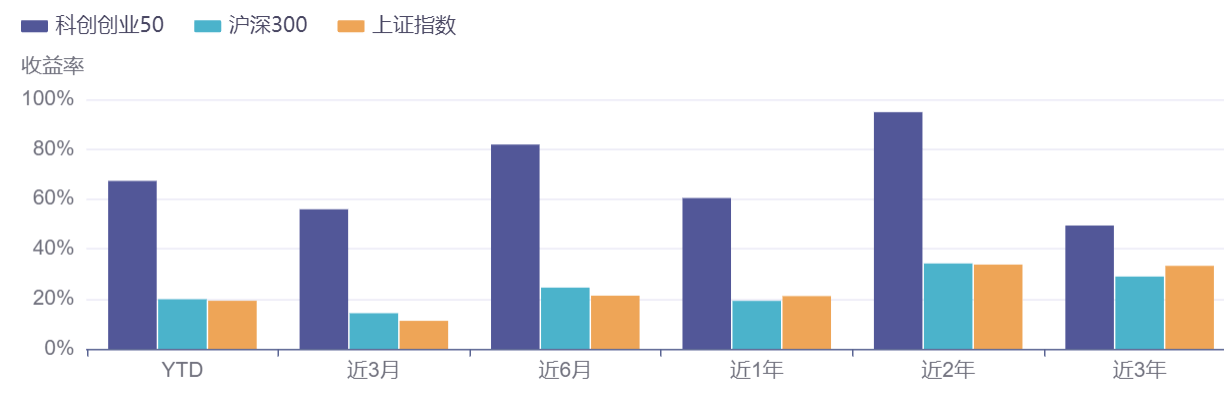
Core Viewpoint - The A-share market is experiencing a significant upward trend, with the Shanghai Composite Index surpassing 4000 points for the first time in ten years, driven by growth sectors such as AI computing, communications, and semiconductors. The ChiNext 50 index, which includes leading companies from the Sci-Tech Innovation Board and the ChiNext Board, has seen a remarkable increase of over 60% in the past year, making it a popular choice for investors looking to engage in hard technology investments [1][3]. Group 1: Performance and Growth - In Q3 2025, Shenghong Technology reported a revenue of 5.086 billion yuan, marking a year-on-year increase of 78.95%, and a net profit of 1.102 billion yuan, up 260.52% [3]. - CATL, the largest weight stock in the ChiNext 50, also showed strong performance in its Q3 report, with a revenue of 283.072 billion yuan for the first three quarters, a 9.28% increase year-on-year, and a net profit of 49.034 billion yuan, up 36.2% [3]. - Cambricon's performance in the first half of 2025 exceeded expectations, with revenue reaching 2.881 billion yuan, a staggering year-on-year growth of 4348%, and a net profit of 1.038 billion yuan, up 296% [3]. Group 2: Policy and Market Sentiment - The advancement of the "14th Five-Year Plan" mid-term assessment has injected clearer support for domestic substitution and technological innovation, particularly in the semiconductor and information technology sectors, aligning with the ChiNext 50's focus [4]. - The emphasis on technological autonomy and innovation as a primary task in the "15th Five-Year Plan" indicates a shift in industrial policy from quantity to quality, highlighting the significant growth potential in the semiconductor sector [4]. Group 3: Investment Trends - As of September 15, the A-share financing balance exceeded 2.35 trillion yuan, indicating that leveraged funds are actively positioning themselves in technology sectors, with leading stocks from the ChiNext and Sci-Tech Innovation Boards attracting significant net inflows [7]. - The logic for new capital entering the market in Q4 remains robust, with liquidity conditions favoring investments in high-growth sectors and turnaround opportunities [7]. Group 4: Focus on Leading Technology Companies - The current market is in a phase of "industrial momentum restructuring," with new capital showing a higher preference for leading companies that possess significant advantages in technology development, market share, and risk resistance [9]. - The ChiNext 50 index employs a three-tier selection mechanism based on market capitalization, liquidity, and pure technology attributes, ensuring a focus on leading companies while minimizing the impact of small-cap or non-tech stocks [9]. Group 5: Investment Products - For ordinary investors looking to capitalize on the opportunities presented by the ChiNext 50 index, the ChiNext 50 ETF (159781) and its linked funds (Class A: 013304, Class C: 013305) offer a convenient and efficient investment tool [10]. - Investing in this ETF allows investors to avoid extensive individual stock research while sharing in the growth of new productive forces and benefiting from the rise of growth-oriented assets [10].


A股沸腾!十年等待终破4000点,北证50单日上涨超8%
Sou Hu Cai Jing· 2025-10-29 16:32
Core Insights - The A-share market has reached a significant milestone with the Shanghai Composite Index surpassing the 4000-point mark for the first time in ten years, signaling a positive market sentiment despite closing below this level [1][6] - The North Exchange 50 Index experienced a remarkable single-day increase of over 8%, drawing attention to the potential impact of the upcoming North Exchange 50 ETF launch [1][4] Market Structure Changes - The current market environment is fundamentally different from previous instances of the index reaching 4000 points, with a shift from traditional industries to a technology-driven "structural slow bull" market [3][11] - The contribution of the information technology sector to the index's rise has been substantial, accounting for 455 points, contrasting with the reliance on industrial and financial sectors in the past [3] Fund Flows and Policy Support - The recent market rally is attributed to a combination of favorable policies, increased foreign capital inflows, and a stable margin trading balance, indicating heightened market activity [6][11] - The "14th Five-Year Plan" emphasizes technological innovation, providing a long-term rationale for investments in the tech sector [6] Stock Market Divergence - Despite the strong index performance, there is significant internal market divergence, with over 2900 stocks declining and many stocks showing minimal gains, indicating a concentration of funds in technology leaders and high-dividend blue-chip stocks [7] - The extreme valuation disparity between sectors, such as the 174 times P/E ratio for the Sci-Tech 50 compared to a P/B ratio of 1.3 for the banking sector, suggests caution regarding high-flying stocks [7] Future Strategies - Investment strategies should focus on avoiding overvalued technology stocks and instead consider low-valuation sectors such as high-dividend assets, consumer goods, and cyclical products benefiting from improved supply-demand dynamics [9] - Maintaining a balanced portfolio and exercising patience in a volatile market environment is recommended for long-term gains [9]
电动车巨头做LP,低调下注低空经济
FOFWEEKLY· 2025-10-29 10:04
Core Viewpoint - Industry giants are returning to the market, investing to seize opportunities in the next technological transformation [2][3] Group 1: Investment Activities - Aima Technology announced its investment of 32.4 million RMB in a venture capital fund, becoming a limited partner (LP) with a 29.9861% stake [6][8] - The fund will focus on equity investments, particularly in low-altitude economy sectors, indicating Aima's strategic positioning in short-distance electric mobility [6][8] - Aima's previous LP involvement in 2022 with Chen Dao Capital also targeted sectors like new energy and semiconductors, showcasing a consistent investment strategy [8] Group 2: Market Trends - The primary market is experiencing a revival, with LP investment activity reaching a peak in September, showing a 40.3% month-on-month increase and a 38.3% year-on-year increase [11] - In Q3, LP investment activity grew by 9.9% quarter-on-quarter and 11.9% year-on-year, indicating structural improvements driven by policy support [11][12] - The number of newly registered private equity and venture capital funds in September surged by 51.4% month-on-month and 84.4% year-on-year, reflecting a significant recovery in market activity [11] Group 3: Strategic Shifts - Major tech companies like Tencent, Alibaba, and JD.com are increasing their investment pace in the primary market, signaling a consensus on market recovery [12] - Companies in the technology sector, including CATL and Kanglong Chemical, are actively investing in funds that focus on robotics and artificial intelligence, highlighting a shift towards hard technology sectors [12][13] - The urgency in investment stems from a deep-seated industry anxiety, with companies aiming to secure positions in critical technological areas to mitigate supply chain risks and seize strategic opportunities [13] Group 4: Future Outlook - The industry is entering a phase of "quality improvement and quantity reduction," with a more rational approach to investments following recent market cycles [13] - The dual drivers of industrial capital and policy benefits suggest that 2025 could be a pivotal year for the venture capital industry, marking a transition to high-quality development [13][15] - Despite ongoing challenges, the consensus among industry players is that the wave of technological innovation is bringing positive market signals [15][16]


从“十年千亿”到“28日定律”:成都国资的确定性投资哲学
投中网· 2025-10-29 06:30
Core Viewpoint - Chengdu is initiating a systematic practice of industry investment through institutional innovation, marked by the launch of the "Investment 28 Plan" and the signing of the first projects under the future industry fund, indicating a shift from opportunistic investment to a more structured and nurturing investment ecosystem [3][4]. Group 1: Investment Strategy - The "Investment 28 Plan" aims to establish a predictable investment rhythm by designating the 28th of each month as a city-level innovation day, providing a platform for capital and resources to converge for emerging projects [6][8]. - This plan is designed to cultivate a comprehensive ecosystem that supports the entire lifecycle of startups, from seed stage to IPO, through a dual approach of direct investment and sub-funds [6][12]. - The initiative reflects a departure from traditional venture capital models, which often seek quick returns, towards a long-term investment strategy that accommodates the lengthy R&D cycles typical in hard technology sectors [7][12]. Group 2: Ecosystem Development - The "Investment 28 Plan" is not merely about financial returns but focuses on building a stable and efficient interaction platform that reduces transaction costs and enhances resource allocation efficiency [10][12]. - The plan incorporates a "12345" service framework that connects various elements of the innovation ecosystem, ensuring that funded enterprises gain access to a network that includes market validation, policy support, physical space, and media exposure [11][12]. - By fostering a collaborative environment where government and enterprises share risks and rewards, the initiative aims to create a sustainable and resilient industrial ecosystem in Chengdu [17][19]. Group 3: Future Outlook - The recent signing of 15 projects with a total investment of nearly 500 million yuan highlights the targeted approach of the "Investment 28 Plan," aligning with Chengdu's modern industrial system [21][23]. - The strategy aims to enhance the local supply chain's resilience and self-sufficiency, particularly in the context of global supply chain disruptions, thereby contributing to national security and industrial stability [23]. - The ongoing commitment to the "Investment 28 Plan" signifies Chengdu's long-term confidence in its industrial ecosystem, with the potential for future success stories akin to the "Haiguang" narrative [23][24].