
云计算

Search documents
全球重点区域算力竞争态势分析报告(2025年)
Sou Hu Cai Jing· 2025-12-18 13:07
Core Insights - Computing power has become the core engine driving global economic development, with the competition landscape characterized by multi-dimensional comprehensive games, where the US and China lead the first tier, while the EU, ASEAN, Middle East, and India showcase unique characteristics [1][7] Group 1: Global Computing Power Landscape - The US has built a complete industrial ecosystem in chip design, AI foundational software, and technical talent, focusing on protecting innovation and national security, with tech giants increasing capital expenditure on high-performance computing and AI applications [1][7] - China ranks second globally in computing power, leveraging the "East Data West Computing" project to establish a national integrated computing network, supported by a strong policy framework and abundant green energy resources [1][7] - The EU emphasizes policy integration, focusing on green low-carbon initiatives and data security, aiming to enhance local semiconductor industry capabilities [1][7] Group 2: Emerging Economies and Trends - Emerging economies like ASEAN are leveraging digital economic growth to attract international investments, while the Middle East is creating green computing hubs, and India is experiencing explosive growth in computing demand driven by its population dividend [1][7] - The global computing power industry is witnessing rapid expansion, technological upgrades, diversification of application scenarios, supply chain restructuring, business model innovation, and a focus on sustainable development [1][7] Group 3: Strategic Importance of Computing Power - Computing power has evolved into a strategic resource comparable to oil and rare earths, influencing national competitiveness and global order [1][30] - The global computing power scale reached 1397 EFLOPS in 2023, a 54% year-on-year increase, with projections indicating it could exceed 16 ZFlops by 2030 [1][31] - The demand for computing power is driven by technological innovation, particularly in AI, and the rapid growth of the digital economy, with significant investments from major tech companies [1][35][36]





百度难渡...
Sou Hu Cai Jing· 2025-12-18 12:51
Group 1 - Baidu is undergoing significant layoffs, with reports indicating that some departments are seeing cuts of 30%-40% [2][5][9] - The layoffs are affecting not only older employees but also recent graduates, highlighting a shift in workforce dynamics [2][9] - Baidu is relocating its outsourcing teams to Xi'an, imposing job insecurity on lower-tier workers [2][11] Group 2 - Baidu's third-quarter financial results were disappointing, with a net loss of 11.2 billion RMB and a total revenue of approximately 31.2 billion RMB, marking a year-on-year decline of 7% [12][13] - The company's core revenue also fell by 7% year-on-year, with online marketing revenue dropping by 17.6% [12][13] - Baidu's advertising revenue has been declining for six consecutive quarters, indicating a troubling trend in its core business [12][13] Group 3 - The decline in Baidu's performance is attributed to changing user search habits and increased competition from platforms like Douyin and WeChat [13][15] - Baidu's market position has weakened, with its media index ranking dropping to ninth place, behind competitors [13][15] - The company has struggled to capitalize on the AI sector, with its AI cloud market share being significantly lower than competitors like Alibaba and Huawei [16][17] Group 4 - Baidu's missed opportunities in the mobile internet space have been a critical factor in its current struggles, as highlighted by past comments from CEO Robin Li regarding the challenges of adapting to new technologies [19][20] - Despite having innovative products, Baidu's approach has often been criticized for being reactive rather than proactive in the market [20][22] - Li's recent statements suggest a cautious approach to new projects, emphasizing the importance of technology's decisive role in future endeavors [23]


张燕生:历史与当下的反全球化力量,往往正是全球化推手
Cai Jing Wang· 2025-12-18 12:24
Core Viewpoint - The forum emphasizes the importance of domestic demand as a driving force for China's economic growth in the short term, while focusing on industry, technology, and domestic demand for long-term development [1][12]. Group 1: Economic Strategy - Zhang Yansheng, a researcher at the China Macroeconomic Research Institute, highlighted that the core of China's modernization and economic development is to strengthen consumption and investment to effectively counter international economic changes [1][12]. - The short-term annual plan will focus on "domestic demand as the main driver," while the medium to long-term strategy will involve promoting industry, technology, and domestic demand [1][12]. Group 2: Global Economic Environment - The current international policy environment and economic order are undergoing changes, making it crucial to steadily promote economic growth and stabilize exports in the coming years [4][12]. - The "globalization paradox" suggests that the forces against globalization often stem from those who were once its proponents, indicating a complex relationship between global cooperation and protectionism [4][8]. Group 3: Future Challenges - The future of global economic development will face multiple challenges, including the sustainability of globalization and the potential for increased protectionism and technological decoupling among major powers [8][11]. - Key factors influencing the next five years include the direction of global trade and investment, the advancement of technological revolutions, and the evolution of major power relations [6][8]. Group 4: Technological Revolution - The new technological revolution, characterized by artificial intelligence, cloud computing, big data, and blockchain, is expected to have profound impacts on the economy and industries [13]. - The forum discussed the importance of enhancing labor productivity and overall factor productivity through the application of new technologies [13].
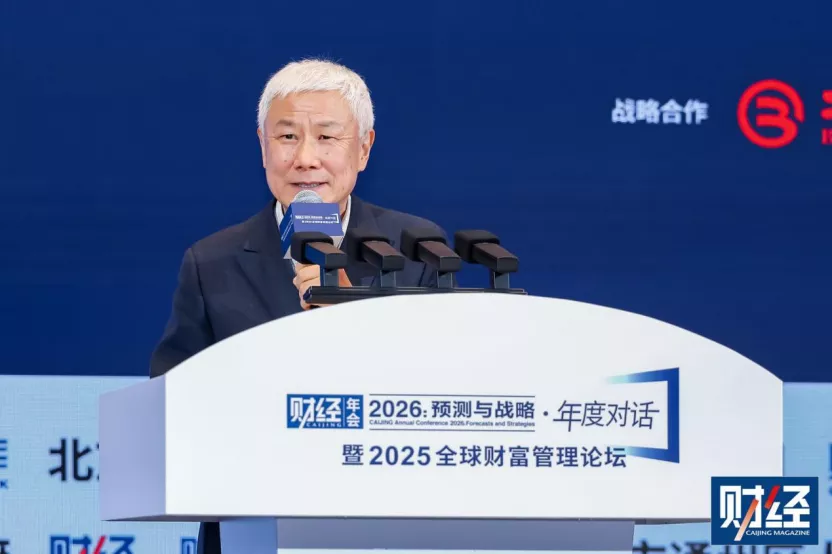
中国宏观经济研究院研究员张燕生:产业、科技和内需是未来十年的发展动力
Sou Hu Cai Jing· 2025-12-18 10:20
Group 1 - The core viewpoint emphasizes the importance of domestic demand in driving China's economic growth and stability in the face of changing international conditions [2] - Zhang Yansheng highlights that the short-term annual plan focuses on "domestic demand-led" strategies, while the medium to long-term plan will promote growth through industry, technology, and domestic demand over the next five to ten years [2] - The article discusses the "paradox of globalization," noting that the new globalization differs from the past by being based on market rules, enterprise subjects, and the empowerment of artificial intelligence, indicating a slow and complex process that aligns with global common interests [2] Group 2 - For the future global governance system over the next five years, Zhang Yansheng suggests maintaining strategic determination, historical patience, and bottom-line thinking as essential supports in a complex environment [3]
云鼎科技:公司深耕信息技术与能源行业融合的细分领域
Zheng Quan Ri Bao Zhi Sheng· 2025-12-18 07:49
Group 1 - The core viewpoint of the article is that Yunding Technology is focusing on the integration of information technology and the energy industry, leveraging advanced technologies to provide comprehensive solutions for energy enterprises [1] Group 2 - The company is deeply engaged in niche areas that combine information technology with the energy sector, addressing the intelligent development needs of the energy industry [1] - Yunding Technology utilizes technologies such as 5G, artificial intelligence, big data, cloud computing, and the Internet of Things to enhance its service offerings [1] - The company specializes in providing digital transformation solutions and services for coal, chemical, electric power, and new energy enterprises [1]

纳指跳水拖累港股,低位AI龙头再遭错杀!资金溢价抄底,百亿港股互联网ETF(513770)连续吸金逾11亿元
Xin Lang Cai Jing· 2025-12-18 06:45
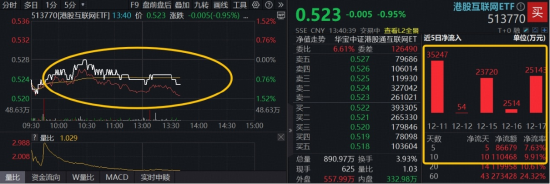
受隔夜美股科技股下挫影响,12月18日,港股再度低开向下,恒生科技指数跌逾1%。科网龙头多数回 调,截至发稿,小米集团-W下跌3%,阿里巴巴-W、快手-W跌逾1%,腾讯控股、美团-W跟跌。 重仓互联网龙头的港股互联网ETF(513770)场内价格现跌0.95%,盘中持续宽幅溢价,显示买盘资金 积极吸筹。上交所数据显示,港股互联网ETF(513770)近10日连续吸金,合计获资金净流入逾11亿 元。 分析认为,近期港股反复调整,主要受到多重因素影响,包括海外流动性担忧、年底资金获利了结、南 向资金流入速度放缓以及12月的解禁高峰等。市场在震荡中寻找方向。 随着科技龙头的回调深入,机构总体对年后港股修复预期较高,提示当下左侧布局机会。银河证券表 示,流动性宽松环境叠加政策利好,港股有望震荡上行。科技板块仍是中长期投资主线,经历前期调整 后估值回落,在多重利好因素提振下,有望反弹回升。 提醒:近期市场波动可能较大,短期涨跌幅不预示未来表现。请投资者务必根据自身的资金状况和风险 承受能力理性投资,高度注意仓位和风险管理。 数据来源:沪深交易所等。中证港股通互联网指数近5个完整年度的涨跌幅分别为:2020年, 109. ...





张燕生:新科技革命和产业变革是未来需要把握的核心机遇
Xin Lang Cai Jing· 2025-12-18 06:23
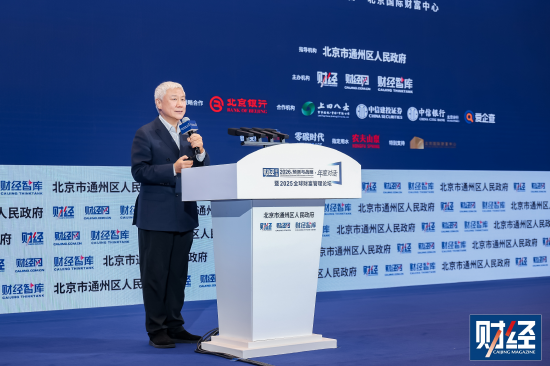
Core Insights - The 2026 Financial Annual Conference will be held in Beijing from December 18-20, 2025, focusing on global wealth management and strategic predictions for the future [3][6]. Group 1: Global Supply Chain and Geopolitical Risks - Zhang Yansheng, a researcher at the Chinese Academy of Macroeconomic Research, highlighted that China has become the most influential country in global trade, surpassing the US and Germany, due to the IT revolution over the past 40 years [3][6]. - He warned of the risk of "decoupling" due to geopolitical tensions, emphasizing the need for a strategy of "linking without decoupling, cooperation without confrontation" [3][6]. - Zhang proposed a new globalization model based on market, enterprise, civil society, and artificial intelligence, advocating for the facilitation of visas and flights to promote frequent exchanges among people [3][6]. Group 2: Economic Outlook and Domestic Demand - Looking ahead to the next five years, Zhang cited predictions from international authoritative institutions indicating that global economy, trade, and direct investment will remain in a contraction phase, with heightened uncertainty risks [3][6]. - In this context, the strategic direction of China's 14th Five-Year Plan is crucial, with the central economic work conference prioritizing "domestic demand" as a key task [3][6]. Group 3: Technological Revolution and Opportunities - Zhang emphasized that the new technological revolution and industrial transformation represent core opportunities for the future, comparing it to the IT revolution of the 1990s that benefited China significantly [4][7]. - He pointed out that technologies like artificial intelligence, cloud computing, and big data are essential for enhancing labor productivity and total factor productivity, which can replace traditional business models and create new growth points [4][7]. - In the face of external economic pressures, Zhang stressed that China must boost domestic demand and rely on technological innovation to cultivate new momentum for stable development [4][7].
汉得信息跌2.01%,成交额8.06亿元,主力资金净流出1.32亿元
Xin Lang Cai Jing· 2025-12-18 06:15
Core Viewpoint - Han's Information has experienced a stock price increase of 42.41% this year, but has seen a recent decline of 5.23% over the last five trading days [2]. Group 1: Stock Performance - As of December 18, Han's Information's stock price was 17.59 CNY per share, with a market capitalization of 17.981 billion CNY [1]. - The stock has fluctuated with a 3.11% increase over the last 20 days and a 4.97% decrease over the last 60 days [2]. - The company has appeared on the trading leaderboard eight times this year, with the most recent occurrence on March 7, where it recorded a net buy of -517 million CNY [2]. Group 2: Financial Performance - For the period from January to September 2025, Han's Information reported a revenue of 2.439 billion CNY, reflecting a year-on-year growth of 3.67%, and a net profit attributable to shareholders of 145 million CNY, which is a 6.96% increase [3]. - The company has distributed a total of 415 million CNY in dividends since its A-share listing, with 125 million CNY distributed over the last three years [4]. Group 3: Shareholder Information - As of December 10, the number of shareholders for Han's Information was 123,000, a decrease of 3.91% from the previous period [3]. - The average number of circulating shares per shareholder increased by 4.28% to 7,943 shares [3]. - The top ten circulating shareholders include Hong Kong Central Clearing Limited, which increased its holdings by 11.1169 million shares, and Southern CSI 1000 ETF, which decreased its holdings by 95,600 shares [4].

2026-2032年中国智慧消防行业全景调研及市场前景预测报告
Sou Hu Cai Jing· 2025-12-18 05:18
Core Insights - The article emphasizes the importance of smart firefighting as an advanced solution that integrates various systems to enhance risk detection and emergency response capabilities, significantly reducing fire risks and impacts [2] - The report titled "2026-2032 China Smart Firefighting Industry Panorama Research and Market Outlook" provides a comprehensive analysis of the smart firefighting industry, including market environment, operational status, competitive landscape, key enterprise performance, and future trends [2] Group 1: Industry Overview - Smart firefighting focuses on breaking down information silos between systems and improving perception, early warning, and command capabilities through advanced technologies like IoT, cloud computing, AI, and blockchain [2] - The report consists of fifteen chapters covering various aspects of the smart firefighting industry, including market development environment, operational status, competitive landscape, and investment forecasts [2] Group 2: Market Analysis - The report analyzes the current demand and supply conditions in the smart firefighting industry, providing insights into market size and growth potential [3] - It includes a detailed examination of the competitive landscape, highlighting key players and their operational performance [3][4] Group 3: Future Trends - The report forecasts the development trends of the smart firefighting industry from 2026 to 2032, including market size predictions and application trends [3][4] - It also discusses the implications of macroeconomic factors and regulatory policies on the industry [3][4] Group 4: Data Sources - The research data is primarily sourced from national statistics, customs data, survey data, and various market monitoring databases, ensuring a comprehensive and reliable analysis [2]

实达集团涨2.06%,成交额7.27亿元,主力资金净流出126.12万元
Xin Lang Cai Jing· 2025-12-18 03:49
Group 1 - The core viewpoint of the news is that Shida Group's stock has shown significant volatility, with a year-to-date increase of 37.12% but a recent decline of 13.01% over the last five trading days [1] - As of December 18, Shida Group's stock price was 4.95 CNY per share, with a total market capitalization of 10.783 billion CNY [1] - The company has experienced a net outflow of main funds amounting to 126.12 thousand CNY, with large orders showing a buy of 1.26 billion CNY and a sell of 1.35 billion CNY [1] Group 2 - Shida Group, established on May 30, 1988, is located in Fuzhou, Fujian Province, and was listed on August 8, 1996 [2] - The company's main business includes the research, design, production, and sales of mobile communication smart terminals and related core components, with 98.41% of revenue coming from big data business [2] - As of September 30, the number of shareholders was 98,100, a decrease of 8.28% from the previous period, with an average of 22,191 circulating shares per person, an increase of 9.51% [2] Group 3 - Shida Group has cumulatively distributed 124 million CNY in dividends since its A-share listing, with no dividends distributed in the last three years [3]
