
科技金融

Search documents
中国建设银行湖南省分行:贡献服务中部地区崛起的金融力量
Ren Min Wang· 2025-11-25 01:32
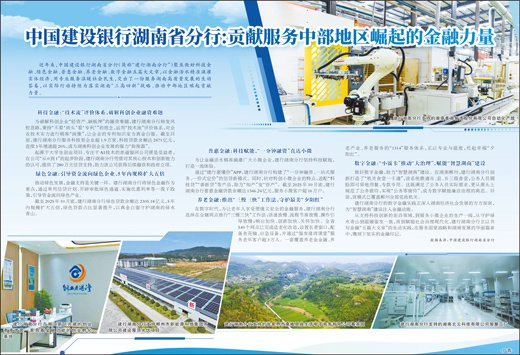
Core Viewpoint - China Construction Bank Hunan Branch focuses on five key areas: technology finance, green finance, inclusive finance, pension finance, and digital finance, contributing to Hunan's high-quality development and supporting the "Three Highs and Four New" strategy [2][3][4][5][6][7] Group 1: Technology Finance - The bank has developed a "technology flow" evaluation system to address the financing difficulties of technology enterprises, allowing patents to be converted into financial assets [2] - Over 19,000 technology enterprises have been served, with a technology loan balance of 247.1 billion yuan, growing at over 20% for three consecutive years [2] Group 2: Green Finance - Green finance is prioritized, with a loan balance of 230.52 billion yuan expected by October 2025, representing a fivefold increase over five years [3] - The bank implements policies such as separate credit plans and green channels to direct funds towards green industries [3] Group 3: Inclusive Finance - The bank has introduced a new credit model through the "CCB Hui Dong Ni" app, enabling "one-minute financing" for small and micro enterprises [4] - The inclusive finance loan balance reached 134.62 billion yuan, serving over 160,000 small micro customers [4] Group 4: Pension Finance - The bank has implemented a "three slow, three fast" approach to enhance financial services for the elderly, with 540 branches undergoing age-friendly modifications [5] - A comprehensive service system covering pension finance, industry, and services is in place to support the elderly [5] Group 5: Digital Finance - The bank has innovated a "canteen card" system to facilitate digital governance, allowing public officials to use facial recognition for meals across different locations [6] - This initiative promotes clean governance and has been adopted by all party and government agencies [6] Group 6: Overall Impact - The bank's digital finance practices are integrated into various aspects of Hunan's economic and social development, enhancing support for national strategies and local growth [7]


让理财资金成为科创领域的“耐心资本”
Jin Rong Shi Bao· 2025-11-25 01:04
一是产品创新,丰富资金来源。将募集资金重点投向科技创新领域,引导社会资金汇聚为支持科技 创新的规模化资本。产品运作过程中,通过强化自身投研能力,优化资产配置,切实提升产品收益,增 强产品吸引力,扩大资金募集规模,为科技创新产业发展注入理财动力。 二是生态联动,汇聚各方合力。理财公司应充分利用理财公司母行在网点、人员方面的优势,在符 合监管要求、落实风险隔离的前提下,与母行集团积极联动,共享地方政府产业政策与科技园区资源, 优选目标客户,形成覆盖企业初创、成长到成熟各阶段的综合性金融服务方案,实现"政府+产业+金 融"协同发展,打造金融服务科技创新企业"生态圈"。 三是投资协同,强化股债结合。理财公司一方面可以充分发挥理财资金在债券类业务上的优势,重 点投资各类科技创新债券,定向支持新质生产力、"两重""两新"等重点领域;另一方面探索股债结合, 结合科技创新企业发展特点,通过发行"固收+"、权益类及专项私募产品,开展股票、REITs、私募股权 等各类资本市场业务,深度挖掘科技创新企业资金需求,提供全生命周期金融服务。 《金融时报》记者:基于这些路径与机制,渤银理财在支持科技创新方面取得了哪些具体进展和成 效?能 ...
交易商明晰证券业场外业务功能定位
Zheng Quan Ri Bao· 2025-11-24 23:26
Core Viewpoint - The report highlights the proactive role of over-the-counter (OTC) derivatives traders in supporting national strategies and the real economy, showcasing their contributions to the financial sector through various initiatives and case studies [1]. Group 1: OTC Derivatives Empowerment - 44 OTC traders participated in a survey, with 42 providing effective data and case studies, demonstrating the industry's achievements in the financial sector [2]. - In the technology finance sector, 17 traders customized OTC derivatives to meet the complex needs of tech companies and investors, facilitating capital flow into the tech sector through innovative products [2]. - In green finance, 30 traders developed a low-carbon economy service system, utilizing OTC derivatives to support green industries and optimize resource allocation [2]. Group 2: Inclusive Finance and Pension Finance - 30 traders expanded their service coverage in inclusive finance, providing affordable financial services to small and micro enterprises, farmers, and the general public, enhancing economic resilience [3]. - In pension finance, traders are focusing on comprehensive wealth management for residents, offering innovative risk management and personalized solutions through OTC derivatives [3]. Group 3: Digital Finance - 37 traders emphasized the use of financial technology in OTC business development, transitioning risk management from experience-driven to algorithm-driven approaches [4]. Group 4: Consensus on Function Positioning - Traders reached a consensus on the role of OTC derivatives in the high-quality development of the securities industry, recognizing their ability to connect on-market and off-market activities and act as a stabilizing force [5]. - OTC derivatives provide customized, flexible, and refined management tools for professional investors, meeting diverse investment needs [5]. - The business model of OTC derivatives is driving strategic transformation and service upgrades for traders, enhancing their core capabilities in risk management and digital empowerment [5]. Group 5: Challenges and Recommendations - Despite achievements, traders face challenges such as limited business types, disparities in funding and talent, and the need for improved understanding of regulatory guidance [6]. - Recommendations include enhancing top-level design, supporting robust cross-border business systems, strengthening digital investment, and promoting positive industry image [6].
年度科技金融服务大奖
Nan Fang Du Shi Bao· 2025-11-24 23:11
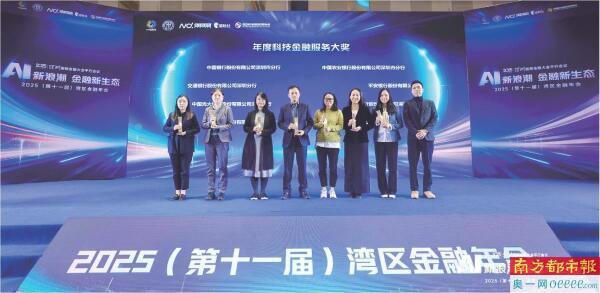
Core Insights - The article highlights the recognition of various banks in Shenzhen for their contributions to providing high-quality financial services to technology innovation enterprises, thereby supporting the development of new industries and economic models [2][3][4][5]. Group 1: Awarded Institutions - The awarded institutions include major banks such as Bank of China, Agricultural Bank of China, Bank of Communications, Ping An Bank, China Everbright Bank, Shanghai Bank, Guangfa Bank, and Zhuhai Huaren Bank [2]. Group 2: Contributions of Awarded Banks - **Bank of China Shenzhen Branch**: Focused on inclusive finance and key industries, serving over 15,000 local tech enterprises with technology loans exceeding 270 billion yuan, and loans for strategic emerging industries and manufacturing surpassing 200 billion yuan each [2]. - **Agricultural Bank of China Shenzhen Branch**: Innovated multiple financial products, including the first knowledge property asset-backed note and a customized loan product for drone technology enterprises [2]. - **Bank of Communications Shenzhen Branch**: Developed the "Kechuang Pengfei Loan" to address financing difficulties for small and medium-sized tech enterprises by integrating 12 lending dimensions into the assessment system [3]. - **Ping An Bank**: Established a technology finance center to create a comprehensive financial service system covering the entire lifecycle of tech enterprises, with specialized teams in key branches [3]. - **China Everbright Bank Shenzhen Branch**: Built a specialized service team and innovative "Sunshine Innovation" products to support enterprises throughout their lifecycle [3]. - **Shanghai Bank Shenzhen Branch**: Focused on providing diversified financial support for tech innovation enterprises, establishing a unique "12345" technology finance service system [3]. - **Guangfa Bank Shenzhen Branch**: Emphasized customer-centric high-quality development and created a comprehensive technology finance service system [4]. - **Zhuhai Huaren Bank**: Engaged in the Bay Area development, focusing on integrating finance with industry to create a technology-driven specialty industrial bank [5].

锚定“十五五”发展蓝图 写好金融“五篇大文章”
Nan Fang Du Shi Bao· 2025-11-24 23:11
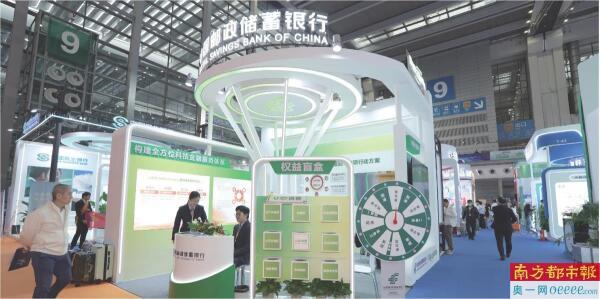
Core Viewpoint - The article emphasizes the role of China Postal Savings Bank's Shenzhen branch in supporting the real economy through targeted financial services aligned with national strategies, particularly focusing on the "14th Five-Year Plan" and its five key areas of financial development [2][6]. Group 1: Financial Support for Real Economy - The Shenzhen branch integrates its services with the "14th Five-Year Plan" by focusing on the development of a modern industrial system and strengthening the real economy [2]. - The branch has developed a comprehensive service system that aligns with the "20+8" industrial cluster strategy, ensuring a precise match between financial resources and the needs of Shenzhen's real economy [2][3]. Group 2: Inclusive Finance Initiatives - The branch utilizes its 69 outlets across the city to enhance financial accessibility, particularly in urban agriculture and rural revitalization, launching products like "U Grain Easy Loan" to support the grain industry [3]. - It has served over 3,000 small and micro enterprises, issuing loans exceeding 15 billion yuan, focusing on advanced manufacturing and technology-driven businesses [3]. Group 3: Technological and Green Finance - The branch has established a dedicated technology finance division, offering specialized products like "Tech Innovation Loans" and "Intellectual Property Pledge Loans" to support key sectors such as integrated circuits and artificial intelligence [4]. - It is actively involved in green finance, supporting Shenzhen's dual carbon goals through various financial instruments, including green loans and bonds, particularly in sectors like new energy vehicles and green buildings [4]. Group 4: Regional Development and Strategic Partnerships - The branch has signed strategic cooperation agreements with local governments and organizations, channeling over 1 trillion yuan into major projects within the Guangdong-Hong Kong-Macao Greater Bay Area [5]. - It is committed to enhancing service capabilities through digital transformation and risk management improvements, ensuring robust support for the local economy [6]. Group 5: Focus on Livelihood and Consumer Finance - The branch has launched initiatives to boost local consumption, including personal loan subsidies and partnerships with merchants to enhance consumer experiences [7][8]. - It has developed a comprehensive pension finance system, supporting various aspects of elderly care and financial literacy, with significant growth in personal pension accounts [8]. Group 6: Commitment to Continuous Improvement - The Shenzhen branch aims to deepen its financial services' precision and effectiveness, contributing to the high-quality development of the real economy and supporting Shenzhen's role as a model for socialism with Chinese characteristics [8].

发展新质生产力 扎实推进中国式现代化建设
Ren Min Ri Bao· 2025-11-24 22:31
Group 1 - The forum emphasized the importance of improving people's quality of life as a central goal of China's modernization efforts, aligning with the directives from the 20th Central Committee [2][3] - The forum provided a platform for various stakeholders, including government officials, experts, and entrepreneurs, to share experiences and discuss strategies for enhancing public welfare [2][3] - Key topics discussed included high-quality employment, income distribution, education, social security, and sustainable urban development, all aimed at ensuring that the public benefits from economic growth [3][4] Group 2 - The integration of technology and finance was highlighted as a crucial factor for innovation and economic development, particularly in the Guangdong-Hong Kong-Macao Greater Bay Area [8][9] - The forum showcased various innovative practices in financial services that aim to enhance public welfare, including the development of financial products that support green and low-carbon transitions [9][10] - The role of local governments in implementing effective policies and practices to improve living standards was underscored, with examples from different regions demonstrating successful initiatives [5][6] Group 3 - The event featured discussions on the significance of technological innovation in driving sustainable economic growth, with a focus on the role of AI and digital technologies in various sectors [12][16] - The forum also addressed the need for a collaborative approach among financial institutions, technology companies, and government bodies to foster an ecosystem conducive to innovation [10][11] - The importance of international cooperation in advancing technological capabilities and achieving mutual benefits was emphasized as a key strategy for building a strong technological foundation [13][14]

护航民营股权投资机构债券发行 科创债风险分担工具运用稳步拓展
Zhong Guo Zheng Quan Bao· 2025-11-24 21:56
Core Viewpoint - The second batch of technology innovation bonds supported by risk-sharing tools will be issued from November 26 to 28, aiming to expand long-term capital sources for private equity investment institutions and support the development of hard technology enterprises [1] Group 1: Issuance and Support - Four private equity investment institutions plan to issue a total of 930 million yuan in technology innovation bonds, indicating a broader application of risk-sharing tools in financing [2] - The risk-sharing tools will provide credit enhancement for three institutions, while one will receive market-based credit enhancement from China Bond Credit Enhancement Investment Co., showcasing a collaborative effect of policy and market-driven support [2] - The issuance of these bonds is expected to further broaden the long-term capital sources for private equity investment institutions, aiding the development of hard technology enterprises [2] Group 2: Fund Utilization and Impact - Since the issuance of 1.35 billion yuan in technology innovation bonds by five private equity institutions in June, nearly 50% of the raised funds have been utilized, leveraging over 10 billion yuan in total funding for key sectors such as integrated circuits, artificial intelligence, and biomedicine [3] - The issuance of technology innovation bonds has significantly accelerated the establishment and funding pace of venture capital funds, ensuring rapid capital allocation to specific technology enterprises [3] - The funds raised will continue to flow into the technology innovation sector, providing financial support for various innovative activities [3] Group 3: Market Activity and Participation - Since the launch of technology innovation bonds in May, market activity has been continuously stimulated, with over 530 billion yuan supported for 276 enterprises, including 230 technology companies and 46 equity investment institutions [4] - The participation of private enterprises has notably increased, with 55 private companies issuing 107.4 billion yuan in technology innovation bonds, representing 20% of the total issuance in the interbank market [4] - The bond issuance structure is primarily medium to long-term, aligning with research and investment cycles, thereby effectively supporting "patient capital" for long-term investments in hard technology [4] Group 4: Future Development - The trading association will continue to leverage risk-sharing tools and develop the bond market's "technology board," guiding more financial resources towards early, small, long-term investments in hard technology [5]
科创债风险分担工具运用稳步拓展
Zhong Guo Zheng Quan Bao· 2025-11-24 20:13
Core Viewpoint - The issuance of the second batch of technology innovation bonds supported by risk-sharing tools is set to take place from November 26 to 28, aimed at expanding long-term capital sources for private equity investment institutions and supporting the development of hard technology enterprises [1] Group 1: Issuance and Support - Four private equity investment institutions plan to issue a total of 930 million yuan in technology innovation bonds, indicating a broader application of risk-sharing tools in the bond market [1] - The China Interbank Market Dealers Association will continue to leverage risk-sharing tools to develop the "technology board" in the bond market, promoting the growth of patient and long-term capital [1] Group 2: Fund Utilization and Impact - Since June, five private equity investment institutions have raised 1.35 billion yuan through technology innovation bonds, with nearly 50% of the funds already utilized, effectively leveraging over 10 billion yuan in total funding for key sectors such as integrated circuits, artificial intelligence, and biomedicine [2] - The issuance of technology innovation bonds has significantly accelerated the establishment and funding pace of venture capital funds, ensuring that capital is quickly matched to specific technology enterprises [2] Group 3: Market Activity and Participation - As of November 21, the association has supported 276 enterprises in issuing over 530 billion yuan in technology innovation bonds, with a notable increase in participation from private enterprises [3] - The bond issuance structure is primarily medium to long-term, aligning with the research and investment cycles, with over 60% of the issuance being five years or longer, effectively supporting the cultivation of patient capital for long-term investments in hard technology [3]
凝心聚力做好金融“五篇大文章” 交易商明晰证券业场外业务功能定位
Zheng Quan Ri Bao· 2025-11-24 16:51
Core Viewpoint - The report highlights the proactive role of over-the-counter (OTC) derivatives traders in supporting national strategies and the real economy, showcasing their contributions to the financial sector's "five major articles" [1] Group 1: OTC Derivatives Empowerment - A special survey conducted by China Securities Intermediary Co., Ltd. covered 44 traders, with 42 providing effective data and case studies, demonstrating the industry's achievements in the financial "five major articles" [2] - In the technology finance sector, 17 traders offered customized OTC derivatives to meet the complex needs of tech companies and investors, facilitating capital flow into the tech sector through the development of tech-focused ETFs and participation in high-tech company financing [2] - In green finance, 30 traders utilized flexible OTC derivatives to support low-carbon economy initiatives, including trading linked to green assets and developing ESG-themed indices to attract new investors [2] Group 2: Inclusive Finance and Pension Finance - In inclusive finance, 30 traders expanded service coverage and accessibility, providing affordable financial services to small and micro enterprises, farmers, and the general public, enhancing economic resilience [3] - Traders are actively developing comprehensive wealth management solutions for retirement, leveraging OTC derivatives for risk management and personalized investment strategies [3] Group 3: Digital Finance - 37 traders emphasized the use of financial technology in OTC business development, transitioning risk management from experience-driven to algorithm-driven approaches, including the creation of a fully digital platform for business operations and risk control [4] Group 4: Consensus on Function Positioning - Traders reached a consensus on the role of OTC derivatives in the high-quality development of the securities industry, recognizing their ability to connect on-market and off-market activities, serve as risk intermediaries, and provide efficient asset allocation tools [5] - The OTC derivatives business is seen as a driver for strategic transformation and service upgrades, enabling traders to evolve from channel services to multifaceted roles while strengthening risk management and digital empowerment [5] Group 5: Challenges and Recommendations - Despite achievements, traders face challenges such as limited business types, disparities in funding and innovation capabilities, and the need for improved understanding of regulatory guidance [6] - Recommendations include enhancing top-level design for OTC derivatives, supporting robust cross-border business development, increasing digital investment, and promoting positive industry image [6]
又有两家银行AIC获批开业 为何成为银行系股权投资“新宠”?
Xin Jing Bao· 2025-11-24 13:56
Core Points - Two additional financial asset investment companies (AIC) under joint-stock banks have been approved to commence operations, namely 招银金投 (Zhaoyin Financial Investment) and 信银金投 (Xinyin Financial Investment) [1][2] - The establishment of these AICs is part of a broader trend to enhance market-oriented debt-to-equity swaps and equity investments, particularly aimed at supporting technological innovation [2][3] Summary by Sections Approval and Capitalization - 招银金投 has a registered capital of 15 billion RMB, while the other two AICs have a capital of 10 billion RMB each [2] - All three AICs are located in South China, with 兴银金投 (Xingyin Financial Investment) in Fuzhou, 招银金投 in Shenzhen, and 信银金投 in Guangzhou [2] Focus on Technology and Innovation - The AICs are targeting market-oriented debt-to-equity swap businesses and aim to empower the development of technology innovation [2][3] - AICs are seen as a crucial component in providing "patient capital" to support technology-driven enterprises, addressing the limitations of traditional bank credit [3][5] Expansion and Future Prospects - The AIC initiative has expanded since its inception in 2018, with regulatory bodies now allowing more banks to establish AICs, including six major state-owned commercial banks and three joint-stock banks [4][6] - The expansion of AICs is expected to enhance the flow of funds towards technology innovation and improve the efficiency of financial resource allocation [6] Internal Coordination and Risk Management - The internal coordination between lending and investment within banks is expected to improve efficiency and unify risk preferences, thereby better serving major national technology projects and small to medium-sized tech enterprises [5][6] - The strategy of investing early, in smaller amounts, and focusing on long-term and hard technology is anticipated to diversify income sources and mitigate the pressure from narrowing net interest margins [6]


