
关税战

Search documents
“请求会谈”,是一个重要转折
Bei Jing Qing Nian Bao· 2025-05-08 00:59
百年未有之大变局,又有新变化。 (文章来源:北京青年报) 5月7日一大早,外交部发布消息,何立峰副总理将于5月9日-12日访问瑞士,期间与美国财政部长贝森 特举行会谈。随后商务部以答记者问的方式,就中美经贸高层会谈再次阐明态度。 通稿的措辞非常精准,比如提到近期美方高层不断就调整关税措施放风,并通过多种渠道主动向中方传 递信息,希望与中方谈起来,其中"不断""多种渠道""主动"等用词就特别有画面感,让人仿佛看到一个 苦等电话的焦灼身影。 而中方在认真评估后,在充分考虑全球期待、中方利益、美国业界和消费者呼吁的基础上,决定同意与 美方进行接触。也就是说我们不是仅考虑了自身利益,而是本着一个负责任大国的态度,才决定进 行"接触""会谈"。 但会谈并不等同于谈判,如果美方想要通过谈判解决问题,就必须认识到自身的错误,拿出诚意,通过 平等协商解决双方关切。通稿还向其他一些经济体"喊话",绥靖换不来和平,妥协得不到尊重。 在外事场合中,谁主动谁应邀往往大有深意,这绝不只是个"面子"问题,而是关乎"战略势能"。所以外 交部随后在例行记者会上也强调,这次会谈是应美方请求举行的,而美国财政部长贝森特在被问到是谁 先给对方打电 ...
欧洲认输了?要给美500亿保命,关键时刻,中方喊话我们不想打仗
Sou Hu Cai Jing· 2025-05-07 22:56
Core Viewpoint - The European Union is considering a proposal to purchase 50 billion euros worth of American goods to ease tensions over tariffs imposed by the Trump administration, indicating a willingness to compromise in the ongoing trade dispute [1][3][5]. Group 1: EU's Response to Tariffs - The EU's trade commissioner has stated that the EU will not accept a 10% baseline tariff on European goods as a long-term solution to the trade dispute with the U.S. [1] - The EU is contemplating increasing purchases of American products, such as natural gas and soybeans, to reduce the trade deficit and appease U.S. concerns [3][5]. - This approach suggests that Europe is in a difficult position and lacks the confidence to confront the U.S. directly, opting instead for negotiation [3][5]. Group 2: Potential Outcomes of Compromise - If the EU successfully negotiates the purchase of 50 billion euros in U.S. goods in exchange for the cancellation of the 10% tariff, it could lead to a mutually beneficial situation where European goods can continue to enter the U.S. market [6]. - However, achieving a favorable agreement that satisfies all 27 EU member states will be challenging, as it may require sacrificing individual national interests [8]. - The EU's hesitation to retaliate against U.S. tariffs reflects a broader uncertainty among international entities, including Japan, on how to effectively respond to U.S. trade policies [8].

“关税战”冲击美国出口 涨价、失业恐接踵而至
Yang Shi Xin Wen· 2025-05-07 18:36
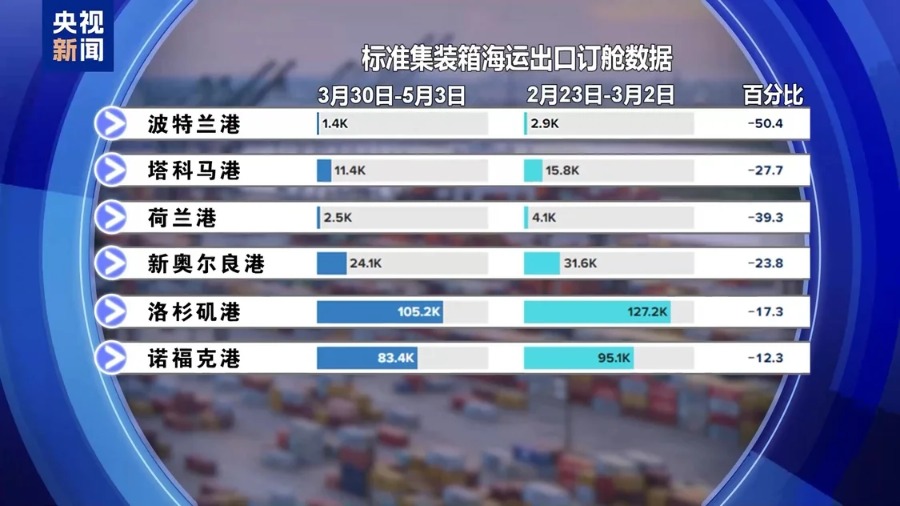
美国政府滥施关税的影响正在持续恶化。据美国消费者新闻与商业频道(CNBC)6日报道,由于美国政府执意挑起"关税战", 许多企业取消了制造订单,美国的进口量出现暴跌,如今美国各地港口的出口也出现下滑。 报道称,维齐恩全球海运订单追踪系统(Vizion)分析了关税生效前后的集装箱订舱数据,他们发现,美国全国大多数港口的出 口量都出现明显下降。 维齐恩首席执行官凯尔·亨德森表示:"这意味着,原计划在未来六到八周内到达的货物根本无法送达。此外,由于关税推高了成 本,小型企业正在暂停订单,曾经有可靠运输渠道的商品现在价格翻了一倍,迫使进口商作出艰难的抉择。"这种成本增加和订 单减少的双重压力,进一步加剧了出口下滑的趋势。 涨价、失业关税对美国经济带来连锁冲击 美国银行全球研究部门的报告指出,尽管美国企业在今年年初提前"囤货",商品库存却没有大幅度增加,许多零售商可能只有 一到两个月的库存,任何不可预见的需求或供应中断都可能影响零售商在美国的商品供应和商品价格。 美国南加州海事交易所执行董事基普林·洛蒂特警告说,到美货船数量和集装箱量减少,将导致供应链中的劳动力、卡车、火车 等方面出现运力过剩,"由于货物抵达量的减少,他 ...
氧化铝价格下行供给增量预期致市场承压
Zheng Quan Shi Bao· 2025-05-07 17:57
证券时报记者赵黎昀 2024年,氧化铝价格一路高歌猛进,市场价格及行业盈利水平都创下历史高点。 然而,近半年来,随着供给增量显现,成本支撑下移,氧化铝现货吨价一月间"狂泻"超2000元,行业瞬 间陷入大量亏损困局。 作为铝产业链上游重要材料之一,氧化铝价格近年异常地急涨急跌,无疑对上下游产品价格及企业利润 造成影响。下游电解铝企业在成本骤降后,已走出前期亏损,迎来高利润空间。 在国际贸易形势多变的当下,行业分析人士认为,基于我国铝产品出口的多元化及完备的工业体,从中 长期看,"关税战"对铝产业链影响不大。不过,氧化铝目前仍存显著供给压力,短期价格或仍以弱势震 荡为主。 价格下行 "去年做氧化铝的企业赚得盆满钵满,如今风水轮流转,随着氧化铝价格大跌,下游电解铝的日子自然 就好起来了。"谈及近期产业链上下游市场行情,一位电解铝行业人士坦言,作为铝产业链重要的上游 原材料之一,氧化铝价格近年巨幅波动,显著牵动了行业市场格局。 去年四季度,氧化铝价格持续上涨,电解铝价格下跌,氧化铝行业利润创出历史新高,而电解铝行业利 润创出近几年最差情况。但今年以来,随着氧化铝价格持续下跌,电解铝价格回暖,上下游行业利润已 出现明显 ...
美国人心服口服,特朗普终于“认输”,中方大人物赴美,事情不简单
Sou Hu Cai Jing· 2025-05-07 15:22
Group 1 - The core viewpoint of the articles indicates that the ongoing trade tensions between the US and China are becoming increasingly untenable, with expectations of a de-escalation in the near future as both sides express willingness to negotiate [1][3][5] - US Treasury Secretary acknowledged the difficulties of the current tariff standoff and anticipated a period of easing tensions, which aligns with President Trump's recent signals to cool down the situation [1][3] - The Chinese government, represented by its finance minister, emphasized the importance of equal dialogue and negotiation to resolve trade disputes, countering the US's unilateral tariff actions [3][5] Group 2 - The articles highlight that the US's aggressive tariff policies have not only harmed its own economy but have also led to a backlash from traditional allies, who are now opposing US's unilateralism [5][7] - Data shows that China's total foreign trade continues to rise, while its trade share with the US is gradually declining, indicating a reduced dependency on the US and a strengthening of China's economic resilience [5][7] - The call for multilateralism and cooperation among nations at recent meetings underscores a collective push against US's trade practices, with a focus on maintaining a rules-based international trading system [7]
美国波特兰港出口量下降约50%
news flash· 2025-05-07 15:06
由于美国政府执意挑起"关税战",许多企业取消了制造订单,美国的进口量出现暴跌,如今美国各地港 口的出口也出现下滑。其中波特兰港的出口量下降了50.4%,为下滑幅度最大的港口。美国银行全球研 究部门的报告指出,尽管美国企业在今年年初提前"囤货",商品库存却没有大幅度增加,许多零售商可 能只有一到两个月的库存,任何不可预见的需求或供应中断,都可能影响零售商在美国的商品供应和商 品价格。(CCTV国际时讯) ...
全球媒体聚焦丨“大洋两岸都感到担忧”美媒聚焦关税对经济的连锁影响
Yang Shi Xin Wen Ke Hu Duan· 2025-05-07 14:29
随着美国政府对来自中国的进口商品加征高额关税,美国西北海港联盟联合主席兼塔科马港总裁约翰·麦卡锡预计,来自 中国的货运量将下降,随之而来的可能就是美国人的失业,以及货架上商品种类的减少。 此外,他还表示,自己刚从越南和韩国出差回来,并有机会同那里的航运业人士交流,他认为大洋两岸都感受到了不确 定性,以及对未来的担忧。 监制丨蔡耀远 责编:张靖雯、卢思宇 美国西北海港联盟经营着西雅图港和塔科马港。在接受波士顿公共广播电台(WBUR)采访时,麦卡锡表示,通过该港 口联盟进口的商品中有约51% 是来自中国,进口商品包括家具、塑料制品、玩具等等;而同中国的贸易往来也占该港口 联盟业务量的40%。他认为,港口相关工作将受到影响。 "首当其冲的是那些离航运码头最近的工作,尤其是两港的码头工人",麦卡锡表示。此外还有卡车司机、维持码头运营 的相关人员等等。他表示,关税战的持续肯定会给他们带来直接影响。 麦卡锡认为,关税战的继续会导致到港船只数量的下降,会导致货船越来越小,最终导致货运量越来越少,港口业务量 下降。比如,苹果是两港所在的华盛顿州的重要出口产品,此前2018年的贸易战已导致该联盟失去了苹果出口市场。麦 卡锡表示 ...
中方援手抵达,美国经济雪崩,梅德韦杰夫一语定调,特朗普犯下大错
Sou Hu Cai Jing· 2025-05-07 13:09
据环球时报报道,金砖国家外长会晤近日在巴西里约热内卢结束。巴西外长维埃拉在记者会上说,与会外长们就反对全球"关税战"达成共识,坚决反对贸易 保护主义。维埃拉说:"我们坚决反对贸易保护主义死灰复燃以及以环境为借口采取的一些非关税措施。我们认为世界贸易组织改革对解决贸易争端至关重 要。"会晤发表主席声明说,外长们严重关切违反世贸组织规则的、不公正的单边保护主义行径,支持以世贸组织为核心的多边贸易体系。 值得一提的是,会议主席声明只字不提美国,是因为作为金砖国家缔约国之一的印度,为与美国达成贸易协议换取特朗普的关税豁免,在本次外长会议上从 中作梗,导致原本计划谴责美国保护主义政策的联合声明,最终因印度的阻挠而"流产"。因此,在会议主席声明中,就出现没有提及美国,但几乎每一句都 在谴责美国保护主义政策的情况。现阶段,美国政府滥施关税给美国国内带来的影响正不断显现。 特朗普(资料图) 这种做法不仅不利于美国的制造业发展,而且还会迅速增加美国民众的生活成本。在此轮关税大战中,特朗普并未表现出强硬到底的姿态,反而在中国为首 的国家宣布反制后,主动表达了希望谈判的意愿。这种毫无战略前瞻的政治决策,不仅让全世界对美国的认可度快 ...
【深度】如何纾解关税战影响?国新办这场发布会给出答案
Xin Lang Cai Jing· 2025-05-07 12:59
Core Viewpoint - The Chinese government is implementing targeted financial support measures for businesses significantly impacted by tariffs, focusing on "one enterprise, one policy" precision services to stabilize operations and expand markets [1][2]. Group 1: Financial Support Measures - The government aims to provide precise services to market entities heavily affected by tariffs, particularly small and private enterprises facing financing difficulties [2][8]. - A financing coordination mechanism has been established, with over 67 million businesses visited and loans amounting to 12.6 trillion yuan issued, one-third of which are credit loans [2][8]. - The People's Bank of China announced an increase in re-lending quotas for small and micro enterprises to 3 trillion yuan, with a reduction in re-lending rates to enhance financial support [8][9]. Group 2: Identification of Affected Enterprises - Accurate identification of enterprises affected by tariffs is crucial, focusing on those primarily engaged in exports, especially those with a high proportion of exports to the U.S. [2][3]. - Supply chain enterprises, although not directly exporting, also face indirect impacts due to reliance on export orders and should be included in the identification process [3][4]. - Factors such as the nature, scale, employment impact, and financial status of enterprises should be considered to prioritize support [3][4]. Group 3: Export Stability and Domestic Sales Expansion - Policies to stabilize exports include ensuring continuous lending to affected enterprises and supporting cross-border e-commerce and overseas warehouses [6][7]. - Measures to assist in expanding domestic sales involve providing financing guarantees for export-to-domestic sales transitions and reducing barriers for pure foreign trade enterprises entering domestic markets [7][8]. - The government emphasizes the need to streamline domestic certification and approval processes to facilitate quicker market entry for products transitioning from export to domestic sales [7][8]. Group 4: Focus on Small and Micro Enterprises - Small and micro enterprises are identified as a key focus for support due to their significant role in employment and their vulnerability to tariff impacts [8][9]. - The overall export volume for 2024 is projected at 3.58 trillion USD, with private enterprises accounting for 64.6% of this, highlighting their importance in stabilizing foreign trade [8][9]. - Policies aim to enhance the financing environment for small and micro enterprises by improving credit access and reducing financing costs [9][10].
中国德国商会:美国滥施关税对德企造成挑战,望德国政府更积极与中方互动
2 1 Shi Ji Jing Ji Bao Dao· 2025-05-07 12:22
Group 1 - The latest business confidence survey by the China-Germany Chamber of Commerce indicates that despite the challenges posed by the new round of tariffs initiated by the U.S. government, half of the surveyed German companies plan to increase their investments in China [1][5] - Over one-third of the surveyed companies are accelerating their localization efforts as a strategic response to ongoing trade tensions [1][3] - A significant 76% of German companies in China report being affected by U.S. tariffs, with the automotive and machinery sectors being the most impacted, at 93% and 86% respectively [3][4] Group 2 - The survey reveals that 67% of German companies are calling for the new German government to enhance interactions with China to support their business development [1][2] - 52% of German companies believe that improving China's public image in Germany would enhance their operational performance [1][3] - Despite the challenges, 29% of the surveyed companies expect their revenue in China to grow by 2025 [4][5] Group 3 - The economic outlook for Germany has been downgraded by the IMF, with expected growth rates of 0.3% and 1.3% for the next two years, partly due to the impact of trade wars [4][5] - In 2024, Germany's total foreign trade is projected to be €2.88 trillion, with exports at €1.56 trillion and imports at €1.32 trillion, reflecting a slight decline in both [3][4] - Germany remains China's largest trading partner in the EU, with bilateral trade expected to reach $201.88 billion in 2024, a decrease of 2.4% year-on-year [6]